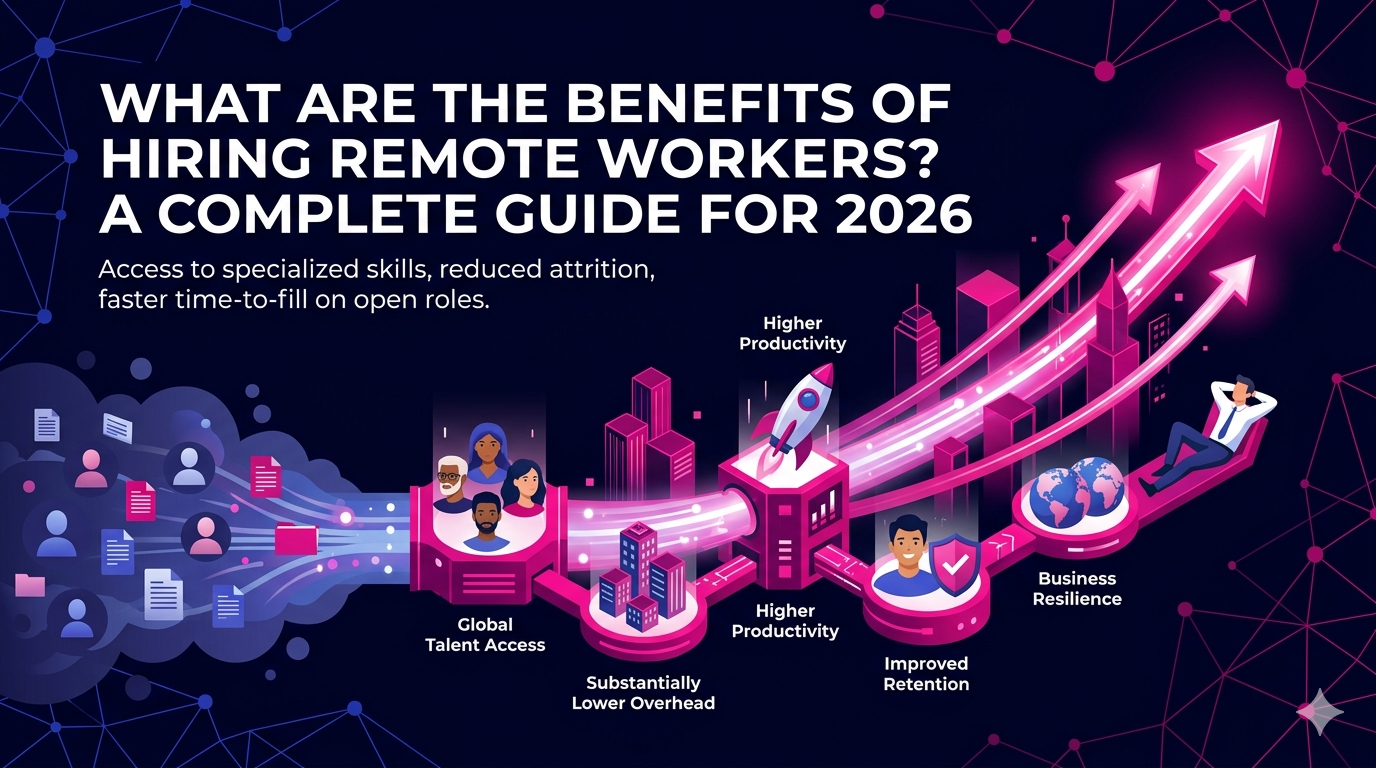
If you are running a business in 2026 and still debating whether remote hiring is worth it, you are asking the right question. What are the benefits of hiring remote workers? The answer goes far beyond saving on office rent. Businesses that have built distributed teams report real advantages in talent quality, operational flexibility, cost structure, and employee retention. This guide breaks down exactly what those benefits look like in practice and how you can start capturing them for your own business.
The Business Case for Hiring Remote Workers Has Never Been Stronger
The remote work economy has matured significantly since the early 2020s. In 2026, hiring remote workers is not a workaround or a compromise. It is a deliberate strategic choice that gives businesses access to a global talent pool, leaner cost structures, and teams that can operate across time zones without requiring physical infrastructure.
Business owners who have made the shift consistently point to the same core advantages. Understanding those advantages in detail helps you build a stronger business case and make smarter decisions about which roles to hire remotely and how to structure your team.
What Are the Key Benefits of Hiring Remote Workers?
The benefits of remote hiring span financial, operational, and cultural dimensions. Below is a detailed breakdown of the most impactful advantages businesses experience when they build remote teams.
Access to a Wider and Higher-Quality Talent Pool
When you limit hiring to a specific city or region, you are automatically restricting the range of candidates available to you. One of the most significant benefits of hiring remote workers is the ability to source talent from anywhere in the world. This matters enormously for specialized roles where strong local candidate pools simply do not exist.
In competitive hiring markets, remote hiring also lets you reach professionals who are not actively job searching but are open to the right opportunity. You are no longer competing only against local employers. You are finding the best person for the role, regardless of where they live.
Substantially Lower Overhead Costs
One of the most immediately measurable benefits of hiring remote workers is cost reduction. When team members work remotely, you eliminate or significantly reduce expenses related to office space, utilities, equipment, and on-site perks. For growing businesses managing tight margins, these savings can be redirected into product development, marketing, or additional hires.
Remote hiring also opens access to skilled professionals in regions where compensation expectations differ from major metropolitan markets. This does not mean compromising on quality. It means finding excellent talent at compensation levels that are fair in their local context while being cost-effective for your business.
Higher Productivity and Focused Output
Multiple studies conducted in recent years consistently show that remote workers often outperform their in-office counterparts on measurable output metrics. Without the interruptions of an open-plan office, lengthy commutes, and unplanned social engagements, remote professionals tend to complete work faster and with greater focus.
Remote team members also have more control over their working environment and schedule, which contributes to higher energy levels and better sustained concentration throughout the workday. For output-focused roles in sales, marketing, research, and operations, this translates directly into business results.
Improved Employee Retention and Satisfaction
Turnover is one of the most expensive and disruptive forces in any business. The cost of replacing a single employee, when you factor in recruitment, onboarding, and lost productivity, can easily exceed several months of that person’s salary. One of the most overlooked benefits of hiring remote workers is the positive effect on retention.
Remote professionals consistently report higher job satisfaction, primarily because of the flexibility and autonomy their work arrangement provides. When you give employees the ability to work in an environment that suits them and build a schedule that supports their life, they are significantly more likely to stay with your business long-term.
Business Continuity and Operational Resilience
Distributed remote teams are inherently more resilient than centralized in-office operations. When a business depends on a single physical location, any disruption to that location can halt operations. Remote teams continue functioning regardless of what happens in any particular city or region.
This resilience extends to coverage across time zones as well. A remote team with members in different regions can handle customer inquiries, manage campaigns, and keep operations running outside of standard business hours without requiring shift premiums or overtime costs.
Faster Hiring and Greater Workforce Flexibility
Remote hiring typically moves faster than traditional local hiring because the candidate pool is larger and the logistics of interviewing are simpler. Video interviews, asynchronous assessments, and digital onboarding processes mean you can move from job posting to first day significantly faster.
Remote hiring also gives you more flexibility to scale. You can bring in a specialist for a specific project, expand a function during a growth phase, or reduce headcount when a cycle slows down, all with less complexity than managing an in-office workforce.
Which Roles Benefit Most From Remote Hiring?
While most knowledge-work roles can be performed remotely, some functions see particularly strong results when staffed with dedicated remote professionals.
Sales and Lead Generation
Remote sales development representatives and lead generation specialists deliver strong results when given clear targets, good tools, and consistent management. The structured, output-focused nature of sales work makes it highly compatible with remote arrangements. If your pipeline needs strengthening, exploring remote lead generation experts is a direct way to apply the benefits of remote hiring to revenue growth.
Digital Marketing and SEO
Content strategy, paid media management, SEO, and social media are among the most commonly outsourced remote functions. These roles require deep expertise, continuous execution, and regular analysis. Remote professionals who specialize in these areas often bring more focused skill than a generalist in-house hire at a comparable cost.
Customer Support
Remote customer support teams allow businesses to provide coverage across extended hours, handle volume fluctuations efficiently, and maintain consistent quality without geographic constraints on hiring.
Administrative and Executive Support
Remote virtual assistants and executive assistants handle scheduling, research, communications, and operational tasks that free up leadership to focus on higher-value work. The time savings for executives who leverage remote administrative support are considerable.
What the Research Says About the Benefits of Remote Hiring
The evidence supporting remote hiring continues to accumulate. According to findings from McKinsey’s research on the future of work and the benefits of flexible hiring models, companies that embrace remote and hybrid talent strategies consistently report better access to specialized skills, reduced attrition, and faster time-to-fill on open roles. These are not marginal improvements. They represent structural advantages that compound over time as your remote team matures.
How to Maximize the Benefits of Hiring Remote Workers
Realizing the full potential of remote hiring requires more than posting a job description and hoping for the best. The businesses that get the most from their remote teams invest in the following:
Clear Role Definitions and Expectations
Remote workers perform best when they understand exactly what is expected of them, what success looks like, and how their work connects to broader business goals. Vague briefs produce vague results regardless of how talented the person is.
Strong Communication Infrastructure
Tools like Slack, Notion, Loom, and Asana form the backbone of effective remote team communication. Establishing clear norms around response times, meeting frequency, and documentation expectations reduces friction and keeps remote teams aligned.
Regular Performance Reviews and Feedback
Remote team members benefit from structured feedback just as much as in-office employees. Scheduled one-on-ones, clear KPIs, and regular check-ins build trust, surface issues early, and reinforce the professional relationship that keeps good people engaged and performing.
Working With a Trusted Remote Staffing Partner
One of the most reliable ways to benefit from remote hiring is to work with a platform that specializes in vetting and placing remote talent. This removes the uncertainty of sourcing candidates independently and gives you access to professionals who have already been assessed for the skills and work habits your business needs.
FAQ Section
What are the benefits of hiring remote workers compared to in-office staff?
The benefits of hiring remote workers compared to in-office staff include lower overhead costs, access to a global talent pool, higher productivity in many role types, improved retention rates, and greater workforce flexibility. Remote hiring also allows businesses to staff specialized roles that may not have strong local candidate pools.
Are the benefits of hiring remote workers applicable to small businesses?
Yes, and often more so than for large enterprises. Small businesses benefit from remote hiring because it allows them to access specialist skills without committing to full-time in-house salaries and related overhead. A small business can build a high-performing remote team across sales, marketing, and operations for a fraction of the cost of an equivalent in-office team.
What are the productivity benefits of hiring remote workers?
Remote workers typically report fewer interruptions, more focused work time, and greater autonomy over their schedules. Research consistently shows that these factors contribute to higher output and better quality work across many role types. The productivity benefits of hiring remote workers are especially pronounced in roles that require deep focus, such as writing, analysis, coding, and research.
How do the financial benefits of hiring remote workers add up over time?
The financial benefits of hiring remote workers compound as your team grows. Each remote hire reduces office space requirements, equipment costs, and facilities expenses. Over a year, a business with ten remote employees can save tens of thousands of dollars compared to running an equivalent in-office team, while often achieving better results due to wider talent access.
What are the long-term benefits of hiring remote workers for business growth?
Over the long term, businesses that hire remote workers build more adaptable and scalable organizations. They are not constrained by local hiring markets, can adjust headcount more fluidly, and tend to attract professionals who value autonomy and perform at a high level without close supervision. These characteristics support faster growth and stronger competitive positioning over time.
How do I start realizing the benefits of hiring remote workers for my business?
The most effective starting point is to identify one or two roles that are well-suited to remote work and hire through a platform that specializes in remote talent. Start with a clearly defined scope, strong onboarding documentation, and regular check-ins. As you build confidence in the model, you can expand your remote team and capture the full range of benefits remote hiring delivers.
Build Your Remote Team and Start Capturing These Benefits Today
The question of what are the benefits of hiring remote workers has a clear and well-supported answer in 2026. Cost savings, talent quality, productivity, retention, and resilience are all measurably better for businesses that build distributed teams thoughtfully. The businesses that act on this now are building structural advantages that will be difficult for competitors to close.
Whether you are hiring your first remote specialist or scaling an existing distributed team, The Remote Reps gives you access to pre-vetted professionals across sales, marketing, operations, and support. Explore the full range of roles available and take the next step toward building a remote team that delivers real results. Start by reviewing how remote lead generation experts can drive growth for your business right now.