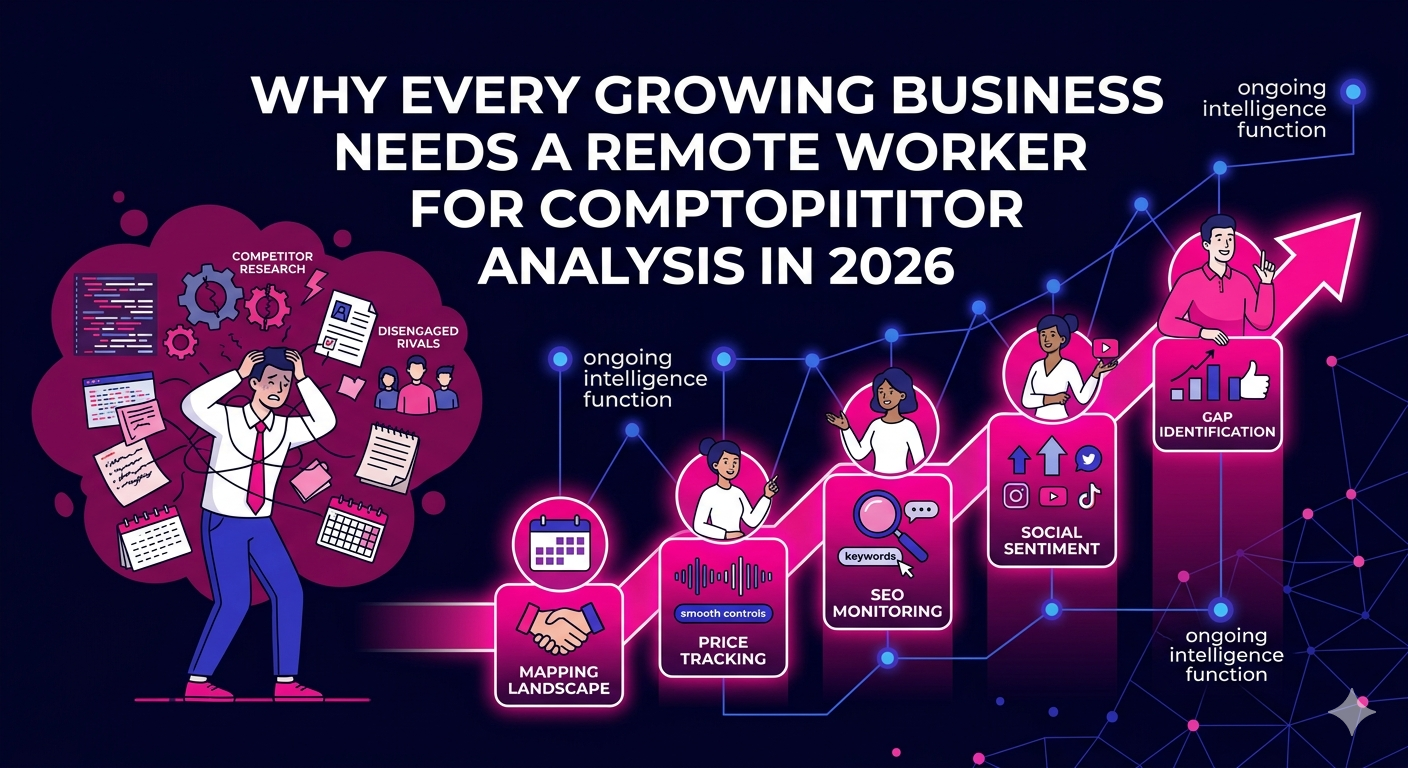
In today’s fast-moving market, knowing what your competitors are doing is not a nice-to-have. It is a core business function. Yet most small and mid-sized businesses handle competitor research inconsistently, squeezing it in between other priorities or skipping it altogether. Hiring a remote worker for competitor analysis changes that entirely. It turns a sporadic task into a structured, ongoing intelligence function that directly informs your strategy and keeps you ahead of the curve.
This guide covers what a remote competitor analysis specialist actually does, what to look for when hiring one, and how businesses in 2026 are using this role to sharpen their positioning and grow faster.
What Is Competitor Analysis and Why Does It Require Dedicated Attention?
Competitor analysis is the process of systematically researching your rivals to understand their strengths, weaknesses, pricing strategies, marketing messaging, product positioning, and customer sentiment. When done properly, it reveals opportunities your business can exploit and threats you can prepare for before they become problems.
The challenge is that thorough competitor research is time-consuming. Pulling data from multiple sources, tracking changes over time, synthesizing findings into actionable insights, and staying current as competitors evolve all require consistent effort. That is why businesses that rely on occasional, ad hoc research rarely get the full strategic benefit of the work.
A dedicated remote worker for competitor analysis handles this function continuously and systematically so you always have a clear picture of where you stand relative to your market.
What a Remote Competitor Analysis Specialist Actually Does
The scope of this role is broader than most business owners initially expect. A skilled remote professional in this area goes well beyond a quick Google search on your top three rivals.
Core Tasks in Remote Competitor Research
- Mapping the competitive landscape by identifying direct and indirect competitors
- Monitoring competitor websites, landing pages, and product updates on a regular schedule
- Tracking competitor pricing changes and promotional activity
- Analyzing competitor SEO performance, keyword rankings, and content strategy
- Reviewing competitor social media presence, engagement rates, and messaging themes
- Gathering and synthesizing customer reviews from platforms like G2, Trustpilot, and Google
- Monitoring job postings to identify strategic hires and growth signals
- Compiling structured reports with actionable recommendations for your team
Beyond these regular tasks, a remote competitor analysis worker also watches for signals of major strategic shifts, such as a competitor entering a new market, launching a new product line, or significantly changing their messaging. Having someone dedicated to this means you are rarely caught off guard.
Key Skills to Look for in a Remote Competitor Analysis Hire
Not every research-oriented professional is cut out for this role. Competitor analysis sits at the intersection of research, marketing strategy, and data interpretation. When evaluating candidates, look for the following capabilities.
Research and Data Literacy
Your remote worker for competitor analysis needs to be comfortable using tools like SEMrush, Ahrefs, SimilarWeb, SpyFu, and social listening platforms. They should know how to pull structured data, identify trends, and distinguish meaningful signals from noise.
Strategic Thinking
Raw data without interpretation is not useful. The best remote competitor research professionals can look at what they find and tell you what it means for your business. They understand positioning, pricing psychology, and marketing strategy well enough to frame findings in a business context.
Clear Written Communication
The output of this role is typically reports and briefings that will be read by busy decision-makers. Your hire needs to write clearly, summarize findings concisely, and highlight the most important implications without burying them in data.
Attention to Detail and Consistency
Competitor research is only valuable when it is done regularly and methodically. Look for someone who takes a structured approach, documents their process, and delivers on schedule without needing to be chased.
How Remote Competitor Analysis Drives Business Growth in 2026
The competitive environment in 2026 moves quickly. New entrants emerge in established categories. Funding rounds shift the capabilities of rivals overnight. Content and SEO strategies can change the visibility landscape in a matter of months. Businesses that stay ahead of these changes make faster, more confident decisions than those operating with outdated or incomplete market intelligence.
Improving Your Marketing and Messaging
When your remote competitor analysis worker tracks how rivals position their messaging, you gain insight into what resonates with your shared audience and where gaps exist that you can fill. If three of your competitors are all emphasizing speed and you are the only one emphasizing reliability, that becomes a clear differentiation opportunity.
Informing Your SEO and Content Strategy
A large part of competitive intelligence in 2026 involves understanding what keywords your rivals are ranking for, what content they are publishing, and where their organic traffic is coming from. This directly shapes your own content roadmap. Combining remote competitor analysis with strong SEO support creates a powerful feedback loop between market intelligence and content execution. If you are also looking to strengthen your search presence, remote SEO experts at The Remote Reps can work alongside your analyst to turn competitive insights into rankings.
Strengthening Your Pricing Strategy
Price is one of the most sensitive levers in any business. Knowing how competitors are pricing similar offerings, what they include at each tier, and where they are competing on value versus cost helps you position your own pricing with much greater precision.
Identifying Gaps Your Competitors Are Missing
Customer reviews of competitor products are a goldmine of information. A skilled remote worker for competitor analysis will regularly scan these reviews to identify recurring complaints, unmet needs, and feature requests that your business could address. This is one of the most direct paths to product improvement and differentiation.
Building a Competitive Intelligence System With Remote Talent
The most effective businesses do not just hire a remote competitor analysis worker and ask them to research as needed. They build a structured competitive intelligence system that produces consistent outputs on a predictable cadence.
Monthly Competitor Briefings
A standard monthly report covering key developments across your top five to ten competitors, with a summary of what changed and what it means for your business.
Quarterly Deep Dives
A more thorough analysis each quarter that looks at longer-term trends, shifts in market positioning, and strategic implications for the coming period.
Real-Time Alerts
Setting up monitoring tools so your remote analyst can flag major competitor moves as they happen, rather than waiting for the next scheduled report.
According to research published by Gartner’s competitive intelligence research, organizations that use structured competitor analysis processes consistently outperform peers in market responsiveness and strategic decision-making. Building that structure with remote talent is a cost-effective and scalable way to get those results without committing to a full-time in-house hire.
What to Expect When Onboarding a Remote Competitor Analysis Worker
Onboarding this type of specialist well makes a significant difference in the quality of output you receive. Here is how to set your remote hire up for success from day one.
- Share your current understanding of the competitive landscape and any existing research
- Define which competitors to prioritize and which dimensions to track most closely
- Agree on reporting formats and delivery schedules that fit your decision-making cycle
- Provide access to any tools or subscriptions you already use for market research
- Schedule a brief weekly or biweekly check-in to discuss findings and adjust priorities
The better your briefing process, the faster your remote worker for competitor analysis will produce intelligence that is genuinely useful rather than just informative.
FAQ Section
What does a remote worker for competitor analysis actually do on a day-to-day basis?
A remote worker for competitor analysis typically spends their time monitoring competitor websites, tracking SEO and content changes, reviewing customer reviews and social media activity, and preparing structured reports. Daily tasks depend on the reporting cycle you have agreed on, but the core focus is always on turning competitor activity into actionable business intelligence.
How much does it cost to hire a remote worker for competitor analysis?
Costs vary based on experience, location, and scope. In 2026, part-time remote competitor analysis specialists typically charge between $800 and $2,500 per month, while full-time hires with strong strategic and analytical skills may range from $2,500 to $5,000 per month. The return on investment from improved strategic decisions often far exceeds the cost of the role.
What tools should a remote worker for competitor analysis know how to use?
The most commonly used tools include SEMrush, Ahrefs, SimilarWeb, SpyFu, BuzzSumo, and various social listening platforms. A strong remote competitor analysis hire will have hands-on experience with at least several of these and the ability to learn new tools quickly as your needs evolve.
How often should a remote competitor analysis worker deliver reports?
Most businesses find a monthly summary report paired with quarterly deep-dive analyses works well as a baseline. Real-time alerts for significant competitor moves add a responsive layer on top of that structure. The right cadence depends on how fast-moving your industry is and how frequently your team makes strategic decisions based on market intelligence.
Can a remote worker for competitor analysis also support other marketing functions?
Yes. Many remote competitor analysis professionals have backgrounds in digital marketing, SEO, or content strategy and can contribute across related functions. Some businesses also pair their competitor analyst with a broader remote digital marketing team to make sure insights are immediately actioned in campaigns, content, and positioning work.
Is it better to hire a freelance remote competitor analysis worker or go through a staffing platform?
A staffing platform that specializes in remote marketing and research talent offers several advantages over sourcing freelancers independently. You get access to pre-vetted candidates, faster placement, and ongoing support if the relationship does not work out. For businesses that need a remote worker for competitor analysis as part of a broader remote team, a specialist platform delivers better reliability and a more consistent hiring experience.
Start Building Your Competitive Intelligence Function Today
Businesses that understand their competitive landscape make faster and more confident decisions. They spot opportunities before their rivals do, avoid strategic blind spots, and build messaging that genuinely differentiates them in the market. Hiring a remote worker for competitor analysis is one of the most direct investments you can make in your strategic clarity and long-term growth.
Whether you need a part-time analyst to deliver monthly intelligence reports or a full-time specialist to run a continuous monitoring function, The Remote Reps can connect you with the right talent. Explore how remote SEO and market research professionals can help your business stay ahead of the competition in 2026 and beyond.