Hiring has changed more in the past three years than in the previous two decades combined. If you have been hearing the term and wondering what is AI enabled staffing, you are asking exactly the right question. In 2026, AI enabled staffing is reshaping how companies find, evaluate, and place remote talent, cutting hiring timelines from weeks to days while improving the quality and fit of every hire. This guide explains what it means, how it works, and why forward-thinking businesses are adopting it as their default approach to building remote teams.
What Is AI Enabled Staffing, Exactly?
AI enabled staffing refers to the use of artificial intelligence and machine learning tools throughout the recruitment and placement process. Rather than relying entirely on manual resume reviews, subjective interviews, and gut-feel decisions, AI enabled staffing platforms use data-driven systems to match candidates to roles with greater speed and accuracy.
This does not mean a robot makes your hiring decisions. Human judgment remains central to the process. What AI does is eliminate the slow, repetitive, and error-prone parts of recruiting so that both employers and candidates get better outcomes in less time.
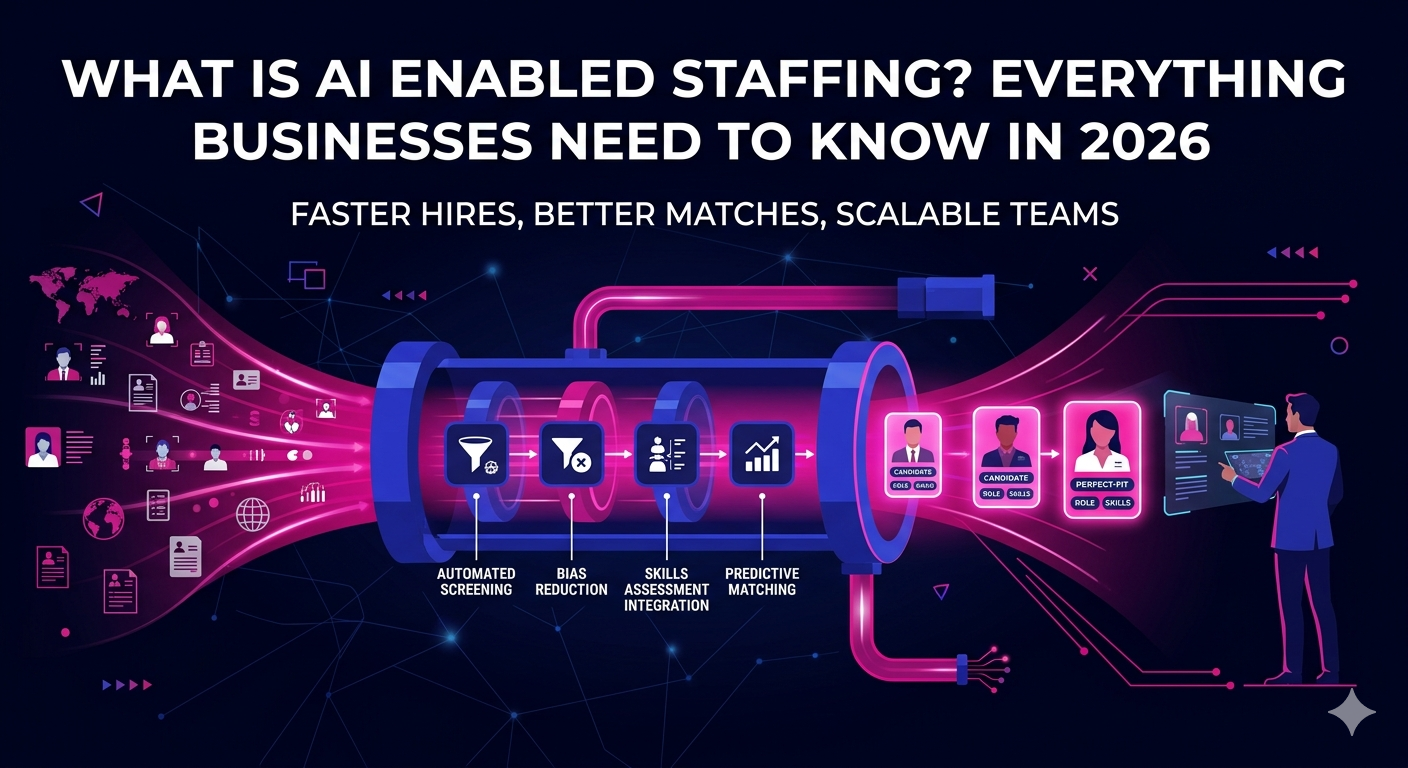
AI enabled staffing typically involves:
- Automated candidate screening based on skills, experience, and role-fit signals
- Natural language processing to analyze resumes, portfolios, and work samples
- Predictive scoring to rank candidates by likelihood of success in a given role
- Bias reduction tools that evaluate candidates on merit-based criteria
- Intelligent matching algorithms that align candidate profiles with employer requirements
- Automated scheduling, follow-up, and communication throughout the hiring workflow
How AI Enabled Staffing Differs From Traditional Recruitment
Traditional recruitment is linear and slow. A job is posted, applications arrive, a recruiter reviews each one manually, a shortlist is built, interviews are scheduled, and a decision is made. At every step, human bandwidth is the limiting factor. For remote roles that attract hundreds of applicants, this process can take four to eight weeks and still result in a poor hire.
AI enabled staffing compresses and improves this entire sequence. Here is how the key differences play out in practice:
Speed of Shortlisting
Traditional recruiters might spend two to three hours reviewing 50 resumes. An AI enabled staffing platform can evaluate the same 50 candidates in seconds and surface the top ten based on a weighted scoring model that accounts for skills, experience level, industry background, and communication indicators. This frees recruiters to focus their time on the candidates most likely to succeed.
Consistency and Objectivity
Human reviewers are influenced by unconscious bias, fatigue, and inconsistency. The tenth resume reviewed on a Friday afternoon receives less attention than the first reviewed Monday morning. AI enabled staffing applies the same evaluation criteria to every candidate, every time, which produces a more consistent and defensible shortlist.
Predictive Matching
One of the most powerful features of AI enabled staffing is predictive matching. By analyzing patterns in historical hire data, successful employee profiles, and role performance metrics, AI systems can identify which candidates are likely to thrive in a specific role at a specific type of company. This is fundamentally different from traditional keyword matching, which flags candidates based on words in a resume rather than actual fit signals.
Why AI Enabled Staffing Matters More for Remote Teams
Remote hiring presents unique challenges. You cannot rely on in-person chemistry, body language, or office culture fit assessments. The candidate pool is global, which makes volume management even harder. And the cost of a bad remote hire, factoring in onboarding, tool access, and lost productivity, is significant.
AI enabled staffing addresses all of these challenges directly. It gives hiring managers structured, data-backed profiles for every candidate, highlights remote-work readiness indicators such as async communication skills and self-management history, and makes global talent pools manageable rather than overwhelming.
Businesses that use AI enabled staffing for remote roles consistently report faster time-to-hire, higher first-year retention rates, and stronger performance from new hires compared to those using traditional methods.
The Core Components of an AI Enabled Staffing Platform
Not all AI staffing solutions are built the same. When evaluating platforms or providers, look for these core components that define a genuinely capable AI enabled staffing system:
Intelligent Candidate Sourcing
The platform should be able to proactively identify and engage qualified candidates from multiple channels rather than waiting passively for applications. AI driven sourcing uses pattern recognition to find passive candidates who match the role profile, dramatically widening the talent pool.
Skills-Based Assessment Integration
AI enabled staffing works best when combined with structured skills assessments. The AI scores candidates based on assessment results alongside resume data, giving employers a multi-dimensional view of each person rather than a one-dimensional keyword match.
Continuous Learning and Improvement
The best AI staffing systems improve over time. As hiring outcomes are tracked, the algorithm learns which candidate signals correlate with strong performance and adjusts its scoring accordingly. This means the platform gets smarter with every hire made through it.
Human-in-the-Loop Decision Making
AI enables better decisions but should not replace them. A well-designed AI enabled staffing process always includes human review at key decision points, particularly for final selection and offer extension. The goal is augmentation, not automation of judgment.
Who Benefits Most From AI Enabled Staffing?
While any business can benefit from more efficient hiring, AI enabled staffing delivers the greatest value for organizations in these situations:
- Companies hiring for multiple remote roles simultaneously across different functions
- Fast-growing businesses that need to scale their teams quickly without sacrificing quality
- Organizations with limited in-house HR capacity that cannot manage high application volumes manually
- Businesses hiring globally who need consistent evaluation standards across diverse candidate pools
- Companies that have experienced high turnover from poor hiring decisions and want a more data-driven approach
If your business falls into any of these categories, AI enabled staffing is not a nice-to-have in 2026. It is a competitive necessity.
AI Enabled Staffing in Action: What the Process Looks Like
Here is a practical example of how AI enabled staffing works for a company hiring a remote digital marketer:
- The employer defines role requirements through a structured intake form covering skills, experience level, tools proficiency, and remote work expectations
- The AI platform sources candidates from its database and external channels, filtering for match signals
- Each candidate is scored and ranked, with a profile generated that highlights their strongest qualifications and any potential gaps
- The top candidates complete a skills assessment, with results automatically appended to their profile
- A human recruiter reviews the top-ranked, assessment-verified candidates and selects those to advance to interviews
- Interview scheduling is automated, and post-interview feedback is captured and stored for future reference
- An offer is extended and onboarding begins, with data from the process feeding back into the platform to improve future matches
The entire process, from intake to offer, can be completed in under two weeks for most remote roles when using a well-built AI enabled staffing system.
Platforms like The Remote Reps combine AI enabled staffing processes with human expert oversight to deliver pre-vetted remote professionals across sales, marketing, operations, and support. Whether you need a remote digital marketer matched through an AI-powered staffing process or a specialist in any other function, the combination of intelligent matching and human judgment produces consistently strong results.
For a broader overview of how AI is transforming talent acquisition, SHRM’s talent acquisition resource center covers how AI enabled staffing is being adopted across industries in 2026.
Conclusion: The Future of Hiring Is Already Here
Understanding what is AI enabled staffing is the first step toward using it to your advantage. In 2026, businesses that continue to rely on slow, manual hiring processes will struggle to compete for top remote talent with those that have adopted smarter, faster, data-driven approaches. AI enabled staffing is not a trend to watch. It is a shift that is already redefining how the best companies build their teams.
If you are ready to experience the difference, explore The Remote Reps and connect with pre-vetted remote professionals matched through an AI-informed staffing process designed for growing businesses.
Frequently Asked Questions About AI Enabled Staffing
What is AI enabled staffing and how is it different from traditional recruitment?
AI enabled staffing uses artificial intelligence to automate and improve candidate sourcing, screening, and matching. Unlike traditional recruitment, which relies heavily on manual review and subjective judgment, AI enabled staffing applies consistent, data-driven scoring to every candidate. This results in faster shortlisting, reduced bias, and better overall hire quality, particularly for remote roles where the candidate pool is large and diverse.
Is AI enabled staffing suitable for small businesses?
Yes. In fact, small businesses often benefit the most from AI enabled staffing because they lack the internal HR resources to manage high application volumes manually. By using a platform that incorporates AI enabled staffing tools or working with a staffing partner that uses them, small businesses can access the same quality of talent as larger organizations without needing a dedicated recruiting team.
Does AI enabled staffing eliminate the need for human recruiters?
No. What is AI enabled staffing if not a tool to make human recruiters more effective? AI handles the high-volume, repetitive parts of the process such as initial screening and scoring. Human recruiters remain essential for understanding nuanced role requirements, building candidate relationships, conducting interviews, and making final decisions. The best outcomes come from combining AI efficiency with human judgment.
How accurate is AI enabled staffing in predicting candidate success?
Accuracy depends on the quality of the platform and the data it has been trained on. Mature AI enabled staffing systems that have processed thousands of hires and tracked outcomes over time achieve meaningfully higher placement success rates than manual processes. That said, no system is perfect. Combining AI scoring with structured assessments and human review produces the most reliable results.
What types of roles can be filled using AI enabled staffing?
AI enabled staffing works across a wide range of functions including sales, marketing, customer support, operations, finance, legal, and technical roles. It is particularly effective for remote positions where the candidate pool is global and volume management is a challenge. Any role with clearly defined skills requirements and measurable performance outcomes is well-suited to an AI enabled staffing approach.
How do I get started with AI enabled staffing for my business?
The simplest entry point is to work with a staffing platform that already integrates AI enabled staffing into its process. This way you benefit from intelligent candidate matching without needing to build or manage any technology yourself. Define your role requirements clearly, communicate your ideal candidate profile in detail, and let the platform handle the sourcing and initial evaluation. From there, your involvement focuses on reviewing top candidates and making final decisions.