If you have been struggling to justify the cost of building an internal sales development team, you are not alone. For many businesses in 2026, the best alternative to hiring in-house SDRs is not a workaround or a compromise. It is a genuinely superior model that delivers better pipeline results at a fraction of the cost. This guide explains exactly why, and what you should do instead.
Sales development representatives are the engine of outbound growth. They prospect, qualify leads, book discovery calls, and keep your pipeline moving. But hiring, training, and retaining in-house SDRs has become one of the most expensive and time-consuming investments a growth-focused company can make. There is a smarter path forward.
Why In-House SDR Hiring Is Broken in 2026
Before exploring the best alternatives to in-house SDR hiring, it helps to understand why the traditional model is failing so many businesses right now.
The Cost of an In-House SDR Goes Far Beyond Salary
The fully loaded cost of a single in-house SDR in a major market typically includes:
- Base salary plus commission or bonus structure
- Payroll taxes and employee benefits
- Recruitment fees or internal hiring costs
- Onboarding, training, and ramp time (often 60 to 90 days before full productivity)
- Sales tools, CRM licenses, and sequencing software
- Management overhead and ongoing coaching
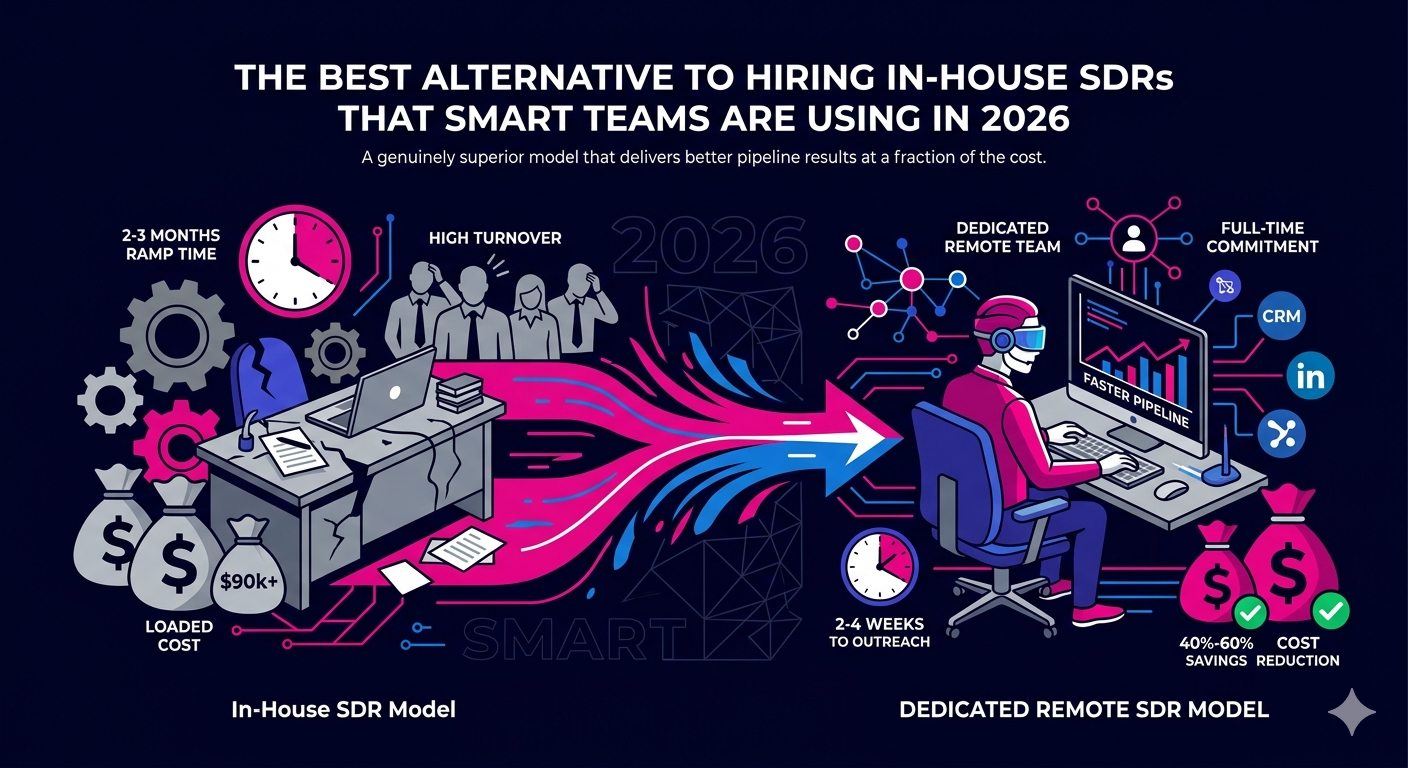
When you add it all up, a single in-house SDR can cost a business well over $90,000 to $120,000 per year in total investment, and that figure assumes they stay. SDR turnover rates remain among the highest in any sales function, with average tenure sitting at under 18 months in many organizations.
Ramp Time Kills Pipeline Momentum
Even when you hire the right person, the time between offer acceptance and full pipeline contribution is significant. Most in-house SDRs take two to three months to become fully productive. For a business trying to build revenue momentum, that delay is costly and often underestimated during the planning stage.
The Best Alternative to In-House SDR Hiring: Dedicated Remote SDRs
The most effective and widely adopted alternative to hiring in-house SDRs in 2026 is building a dedicated remote SDR team through a specialist staffing partner. This model gives you full-time, committed sales development professionals who work exclusively for your business, without the overhead, ramp delays, or retention risks of traditional in-house hiring.
Companies using dedicated remote SDRs from The Remote Reps gain access to pre-vetted, trained sales development professionals who can begin contributing to pipeline far faster than a conventional in-house hire.
What Makes Dedicated Remote SDRs Different from Freelancers or Agencies
This is an important distinction. A dedicated remote SDR is not a freelancer juggling five clients, and they are not an agency running generic outreach on your behalf. They are:
- Working full-time, exclusively for your business
- Integrated into your sales process, tools, and CRM
- Aligned with your ICP, messaging, and qualification criteria
- Managed to KPIs and reporting structures you define
- Available consistently during your required working hours
The result is the accountability and output of an in-house hire, with the cost and flexibility advantages of a remote model.
Cost Comparison: Remote SDRs vs In-House SDRs
One of the most compelling reasons businesses choose dedicated remote SDRs as the best alternative to in-house hiring is the cost differential. Across comparable output metrics, a dedicated remote SDR typically costs 40% to 60% less than the fully loaded cost of an equivalent in-house role.
That gap does not reflect a difference in quality. It reflects the absence of location-based salary inflation, office infrastructure costs, and the expensive administrative layer that comes with domestic employment. According to research cited by Gartner’s analysis of remote workforce models and cost-per-hire benchmarks, organizations leveraging remote talent models consistently report lower cost-per-hire and improved time-to-productivity metrics compared to traditional in-house recruitment.
Speed to Pipeline: How Remote SDRs Outperform In-House Timelines
Faster Hiring and Onboarding
Working with a dedicated remote SDR provider dramatically compresses hiring timelines. Instead of posting a job, reviewing hundreds of applications, running multi-stage interviews, negotiating offers, and waiting through notice periods, you receive pre-screened candidates who are already assessed against sales development benchmarks.
Most businesses partnering with a specialist provider go from briefing to active outreach in two to four weeks, compared to two to four months for a typical in-house SDR hire.
Pre-Trained Sales Development Professionals
The best remote SDR providers invest in training their talent before placement. That means your remote SDR arrives with foundational knowledge of prospecting frameworks, objection handling, CRM hygiene, and outreach cadence design. Your internal team’s role is to refine and align, not build from scratch.
Flexibility and Scalability That In-House Teams Cannot Match
Another reason dedicated remote SDRs represent the best alternative to in-house hiring is operational flexibility. With an in-house team, scaling up means repeating an expensive, slow hiring cycle. Scaling down means redundancies, severance, and potential legal complexity depending on your jurisdiction.
A dedicated remote model allows you to:
- Add SDR capacity in response to campaign or product launch cycles
- Adjust team size based on seasonal pipeline demand
- Test new markets or verticals without long-term headcount commitments
- Redeploy focus areas quickly when strategy evolves
This kind of agility is a genuine competitive advantage for businesses operating in fast-moving markets.
Quality of Output: What to Expect From a Remote SDR Team
Measurable Pipeline Contribution
The output of a well-managed dedicated remote SDR should be measured in the same terms as any in-house SDR: qualified meetings booked, opportunities created, connection rates, and pipeline value generated. There is no reason to accept lower standards simply because the role is remote.
In fact, many businesses report that remote SDRs outperform in-house counterparts on core activity metrics. Fewer office distractions, structured daily targets, and digital accountability tools create an environment where consistent output is easier to maintain and track.
Integration With Your Sales Stack
A high-quality remote SDR placement means the professional works within your existing tools: your CRM, sequencing platform, LinkedIn Sales Navigator, video prospecting tools, and reporting dashboards. There is no parallel infrastructure to maintain. They operate as a fully embedded member of your sales development function.
Beyond SDRs: Building a Complete Remote Revenue Team
Once businesses experience the results of dedicated remote SDRs as the best alternative to in-house hiring, many expand the model across their go-to-market function. The same approach applies to roles including:
- Full-cycle remote sales representatives for closing roles
- Cold email specialists and outbound strategists
- GTM engineers for sales automation and tech stack optimization
- Lead generation experts for top-of-funnel pipeline building
The businesses growing fastest in 2026 are not trying to hire every function locally. They are building distributed, specialized teams that bring the right expertise to each part of the revenue engine.
How to Choose the Right Remote SDR Partner
Not all remote SDR providers are equal. When evaluating partners, look for the following:
- A rigorous vetting and assessment process for SDR candidates
- Demonstrated experience placing SDRs in your industry or adjacent verticals
- Transparent onboarding process and clear communication protocols
- Ongoing support and performance management after placement
- Client testimonials and verifiable case studies showing pipeline outcomes
The goal is a long-term partnership, not a transactional hire. The right provider takes time to understand your ICP, sales motion, and growth targets before recommending a candidate.
Conclusion: Stop Overpaying for In-House SDRs
In 2026, businesses that cling to the in-house SDR model out of habit are leaving significant revenue and efficiency on the table. The best alternative to hiring in-house SDRs is a dedicated remote model that delivers the same pipeline outcomes with greater speed, lower cost, and far more flexibility.
If you are ready to build a leaner, faster, and more scalable sales development function, explore what a dedicated remote SDR team can do for your business today.
FAQ: Best Alternative to Hiring In-House SDRs
What is the best alternative to hiring in-house SDRs for a growing startup?
For a growing startup, the best alternative to hiring in-house SDRs is partnering with a dedicated remote SDR provider. This approach eliminates the cost and delay of traditional recruitment, gives you access to pre-vetted sales talent, and lets you scale your outbound function without the fixed overhead of full-time local employment. Startups benefit especially from the flexibility to adjust team size as the business evolves.
How much can I save by choosing a remote SDR instead of an in-house hire?
Most businesses find that the best alternative to hiring in-house SDRs, which is a dedicated remote SDR model, reduces total employment cost by 40% to 60%. The savings come from eliminating office costs, reducing local payroll tax burdens, and accessing talent in cost-competitive markets without compromising on skills or output quality.
Will a remote SDR be as effective as an in-house SDR for pipeline generation?
Yes. When placed correctly and integrated into your sales tools and processes, a dedicated remote SDR can match and often exceed the pipeline contribution of an in-house hire. The best alternative to in-house SDR hiring is not about lowering your standards. It is about accessing the same quality of talent through a more efficient and cost-effective model.
How long does it take to get a remote SDR up and running compared to an in-house hire?
One of the biggest advantages of choosing the best alternative to hiring in-house SDRs is speed. A dedicated remote SDR can typically be placed and actively prospecting within two to four weeks. An in-house SDR hire, by contrast, often takes two to four months from job posting to full productivity once recruitment, onboarding, and ramp time are accounted for.
Can the best alternative to in-house SDRs work for enterprise-level sales cycles?
Absolutely. Dedicated remote SDRs are placed based on your specific ICP, sales motion, and industry requirements. Whether your sales cycle is transactional or complex and enterprise-focused, the right remote SDR provider will match you with professionals who have relevant experience and can handle the research, personalization, and multi-touch outreach that longer cycles demand.