When you need remote talent fast, the first decision you face is also one of the most consequential: should you go through a remote staffing agency or hire a freelancer directly? The remote staffing agency vs freelancer debate has become one of the most searched hiring questions of 2026, and for good reason. Both options offer remote talent, but they operate very differently in terms of cost, quality control, reliability, and long-term value.
This guide breaks down both options in full so you can make the right call for your business, your budget, and your team structure. There is no universal answer, but by the end, you will know exactly which path makes the most sense for your situation.
Understanding the Core Difference: Remote Staffing Agency vs Freelancer
Before comparing them side by side, it helps to understand what each option actually involves.
What Is a Remote Staffing Agency?
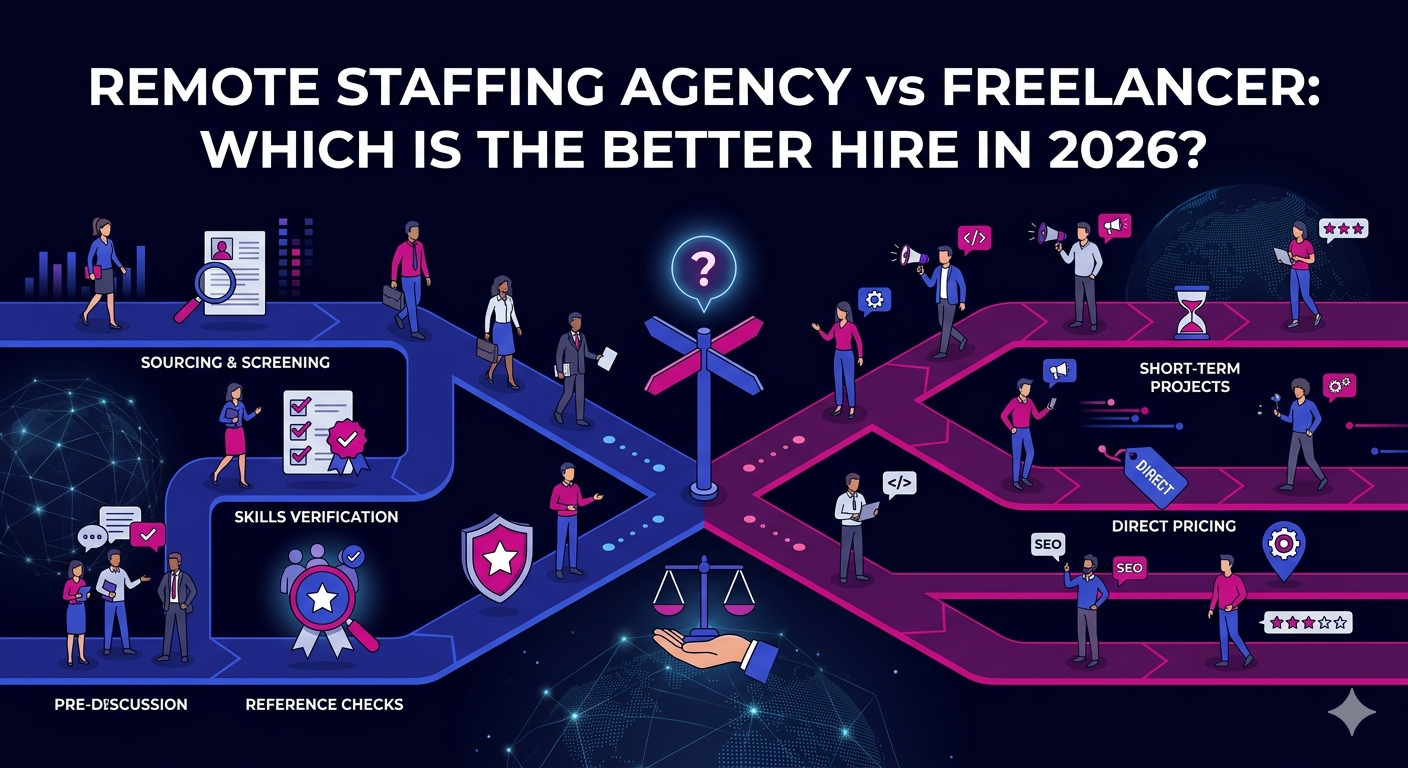
A remote staffing agency sources, screens, and places pre-vetted remote professionals on your behalf. The agency handles the recruitment pipeline, skills verification, reference checks, and often initial onboarding logistics. You receive a shortlist of qualified candidates who have already been assessed against your requirements. Some agencies also provide ongoing performance management, replacement guarantees, and compliance support.
What Is a Freelancer?
A freelancer is an independent professional you hire directly, typically through a platform like Upwork, Fiverr, or Toptal, or through your own network. There is no intermediary managing the relationship. You handle the sourcing, screening, contracting, and management entirely on your own. The freelancer sets their own rates and operates as a fully independent business.
Head-to-Head Comparison: Remote Staffing Agency vs Freelancer
Let us compare these two options across the factors that matter most to growing businesses in 2026.
Quality and Vetting
This is where the remote staffing agency vs freelancer gap is most visible. Agencies invest heavily in recruitment infrastructure. They use structured interviews, skills testing, portfolio reviews, and reference checks before a candidate ever reaches you. The vetting burden is largely removed from your plate.
With freelancers, the quality can be exceptional, but the vetting process sits entirely with you. Unless you are working with a platform that has rigorous application standards, you may spend significant time reviewing portfolios, conducting interviews, and discovering mismatches after work has already begun. Platform ratings help, but they are not a substitute for structured screening.
Cost
Freelancers are often perceived as the cheaper option, and for short, well-defined projects, they frequently are. You pay directly for hours or deliverables with no agency margin. Hourly rates in 2026 range widely depending on the skill and the freelancer’s location, from $10 per hour for entry-level support work to $150 or more per hour for senior specialists.
Agencies charge a premium over raw hourly rates, either as a placement fee or a monthly retainer margin. However, when you factor in the time you save on recruitment, the replacement guarantee if a hire does not work out, and the reduced risk of a bad hire, the total cost of ownership often favors the agency for roles that require sustained, ongoing support.
Reliability and Commitment
Freelancers operate independently. They may be managing multiple clients simultaneously, which can affect their availability and responsiveness. A freelancer who is in high demand may deprioritize your work during a busy period, or leave a project entirely if a better opportunity arises. This is an accepted trade-off of the freelance model.
Agency-placed professionals tend to operate with greater accountability because the agency’s reputation is tied to their performance. Many remote staffing agencies have contractual service levels and will provide a replacement candidate if a placed professional leaves or underperforms within a defined period. That replacement guarantee alone provides peace of mind that the freelance model cannot match.
Scalability
If you need to scale your remote team quickly, working through a remote staffing agency is significantly faster and more predictable. Agencies maintain active candidate pipelines and can typically place qualified professionals within one to three weeks. Scaling a freelance team requires you to repeat the full sourcing and screening process for each new hire, which adds time and management overhead at exactly the moment you need to move fast.
Compliance and Contracts
Hiring freelancers internationally introduces compliance considerations around contractor classification, payment methods, and local labor regulations. In 2026, misclassification of workers remains a significant legal risk in many jurisdictions. You are responsible for managing this when hiring freelancers directly.
Reputable remote staffing agencies handle compliance on your behalf or provide clear contractual frameworks that protect both parties. This is a meaningful operational advantage, particularly for businesses that are scaling remote teams across multiple countries.
When a Freelancer Is the Right Choice
The remote staffing agency vs freelancer decision does not always favor one side. There are specific scenarios where hiring a freelancer directly is the smarter, more efficient move.
- You have a clearly scoped, one-time project with a defined deliverable and deadline
- You need a highly niche specialist for a short engagement and have the internal capacity to vet them yourself
- Your budget is limited and the role does not require ongoing commitment
- You already have an established network of trusted freelancers you can call on directly
- The project carries low risk if the hire does not work out on the first attempt
When a Remote Staffing Agency Is the Right Choice
For most growing businesses, a remote staffing agency offers superior outcomes across the majority of hiring scenarios. Consider this path when:
- You need a dedicated professional for an ongoing role rather than a one-off project
- You lack the internal HR capacity to manage a full recruitment process
- The role is business-critical and a bad hire would be costly to recover from
- You want a replacement guarantee and ongoing performance accountability
- You are scaling quickly and need to place multiple roles within a short window
- International compliance adds complexity you are not equipped to manage internally
To explore the full range of pre-vetted remote professionals available through a trusted staffing partner, browse our remote virtual assistant and support staffing services at The Remote Reps, where every candidate is screened before they reach you.
The Hidden Costs of Getting This Decision Wrong
One of the most underappreciated factors in the remote staffing agency vs freelancer comparison is the cost of a bad hire. Studies consistently show that a failed hire costs between one and three times the annual salary of the role. For remote positions, where onboarding and integration take additional time and effort, this figure can be even higher.
A freelancer who disappears mid-project, delivers substandard work, or misrepresents their experience creates direct costs in rework, delays, and lost revenue. Those costs are invisible in a simple hourly rate comparison but very visible in your quarterly results.
Agencies absorb much of this risk through their vetting infrastructure and replacement policies. When you evaluate the remote staffing agency vs freelancer decision purely on rate, you are only looking at part of the picture.
Making the Right Call for Your Business
Here is a simple decision framework to apply to your next remote hire in 2026.
- Is this a one-time project under 30 days? Consider a freelancer.
- Is this a recurring or open-ended role? Use a remote staffing agency.
- Do you have time to vet candidates yourself? Freelancer is feasible.
- Is the role business-critical with limited margin for error? Use a remote staffing agency.
- Do you need to fill multiple roles quickly? A remote staffing agency wins on speed and consistency.
For roles in sales, marketing, legal support, customer service, and operations, a remote staffing agency consistently outperforms the freelance route on quality, reliability, and long-term value. If you are building out your sales development function, for example, our remote SDR staffing services connect you with high-performing sales development representatives who are screened, trained, and ready to contribute from day one.
For a broader look at how the remote work landscape is evolving in 2026 and what it means for hiring decisions, the Society for Human Resource Management’s research on remote work and staffing provides authoritative data to help you navigate the remote staffing agency vs freelancer decision with confidence.
FAQ: Remote Staffing Agency vs Freelancer
Is a remote staffing agency or a freelancer more cost-effective for ongoing roles?
For ongoing roles, a remote staffing agency is typically more cost-effective when total cost of ownership is considered. While the hourly rate through an agency may be slightly higher than a direct freelancer rate, the vetting, replacement guarantee, and reduced management overhead offset that difference significantly over the duration of a sustained engagement.
How does quality compare between a remote staffing agency and a freelancer?
In the remote staffing agency vs freelancer quality comparison, agencies have a structural advantage. They apply multi-stage screening processes before any candidate reaches you, which filters out unqualified applicants at scale. With freelancers, quality varies widely and the vetting burden falls entirely on the hiring business. Top platforms do maintain high-quality pipelines, but they require more effort to navigate effectively.
Which option is faster when I need to hire a remote professional quickly?
A remote staffing agency is almost always faster for urgent or multiple hires. Agencies maintain active pipelines of pre-screened candidates and can typically place a qualified professional within one to three weeks. Hiring a freelancer directly requires you to post, screen, interview, and contract from scratch, which can take just as long or longer, especially for specialized roles.
What are the compliance risks in the remote staffing agency vs freelancer decision?
Hiring freelancers directly, particularly across international borders, introduces risks around contractor classification, tax obligations, and local labor laws. Misclassification of independent contractors is an active enforcement priority in many countries in 2026. A reputable remote staffing agency manages compliance frameworks on your behalf, reducing your legal exposure considerably.
Can I switch from freelancers to a remote staffing agency without disrupting my operations?
Yes, and many growing businesses make this transition as their team needs become more consistent and their tolerance for hiring risk decreases. The transition typically involves defining your ongoing role requirements, engaging the agency for new hires as current freelance contracts expire, and standardizing onboarding through the agency’s placement process. Most businesses find the transition straightforward when managed with a short overlap period.
Does the remote staffing agency vs freelancer choice depend on the role or industry?
Significantly. Roles that require confidentiality, consistency, and deep integration with your operations, such as executive assistants, legal support, sales development, and customer service, are almost always better filled through a remote staffing agency. Short-term creative or technical projects with clear deliverables can be well-served by freelancers. The more ongoing and business-critical the role, the stronger the case for an agency.
Choose the Hiring Model That Matches Your Growth Stage
The remote staffing agency vs freelancer decision is not about which option is universally better. It is about which option is right for the specific role, timeline, and risk tolerance you are working with in 2026. For most growing businesses that need reliable, accountable, and scalable remote talent, a remote staffing agency delivers a fundamentally stronger outcome.
When you are ready to build a remote team that performs from day one, explore the full range of pre-vetted professionals at The Remote Reps, where quality, accountability, and results are built into every placement.