
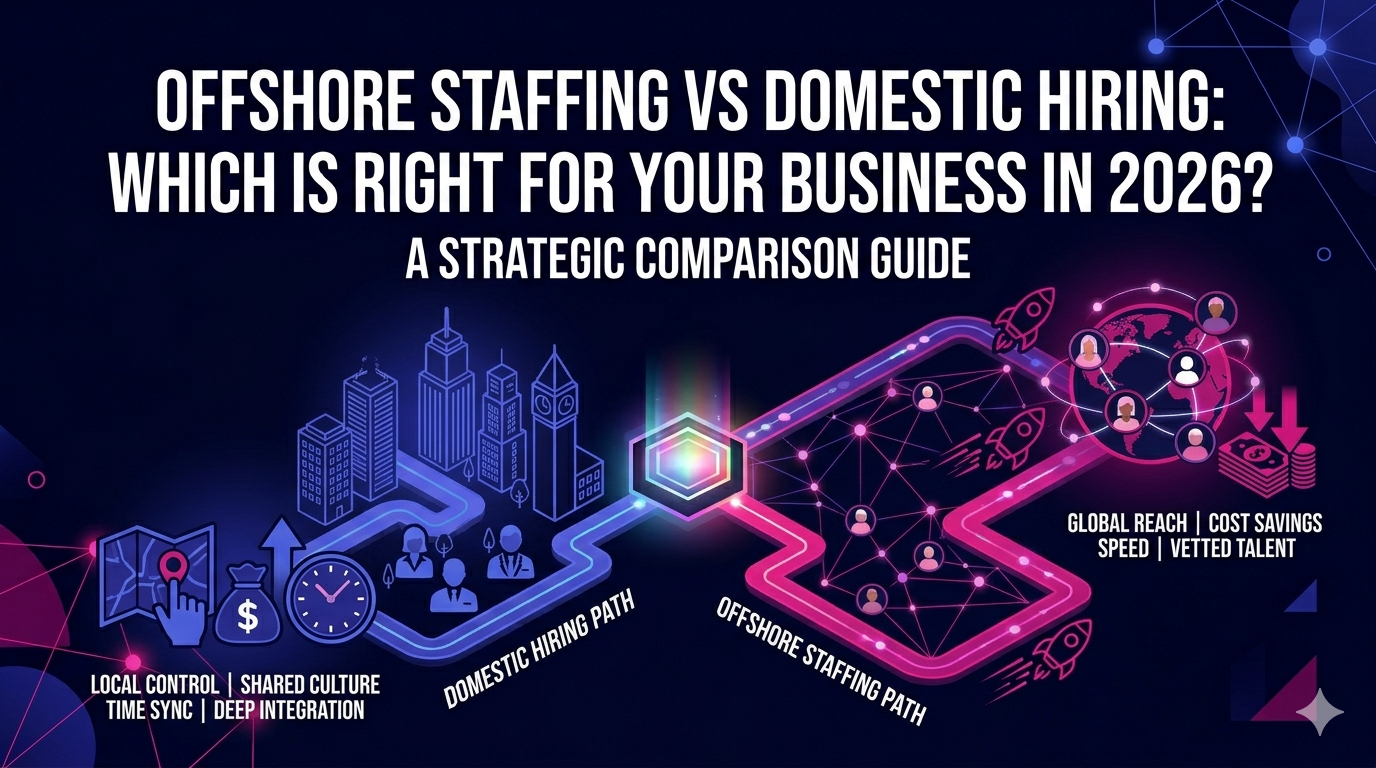
Every growing business eventually faces the same question: should you build your team locally or look beyond your borders? The debate around offshore staffing vs domestic hiring has never been more relevant. With remote work now standard and global talent pools more accessible than ever, making the wrong choice can cost you time, money, and momentum.
This guide breaks down the real differences between offshore staffing and domestic hiring across cost, talent quality, scalability, and risk so you can make a data-driven decision that supports your 2026 growth strategy.
What Is Offshore Staffing?
Offshore staffing means hiring employees or contractors based in another country, typically where labor costs are lower and specialized talent is abundant. Businesses commonly offshore roles in sales, digital marketing, customer support, lead generation, and administrative functions.
Offshore staffing is not just about cutting costs. It is about building a distributed team of skilled professionals who can run operations around the clock, often with expertise that rivals or exceeds local candidates.
What Is Domestic Hiring?
Domestic hiring refers to recruiting employees who live and work in the same country as your business. These hires are subject to local labor laws, compensation benchmarks, and typically share the same time zone and cultural context as your core team.
Domestic hiring has traditionally been the default for most businesses, especially those prioritizing in-person collaboration or dealing with highly regulated industries.
Offshore Staffing vs Domestic Hiring: A Head-to-Head Comparison
1. Cost Differences
This is where offshore staffing creates the most dramatic contrast. According to industry benchmarks, businesses can save anywhere from 40% to 70% on labor costs when hiring offshore compared to domestic equivalents, factoring in salary, benefits, payroll taxes, and overhead.
- A domestic sales development representative (SDR) in the US costs between $55,000 and $80,000 per year in base salary alone
- An equally qualified offshore SDR can be hired for a fraction of that cost without compromising performance
- Domestic hires also bring hidden costs: office space, equipment, benefits packages, employer taxes, and onboarding expenses
If budget efficiency is a priority, offshore staffing wins this category decisively.
2. Access to Talent
Domestic hiring limits your talent pool to a specific geography. In competitive markets, top candidates are either already employed or command premium salaries. Hiring domestically also means competing with thousands of other employers in the same labor market.
Offshore staffing opens access to a global talent pool. Countries like the Philippines, Colombia, India, and Eastern Europe have produced world-class professionals across sales, marketing, development, and operations. The offshore talent available today is tech-savvy, fluent in English, and accustomed to working with international teams.
If you need offshore sales development representatives who are trained, vetted, and ready to perform, the global talent market delivers options that domestic hiring simply cannot match at the same price point.
3. Scalability and Speed
Scaling a domestic team is slow. Posting jobs, filtering applicants, conducting interviews, negotiating offers, and waiting through notice periods can take two to four months per hire. For fast-growing companies, that lag is costly.
Offshore staffing through a dedicated provider can compress that timeline dramatically. Many offshore staffing firms maintain pre-vetted talent pipelines, allowing businesses to onboard new team members in days rather than months. Whether you need to scale up for a product launch or pull back after a slow quarter, the flexibility of offshore models is unmatched.
4. Time Zone and Availability
Domestic hiring gives you same-time-zone alignment by default. For roles that require real-time collaboration, this matters. Offshore teams in significantly different time zones can introduce delays in communication and decision-making.
However, this is often overstated. Many offshore professionals work flexible hours and are accustomed to overlapping with US, UK, or Australian business hours. Additionally, for roles like customer support or lead generation, time zone differences can work in your favor by extending your operational coverage to 24 hours a day.
5. Compliance and Legal Considerations
Domestic hiring gives you a clear legal framework: local employment laws, payroll systems, and HR processes you already understand. There are fewer unknowns.
Offshore staffing introduces cross-border compliance, contracts, intellectual property protections, and payment logistics. However, a reputable offshore staffing partner handles all of this on your behalf, removing the administrative burden and legal risk from your plate entirely.
6. Cultural Alignment and Communication
Domestic hires often align naturally with your brand voice, customer culture, and business norms. Offshore hires require intentional onboarding and communication protocols to bridge cultural gaps.
That said, modern offshore professionals, particularly those who specialize in working with international clients, are highly culturally adaptable. With proper onboarding and clear processes, communication differences become negligible over time.
When Domestic Hiring Makes More Sense
Offshore staffing is not the right answer for every situation. There are cases where domestic hiring remains the smarter choice:
- Roles that require on-site presence such as warehouse, logistics, or in-person sales
- Highly regulated industries where local licensing and compliance are non-negotiable
- Executive-level positions that demand deep integration with company culture and leadership
- Roles that depend on hyper-local market knowledge or community relationships
When Offshore Staffing Delivers a Clear Advantage
For a wide range of business functions, offshore staffing outperforms domestic hiring on nearly every metric that matters to a scaling company:
- Sales roles including SDRs, closers, and account managers
- Digital marketing functions such as SEO, PPC, content, and social media management
- Lead generation and cold outreach operations
- Customer support and virtual assistance
- Back-office functions including executive assistance, legal support, and e-commerce management
Explore the full range of offshore lead generation experts available through The Remote Reps to see how businesses are scaling their pipelines at a fraction of domestic hiring costs.
The Real Cost of Getting This Decision Wrong
Hiring domestically when you could have hired offshore does not just cost you money. It slows your growth. Every dollar overpaid on labor is a dollar not invested in product development, marketing, or customer acquisition.
Conversely, hiring offshore without the right partner can expose you to poor quality hires, misaligned expectations, and compliance headaches. The key is working with a staffing partner who specializes in matching businesses with pre-vetted offshore talent.
According to SHRM research on offshore staffing vs domestic hiring costs, the average cost per domestic hire in the US exceeds $4,700 when factoring in recruiting, onboarding, and productivity ramp-up. Offshore staffing models can reduce that figure significantly while often delivering faster time-to-productivity.
How to Choose the Right Offshore Staffing Partner
Not all offshore staffing agencies are equal. When evaluating partners, prioritize these factors:
- A transparent vetting and recruitment process with verifiable track records
- Specialists in the roles you need to fill, not generalist agencies trying to cover everything
- Client testimonials and case studies from businesses similar to yours
- Clear contracts that protect your intellectual property and data
- Ongoing performance support and replacement guarantees
You can read real client experiences in the testimonials from businesses that have chosen offshore staffing to understand how The Remote Reps delivers consistent results across industries.
Conclusion: Making the Right Call in 2026
The offshore staffing vs domestic hiring debate does not have one universal answer, but the data strongly favors offshore staffing for most scalable business functions in 2026. Lower costs, broader talent access, faster onboarding, and greater flexibility give offshore staffing a clear edge for companies that want to grow without inflating their payroll.
If you are ready to explore what offshore staffing can do for your sales team, marketing function, or back-office operations, visit The Remote Reps to connect with pre-vetted offshore professionals who are ready to contribute from day one.
Frequently Asked Questions
What is the main difference between offshore staffing vs domestic hiring?
Offshore staffing involves hiring employees or contractors based in another country, while domestic hiring refers to recruiting talent within your own country. The key differences in offshore staffing vs domestic hiring come down to cost, talent availability, scalability, and legal compliance requirements.
Is offshore staffing vs domestic hiring better for cost savings?
In most cases, offshore staffing delivers significantly greater cost savings than domestic hiring. Businesses typically save 40% to 70% on labor costs with offshore staffing when comparing equivalent roles, since offshore professionals in countries like the Philippines or Colombia command lower salaries without sacrificing skill or output quality.
How does offshore staffing vs domestic hiring affect quality of work?
Quality depends on the vetting process, not the geography. When sourced through a reputable offshore staffing partner, offshore hires can match or exceed the performance of domestic hires, particularly in sales, marketing, and support roles. Many offshore professionals have international education and extensive experience working with global clients.
What roles are best suited for offshore staffing vs domestic hiring?
Offshore staffing is ideal for sales development, digital marketing, lead generation, customer support, virtual assistance, content creation, and back-office operations. Domestic hiring tends to be a better fit when the role requires physical presence, highly specific local licensing, or deep integration with executive leadership teams.
How long does it take to hire through offshore staffing vs domestic hiring?
Offshore staffing through a specialized provider is typically much faster than domestic hiring. While domestic hiring can take two to four months per role, offshore staffing firms with pre-vetted pipelines can match and onboard candidates within days to a few weeks, depending on role complexity and business requirements.
What are the compliance risks in offshore staffing vs domestic hiring?
Domestic hiring involves familiar local labor laws and payroll regulations. Offshore staffing introduces cross-border contracts, IP protection clauses, and international payment logistics. However, working with a dedicated offshore staffing partner mitigates these risks since they manage compliance on your behalf, leaving you free to focus on managing performance and results.