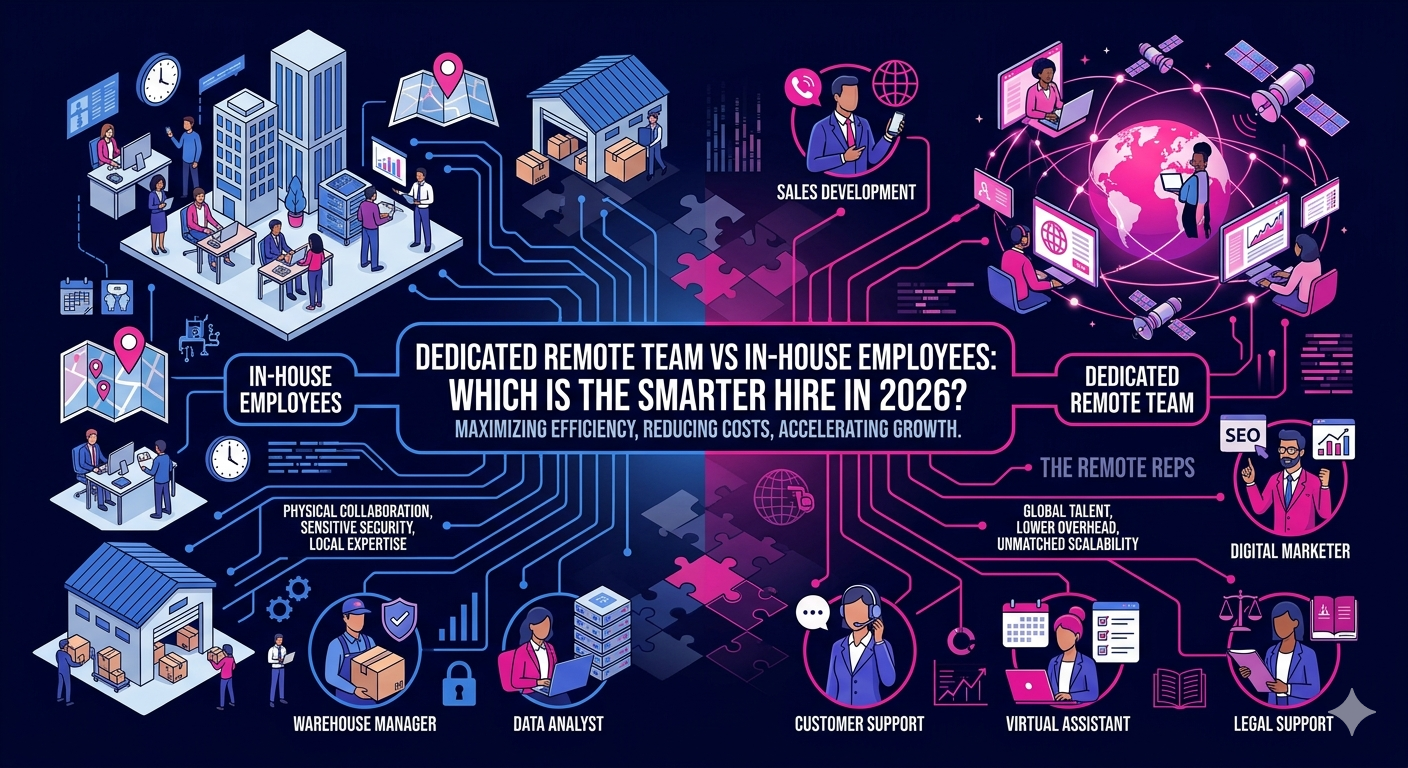
The debate around a dedicated remote team vs in-house employees has never been more relevant. As businesses reassess their hiring strategies in 2026, the choice between building a local workforce and partnering with a dedicated remote team can define your operational efficiency, cost structure, and ability to scale. Whether you run a startup or an established enterprise, understanding the real-world trade-offs is essential before you commit.
This guide breaks down everything you need to know, from costs and productivity to culture and flexibility, so you can make a decision that actually moves your business forward.
What Is a Dedicated Remote Team?
A dedicated remote team is a group of full-time professionals who work exclusively for your business but are based remotely, often through a staffing or outsourcing partner. Unlike freelancers or project-based contractors, these individuals are integrated into your workflow, aligned with your goals, and available on a consistent schedule.
In contrast, in-house employees are hired locally, work from your office or a company-designated location, and are managed directly as part of your internal team.
Both models have distinct advantages. The right choice depends on your business priorities, budget, and the nature of the roles you need to fill.
Cost Comparison: Remote Teams vs In-House Hiring
The True Cost of In-House Employees
When you hire in-house, the salary is just the beginning. Consider the full picture:
- Payroll taxes and employee benefits (health insurance, retirement contributions)
- Office space, equipment, and utilities
- Recruitment fees, onboarding, and training costs
- Paid time off, sick leave, and statutory entitlements
- HR administration and compliance overhead
Depending on the role and location, the true cost of an in-house employee can be 1.25 to 1.4 times their base salary, and that figure rises sharply in major cities where rent and wages are high.
Why a Dedicated Remote Team Reduces Overhead
With a dedicated remote workforce, many of those overhead costs disappear. You are not paying for physical office space, local tax burdens, or expensive benefits packages tied to your geography. You gain access to skilled professionals in markets where talent is both high-quality and cost-competitive.
For roles like sales development, digital marketing, customer support, and administrative work, a dedicated remote team can deliver the same output at a significantly reduced total cost, often freeing up capital for growth-focused investments.
Productivity and Performance: What the Data Shows
One of the most persistent myths in the dedicated remote team vs in-house employees conversation is that remote workers are less productive. Research consistently challenges this assumption.
Studies published by Stanford and referenced in Harvard Business Review’s analysis of remote workforce productivity found that remote employees show measurably higher output compared to their office-based peers, primarily due to fewer interruptions, reduced commute fatigue, and greater autonomy over their work environment.
When a dedicated remote team is structured correctly, with clear KPIs, regular communication rhythms, and the right management tools, performance outcomes are highly competitive with in-house teams.
Talent Access: Global Reach vs Local Limits
In-House Hiring Is Geographically Constrained
When you hire in-house, your talent pool is limited to candidates who live within commuting distance or are willing to relocate. In a competitive labor market, this restriction drives up salaries and lengthens time-to-hire, especially for specialized roles in sales, marketing technology, or legal support.
Remote Teams Open the Global Talent Market
A dedicated remote team model gives you access to professionals across multiple time zones and markets. Need a cold email expert, a PPC specialist, or a paralegal with niche expertise? With remote hiring, geography is no longer a barrier.
This is one of the most compelling arguments for businesses exploring dedicated remote lead generation experts or other specialized roles that are difficult and expensive to fill locally.
Flexibility and Scalability
Scaling an in-house team is slow and expensive. Recruitment cycles take weeks or months. Onboarding takes additional time. And if business conditions change, reducing headcount carries significant legal and financial consequences depending on your jurisdiction.
A dedicated remote team is structurally designed for flexibility. You can scale headcount up during growth phases and adjust during leaner periods without the overhead of termination costs, severance packages, or the reputational risks associated with layoffs.
This scalability advantage is particularly important for businesses operating in dynamic sectors like e-commerce, SaaS, or agencies where project volume fluctuates across the year.
Communication, Culture, and Collaboration
In-House Teams and Organic Culture Building
There is a genuine advantage to physical co-location when it comes to spontaneous collaboration and cultural cohesion. In-house teams can develop rapport naturally through shared spaces, and some types of creative or fast-paced work benefit from real-time, in-room collaboration.
Building Culture With a Remote Team
That said, intentional culture-building in a remote environment is absolutely achievable. Businesses that invest in structured onboarding, regular video check-ins, clear documentation, and asynchronous communication tools consistently report high engagement and team cohesion with their dedicated remote employees.
The key is choosing a remote staffing partner that prioritizes cultural alignment from the outset, not just skills matching. At The Remote Reps, every placement is built around understanding your team’s working style, communication preferences, and performance expectations.
Security, Compliance, and Risk Management
A common concern when evaluating dedicated remote teams vs in-house employees is data security and compliance. This is a legitimate consideration, particularly in regulated industries like legal, finance, or healthcare.
However, these risks are fully manageable. Reputable remote staffing providers use NDAs, data security protocols, and role-specific access controls. In many cases, dedicated remote professionals operate within more structured compliance frameworks than informal in-house arrangements.
For businesses that need specialized compliance support, roles such as dedicated remote paralegals or legal assistants can be sourced through providers that understand regulatory requirements and can ensure proper documentation standards are met.
When In-House Hiring Still Makes Sense
To be fair and objective, in-house hiring remains the better choice in specific scenarios:
- Roles requiring hands-on physical presence, such as warehouse operations, lab work, or in-person client management
- Highly sensitive positions where on-site monitoring is a non-negotiable security requirement
- Roles that depend heavily on moment-to-moment leadership visibility and spontaneous decision-making
Outside of these scenarios, the case for building or expanding through a dedicated remote team is consistently strong.
Which Model Wins in 2026?
For most modern businesses, the answer is a hybrid approach. Core leadership and strategic roles may remain in-house, while specialized, scalable, or high-volume functions are handled by dedicated remote professionals.
The businesses winning in 2026 are not asking “remote or in-house?” They are asking “which roles benefit most from each model, and how do I build a team that maximizes both?” That question leads to leaner cost structures, wider talent access, and faster growth.
If you are ready to explore what a dedicated remote sales development team or other specialized remote roles can do for your business, now is the time to start that conversation.
FAQ: Dedicated Remote Team vs In-House Employees
Is a dedicated remote team as reliable as in-house employees?
Yes. When structured correctly, a dedicated remote team operates with the same reliability as an in-house team. The key factors are clear role definitions, consistent communication, and strong performance management. Many businesses find that dedicated remote professionals are actually more accountable because their output is easier to measure and track through digital tools.
How does the cost of a dedicated remote team compare to hiring in-house employees?
In most cases, building a dedicated remote team is significantly more cost-effective than hiring in-house employees. You eliminate expenses related to office space, local payroll taxes, benefits administration, and recruitment overhead. For roles like sales, marketing, and administrative support, the savings can range from 30% to 60% depending on the market.
Can a dedicated remote team integrate with my existing in-house employees?
Absolutely. Dedicated remote teams are designed to work alongside your existing workforce. With the right onboarding process, shared tools, and communication protocols, remote and in-house employees can collaborate seamlessly. Many businesses run blended teams where both groups operate as a single, cohesive unit.
What types of roles work best for a dedicated remote team vs in-house employees?
Roles that are well-suited for a dedicated remote team include sales development, digital marketing, SEO, PPC, social media management, customer support, virtual assistance, cold email outreach, lead generation, and legal support functions. In-house hiring is typically reserved for roles requiring physical presence, hands-on management, or regulated on-site operations.
How do I choose the right provider for building a dedicated remote team?
Look for a provider that specializes in your industry, offers transparent vetting processes, provides ongoing support after placement, and demonstrates clear alignment with your business goals. Reviewing case studies, client testimonials, and the range of roles the provider supports will give you a strong indication of fit. The best providers treat remote placement as a long-term partnership, not a transactional hire.