
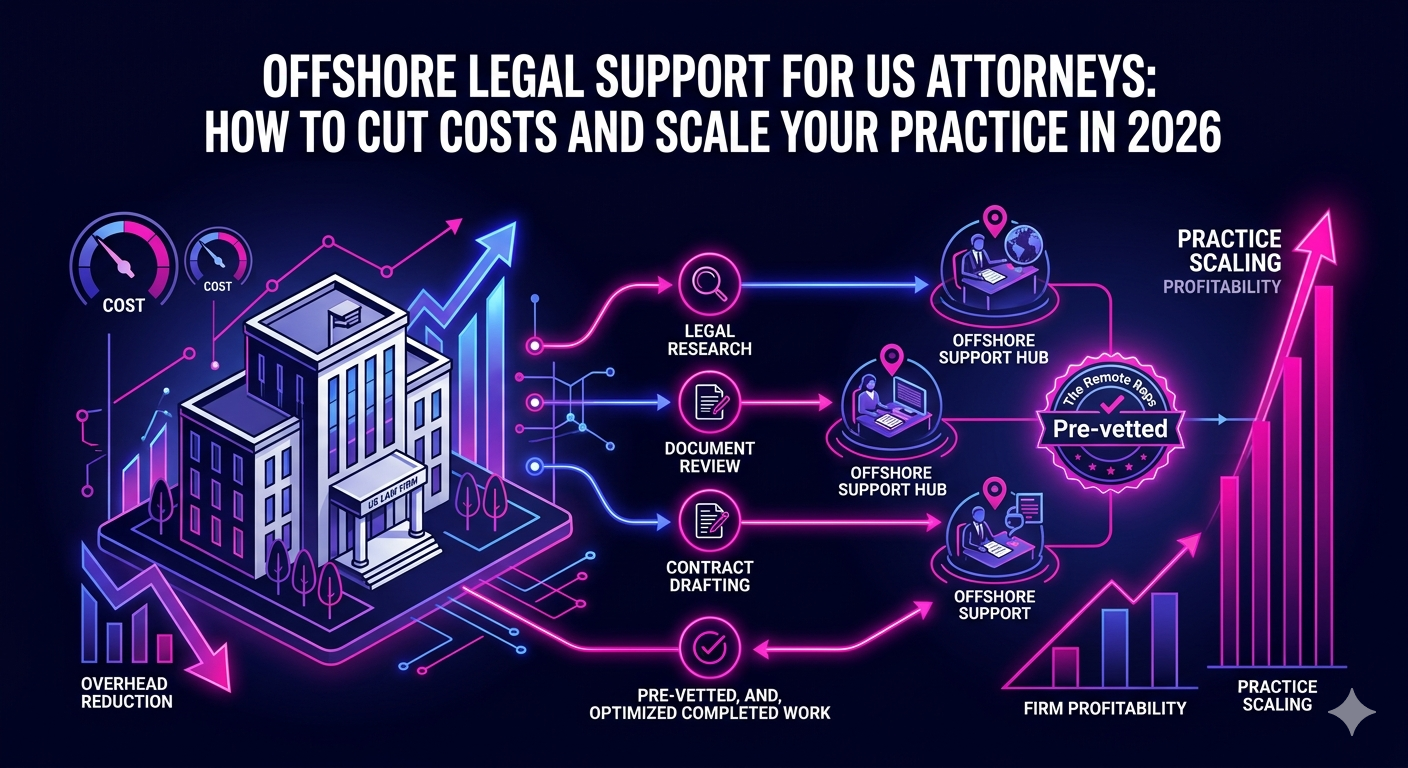
American law firms are under more pressure than ever to deliver high-quality legal work at competitive rates. Associate salaries, overhead costs, and billing rate sensitivity have created a squeeze that affects firms of every size. One of the most effective responses to this challenge is building a model around offshore legal support for US attorneys. Done correctly, it reduces operating costs significantly while maintaining the quality standards your clients expect.
This guide explains what offshore legal support covers, how to evaluate providers, what compliance considerations to keep in mind, and how to find the right talent to support your US-based practice in 2026.
What Is Offshore Legal Support for US Attorneys?
Offshore legal support refers to legal and administrative work performed by qualified professionals located outside the United States on behalf of US law firms and attorneys. These professionals are typically based in countries with strong English-language proficiency, established legal education systems, and significant experience supporting US legal work.
Common Tasks Handled by Offshore Legal Support Teams
- Legal research using US case law databases such as Westlaw and LexisNexis
- Document review and e-discovery support for litigation matters
- Contract drafting, review, and redlining for corporate and transactional work
- Preparation of legal memoranda and case summaries
- Due diligence research for mergers, acquisitions, and real estate transactions
- Drafting pleadings, motions, and discovery responses under attorney supervision
- Legal billing support, time entry review, and invoice preparation
- Client intake coordination and case management administration
- Intellectual property research and trademark monitoring
The scope of offshore legal support continues to expand as communication tools and cloud-based legal platforms make geographic distance almost irrelevant to day-to-day workflow collaboration.
Why US Attorneys Are Turning to Offshore Legal Support in 2026
The financial case for offshore legal support for US attorneys has never been stronger. Skilled legal professionals in countries such as the Philippines, India, and South Africa can deliver quality work at hourly rates that represent a fraction of comparable US-based costs. But cost is only part of the equation.
Significant Cost Reduction Without Sacrificing Quality
A US-based associate attorney costs between $120,000 and $200,000 per year in salary alone before benefits, malpractice insurance, and overhead. Even a skilled US paralegal or legal assistant runs $45,000 to $65,000 annually with benefits. Offshore legal support professionals performing comparable work can often be engaged at $15 to $40 per hour, producing annual savings that can easily exceed $50,000 to $100,000 per role when all costs are tallied.
For small and mid-size firms operating on thin margins, these savings can be reinvested into client development, technology, or simply improving partner profitability.
Access to a Larger and More Specialized Talent Pool
Hiring locally limits your options to candidates within a reasonable commute or willing to relocate. Offshore hiring opens access to legal professionals with specific subject matter expertise in areas such as US patent law, securities regulations, real estate transactions, or immigration, regardless of where they are located. This depth of specialization is hard to source in smaller US markets.
Extended Operational Hours
Time zone differences that might seem like a disadvantage can actually work in your favor. When your offshore legal support team is working while your US office is closed, research is completed overnight, documents are ready for attorney review first thing in the morning, and client deadlines become much easier to meet. For litigation practices with unpredictable workloads, this coverage can be a genuine competitive advantage.
Scalability Without Long-Term Commitments
Offshore legal support arrangements are typically more flexible than in-house hiring. You can scale hours up during busy trial preparation periods and reduce them during slower stretches without the complexity and cost of layoffs. This flexibility allows your firm to stay lean while meeting demand surges.
Key Compliance and Ethical Considerations for US Attorneys
Before engaging offshore legal support, US attorneys have a professional responsibility to understand the ethical framework governing these arrangements. The good news is that most state bar authorities have addressed this issue and permit offshore outsourcing under defined conditions.
Supervision Obligations
ABA Model Rules 5.1 and 5.3 require supervising attorneys to ensure that the work of non-attorney staff complies with the Rules of Professional Conduct. This obligation does not disappear when the support staff is located overseas. You must maintain active supervision over all offshore legal work product and review it before it is used or submitted.
Client Confidentiality and Data Security
Model Rule 1.6 requires attorneys to make reasonable efforts to prevent the unauthorized disclosure of client information. When using offshore legal support, this means implementing data security protocols such as encrypted file sharing, secure communication channels, non-disclosure agreements with all offshore staff, and access controls that limit data exposure to only what is necessary for each task.
Disclosure to Clients
Some state bars require or recommend disclosure to clients when legal work is being outsourced. Even where not strictly required, transparency with clients about how their matters are staffed is a best practice that builds trust and avoids potential disputes. Review your specific state bar guidance before structuring any offshore engagement.
For a thorough review of the professional responsibility framework applicable to offshore legal support for US attorneys, the American Bar Association’s professional responsibility resources provide detailed guidance on outsourcing obligations under the Model Rules.
How to Find and Vet Offshore Legal Support for Your US Practice
The quality of offshore legal support varies widely. A rigorous sourcing and screening process is essential to finding professionals who can meet the standards your practice demands.
Work with a Specialized Legal Staffing Service
General freelance platforms give you volume but not reliability. A specialized legal staffing provider pre-screens candidates for legal knowledge, English proficiency, US legal system familiarity, and confidentiality awareness. This dramatically reduces your time investment and the risk of placing someone who cannot handle the demands of US legal work.
The Remote Reps connects US law firms with experienced, vetted offshore legal support professionals who understand the specific workflows, deadlines, and standards that US attorneys require. Their team handles sourcing and initial screening so you receive candidates who are ready to contribute from the start.
Assess English Writing Proficiency Rigorously
Legal writing demands precision. A candidate’s ability to communicate clearly in written English is not optional. Ask shortlisted candidates to complete a writing sample such as a legal research memo or a contract summary. Review it for clarity, grammar, structure, and accuracy before proceeding to further interviews.
Test Familiarity with US Legal Research Tools
Offshore legal professionals who have worked with US firms should be comfortable navigating Westlaw, LexisNexis, CourtListener, or PACER depending on the role. Give candidates a research task using one of these platforms and evaluate the quality and organization of their output.
Verify Prior US Legal Experience
A candidate who has previously supported US attorneys will have a much shorter ramp-up time than one coming from a different legal system. Ask specifically about prior US clients, types of matters supported, and how they handled supervision and quality review processes.
Building an Effective Working Relationship with Offshore Legal Support
Placing the right person is only half the job. Structuring the working relationship for success is equally important.
Provide Detailed Task Instructions
Ambiguous instructions produce inconsistent output. Every task assigned to offshore support should include a clear objective, relevant context, the preferred format for the deliverable, the deadline, and any sources or precedents to reference. The more specific your instructions, the more closely the output will match your expectations.
Establish a Daily or Weekly Check-In Rhythm
Regular communication prevents small misunderstandings from growing into costly errors. A brief daily status update via email and a weekly video call to review work in progress and upcoming priorities keeps offshore legal support professionals aligned with your firm’s needs and workload.
Use Secure Cloud-Based Collaboration Tools
Platforms such as Clio, NetDocuments, or SharePoint combined with encrypted communication tools create a secure and organized working environment that makes remote collaboration practical. Avoid relying on personal email accounts for transmitting any client-related materials.
Complementary Remote Roles That Pair Well with Offshore Legal Support
Many US firms that begin with offshore legal research or document support expand their remote team over time to cover a broader range of needs. Roles that complement offshore legal support include:
- Remote paralegals for substantive case preparation and discovery management
- Remote legal secretaries for court filings, scheduling, and attorney correspondence
- Remote virtual assistants for administrative support and client intake management
A well-structured remote legal team allows US attorneys to operate with significant leverage, completing more matters per attorney without proportionally increasing headcount or overhead.
Conclusion: Build a Smarter Practice with Offshore Legal Support
Offshore legal support for US attorneys is no longer a workaround for budget-constrained solo practitioners. It is a deliberate operational strategy used by forward-thinking firms of every size to reduce costs, access specialized talent, and deliver faster turnaround on legal work product. The compliance framework is clear, the talent pool is deep, and the tools to manage remote teams are mature.
If you are ready to explore how offshore legal support can work for your US practice, connect with the team at The Remote Reps and find vetted offshore legal support professionals who are ready to integrate into your workflow today.
Frequently Asked Questions
Is offshore legal support for US attorneys ethically permissible?
Yes, offshore legal support for US attorneys is ethically permissible under the ABA Model Rules and most state bar guidelines, provided the supervising attorney maintains active oversight of all work product, implements appropriate data security measures, and complies with any applicable disclosure requirements. Attorneys should review their specific state bar’s guidance on legal outsourcing before engaging offshore support.
What types of tasks can be handled through offshore legal support for US attorneys?
Offshore legal support for US attorneys can cover a wide range of tasks including legal research, document review, contract drafting, due diligence, preparation of legal memoranda, e-discovery support, case management administration, billing support, and intellectual property research. The supervising attorney must review and take responsibility for all work product before it is used or submitted.
How much can US attorneys save by using offshore legal support?
US attorneys can save substantially by using offshore legal support. Offshore legal professionals performing work comparable to US paralegals or junior associates typically charge $15 to $40 per hour, compared to $45,000 to $200,000 or more annually for equivalent in-house staff. Firms that engage offshore support for high-volume tasks such as document review or legal research frequently report annual savings exceeding $50,000 per role after all costs are considered.
How do US attorneys protect client confidentiality when using offshore legal support?
US attorneys can protect client confidentiality when using offshore legal support by requiring all offshore staff to sign non-disclosure agreements, using encrypted file-sharing platforms and secure communication tools, implementing access controls that limit data exposure to only what is necessary for each assignment, and conducting periodic security reviews of their offshore workflows. These practices align with the reasonable care standard required under ABA Model Rule 1.6.
What should US attorneys look for when hiring offshore legal support professionals?
When hiring offshore legal support for US attorneys, prioritize candidates with demonstrated experience supporting US legal matters, strong English writing ability, familiarity with US legal research platforms, a clear understanding of confidentiality obligations, and verifiable references from prior US law firm clients. Working with a specialized legal staffing service that pre-screens candidates against these criteria significantly reduces the risk of a poor hire.
Can offshore legal support for US attorneys handle time-sensitive matters?
Yes, offshore legal support for US attorneys can handle time-sensitive matters effectively, particularly when time zone differences are leveraged strategically. Offshore teams working while your US office is closed can complete research, draft documents, or review materials overnight so work is ready for attorney review first thing in the morning. Clear instructions, deadline tracking tools, and established communication protocols are essential for managing urgent assignments reliably.