What if you could build a high-performing team at a fraction of what you are currently spending? Thousands of businesses in 2026 are doing exactly that. They save 70 percent on hiring with remote staff by replacing expensive local recruitment with a smarter, leaner model that delivers equal or better results. This guide explains exactly how that is possible and how your business can do the same.
The shift is not just about cutting costs. It is about gaining access to a wider talent pool, reducing time-to-hire, and building a more flexible workforce that scales with your business rather than holding it back.
Why Businesses Are Choosing to Cut Hiring Costs With Remote Staff
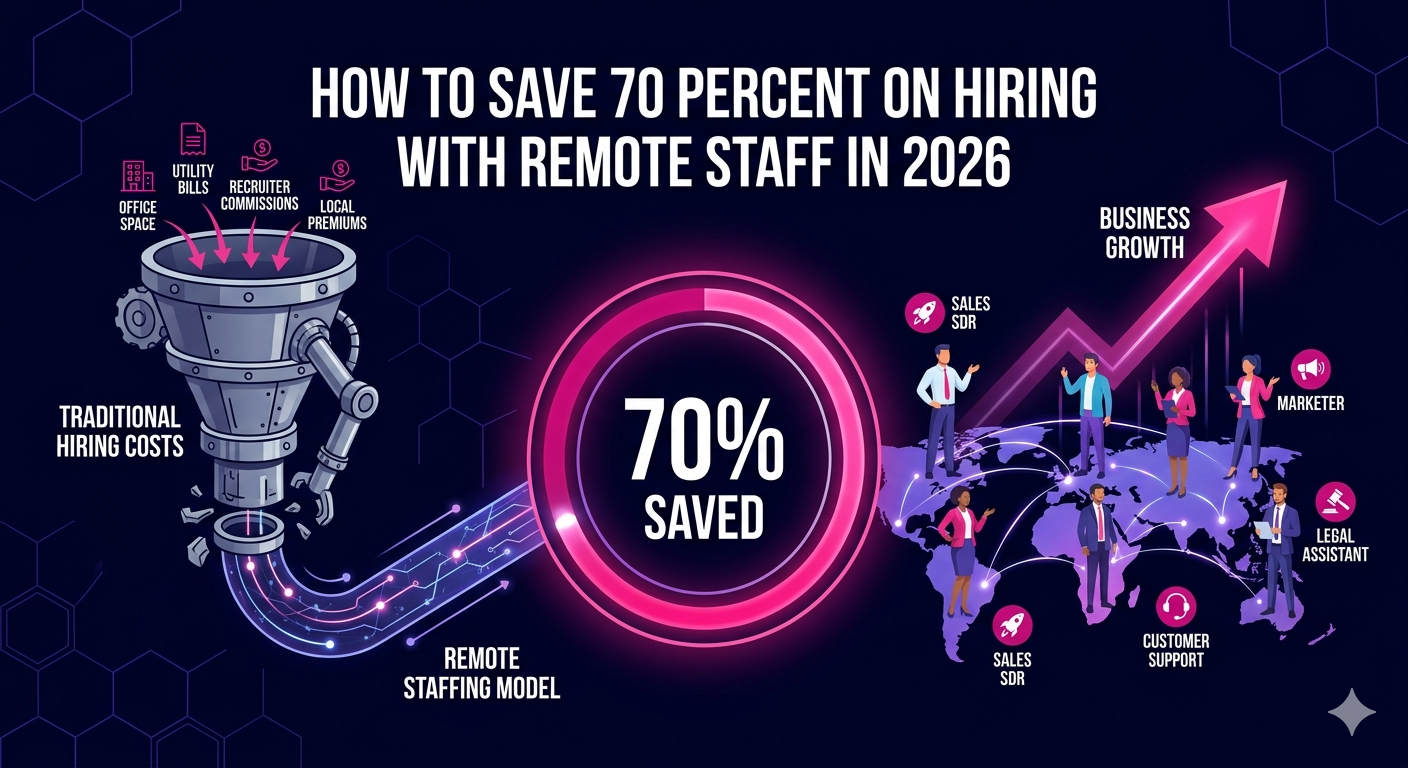
The traditional hiring model carries enormous hidden expenses that most business owners do not fully account for. When you add up job board advertising, recruiter fees, onboarding costs, office space, equipment, payroll taxes, and benefits, the true cost of a single in-office hire can easily reach $15,000 to $25,000 or more before that person contributes a single dollar in output.
Remote staffing removes or dramatically reduces almost every one of these costs. That is why companies that make the switch consistently report savings of 50 to 70 percent per hire, and in many cases even more.
The Real Numbers Behind Remote Hiring Savings
To understand why it is possible to save 70 percent on hiring with remote staff, consider what you are actually eliminating:
- Office and facilities costs: No desk, no utilities, no office lease allocation per head.
- Local salary premiums: Remote professionals in skilled global markets often earn strong incomes at rates that are significantly lower than equivalent roles in the United States, Canada, or Western Europe.
- Recruiter commissions: Traditional recruiters charge 15 to 30 percent of a hire’s annual salary. Remote staffing platforms operate on leaner, more transparent fee structures.
- Benefits and perks: Remote arrangements often involve different benefit structures that reduce the employer’s cost burden.
- Reduced turnover costs: Remote workers report higher job satisfaction on average, which lowers attrition and the cost of re-hiring.
Which Roles Can Help You Reduce Hiring Costs by 70 Percent
One of the most common misconceptions about remote staffing is that it only applies to basic administrative tasks. In reality, businesses in 2026 are filling highly specialized, revenue-generating roles remotely and achieving the same substantial cost reductions.
Sales and Lead Generation
Sales development representatives, cold email experts, and lead generation professionals are among the most impactful remote hires a business can make. These roles directly influence revenue, and hiring them remotely means you get the same pipeline-building output at a dramatically lower cost per seat. Explore remote lead generation experts who help businesses cut costs and grow revenue without the overhead of a local sales hire.
Digital Marketing and SEO
Content writers, SEO specialists, PPC managers, social media managers, and media buyers are all roles that operate entirely online. There is no practical reason to hire these professionals locally, and doing so adds significant unnecessary cost. Remote marketing hires in this category regularly deliver full-time output at part-time local rates.
Customer Support
Customer support is one of the most cost-sensitive departments in any business. Remote customer support professionals handle live chat, email, and phone support across multiple time zones, often at 50 to 70 percent of the cost of equivalent local staff.
Legal and Administrative Support
Legal assistants, paralegals, executive assistants, and virtual assistants are filling remote roles across law firms, financial services companies, and corporate teams in 2026. The cost savings in this category are substantial, with many businesses reporting per-hire savings well above the 70 percent benchmark.
A Step-by-Step Approach to Saving 70 Percent on Hiring
Achieving maximum savings on remote hiring is not accidental. It requires a clear process and the right partner. Here is how to do it systematically.
Step 1: Audit Your Current Hiring Costs
Start by calculating your true all-in cost per hire for each role you regularly fill. Include base salary, benefits, taxes, office allocation, equipment, and recruitment fees. This number will become your baseline for measuring savings once you shift to remote staffing.
Step 2: Identify Roles That Can Transition to Remote
Not every role needs to be in-office. Review your open positions and existing team structure to identify which functions can be performed remotely without any reduction in quality or output. In most businesses, this list is longer than expected.
Step 3: Partner With a Specialized Remote Staffing Platform
General job boards are not optimized for remote hiring. A specialized platform that pre-vets candidates, tests for communication skills, and matches talent to specific role requirements will deliver far better results in far less time. This is where you capture the majority of your savings while also reducing risk.
Step 4: Define Clear Expectations and KPIs
To get the most out of a remote hire, define success upfront. Set measurable key performance indicators, establish communication norms, and document the tools and workflows the hire will use. The clearer your expectations, the faster your remote staff becomes productive.
Step 5: Measure Savings and Scale
After your first remote hire, calculate the actual savings against your baseline. Most businesses are surprised by how quickly the numbers confirm the potential to save 70 percent on hiring with remote staff. Use that data to build a case for scaling the model across additional departments.
Common Concerns About Remote Hiring and Why They Should Not Hold You Back
Despite the clear financial case, some business owners hesitate to make the shift. Here are the most common concerns and why they are less of a barrier than they appear.
Will Communication Be a Problem?
Communication challenges are manageable with the right tools and expectations. The best remote staffing platforms specifically screen for English proficiency and communication skills, ensuring that the professionals placed with your team can collaborate effectively from day one.
Will I Get the Same Quality of Work?
Quality depends on the vetting process of the platform you use, not on where the professional is located. Pre-vetted remote candidates who have been tested for their specific skill sets consistently perform at the same level as local hires in comparable roles.
What If the Hire Does Not Work Out?
Reputable remote staffing platforms include replacement guarantees. If a placement does not meet expectations within a specified period, the agency will find a replacement at no additional cost. This significantly reduces the risk associated with any individual hire.
According to data shared by Business News Daily on remote work productivity and cost savings, remote workers are consistently as productive as or more productive than their in-office counterparts, reinforcing the case that businesses can save 70 percent on hiring with remote staff without sacrificing output.
Why TheRemoteReps Is Built to Help You Save on Hiring
TheRemoteReps was founded specifically to give businesses access to pre-vetted, highly skilled remote professionals across sales, marketing, customer support, legal, and administrative roles. Every candidate goes through a rigorous screening process before being presented to a client, which means you spend less time filtering and more time growing.
The platform’s pricing model is transparent, the talent pool is deep, and the track record of delivering savings is documented. If you want to see how other companies have achieved real results, read the client success stories from businesses that used remote staffing to dramatically reduce hiring costs.
Conclusion: Start Saving on Hiring Costs Today
The ability to save 70 percent on hiring with remote staff is not a promise reserved for large enterprises with big budgets and dedicated HR teams. It is a practical, repeatable strategy that businesses of every size are executing right now in 2026.
The savings are real, the talent is available, and the process is simpler than most people expect. The only thing standing between your business and significantly lower hiring costs is the decision to start. Visit TheRemoteReps to explore your options and take the first step toward building a leaner, more capable team.
Frequently Asked Questions
Is it really possible to save 70 percent on hiring with remote staff?
Yes. Many businesses genuinely save 70 percent on hiring with remote staff when they account for the full cost of traditional in-office hiring. The savings come from eliminating office overhead, reducing or removing local salary premiums, avoiding high recruiter commissions, and lowering benefit costs. When all of these factors are combined, total savings of 50 to 70 percent per hire are a consistent and well-documented outcome for companies that make the transition.
What types of roles allow you to save 70 percent on hiring with remote staff?
A wide range of roles qualify. Businesses most commonly save 70 percent on hiring with remote staff in sales, lead generation, digital marketing, SEO, PPC, social media management, customer support, virtual assistance, executive assistance, legal support, and content creation. As remote work infrastructure has matured through 2026, the list of viable remote roles has expanded to include almost every non-physical business function.
How do I find quality candidates when trying to save 70 percent on hiring with remote staff?
The key is partnering with a specialized remote staffing platform rather than relying on general job boards. Platforms that pre-screen and test candidates for skills, communication ability, and remote work readiness dramatically reduce your risk and improve hire quality. This is how businesses consistently save 70 percent on hiring with remote staff without compromising on the talent they bring on board.
How long does it take to start seeing savings when hiring remote staff?
Most businesses begin to save 70 percent on hiring with remote staff from the very first placement. The cost difference between a remote hire and an equivalent local hire is immediate and visible in the first invoice or payroll cycle. Over time, as more roles transition to a remote model, the cumulative savings compound and become a significant competitive advantage for the business.
Are there risks involved when trying to save 70 percent on hiring with remote staff?
Like any hiring decision, there are risks, but they are manageable. The most effective way to reduce risk when trying to save 70 percent on hiring with remote staff is to use a platform that offers pre-vetted candidates and replacement guarantees. Clearly defined onboarding processes, measurable KPIs, and consistent communication practices also significantly reduce the likelihood of a placement not working out as expected.