
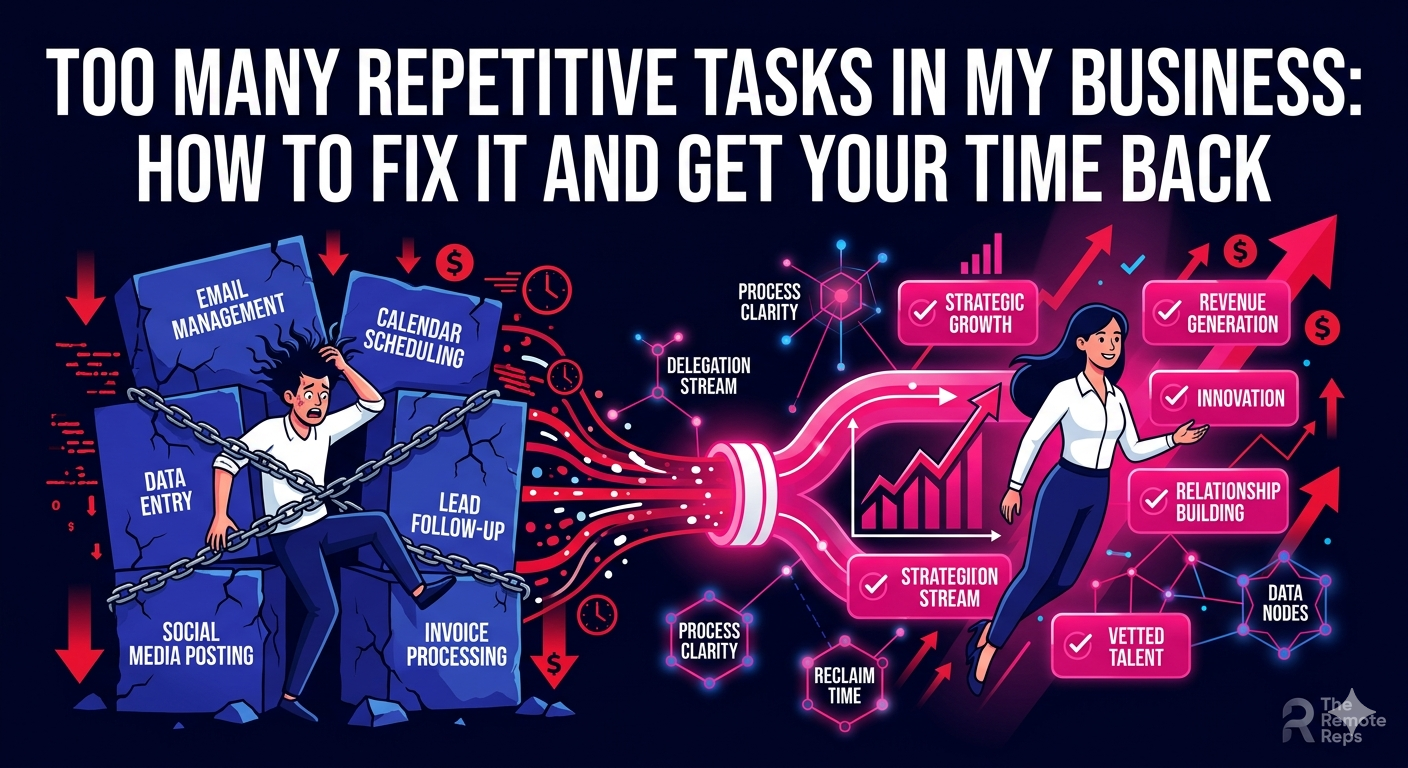
If you have ever caught yourself thinking “there are too many repetitive tasks in my business and I cannot keep doing this,” you are dealing with one of the most common and costly problems entrepreneurs face in 2026. Repetitive, low-value tasks quietly drain hours from your week, pull your focus away from strategy, and create a ceiling on how fast your business can grow. The solution is not working harder. It is working smarter by delegating effectively.
This guide breaks down why repetitive task overload happens, which tasks you should stop doing yourself, and the most practical ways to eliminate this bottleneck for good.
Why Too Many Repetitive Tasks Are Killing Your Business Growth
Repetitive tasks are tasks that follow the same process every time they are completed. Sending follow-up emails, updating spreadsheets, posting on social media, processing invoices, managing customer inquiries, and scheduling meetings all fall into this category. Individually, each one seems harmless. Collectively, they are devastating to your productivity.
Research from productivity studies published in early 2026 shows that business owners who spend more than 30 percent of their working hours on repetitive operational tasks grow at roughly half the rate of those who successfully delegate those functions. The reason is simple: when your day is packed with recurring low-skill work, you have no bandwidth left for sales, innovation, relationship building, or the strategic decisions that actually move the needle.
Signs You Have Too Many Repetitive Tasks Weighing You Down
- You are doing the same tasks at the same time every single day or week
- You feel busy constantly but your business is not moving forward
- You have not had uninterrupted time to work on strategy in weeks
- Simple tasks take longer than they should because your attention is scattered
- You are handling tasks that anyone with basic training could do
- You dread certain parts of your workday because they feel monotonous
If several of these resonate, you have already identified the problem. Now it is time to fix it.
The Most Common Repetitive Tasks Business Owners Should Stop Doing Themselves
One of the first steps to solving the “too many repetitive tasks in my business” problem is categorizing exactly which tasks are consuming your time. Below are the most frequent offenders.
Administrative and Operational Tasks
- Managing and responding to routine emails
- Scheduling meetings and updating calendars
- Data entry and spreadsheet updates
- Invoice generation and payment follow-ups
- File organization and document formatting
- Vendor coordination and order tracking
Marketing and Content Tasks
- Posting and scheduling social media content
- Uploading blog posts and updating website content
- Monitoring ad campaigns and pulling performance reports
- Sending newsletters and email sequences
- Responding to comments and messages on social platforms
Sales and Customer-Facing Tasks
- Following up with leads who have not responded
- Answering the same customer questions repeatedly
- Processing refund or return requests
- Qualifying inbound inquiries before booking calls
- Updating CRM records after every interaction
Every item on these lists represents time you could redirect toward higher-value work. And every single one of them can be handled by a skilled remote professional.
How to Actually Eliminate Repetitive Tasks From Your Business
There are two main approaches to reducing repetitive task load: delegation and automation. In 2026, the most effective businesses use both. Here is how to apply each strategically.
Delegation: Hand Off Tasks to a Skilled Remote Professional
Delegation is the fastest way to remove repetitive tasks from your plate. Instead of automating a process, you hand it to a trained professional who can handle it reliably, adapt when things change, and bring judgment to situations that require a human touch.
A virtual assistant is the most versatile hire for eliminating repetitive business tasks. A good VA can take ownership of your inbox, calendar, data management, research tasks, content coordination, and more. Within days of onboarding, you can reclaim hours every week that were previously consumed by routine work.
If you are ready to stop saying “there are too many repetitive tasks in my business,” explore the dedicated virtual assistant services at The Remote Reps and get matched with a professional who can step in and take over immediately.
Automation: Use Technology to Handle Truly Mechanical Processes
Automation works best for tasks that are 100 percent predictable and require zero judgment. Examples include sending a welcome email when someone subscribes to your list, moving a lead to a new CRM stage when they book a call, or generating a weekly report from existing data.
Tools like Zapier, Make, and native CRM workflows can handle these processes without human intervention. However, automation is not a replacement for delegation. When a task involves variability, client communication, or nuanced decision-making, a trained professional will always outperform a workflow trigger.
The Delegation Plus Automation Combination
The businesses scaling fastest in 2026 use a combined approach. They automate the purely mechanical steps and delegate everything else that requires consistency, communication, or contextual judgment. This hybrid model eliminates the maximum amount of repetitive work while maintaining quality and flexibility.
Building a Delegation System That Actually Works
Many business owners try to delegate, hit a bump in the handoff process, and conclude that it is easier to do things themselves. That conclusion is almost always wrong. The problem is usually not with delegation as a concept but with the system around it. Here is how to build one that works.
Document Before You Delegate
Before handing off any repetitive task, write out the steps involved. Even a rough bullet-point process note is enough to get someone started. You do not need a perfect manual, just enough context for a capable professional to ask the right follow-up questions and take ownership quickly.
Start With Your Highest-Volume Repetitive Tasks
Identify the three to five tasks that consume the most time each week. Delegate those first. Do not try to hand off everything at once. Start narrow, build trust and process clarity, then expand the scope of what your remote professional handles over the following weeks.
Set Clear Expectations and a Review Cadence
Define what good looks like for each task. Agree on turnaround times, output quality standards, and how your remote professional should flag exceptions or unusual situations. Weekly check-ins in the early stages help you course-correct quickly and build alignment.
Use the Right Tools to Stay Aligned Remotely
Project management and communication tools make remote delegation seamless. Platforms like Asana, Trello, Notion, or ClickUp keep tasks organized and visible. Slack or a similar messaging tool keeps communication quick and structured without relying on email chains.
You can also read what business owners experienced after delegating repetitive tasks to remote professionals through The Remote Reps.
Choosing the Right Remote Professional for Your Repetitive Task Workload
Not every repetitive task problem calls for the same solution. Here is a quick guide to matching your most common task types to the right remote professional.
- Admin and scheduling overload: Virtual assistant or executive assistant
- Social media posting and community management: Social media manager
- Lead follow-up and outreach: Sales development representative or cold email expert
- Customer inquiry management: Customer support expert
- Ad monitoring and reporting: PPC expert or media buyer
- SEO content and website updates: SEO specialist or digital marketer
For context on how businesses are rethinking task delegation in 2026, Harvard Business Review’s analysis on the cost of not delegating repetitive work outlines the direct relationship between delegation habits and business performance at every stage of growth.
Stop Letting Repetitive Tasks Slow Down Your Business
Having too many repetitive tasks in your business is not a permanent condition. It is a solvable problem, and the solution is available to you right now. By identifying the tasks consuming your time, delegating them to trained remote professionals, and putting the right tools and systems in place, you can reclaim your schedule and redirect your energy toward the work that grows your business.
Visit The Remote Reps to explore the full range of remote professionals ready to take repetitive work off your plate, from virtual assistants and customer support experts to sales reps and marketing specialists.
Frequently Asked Questions
How do I know if I have too many repetitive tasks in my business?
A clear sign is when you regularly spend more than two to three hours a day on tasks that follow the exact same process every time. If you feel consistently busy but your business is not progressing, too many repetitive tasks are likely consuming the time you should be spending on growth-focused work.
What is the fastest way to reduce too many repetitive tasks in my business?
The fastest solution is to hire a virtual assistant who can take ownership of your most time-consuming recurring tasks immediately. A skilled VA can be onboarded in two to five days and productive within the first week, delivering near-instant relief from admin and operational overload.
Can automation fully solve the problem of too many repetitive tasks in my business?
Automation can handle tasks that are entirely predictable and require no judgment, such as automated email sequences or CRM status updates. However, most repetitive business tasks involve some level of variability or communication, which means a trained human professional will deliver more reliable results than automation alone.
Which repetitive tasks should I delegate first when trying to free up time in my business?
Start with the tasks that take the most time and require the least specialized expertise. Email management, calendar scheduling, data entry, and routine customer follow-ups are ideal first delegations. These tasks are easy to document, simple to hand off, and immediately free up significant hours each week.
How much does it cost to get help with too many repetitive tasks in my business?
The cost depends on the type and volume of tasks involved. A remote virtual assistant typically costs far less than a full-time in-house employee because there are no benefits, payroll taxes, or equipment costs. Most businesses find that even 10 to 20 hours of remote support per week generates a strong return by restoring the owner’s time for higher-value activity.
Will delegating repetitive tasks affect the quality of work in my business?
When you work with vetted, experienced remote professionals, quality typically improves rather than declines. Specialists who focus exclusively on specific task types, such as customer support or social media management, bring a higher level of consistency and skill than a business owner who is handling those tasks reluctantly alongside dozens of other responsibilities.