
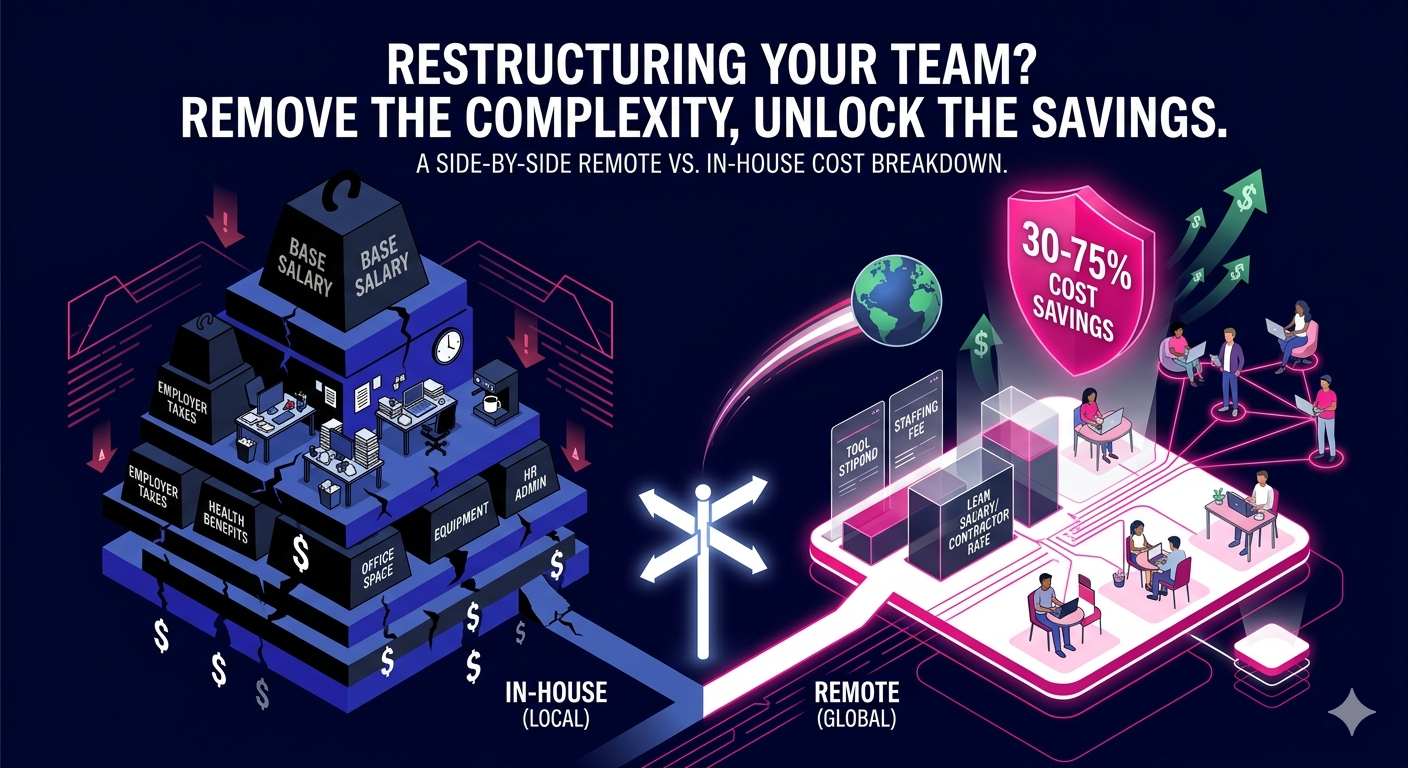
If you are weighing your hiring options, a thorough remote employee cost comparison is one of the most important exercises you can do before committing to a strategy. In 2026, the cost gap between remote and in-house employees has never been more visible, and the numbers consistently favor businesses that hire smart remote talent over building costly local teams.
This guide walks you through a complete breakdown of what remote employees actually cost, how those figures compare to traditional in-house hiring, and what factors you need to account for in your own planning.
Why a Remote Employee Cost Comparison Matters More Than Ever in 2026
The global workforce has shifted dramatically. Inflation, rising commercial real estate costs, and increased salary expectations in major cities have pushed the true cost of local hiring to new highs. Meanwhile, remote hiring platforms have matured, making it easier than ever to find, vet, and manage skilled professionals across time zones.
For any business making staffing decisions today, skipping the remote employee cost comparison is leaving serious money on the table. The difference between the two models can easily reach five figures per employee per year.
The True Cost of an In-House Employee in 2026
Most employers significantly underestimate what an in-house employee actually costs. The base salary is just the starting point. Here is a full picture of what a US-based in-house hire typically runs:
Direct Costs
- Base salary (mid-level role): $50,000 to $85,000 per year
- Employer payroll taxes (FICA, FUTA, SUTA): 7.65% to 12% on top of salary
- Health insurance contribution: $6,000 to $14,000 per year per employee
- Paid time off and sick leave: Equivalent to 10 to 20 days of salary per year
- 401(k) or retirement matching: 3% to 6% of salary on average
Indirect and Overhead Costs
- Office space: $8,000 to $20,000 per employee per year in most US cities
- Equipment (computer, monitors, peripherals): $1,500 to $4,000 upfront
- Software licenses and tools: $500 to $2,500 per year
- Onboarding and training: $1,200 to $4,000 per hire
- HR administration and recruiting fees: $3,000 to $8,000 per hire
When you add all of this up, a mid-level in-house employee in the US costs between $80,000 and $130,000 per year in total. That number often shocks hiring managers who were only thinking about the salary line.
The True Cost of a Remote Employee in 2026
Now let us run the same cost comparison for a remote employee. The structure is leaner, and the savings become obvious quickly.
Remote Employee Direct Costs
- Remote salary or contractor rate (Latin America or Eastern Europe): $18,000 to $40,000 per year
- Remote salary or contractor rate (South or Southeast Asia): $10,000 to $28,000 per year
- Remote salary or contractor rate (US-based remote): $45,000 to $80,000 per year
Remote Employee Overhead Costs
- No office space required: $0
- Reduced or eliminated employer tax obligations (contractor model): $0 to minimal
- Home office stipend (optional): $500 to $1,500 one-time
- Software and communication tools: $300 to $1,200 per year
- Platform or staffing fee (if using a remote hiring platform): $1,500 to $5,000 per year
The all-in cost for a skilled remote professional hired through an established platform typically falls between $14,000 and $45,000 per year for offshore roles, and $48,000 to $85,000 for US-based remote workers. Even in the highest-cost remote scenario, you eliminate office, benefits, and payroll tax overhead.
Remote Employee Cost Comparison: Side by Side
Here is how the numbers look in a direct head-to-head comparison for a mid-level professional role:
In-House vs. Offshore Remote vs. US-Based Remote
- In-house (US, full-time): $80,000 to $130,000 per year total cost
- Remote (Latin America or Eastern Europe): $20,000 to $45,000 per year total cost
- Remote (South or Southeast Asia): $12,000 to $32,000 per year total cost
- Remote (US-based, no office): $50,000 to $90,000 per year total cost
The potential savings range from 30 percent for a US-based remote setup to more than 75 percent for a highly skilled offshore team. Even accounting for management time, communication tools, and occasional travel, the remote model delivers a compelling return.
To explore dedicated remote professionals for your business, review the full range of roles available at The Remote Reps virtual assistant and remote staffing services, where pre-vetted talent is matched to your exact business needs.
Roles Where Remote Hiring Delivers the Highest Cost Savings
Not every role delivers the same savings when you make the switch. Here are the positions where the remote employee cost comparison tends to favor remote hiring most strongly:
Sales and Lead Generation
SDRs, cold email specialists, and lead generation professionals can be hired remotely at a fraction of US market rates while still delivering strong pipeline results. A US-based SDR can cost $65,000 to $90,000 all-in. A skilled remote SDR from Latin America may cost $20,000 to $35,000, with comparable performance when properly managed.
Digital Marketing and SEO
Content writers, SEO specialists, social media managers, and PPC experts are highly abundant in global remote talent pools. Businesses routinely save 50 to 65 percent by hiring remote marketing professionals versus local equivalents.
Customer Support
Customer support is one of the most commonly outsourced functions because the savings are immediate and measurable. A remote support agent covering chat, email, and phone can cost as little as $14,000 to $22,000 per year compared to $45,000 to $60,000 for a local equivalent.
Executive and Legal Assistance
Remote executive assistants and legal support professionals, including paralegals and legal secretaries, are increasingly in demand. Businesses save significantly by hiring remote professionals for these roles without sacrificing quality or confidentiality standards.
Factors That Influence Your Remote Employee Cost Comparison
Your actual savings will depend on several variables. Keep these in mind when running your own numbers:
- Role complexity: Highly specialized roles may require higher rates even remotely, narrowing the gap with local hires.
- Management overhead: Remote teams require thoughtful management. Factor in time spent on onboarding, communication, and performance tracking.
- Time zone alignment: Overlapping working hours reduce friction. Teams in Latin America and Eastern Europe tend to have the most overlap with US and European businesses.
- Turnover rates: Remote talent hired through quality platforms often shows stronger retention than BPO-style arrangements, reducing rehiring and retraining costs.
- Legal and compliance costs: If you are hiring internationally as full-time employees rather than contractors, you may need an Employer of Record (EOR) service, which typically costs $300 to $600 per employee per month.
How to Maximize Your Remote Hiring ROI
Getting the most out of your remote employee investment comes down to process. Here are the steps that consistently deliver the best results:
- Define the role clearly before posting. Vague job descriptions attract mismatched candidates and waste time.
- Use structured onboarding that covers your tools, processes, expectations, and communication norms from day one.
- Set measurable KPIs and review them consistently. Remote workers perform best when accountability is baked into the process.
- Invest in the right tools: project management software, communication platforms, and time tracking if needed.
- Work with a reputable remote staffing platform that pre-vets talent rather than sourcing cold from freelancer marketplaces.
Research from Global Workplace Analytics on remote work cost savings shows that employers save an average of $11,000 per remote worker per year in reduced real estate and overhead alone, before accounting for any salary differences.
Making the Decision: Is Remote Hiring Right for Your Business?
For the vast majority of growing businesses in 2026, the remote employee cost comparison points clearly in one direction. The savings are real, the talent is available, and the tools to manage distributed teams have never been better.
Whether you need sales development reps, digital marketers, customer support agents, executive assistants, or legal support, a well-structured remote hiring strategy will almost always outperform a purely in-house approach on a cost-per-output basis.
Start by auditing your current team for roles that do not require a physical presence. For most knowledge-work and service-based roles, remote hiring is not just a cost-saving measure. It is a competitive advantage.
Frequently Asked Questions About Remote Employee Cost Comparison
What does a remote employee cost comparison typically show for US businesses?
For most US businesses, a remote employee cost comparison reveals savings of 30 to 75 percent compared to hiring locally, depending on the role and the location of the remote worker. The biggest savings come from eliminating office space, employer taxes, and benefits costs, especially when hiring talent from Latin America, Eastern Europe, or Southeast Asia.
Does a remote employee cost comparison account for management and tool expenses?
Yes, a thorough remote employee cost comparison should include the cost of communication and project management tools, any staffing platform fees, and the time investment for onboarding and management. Even after these additions, remote hiring typically delivers significant net savings over in-house headcount.
Which roles show the biggest cost difference in a remote employee cost comparison?
Roles like customer support, digital marketing, lead generation, executive assistance, and legal support tend to show the largest cost differences in a remote employee cost comparison. These are functions where strong talent is globally distributed and where the work does not require a physical office presence.
Is quality compromised when you choose a lower-cost remote employee based on cost comparison alone?
Quality does not have to suffer in a remote employee cost comparison if you hire through a reputable platform that vets candidates rigorously. The key is to evaluate skills, communication, and work history carefully rather than selecting on price alone. Platforms that specialize in pre-vetted remote professionals tend to deliver consistent quality at lower price points than local hires.
How should I factor in time zone differences in a remote employee cost comparison?
Time zone compatibility is an important but often overlooked variable in a remote employee cost comparison. Significant time zone gaps can add coordination costs and slow turnaround times. Remote professionals in Latin America and Eastern Europe typically offer the best overlap with North American and European business hours, making them a strong value choice when combining cost and convenience.
What is the best way to start a remote employee cost comparison for my business?
Start by calculating the full loaded cost of your current in-house roles, including salary, benefits, taxes, office space, and equipment. Then request quotes from remote staffing platforms for equivalent roles. Compare the total annual figures, not just the headline salary, to get an accurate picture of potential savings. Most businesses find the comparison strongly favors remote hiring within minutes of running the numbers.