
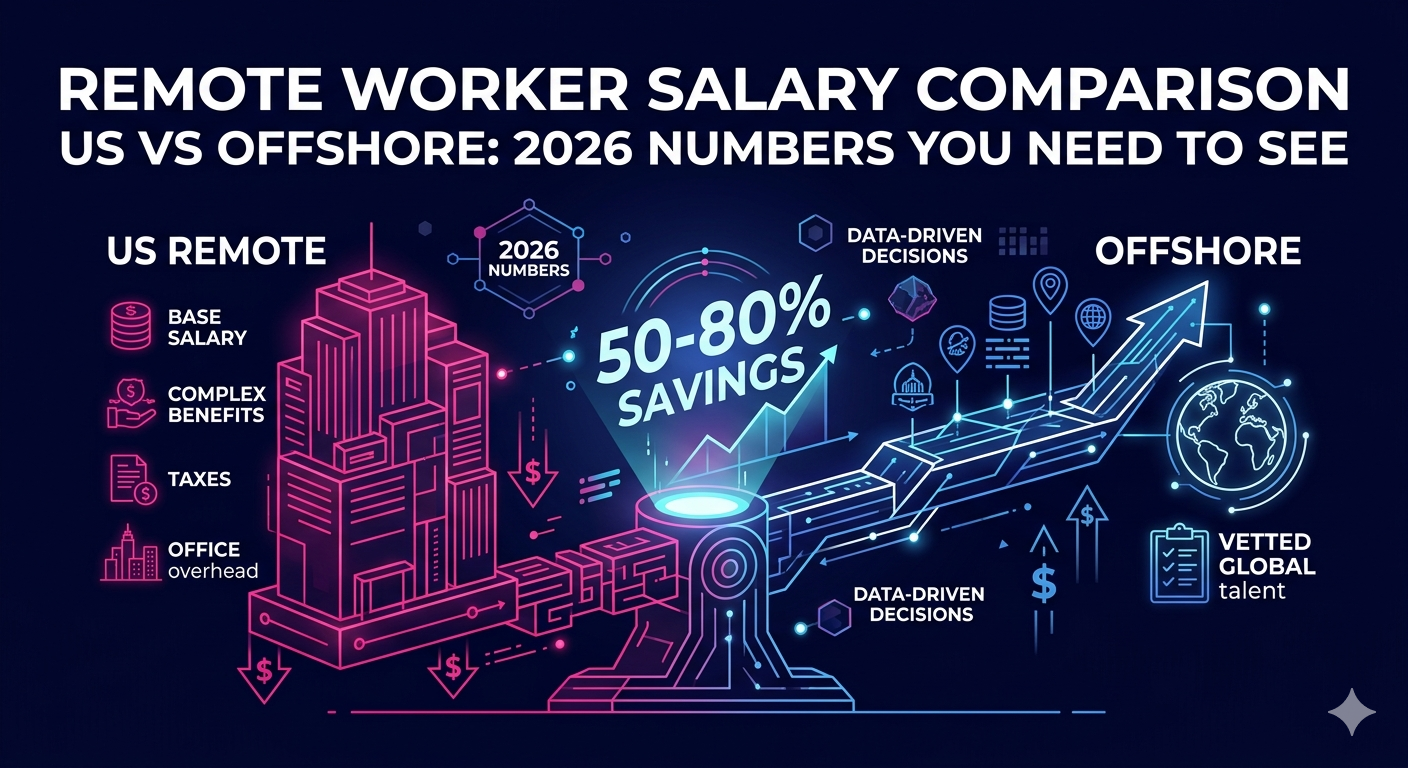
If you are making hiring decisions in 2026, a clear remote worker salary comparison US vs offshore is one of the most valuable tools you can have. Gut instinct and rough estimates are not enough when payroll represents 60 to 80 percent of your operating costs. This guide gives you real, role-specific numbers, context on what drives the gaps, and a practical framework for deciding where to hire based on what each market actually delivers.
Why the US vs Offshore Salary Gap Has Grown in 2026
The wage gap between US-based remote workers and offshore equivalents has widened in recent years due to a combination of domestic wage inflation and the rapid upskilling of talent in major offshore markets. In the US, compensation expectations for remote roles have climbed steadily since 2022, driven by tight labor markets, inflation, and rising cost-of-living expectations even among fully remote workers.
Meanwhile, offshore talent hubs in the Philippines, Latin America, Eastern Europe, and South Asia have continued to mature. English proficiency has improved, tool familiarity has deepened, and more professionals now have direct experience serving international clients. The result is a talent landscape where offshore workers are more capable than ever while the salary differential with US workers has remained wide or grown.
For businesses, this means the remote worker salary comparison US vs offshore has never been more financially significant, or more actionable.
Remote Worker Salary Comparison US vs Offshore: Role-by-Role Breakdown
The figures below reflect 2026 market rates for full-time remote professionals. US figures represent fully loaded annual compensation including base salary and benefits. Offshore figures represent total annual cost through a remote staffing arrangement with no employer overhead.
Virtual Assistant and Administrative Support
- US remote worker annual cost: $52,000 to $72,000 (salary plus benefits and taxes)
- Philippines offshore annual cost: $10,000 to $18,000
- Latin America offshore annual cost: $14,000 to $22,000
- Savings range: 55 to 80 percent
Administrative and virtual assistant roles were among the first to move offshore, and in 2026 they represent one of the most established offshore categories. Quality is high when sourced through vetted providers, and the productivity impact of a well-placed offshore VA is consistently strong.
Customer Support Specialists
- US remote worker annual cost: $48,000 to $68,000
- Philippines offshore annual cost: $9,600 to $16,800
- Latin America offshore annual cost: $12,000 to $20,000
- Savings range: 55 to 80 percent
Customer support is one of the most well-documented offshore success stories. English proficiency in the Philippines is exceptional, and the cultural familiarity with US customer expectations has been built over decades of industry experience.
Digital Marketing Specialists
- US remote worker annual cost: $68,000 to $95,000
- Philippines offshore annual cost: $14,400 to $24,000
- Latin America offshore annual cost: $18,000 to $30,000
- Eastern Europe offshore annual cost: $24,000 to $40,000
- Savings range: 50 to 78 percent
Offshore digital marketers handling SEO, content, social media, and paid campaigns have become a default resource for agencies and in-house marketing teams alike. The offshore talent pool in this category has grown significantly, and output quality from specialist providers is now consistently competitive with domestic hires.
Sales Development Representatives (SDRs)
- US remote worker annual cost: $72,000 to $100,000 (base plus on-target earnings and benefits)
- Latin America offshore annual cost: $18,000 to $32,000
- Philippines offshore annual cost: $14,400 to $24,000
- Savings range: 55 to 75 percent
SDR roles require strong communication skills and cultural alignment with the target market. Latin American markets have become particularly strong for SDRs targeting North American prospects due to time zone overlap and improving English communication standards. For businesses looking to scale outbound without scaling payroll, offshore SDRs are a compelling option in 2026.
SEO and PPC Specialists
- US remote worker annual cost: $75,000 to $110,000
- Philippines offshore annual cost: $16,800 to $28,800
- Eastern Europe offshore annual cost: $28,000 to $48,000
- Savings range: 50 to 75 percent
Technical marketing roles like SEO and PPC management are highly suited to offshore delivery because performance is measurable and tooling is standardized. Offshore specialists using platforms like Ahrefs, SEMrush, and Google Ads operate the same tools as their US counterparts at a fraction of the total cost.
Legal Support Roles
- US remote worker annual cost (paralegal): $58,000 to $82,000
- Offshore paralegal annual cost: $14,400 to $28,800
- US remote worker annual cost (legal assistant): $48,000 to $65,000
- Offshore legal assistant annual cost: $10,800 to $21,600
- Savings range: 55 to 75 percent
Legal support is one of the fastest-growing offshore categories in 2026. Law firms and corporate legal departments are increasingly using offshore legal assistants and paralegals trained in US legal documentation, case management systems, and research processes to reduce support costs without reducing capacity.
What the US vs Offshore Salary Data Does Not Show on Its Own
A raw remote worker salary comparison US vs offshore tells you a lot, but not everything. There are a few important contextual factors that shape the real value of the numbers.
Productivity and Output Are the Real Measure
The salary comparison only matters if output quality is comparable. For roles where performance is measurable and deliverables are clearly defined, offshore hires consistently deliver strong results. The businesses that report poor offshore hiring outcomes are almost always those that failed to define expectations clearly, skipped proper onboarding, or sourced from unvetted platforms.
Time Zone Alignment Varies by Market
Latin American markets offer near-complete overlap with US business hours, which matters for roles requiring real-time communication. Philippines-based workers often operate on a shifted schedule or night shift to align with US time zones, which is standard practice and well-supported by the workforce there. Eastern European talent typically suits European clients or async workflows.
The Overhead Elimination Factor
The salary difference is only part of the savings. When you hire offshore through a staffing provider rather than as a direct employer, you also eliminate payroll taxes, health insurance contributions, workers compensation, and recruitment costs. Those additional savings layer on top of the base salary gap and widen the total cost differential significantly.
You can review how businesses across industries are leveraging this model by looking at the offshore digital marketing professionals available at The Remote Reps, where roles are matched to client needs with pre-vetted talent.
How to Use This Salary Comparison to Make Smarter Hiring Decisions
Armed with the remote worker salary comparison US vs offshore, the practical question is how to apply it. Here is a straightforward framework.
- Identify your highest-cost roles: Start with the positions where the salary gap delivers the most absolute dollar savings, typically senior or specialized roles.
- Assess offshore suitability: Roles that are output-driven, communication-compatible, and do not require physical presence are strong candidates.
- Choose the right market for the role: Match the offshore market to the role type. Latin America for sales and real-time communication, Philippines for support and admin, Eastern Europe for technical depth.
- Use a vetted provider: Do not source offshore talent from open freelance marketplaces for critical roles. A specialist staffing provider pre-screens candidates and handles the matching process.
- Start with one or two roles: Validate the model before scaling. Most businesses that start with a single offshore hire are running multi-person offshore teams within twelve months.
For authoritative benchmarking data on US compensation rates, the Bureau of Labor Statistics Occupational Employment and Wage Statistics report provides current salary figures across all major role categories and is useful for building your own US vs offshore salary comparison.
The Bottom Line on Remote Worker Salaries US vs Offshore in 2026
The numbers are clear and the trend is accelerating. Businesses that understand the remote worker salary comparison US vs offshore and act on it are building leaner, more scalable operations than competitors still paying full domestic overhead for every role. The quality of offshore talent has reached a point where the salary gap no longer represents a trade-off. For the right roles, sourced the right way, it is simply a better value. The only question left is how quickly you are willing to start capturing it.
Frequently Asked Questions
What does a remote worker salary comparison US vs offshore look like for entry-level roles?
For entry-level roles such as virtual assistants, data entry specialists, and junior customer support agents, the remote worker salary comparison US vs offshore typically shows a gap of 60 to 80 percent. A US-based entry-level remote hire costs $40,000 to $55,000 per year fully loaded, while an offshore equivalent in the Philippines or Latin America costs between $9,600 and $18,000 annually.
How accurate is a remote worker salary comparison US vs offshore for specialized roles?
For specialized roles such as SEO specialists, PPC managers, and legal support professionals, the remote worker salary comparison US vs offshore still shows significant gaps, typically 50 to 75 percent. Specialized offshore talent commands higher rates than generalist roles, but remains substantially below US equivalent compensation even at the higher end of offshore market rates.
Does the remote worker salary comparison US vs offshore account for quality differences?
Salary figures alone do not capture quality, but when offshore talent is sourced through a vetted provider and placed in clearly defined roles, output quality is consistently comparable to domestic hires. The remote worker salary comparison US vs offshore becomes most valuable when paired with a structured hiring and onboarding process that sets clear performance expectations from the start.
Which offshore markets offer the best value based on the remote worker salary comparison US vs offshore?
In 2026, the Philippines offers the strongest value for customer support, administrative, and digital marketing roles due to high English proficiency and established international work culture. Latin America is the top choice for sales and real-time communication roles due to time zone alignment with the US. Eastern Europe leads for technical, analytical, and engineering roles where depth of expertise is the priority.
How does the remote worker salary comparison US vs offshore change when you include employer overhead costs?
When you add employer payroll taxes, health insurance, retirement contributions, and office overhead to the US side of the comparison, the total cost gap widens further. A US remote worker earning $60,000 in base salary costs a business $78,000 to $88,000 per year fully loaded. An offshore equivalent hired through a staffing provider costs $12,000 to $30,000 annually with no additional employer overhead, making the true savings even greater than the salary comparison alone suggests.
Can a small business benefit from the remote worker salary comparison US vs offshore, or is this only for large companies?
Small businesses often benefit more from the remote worker salary comparison US vs offshore than large enterprises, because payroll represents a higher proportion of their total budget. Replacing even one domestic hire with an offshore equivalent can free up $30,000 to $60,000 per year that can be redirected toward growth, marketing, or product development. Offshore staffing providers work with businesses of all sizes, and there is no minimum headcount required to start.