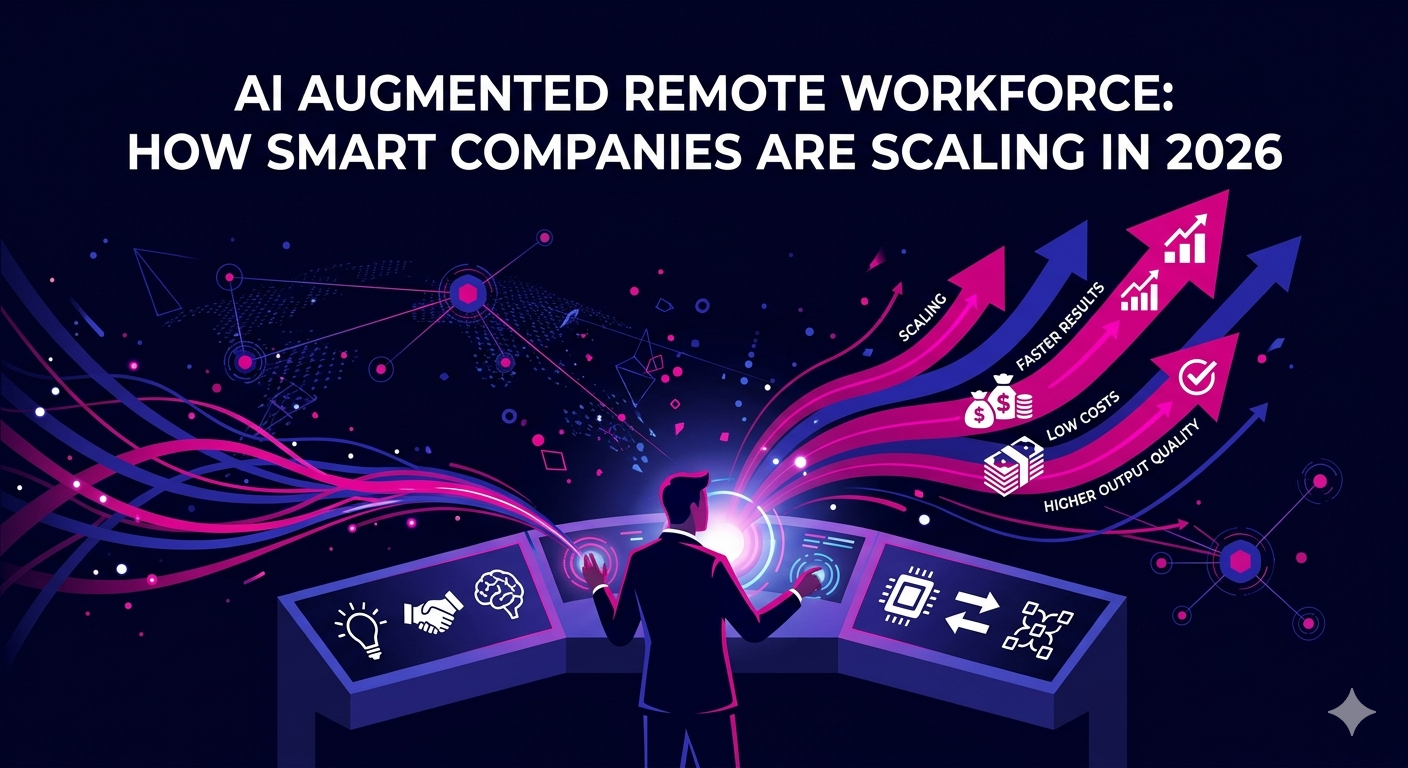
The way businesses hire, manage, and scale their teams has changed permanently. In 2026, the most competitive companies are no longer choosing between human talent and artificial intelligence. They are combining both into what experts now call an AI augmented remote workforce, a model that blends skilled remote professionals with AI-powered tools to deliver faster results, lower costs, and higher output quality.
Whether you run a startup or lead a mid-market company, understanding this shift is no longer optional. It is the defining competitive advantage of this decade.
What Is an AI Augmented Remote Workforce?
An AI augmented remote workforce refers to a distributed team of human professionals whose capabilities are enhanced and extended by artificial intelligence tools, automation platforms, and machine learning systems. Rather than replacing workers, AI acts as a force multiplier, helping remote professionals work smarter, move faster, and produce higher-quality outcomes.
Think of a remote sales development representative who uses AI to research prospects in seconds, personalize outreach at scale, and prioritize leads based on behavioral data. Or a remote digital marketer who uses generative AI to draft ad copy, then applies their own strategic judgment to refine and deploy it. These are not future scenarios. They are happening right now in 2026.
The Difference Between AI Replacement and AI Augmentation
There is an important distinction to understand here. AI augmentation is not about replacing human workers. It is about giving them capabilities they could not have on their own. A human brings creativity, emotional intelligence, contextual judgment, and relationship-building skills. AI brings speed, data processing, pattern recognition, and tireless consistency. Together, they form something more powerful than either could be alone.
Companies that understand this distinction are the ones pulling ahead in 2026.
Why the AI Augmented Remote Workforce Model Is Exploding in 2026
Several converging trends have made this model not just viable but essential:
- AI tools have matured: Platforms like advanced language models, automated CRM systems, and AI-driven analytics dashboards are now accessible to businesses of all sizes, not just enterprise giants.
- Remote work infrastructure is robust: After years of refinement, remote collaboration tools, async communication platforms, and cloud-based workflows have removed the friction that once made distributed teams harder to manage.
- Talent is global: Companies can now access world-class professionals in sales, marketing, customer support, and operations from anywhere, at competitive rates, without sacrificing quality.
- Cost pressures are real: With economic uncertainty in 2026, businesses need to do more with leaner teams. An AI augmented remote workforce delivers exactly that.
According to McKinsey’s research on the future of work and AI augmentation, organizations that integrate AI into their workforce operations see measurable gains in productivity and employee satisfaction when the implementation is thoughtful and human-centered.
Key Roles in an AI Augmented Remote Workforce
Not every role benefits equally from AI augmentation, but the following are among the highest-impact positions when combined with the right tools:
Sales Development Representatives (SDRs)
Remote SDRs paired with AI prospecting tools can research, qualify, and engage with far more leads than a traditional SDR ever could. AI handles data enrichment and initial outreach cadences, while the human SDR focuses on relationship-building and closing conversations. If you are looking to scale your pipeline, exploring AI-powered remote SDR talent is one of the highest-leverage moves available in 2026.
Digital Marketers
Remote digital marketers now use AI to run A/B tests at scale, generate and refine content, analyze audience data in real time, and optimize campaigns automatically. The human role shifts from execution to strategy and creative direction, which is where the real value lies.
Customer Support Specialists
AI handles tier-one inquiries, FAQs, and routing. Remote customer support professionals handle complex issues, emotionally sensitive situations, and relationship-critical interactions. The result is a faster, higher-quality support experience at a lower cost per ticket.
Lead Generation Experts
AI tools can identify, score, and segment prospects with precision. Remote lead generation experts then craft the outreach strategies, test messaging, and manage the human side of the funnel. This combination dramatically improves conversion rates and pipeline quality.
Executive and Virtual Assistants
Remote assistants augmented with AI can manage calendars, conduct research, draft communications, and coordinate complex projects with a level of efficiency that was previously impossible. For founders and executives, this translates to more time spent on high-value work.
How to Build an AI Augmented Remote Workforce That Actually Works
Building this model effectively requires more than just hiring remote talent and handing them AI subscriptions. Here is a practical framework for 2026:
1. Audit Your Workflows for AI Readiness
Before you hire, map out your existing workflows and identify which tasks are repetitive, data-heavy, or rules-based. These are the prime candidates for AI augmentation. Tasks that require creativity, judgment, or relationship management should remain human-led but can still be supported by AI tools.
2. Hire for AI Fluency, Not Just Technical Skills
In 2026, the best remote professionals are those who know how to work with AI tools effectively. When evaluating candidates, look for evidence that they understand how to prompt AI systems, interpret AI-generated outputs critically, and integrate AI into their daily workflows without losing their own strategic thinking.
3. Build AI Into Your Onboarding Process
Do not leave remote workers to figure out which AI tools to use on their own. Build a standardized toolkit into your onboarding so that every new hire starts with the same foundation. This ensures consistency and accelerates time to value.
4. Create Clear Human-AI Handoff Points
Define exactly where AI handles tasks and where human judgment takes over. Ambiguity here is one of the biggest failure points in AI augmented teams. Clear handoff points prevent both over-reliance on AI and underuse of it.
5. Measure Output, Not Activity
Traditional management metrics like hours logged or emails sent become less meaningful in an AI augmented environment. Shift your performance metrics toward outcomes: deals closed, leads qualified, content pieces published, customer issues resolved. This aligns incentives properly and gives your remote team the autonomy to work in the way that produces the best results.
Common Mistakes Companies Make with AI Augmented Remote Teams
Even well-intentioned companies stumble. Here are the most common pitfalls to avoid:
- Over-automating human touchpoints: Some interactions require a human. Customers can tell the difference, and so can prospects. Know where the human element is non-negotiable.
- Hiring remote talent without AI tool access: Giving a remote professional the responsibility without the tools is a recipe for frustration and underperformance.
- Ignoring the communication layer: AI augmentation does not solve communication problems. Remote teams still need clear async communication norms, regular check-ins, and a strong culture of transparency.
- Treating AI outputs as final: AI-generated content, analysis, and recommendations always need human review. The moment you stop reviewing is the moment errors slip through.
The Business Case: ROI of an AI Augmented Remote Workforce
The numbers in 2026 are compelling. Companies that have adopted the AI augmented remote workforce model report significant reductions in cost per hire, faster onboarding timelines, and measurable increases in per-person output. Remote roles augmented by AI in sales, marketing, and customer support consistently outperform their non-augmented counterparts on key performance metrics.
Beyond the financial ROI, there is a strategic advantage that is harder to quantify but equally important: speed. An AI augmented remote team can test ideas, pivot campaigns, and respond to market changes faster than a traditional in-office team bogged down by manual processes.
Conclusion: The Future Belongs to AI Augmented Remote Teams
The companies winning in 2026 are not the ones with the biggest offices or the largest headcount. They are the ones that have figured out how to combine exceptional human talent with intelligent AI tools, deployed across a flexible, remote-first structure. The AI augmented remote workforce is not a trend. It is the new baseline for competitive business operations.
If you are ready to build a remote team that is designed for the AI era, explore the full range of AI-ready remote professionals at The Remote Reps, from SDRs and digital marketers to executive assistants and lead generation experts. Your next competitive advantage is one great hire away.
Frequently Asked Questions About the AI Augmented Remote Workforce
What does AI augmented remote workforce mean for small businesses?
For small businesses, an AI augmented remote workforce means access to skilled professionals who can do more with less. Instead of hiring large in-house teams, small business owners can bring on remote specialists equipped with AI tools that amplify their output, making it possible to compete with much larger organizations at a fraction of the cost.
How do I know if my company is ready to adopt an AI augmented remote workforce?
If your business relies on repetitive tasks, large volumes of data, outbound outreach, or scalable content production, you are likely ready. The AI augmented remote workforce model works best when you have defined workflows, clear performance metrics, and a willingness to invest in the right tools alongside the right people.
What types of roles work best in an AI augmented remote workforce?
Sales development, digital marketing, lead generation, customer support, executive assistance, and content creation are among the strongest fits for an AI augmented remote workforce. These roles involve a mix of repetitive tasks that AI can handle and strategic judgment that humans provide best.
Is the AI augmented remote workforce model secure and compliant?
Security and compliance depend on the tools and protocols you implement. In 2026, most enterprise-grade AI platforms offer strong data governance features. When building your AI augmented remote workforce, establish clear data handling policies, use secure communication tools, and ensure all remote team members are trained on compliance requirements relevant to your industry.
How do I find remote professionals who are skilled in AI augmented workflows?
Look for candidates with demonstrated experience using AI tools in their specific domain. Platforms and agencies that specialize in placing remote talent, such as those that pre-vet professionals for AI fluency, can significantly reduce your hiring time and risk. An AI augmented remote workforce is only as strong as the humans powering it, so vetting for both domain expertise and AI proficiency is essential.
What is the biggest benefit of building an AI augmented remote workforce in 2026?
The biggest benefit is the combination of scale and quality. An AI augmented remote workforce allows you to scale output without proportionally scaling headcount, while maintaining or improving the quality of work. This is particularly valuable in fast-moving functions like sales and marketing, where speed and precision directly impact revenue.