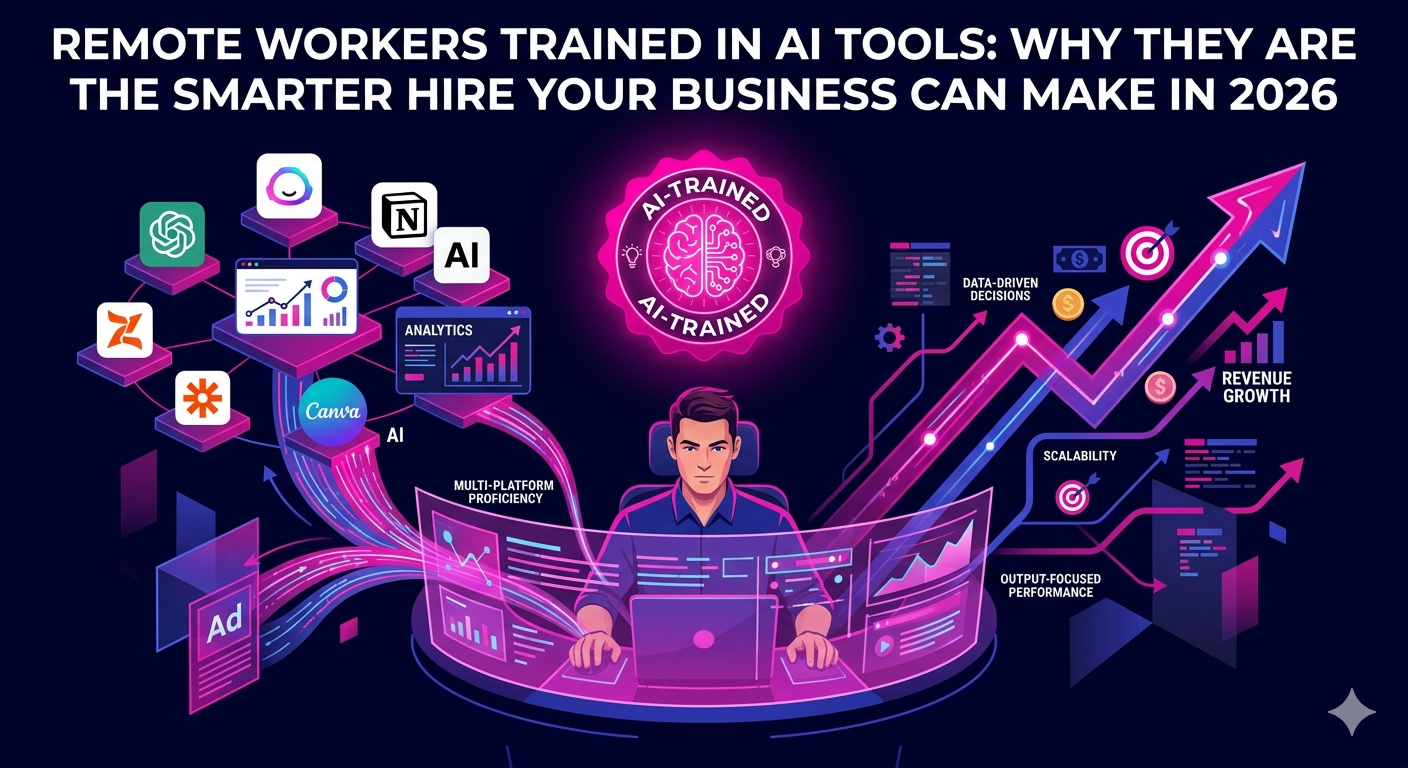
The talent landscape has shifted in a fundamental way. In 2026, the most valuable remote professionals are not just those with years of experience in their field. They are remote workers trained in AI tools who can combine deep domain expertise with the productivity multipliers that modern AI platforms provide. Businesses that hire this caliber of talent are operating with a measurable edge over those that do not.
If you are still hiring remote talent based on experience alone, you are leaving significant output and efficiency on the table. This guide explains exactly what makes AI-trained remote workers different, which roles benefit most, and how to build a team of these high-performance professionals for your business.
What Sets Remote Workers Trained in AI Tools Apart
There is a clear and growing gap between remote workers who have adopted AI tools as a core part of their workflow and those who have not. This gap shows up in output volume, work quality, turnaround time, and the ability to handle tasks that previously required an entire team.
The Productivity Multiplier Effect
Remote workers trained in AI tools do not just work faster. They work smarter by automating repetitive tasks, generating high-quality drafts at scale, analyzing data in real time, and freeing their cognitive capacity for strategic thinking and creative problem-solving.
A digital marketer trained in AI content tools can produce campaign materials in a fraction of the time it takes a traditional hire. A virtual assistant fluent in AI scheduling and workflow tools can manage the operational load of a team of three. These are not incremental improvements. They are order-of-magnitude productivity gains that directly impact your bottom line.
AI Tool Proficiency as a Core Professional Skill in 2026
By 2026, AI tool proficiency has become as foundational as computer literacy was twenty years ago. Professionals who have invested in learning platforms like generative AI writing tools, AI-powered CRM systems, intelligent analytics dashboards, and automated outreach platforms are commanding higher output rates and better results for the businesses they serve.
According to McKinsey’s research on AI-skilled workers and workforce productivity, organizations that deploy AI-proficient talent across key functions are seeing productivity improvements ranging from 20 to 45 percent depending on the role. For remote teams, where output is the primary measure of performance, this advantage is especially pronounced.
Which Remote Roles Benefit Most from AI Tool Training
While virtually every professional role sees some benefit from AI tool adoption, certain remote positions see transformational improvements in output and quality when the person filling them is genuinely trained in relevant AI platforms.
Sales and Lead Generation
Remote sales development representatives and lead generation specialists trained in AI prospecting tools, intelligent sequencing platforms, and AI-driven personalization engines are closing more pipeline with less manual effort. They can research prospects faster, craft more relevant outreach, and manage higher volume sequences without sacrificing quality.
Explore remote workers trained in AI tools for lead generation who can build and execute intelligent outreach campaigns that consistently fill your pipeline with qualified opportunities.
Digital Marketing and Content
Remote digital marketers, SEO specialists, social media managers, and content strategists who are proficient in AI writing assistants, AI SEO analysis tools, and AI-powered social scheduling platforms deliver dramatically more output per hour than those working without these capabilities.
A social media manager trained in AI content generation tools can maintain an active, on-brand presence across five platforms simultaneously. An SEO specialist using AI-powered keyword clustering and content optimization tools can produce and optimize content at a pace that traditional methods simply cannot match.
PPC, Media Buying, and Performance Marketing
Remote PPC experts and media buyers trained in AI-powered bid management, audience segmentation, and creative testing tools are managing larger ad budgets with better results and fewer wasted impressions. AI tools in this space have made it possible for a single skilled remote professional to manage campaigns that previously required a full in-house team.
Virtual and Executive Assistants
The modern remote virtual assistant or executive assistant is a significantly more powerful resource when trained in AI productivity tools. From AI meeting summarizers and intelligent inbox management to automated task tracking and AI-generated reports, these professionals can handle a scope of work that would have required multiple people just a few years ago.
Customer Support
Remote customer support specialists trained in AI ticket routing, sentiment analysis tools, and AI-assisted response generation resolve issues faster and with higher satisfaction scores. They handle greater ticket volumes without a drop in quality, making them a high-value addition to any customer-facing operation.
Cold Email and GTM Operations
Remote cold email experts and GTM engineers who are fluent in AI copywriting tools, intelligent A/B testing platforms, and AI-driven deliverability optimization are generating response rates that outperform traditional manual approaches by a wide margin.
How to Identify Genuinely AI-Trained Remote Workers
The demand for remote workers trained in AI tools has created a market where many candidates claim AI proficiency without the depth to back it up. Knowing how to distinguish genuine expertise from surface-level familiarity is critical to making the right hire.
Look for Specific Tool Fluency, Not General Awareness
Ask candidates to name the specific AI platforms they use daily, describe their workflow integration, and demonstrate how those tools have improved their output. Vague answers about being familiar with AI or having tried some tools are red flags. Strong candidates will speak fluently about specific platforms and give concrete examples of results achieved.
Request Portfolio Evidence
AI-trained remote workers should be able to show work product that reflects the efficiency and quality gains these tools enable. Marketers should show content and campaign outputs. Sales professionals should share outreach samples and performance metrics. The evidence of AI tool proficiency shows up in the work itself.
Test in a Structured Assessment
Role-specific assessments that simulate real work conditions are the most reliable way to verify AI tool proficiency. Ask candidates to complete a task using their preferred AI tools and evaluate both the process and the output. This reveals not just whether they know how to use the tools but whether they use them intelligently and strategically.
Building a High-Performance Team of AI-Trained Remote Professionals
Hiring individual remote workers trained in AI tools is valuable. Building a coordinated team of them is transformational. When multiple remote professionals across sales, marketing, operations, and support are all working with AI-augmented workflows, the compounding effect on business performance is substantial.
Align AI Tools Across Your Remote Team
Standardizing on a core set of AI platforms across your remote team creates consistency, enables knowledge sharing, and allows you to build processes that leverage AI at every touchpoint. When your sales team uses the same AI prospecting tools as your lead generation specialists, and your marketing team’s AI content tools feed directly into your SEO and social workflows, the entire operation becomes more efficient.
Invest in Ongoing AI Tool Development
The AI tool landscape in 2026 evolves rapidly. Remote workers who were cutting-edge in their AI proficiency twelve months ago may be working with outdated approaches today. Build learning and development into your remote team culture by allocating time and budget for AI tool training, encouraging certification in emerging platforms, and creating internal channels for sharing new AI workflows and discoveries.
Measure Output, Not Hours
Managing remote workers trained in AI tools requires an output-focused performance framework. Traditional time-based management misses the point entirely. A remote professional using AI tools effectively may complete in two hours what takes a non-AI-trained peer eight hours. Measuring performance by hours logged rather than value delivered will cause you to misjudge and undervalue your best people.
Why 2026 Is the Critical Year to Make This Shift
The window to gain a meaningful competitive advantage from hiring remote workers trained in AI tools is narrowing. As AI adoption becomes universal, the advantage will shift from simply having AI-trained staff to having the most skilled, most strategically deployed AI-trained staff. The businesses that build their remote teams around AI proficiency now will have a structural talent advantage that is extremely difficult for late adopters to close.
The cost of waiting is real and measurable. Every month spent with a remote team that lacks AI tool training is a month of slower output, higher cost per deliverable, and missed opportunities that more agile competitors are capturing.
If you are ready to hire remote workers trained in AI tools who can deliver results from day one, visit The Remote Reps to explore AI-skilled remote talent across every business function and start building the team your business needs to compete in 2026 and beyond.
Frequently Asked Questions About Remote Workers Trained in AI Tools
What does it mean for remote workers to be trained in AI tools?
Remote workers trained in AI tools have developed hands-on proficiency in using artificial intelligence platforms as part of their daily workflow. This goes beyond basic awareness and includes the ability to use AI writing assistants, AI-powered analytics, intelligent automation platforms, and other role-specific AI applications to increase output, improve quality, and complete work faster than traditional methods allow.
Why should I prioritize remote workers trained in AI tools over candidates with more years of experience?
In 2026, AI tool proficiency often creates a larger performance gap than years of experience. A candidate with three years of experience who uses AI tools effectively may consistently outperform a ten-year veteran who does not. When evaluating remote candidates, AI tool fluency should be weighted as a core competency alongside domain expertise, not as a bonus trait.
Which AI tools should remote workers ideally be trained in?
The most valuable AI tools for remote workers vary by role. Sales and outreach professionals benefit from AI prospecting and sequencing tools. Marketers and content creators benefit from generative AI writing and SEO tools. Operations and administrative professionals benefit from AI scheduling, task management, and reporting tools. The most important thing is that the candidate has practical, workflow-integrated experience with tools directly relevant to the role you are hiring for.
How do I verify that a remote candidate is genuinely trained in AI tools?
The most reliable verification methods are role-specific skill assessments and portfolio reviews. Ask candidates to walk you through their AI workflow for a typical task, show you work produced using their AI tools, and explain how those tools improved their output compared to traditional approaches. Candidates with genuine AI tool training will be able to answer these questions with specific, concrete detail rather than vague generalizations.
Are remote workers trained in AI tools more expensive to hire?
Top remote workers trained in AI tools may command slightly higher rates than candidates without AI proficiency. However, the total cost of employment is typically lower because AI-trained remote professionals deliver more output per hour, require less management oversight, and produce higher quality work that reduces revision cycles. The return on investment from hiring AI-trained remote talent consistently outperforms the cost difference in practice.
Can remote workers trained in AI tools adapt as the technology evolves?
Yes, and this adaptability is one of the defining traits of genuinely AI-trained remote workers. Professionals who have built AI tools into their workflow understand how to evaluate new platforms, integrate them quickly, and update their processes as the technology improves. Ongoing learning is a natural part of working with AI, and strong AI-trained remote workers treat tool development as a continuous professional investment rather than a one-time certification.