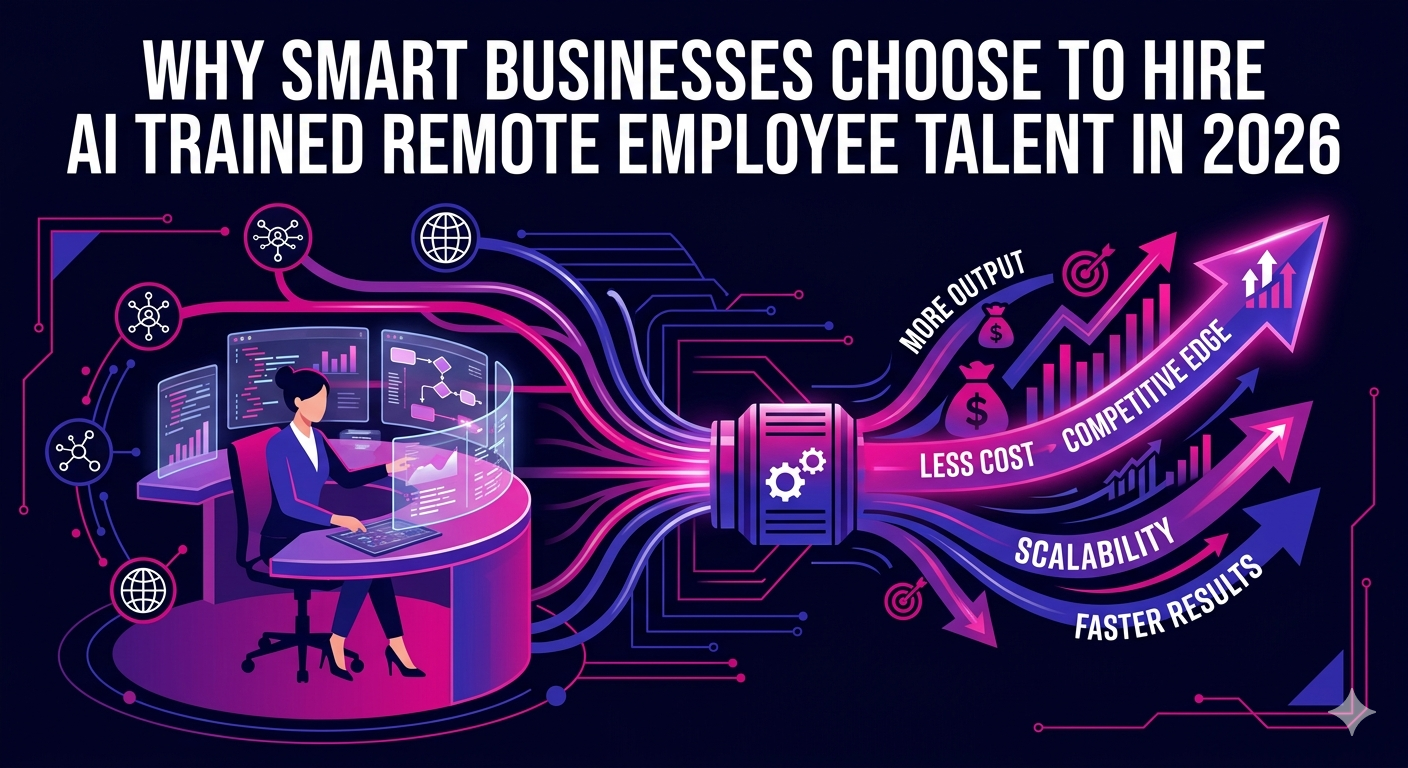
The modern workforce has changed dramatically. Companies that once relied solely on in-house teams are now turning to a smarter, more cost-efficient model: hiring remote employees who are not just experienced in their field but also trained in AI tools and workflows. If you are looking to hire an AI trained remote employee, you are already thinking ahead of the competition.
In 2026, AI literacy is no longer a bonus skill. It is a baseline expectation. Businesses that bring on remote talent with hands-on AI experience are seeing faster output, stronger results, and significantly lower operational costs. This guide breaks down everything you need to know to make the right hire.
What Does It Mean to Hire an AI Trained Remote Employee?
An AI trained remote employee is a professional who works outside your physical office and has been equipped with the knowledge and skills to use modern AI tools effectively. This goes beyond just knowing how to use ChatGPT. These employees understand how to integrate AI into real workflows, whether that is in sales, marketing, customer support, lead generation, or administration.
When you hire AI trained remote talent, you are getting someone who can:
- Use AI writing and content tools to produce work faster without sacrificing quality
- Leverage automation platforms to reduce repetitive manual tasks
- Analyze data using AI-powered dashboards and reporting tools
- Execute outreach campaigns with AI-enhanced personalization
- Support your team with smart workflows that scale without adding headcount
This combination of remote flexibility and AI capability is what makes these professionals so valuable in 2026.
Key Reasons to Hire an AI Trained Remote Employee This Year
1. You Get More Output for Less Cost
One of the biggest reasons businesses hire remote employees is cost savings. But when that remote employee is also AI trained, the value multiplies. These workers complete tasks that previously required two or three people in a fraction of the time. Whether it is drafting outreach emails, managing social media, or handling customer inquiries, an AI trained professional moves faster and more accurately.
2. Your Business Stays Competitive
In 2026, companies not adopting AI are falling behind. When you hire an AI trained remote employee, you are embedding that competitive edge directly into your operations. Your team members are already fluent in the tools your industry is moving toward, which means no lag time for onboarding or tool adoption.
3. Flexibility Without Compromise
Remote employees provide the geographic flexibility modern businesses need. Add AI training on top of that, and you have a hire who is productive across time zones, responsive to shifting workloads, and capable of autonomous execution without constant supervision.
4. Scalability Becomes Realistic
Growing a business is hard when every new task requires a new full-time hire. AI trained remote employees help you scale operations without scaling headcount proportionally. One well-trained remote professional with the right AI stack can deliver what used to take an entire small department.
Which Roles Benefit Most from AI Trained Remote Professionals?
Not all roles are equal when it comes to AI impact. However, several remote positions see an outsized benefit when the hire is AI trained.
Sales Development Representatives
AI trained SDRs can research prospects faster, personalize outreach at scale, and follow up with precision using automated sequences. If you are building a sales pipeline, consider hiring through a specialized platform. You can hire AI trained remote SDRs who are ready to drive qualified pipeline from day one.
Digital Marketers
From content creation to campaign analysis, digital marketers who understand AI tools produce more strategic and data-backed results. An AI trained remote digital marketer can manage multiple channels simultaneously with sharper insights and faster execution.
Lead Generation Experts
Lead generation in 2026 is powered by AI-driven prospecting, intent data, and automated enrichment. Remote lead generation professionals with AI training can build and manage lead pipelines that convert at higher rates. Explore options to hire remote AI trained lead generation experts who are already fluent in modern tools.
Customer Support Specialists
AI trained customer support reps use AI-powered ticketing systems, knowledge bases, and response assistants to handle higher volumes without dropping quality. They resolve issues faster and escalate smarter.
Virtual Assistants and Executive Assistants
Remote VAs and executive assistants with AI training are a force multiplier for busy founders and leaders. They use AI to manage schedules, draft communications, research topics, and automate administrative workflows that would otherwise eat hours of your day.
How to Find and Hire an AI Trained Remote Employee
Step 1: Define the Role Clearly
Before you post a job, know exactly what you need. What tasks will this person own? What tools do they need to be proficient in? What does success look like in 30, 60, and 90 days? The clearer your role definition, the better your hire will be.
Step 2: Use a Specialized Hiring Platform
General job boards are not built for finding pre-vetted, AI trained remote talent. Specialized platforms that focus on remote professionals with verified skills are a far more efficient path. These platforms pre-screen candidates, verify AI tool proficiency, and match you with talent that fits your budget and business model. Learn more about how The Remote Reps connects businesses with top AI trained remote employees across a wide range of roles.
Step 3: Assess AI Tool Proficiency During Interviews
Do not just ask candidates if they know AI tools. Ask them to walk you through how they have used them. Ask for specific examples, outcomes, and workflows. The best AI trained remote employees will have concrete stories about how AI changed their output quality or speed.
Step 4: Start with a Defined Trial Period
Even with a strong hire, a structured trial period of 30 to 60 days gives both parties a chance to confirm the fit. Set clear milestones, provide the right tools, and give honest feedback early.
What the Research Says About Remote AI Talent in 2026
Global hiring trends confirm what forward-thinking businesses already know: AI trained remote workers are among the most in-demand professionals on the market. According to McKinsey’s research on AI in the workplace, organizations that actively hire AI-literate professionals see measurable gains in productivity and output quality across departments. The data makes a compelling case for hiring AI trained remote talent as a strategic priority rather than an afterthought.
Common Mistakes Businesses Make When Hiring Remote AI Talent
- Hiring for credentials over capability: A degree means less than a portfolio of AI-assisted results. Look at what the candidate has actually produced.
- Underestimating onboarding: Even highly skilled remote hires need context about your business, tools, and processes. A structured onboarding saves weeks of confusion.
- Failing to set clear KPIs: Without measurable expectations, remote employees cannot perform at their best. Define what success looks like before day one.
- Ignoring communication fit: Remote work demands excellent async communication skills. Assess how well a candidate writes and documents their thinking.
- Choosing the cheapest option: AI trained remote talent delivers ROI. The lowest-cost hire often costs more in lost time and missed output than a well-matched professional would.
FAQ Section: Hire AI Trained Remote Employee
What is an AI trained remote employee and why should I hire one?
An AI trained remote employee is a remote professional who has hands-on experience using artificial intelligence tools as part of their daily work. When you hire an AI trained remote employee, you gain access to someone who can automate repetitive tasks, analyze data faster, and produce higher-quality output in less time. In 2026, this skill set is essential for businesses that want to stay efficient and competitive.
How much does it cost to hire an AI trained remote employee?
The cost to hire an AI trained remote employee varies depending on the role, experience level, and region. Compared to hiring a full-time in-house employee, remote professionals typically cost significantly less when factoring in office space, equipment, and benefits. Platforms like The Remote Reps help businesses find pre-vetted AI trained talent within their budget, making quality hires more accessible.
What roles are available when I hire an AI trained remote employee?
When you hire an AI trained remote employee through a specialized platform, you can fill roles across sales, marketing, customer support, lead generation, administration, and more. Popular options include SDRs, digital marketers, virtual assistants, executive assistants, cold email experts, and lead generation specialists who are all trained to use modern AI tools in their workflows.
How long does it take to hire an AI trained remote employee?
The timeline depends on where you search and how defined your role requirements are. Through a specialized remote staffing platform, the process can move quickly, often within one to two weeks from initial brief to candidate shortlist. Having a clear job description, defined KPIs, and a structured interview process speeds things up considerably.
What should I look for when I hire an AI trained remote employee?
When you hire an AI trained remote employee, look for demonstrated experience with AI tools relevant to the role, strong async communication skills, a trackable history of results, and the ability to work independently with minimal oversight. Prioritize candidates who can explain how AI has improved their specific workflows, not just those who list AI tools on a resume.
Is hiring an AI trained remote employee better than using in-house staff?
For many business functions, yes. When you hire an AI trained remote employee, you reduce overhead costs, gain access to a global talent pool, and bring in someone who is already trained in the tools that define efficient work in 2026. In-house hiring still makes sense for roles requiring physical presence, but for digital, sales, and administrative tasks, remote AI trained professionals often outperform their in-office counterparts on output per dollar.
Final Thoughts: Make Your Next Hire a Smart One
The companies winning in 2026 are not necessarily the ones with the biggest teams. They are the ones with the smartest teams. When you hire an AI trained remote employee, you are investing in a professional who brings not just experience, but leverage. Every task they complete benefits from the efficiency of AI, which means more done, done faster, and done better.
If you are ready to build a high-performing remote team with AI trained professionals, start by exploring the full range of roles available. Visit The Remote Reps virtual assistant services or browse all available remote talent to find the right fit for your business today.