The single most impactful hiring decision a business can make in 2026 is to hire remote worker with AI and automation experience. Companies that have made this shift are outpacing competitors on output, efficiency, and cost per result. Those still relying on workers who operate manually are falling behind, not because their people are less talented, but because the gap between AI-enabled and non-AI-enabled professionals has grown too wide to ignore.
This guide walks you through everything you need to know to hire remote worker with AI and automation experience the right way, from identifying the skills that matter to finding candidates who will deliver real results from day one.
Why Businesses Are Racing to Hire Remote Workers With AI and Automation Skills
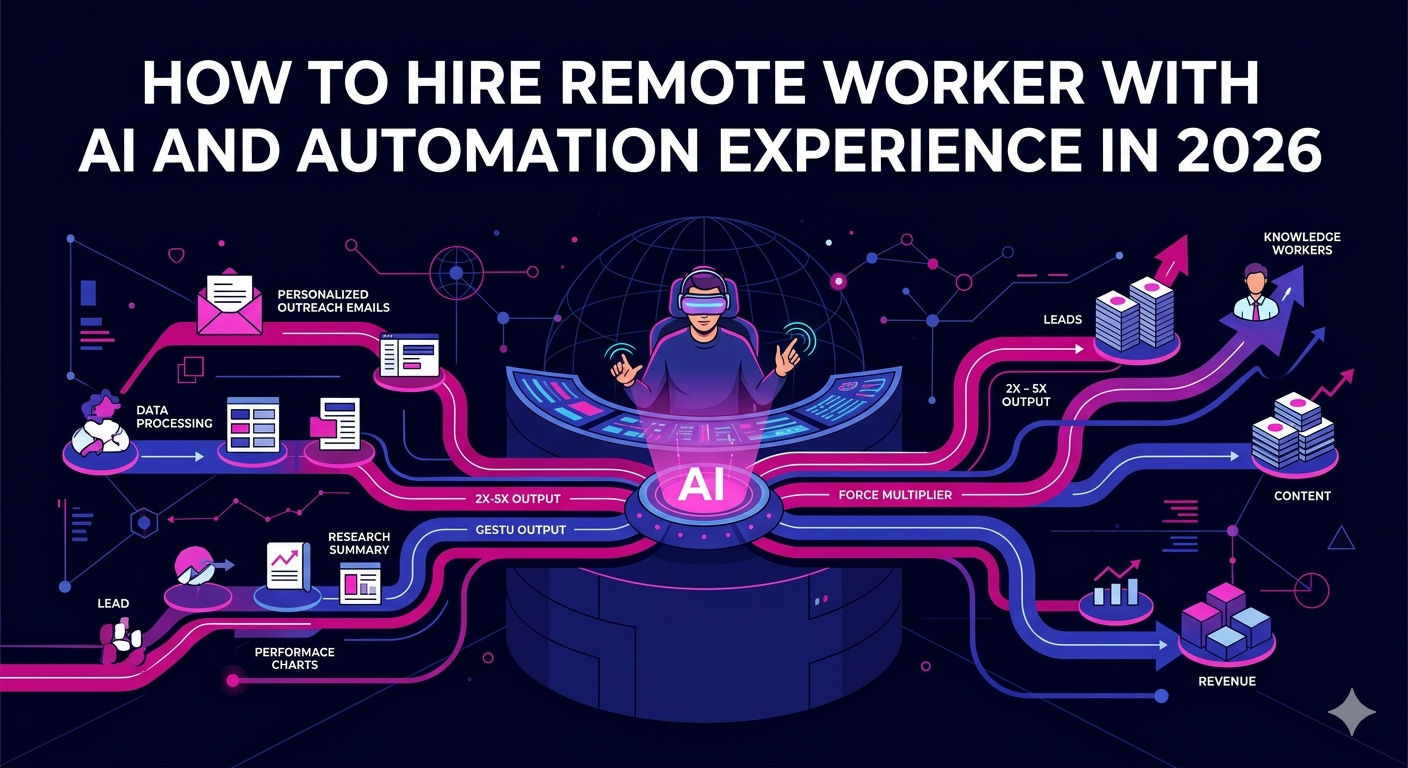
The urgency behind this hiring trend is not hype. It is driven by measurable business outcomes. In 2026, remote workers with AI and automation experience are producing two to five times the output of their manual counterparts in roles spanning sales, marketing, operations, and customer support.
Here is what is fueling the demand:
- AI tools have become accessible: Automation platforms, AI writing tools, agent frameworks, and data processing systems no longer require engineering expertise to operate. Skilled remote professionals can deploy and manage them directly.
- Labor costs are under pressure: Businesses need to grow without proportionally growing headcount. A remote worker with AI and automation experience can handle the workload of multiple traditional employees.
- Remote talent pools are global: The best candidates with these skills are distributed around the world. Hiring remotely gives you access to talent that would never be available in a single local market.
- Competitive speed has increased: Companies that move faster on research, outreach, content, and operations win more business. AI-enabled remote workers are the engine behind that speed.
What Skills Define a Remote Worker With AI and Automation Experience
When you hire remote worker with AI and automation experience, you are looking for a specific combination of technical fluency and professional judgment. Here is what the skill profile looks like in practice:
AI Tool Fluency
This means hands-on experience with AI writing assistants, research agents, data enrichment tools, and workflow automation platforms. The candidate should be able to name the tools they have used, describe specific tasks they automated, and explain how they handled quality control on AI-generated outputs.
Workflow Automation Design
A strong candidate can map out a workflow, identify which steps are candidates for automation, and set up the automation using platforms like Zapier, Make, or custom AI agent frameworks. They do not just use automation. They design and maintain it.
Data Literacy
Remote workers with AI experience are comfortable working with data. They can interpret outputs from AI tools critically, identify errors or inconsistencies, and make decisions based on what the data is showing. This skill is what separates someone who uses AI tools from someone who truly leverages them.
Async Communication and Self-Management
Because this role is remote, strong async communication habits are essential. The best candidates document their workflows, provide proactive updates, and manage their own priorities without requiring constant supervision. These soft skills are as important as technical fluency when you hire remote worker with AI and automation experience.
Domain Expertise
AI and automation skills are most valuable when paired with relevant domain knowledge. A remote sales development representative with automation experience will approach their role differently than a remote marketer or operations coordinator with the same technical background. When you hire remote worker with AI and automation experience, match their domain background to the specific function you need to fill.
Top Roles to Fill When You Hire Remote Worker With AI and Automation Experience
Not every business function benefits equally from AI and automation skills, but the following roles deliver the highest ROI when filled by candidates with this background:
Remote Sales Development Representatives
SDRs with AI and automation experience can research prospects, personalize outreach, manage sequences, and follow up at a scale no manual SDR can match. They use AI tools to enrich lead data, draft personalized messages, and prioritize their pipeline based on behavioral signals. The result is more conversations and more qualified opportunities in less time.
Remote Digital Marketers
Marketing professionals who can automate content creation, ad testing, analytics reporting, and audience segmentation deliver significantly more output per week than those working manually. AI-enabled marketers can run more experiments, iterate faster, and produce better campaign results with fewer resources.
Remote GTM Engineers
Go-to-market engineers who understand AI and automation are among the most in-demand remote hires in 2026. They build the technical infrastructure behind sales and marketing operations, including automated outreach systems, data pipelines, and CRM integrations. If you are scaling a growth function, this is a critical hire.
Remote Virtual and Executive Assistants
Administrative professionals with AI tool fluency can handle research, scheduling, communications, document preparation, and project coordination at a level that significantly exceeds what traditional assistants can manage. They act as a force multiplier for founders and executives who need more time for strategic work.
Remote Lead Generation Experts
Lead generation specialists who use AI tools to identify, score, and enrich prospect lists produce higher quality pipelines faster than any manual approach. They combine data platform expertise with automation workflows to keep your sales team focused on closing rather than prospecting.
If you are ready to hire remote worker with AI and automation experience across any of these functions, explore the AI-fluent remote GTM engineers and specialists at The Remote Reps who are ready to integrate into your team immediately.
Where to Find Remote Workers With AI and Automation Experience
Finding quality candidates in this category requires looking beyond general job boards. Here is where to focus your search in 2026:
- Specialized remote talent platforms: Agencies and platforms that specifically vet remote professionals for AI and automation skills give you a significant head start. They have already done the qualification work, which reduces your time to hire and your risk of a bad fit.
- Community-driven talent networks: Many of the best AI-fluent remote workers are active in professional communities built around specific tools or functions. Participating in or recruiting from these communities puts you in front of candidates who are already demonstrating relevant skills.
- Referrals from existing AI-enabled team members: If you already have remote workers with strong AI skills, ask them for referrals. People with this background tend to know others in similar professional circles.
- Portfolio and work sample evaluation: When you hire remote worker with AI and automation experience, asking for work samples or a paid test project is one of the most reliable ways to assess real capability. Look for evidence of workflow documentation, AI output quality control, and measurable results.
According to the World Economic Forum’s research on hiring remote workers with AI and automation skills, organizations that invest in sourcing professionals with these capabilities report faster project completion, stronger output quality, and better ROI on technology investments compared to teams that have not prioritized this skill set.
How to Evaluate Candidates When You Hire Remote Worker With AI and Automation Experience
The interview process for this role should go beyond resume review. Here is a practical evaluation framework for 2026:
Ask for Specific Tool Experience
Request a list of the AI and automation tools the candidate has used professionally. Then ask them to walk you through a specific workflow they built or managed using those tools. Vague answers are a red flag. Strong candidates will have concrete examples ready.
Test Their Quality Control Instincts
Present a sample of AI-generated output and ask the candidate to review it and identify what they would change or verify before using it. This reveals whether they apply genuine critical judgment to AI outputs or simply accept them at face value.
Assess Async Communication Skills
Give the candidate a brief async task during the hiring process and evaluate how they communicate their progress, ask clarifying questions, and deliver the result. The way they handle this test task is a reliable signal of how they will perform in a fully remote environment.
Conclusion: The Hire That Compounds Over Time
When you hire remote worker with AI and automation experience, you are not just filling a role. You are adding a compounding capability to your business. Every workflow they automate, every AI process they refine, and every manual task they eliminate creates lasting efficiency that benefits your entire operation.
In 2026, this is not a nice-to-have. It is the foundation of a scalable, competitive business. Start building that foundation today by exploring the full roster of AI-experienced remote workers available at The Remote Reps and find the right person to move your business forward.
Frequently Asked Questions About How to Hire Remote Worker With AI and Automation Experience
What is the best way to verify skills when you hire remote worker with AI and automation experience?
The most reliable method is a paid test project or work sample evaluation. Ask the candidate to complete a short task that mirrors their actual responsibilities, such as building a simple automation workflow or reviewing and refining AI-generated content. This gives you direct evidence of their skill level rather than relying solely on their resume or interview performance.
How much should I expect to pay when I hire remote worker with AI and automation experience?
Compensation varies by role, experience level, and geographic location. In 2026, remote workers with genuine AI and automation experience command higher rates than traditional remote workers in the same function, but they typically still cost less than equivalent in-house hires when you factor in overhead and benefits. The productivity premium they deliver usually makes the investment very worthwhile.
Which industries benefit most from the decision to hire remote worker with AI and automation experience?
Sales-driven businesses, digital marketing agencies, e-commerce operations, SaaS companies, and professional services firms see the strongest results. However, any business with repetitive, high-volume tasks in research, communications, data processing, or content production will benefit from choosing to hire remote worker with AI and automation experience in those functions.
How long does onboarding take after you hire remote worker with AI and automation experience?
Most AI-fluent remote workers reach full productivity within two to four weeks when given clear workflows, defined output standards, and access to the tools they need from day one. Candidates who have worked in similar environments before tend to ramp up faster because they can adapt existing frameworks to your specific context rather than starting from scratch.
What are the biggest mistakes companies make when they hire remote worker with AI and automation experience?
The most common mistakes are hiring for AI familiarity rather than demonstrated skill, failing to provide the tools and access needed from day one, and setting unclear expectations about output standards. Companies that hire remote worker with AI and automation experience successfully treat the hire as a strategic investment, not just a role to fill, and invest appropriately in onboarding and workflow documentation.
Can small businesses afford to hire remote worker with AI and automation experience?
Yes. In fact, small businesses often benefit more than large ones from this hire because the output multiplier effect is felt more immediately with a lean team. Part-time or project-based arrangements with remote workers who have AI and automation experience are a cost-effective entry point for smaller operations that want to test the model before committing to a full-time hire.