
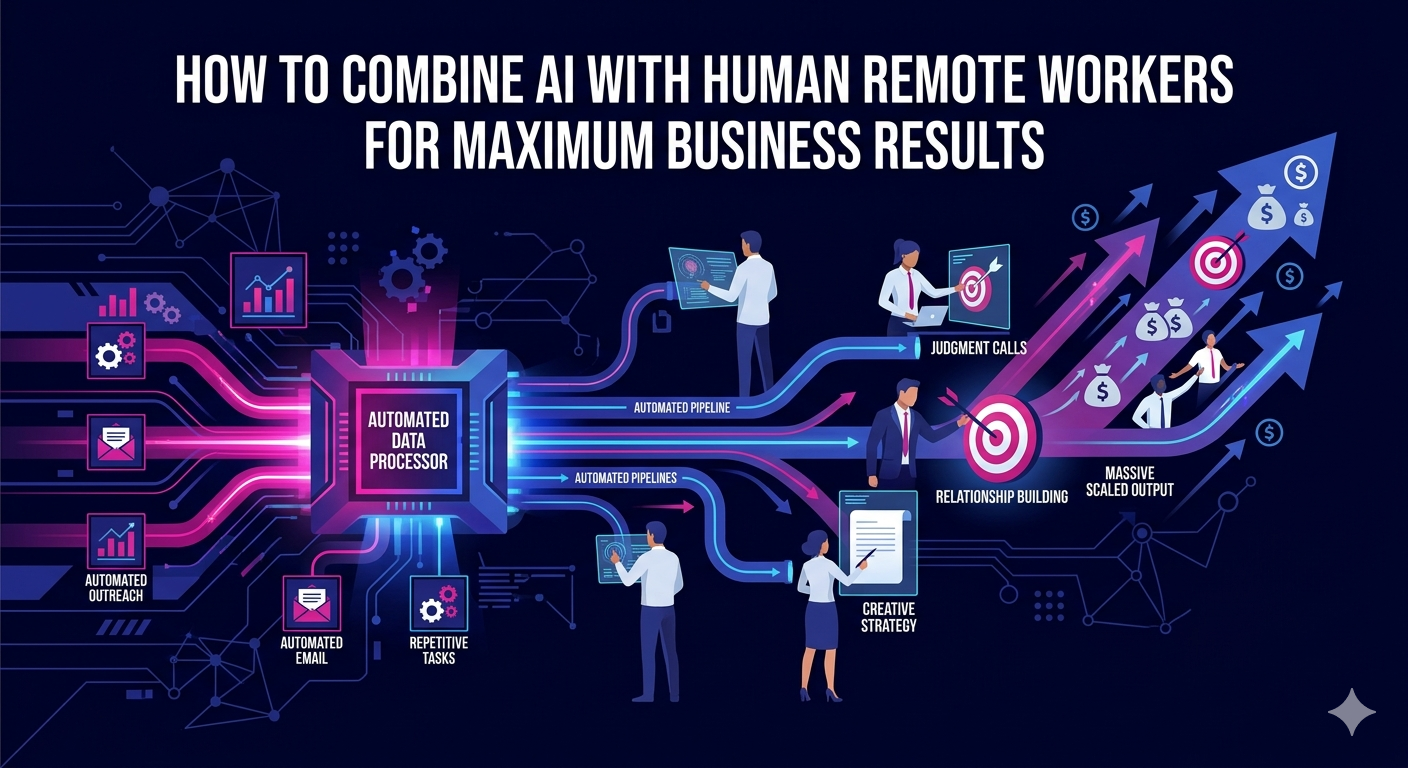
The question is no longer whether AI belongs in the workplace. The real question is how to combine AI with human remote workers in a way that multiplies output without sacrificing the creativity, judgment, and relationship-building that only people can provide. In 2026, the companies winning at remote work are not choosing between AI and human talent. They are building hybrid models where each amplifies the other.
This guide walks you through a practical, step-by-step framework for integrating AI into your remote workforce, covering strategy, tooling, team structure, and the cultural shifts that make it all work.
Why Combining AI with Human Remote Workers Is the Smartest Move in 2026
Remote work has gone mainstream, and so has AI. But treating them as separate strategies misses the bigger opportunity. When you learn how to combine AI with human remote workers effectively, you get something neither can achieve alone: the speed and consistency of automation paired with the nuance and adaptability of human intelligence.
Here is what the data says. According to Gartner’s research on combining AI with enterprise workforces, organizations that integrate AI tools with skilled human workers see up to 35 percent higher output per employee compared to teams relying on either approach alone. The key is intentional design, not ad hoc adoption.
Understanding the Roles: What AI Does vs. What Humans Do
Before building your integration strategy, you need a clear picture of where AI excels and where human remote workers are irreplaceable.
Where AI Performs Best
- Processing and summarizing large volumes of data quickly
- Automating repetitive, rule-based tasks like data entry, scheduling, and report generation
- Monitoring systems and flagging anomalies in real time
- Generating first drafts of written content, emails, and documentation
- Scoring leads, routing tickets, and prioritizing queues automatically
Where Human Remote Workers Are Irreplaceable
- Building client relationships and navigating complex negotiations
- Making judgment calls in ambiguous or high-stakes situations
- Creative strategy, storytelling, and brand voice development
- Mentoring, coaching, and managing team dynamics across cultures
- Understanding emotional context in customer interactions
When you map these strengths against your workflows, the integration points become obvious. AI handles the volume; humans handle the value.
A Step-by-Step Framework to Combine AI with Human Remote Workers
Step 1: Audit Your Current Remote Workflows
Start by mapping every recurring task your remote team performs. Categorize each task by time spent, skill required, and frequency. This audit reveals where automation creates the most leverage and where human judgment is non-negotiable.
Focus on tasks that are:
- High volume and low complexity (strong candidates for full automation)
- High volume and medium complexity (candidates for AI-assisted human work)
- Low volume and high complexity (should remain fully human-led)
Step 2: Select AI Tools That Complement Your Team
The AI tool market in 2026 is saturated. Avoid the trap of adopting every shiny new platform. Instead, choose tools that integrate cleanly with your existing stack and directly support the workflows your remote team relies on daily.
Practical examples by function:
- Sales teams: Gong for call analysis, Salesforce Einstein for pipeline forecasting, Clay for lead enrichment
- Marketing teams: Surfer SEO for content optimization, Jasper for drafting, Metadata for paid campaign automation
- Customer support: Intercom Fin for tier-one query resolution, Zendesk AI for smart ticket routing
- Operations: Notion AI for documentation, Zapier AI for workflow automation, Rippling for HR processes
Step 3: Define Clear Human-AI Handoff Points
One of the most common mistakes companies make when learning how to combine AI with human remote workers is leaving handoff points vague. When does the AI stop and the human begin? Define this explicitly for every workflow.
A practical example in customer support: the AI chatbot handles all tier-one inquiries autonomously. When a query scores above a certain complexity threshold or involves a billing dispute over a set dollar amount, it routes instantly to a human agent with a full conversation summary attached. The human picks up with full context and no wasted time.
Clear handoff protocols reduce errors, eliminate redundancy, and keep customers from feeling passed around.
Step 4: Train Your Remote Team to Work Alongside AI
Technology adoption fails when people feel threatened rather than empowered. When introducing AI to your remote workforce, position every tool as a collaborator that handles the tasks your team finds most draining so they can focus on the work they find most meaningful.
Effective training includes:
- Role-specific onboarding showing exactly how AI integrates into each person’s daily workflow
- Clear guidelines on reviewing and editing AI-generated outputs before use
- Regular feedback loops where team members flag where AI is underperforming
- Recognition for employees who find creative ways to use AI more effectively
Step 5: Measure the Right Metrics
You cannot optimize what you do not measure. When tracking the impact of combining AI with human remote workers, go beyond simple time savings. Look at output quality, employee satisfaction scores, error rates, and customer outcomes.
Useful metrics to track:
- Tasks completed per person per week before and after AI integration
- Average response time and resolution rate in customer-facing roles
- Employee Net Promoter Score to gauge how the team feels about AI adoption
- Revenue per remote employee as a high-level productivity indicator
Real-World Applications Across Remote Team Functions
AI Plus Human Remote Sales Teams
Remote sales teams that combine AI prospecting tools with skilled human reps consistently outperform fully automated outreach or fully manual approaches. AI handles contact research, email personalization at scale, and follow-up sequencing. Human reps focus on discovery calls, objection handling, and closing.
If you are building this kind of hybrid sales operation, partnering with remote lead generation experts who are already fluent in AI-assisted prospecting gives you a significant head start over competitors still figuring out the basics.
AI Plus Human Remote Marketing Teams
Content production is one of the clearest examples of combining AI with human remote workers successfully. AI generates research summaries, outlines, and first drafts at speed. Human marketers apply brand voice, editorial judgment, and strategic framing to produce content that actually resonates with audiences.
The same principle applies to paid media. AI optimizes bids and audience targeting in real time. Human media buyers set strategy, interpret trends, and make creative decisions that algorithms cannot replicate.
AI Plus Human Remote Executive Assistants
Remote executive assistants in 2026 are among the most AI-augmented professionals in any organization. AI handles calendar management, travel booking, email triage, and meeting summaries automatically. This frees executive assistants to focus on higher-level coordination, stakeholder communication, and project management that requires context and discretion no AI tool currently possesses.
Explore how remote executive assistants trained in AI-powered workflows can reclaim dozens of hours per week for your leadership team.
Common Mistakes to Avoid When Integrating AI with Remote Workers
- Over-automating without review: AI outputs require human quality control, especially in client-facing communications and legal or financial documents.
- Ignoring change management: Rolling out AI without proper communication and training breeds resentment and low adoption rates.
- Choosing tools that do not integrate: Siloed AI tools that do not connect with your CRM, project management, or communication platforms create more friction than they solve.
- Measuring the wrong outcomes: Tracking only cost savings misses the full value of combining AI with human remote workers, which includes quality improvements and employee experience gains.
The Path Forward: Building a Truly Hybrid Remote Organization
The future of remote work is not fully automated and it is not fully human either. It is a carefully designed collaboration between AI systems and skilled remote professionals who know how to get the most from both. Companies that invest now in learning how to combine AI with human remote workers will have a structural advantage that compounds over time.
The talent you hire matters as much as the tools you choose. Remote professionals who understand AI, can work alongside it fluently, and still bring irreplaceable human capabilities to the table are the most valuable hires you can make in 2026.
Ready to build your AI-augmented remote team with professionals who know how to deliver results? Visit The Remote Reps and connect with pre-vetted remote talent across sales, marketing, operations, and more.
Frequently Asked Questions About Combining AI with Human Remote Workers
What does it mean to combine AI with human remote workers?
To combine AI with human remote workers means designing workflows where AI tools handle repetitive, data-heavy, or high-volume tasks while human employees focus on strategy, creativity, relationship management, and complex decision-making. The goal is not to replace people but to amplify what each person on your remote team can accomplish within the same working hours.
What are the biggest benefits of combining AI with human remote workers?
The biggest benefits of combining AI with human remote workers include higher productivity per employee, faster turnaround times on routine tasks, reduced operational costs, improved consistency in customer-facing communications, and greater job satisfaction among remote staff who spend less time on tedious work and more on meaningful contributions.
How do I start combining AI with human remote workers without disrupting my team?
The best way to start combining AI with human remote workers without disruption is to begin with a single workflow or department rather than rolling out changes company-wide. Choose a function with clear repetitive tasks, introduce one well-integrated AI tool, train the team thoroughly, and gather feedback before expanding. A phased approach reduces resistance and builds confidence across your remote organization.
Will combining AI with human remote workers reduce headcount?
Not necessarily. Most organizations that successfully combine AI with human remote workers find that AI handles increased workload without requiring proportional headcount growth rather than eliminating existing roles. Some roles do evolve or shift in focus, which is why ongoing training and clear communication about the purpose of AI adoption is essential for maintaining team trust.
Which remote team functions benefit most from combining AI with human workers?
The functions that benefit most from combining AI with human remote workers are sales (lead research and follow-up automation paired with human relationship-building), marketing (AI-assisted content and campaign optimization paired with human strategy), customer support (AI-handled tier-one queries paired with human resolution of complex issues), and executive assistance (AI-managed scheduling and triage paired with human coordination and judgment).
How do I measure success when combining AI with human remote workers?
Measure success when combining AI with human remote workers by tracking a blend of productivity metrics, quality indicators, and employee experience scores. Key indicators include output volume per person, error rates in AI-assisted work, customer satisfaction ratings, employee Net Promoter Score, and revenue per remote team member. Reviewing these metrics quarterly helps you refine your integration strategy continuously.