
The sales development landscape has changed more in the past two years than in the previous decade. AI-powered prospecting tools have matured rapidly, and the question every revenue leader is asking is no longer theoretical. When it comes to AI SDR vs human SDR, which one actually fills your pipeline, converts more meetings, and delivers a better return on investment in 2026?
The honest answer is more nuanced than most vendors want you to believe. This guide breaks down exactly what each option delivers, where each one falls short, and how the smartest sales teams are combining both to outperform their competitors.
What Is an AI SDR and How Does It Work?
An AI SDR is a software-driven system that performs the prospecting and outreach tasks traditionally handled by a human sales development representative. In 2026, AI SDR platforms can identify target accounts, enrich contact data, write personalized outreach sequences, send emails, follow up automatically, and route interested prospects to a human closer.
Leading platforms in this category include tools like Artisan, 11x, and Ava by Bosh. These systems run continuously, do not require breaks, and can contact hundreds or thousands of prospects simultaneously.
The appeal is obvious. No salary, no benefits, no ramp time, no sick days. At face value, the AI SDR appears to win the AI SDR vs human SDR debate before it even begins. But the full picture is more complicated.
What a Human SDR Brings to the Table
A skilled human SDR does things that no AI system can reliably replicate in 2026. They read tone, adapt in real time, handle objections conversationally, build genuine rapport, and exercise the kind of situational judgment that turns a cold prospect into a booked meeting.
Human SDRs also represent your brand in a way that matters to buyers. Research from Gartner consistently shows that B2B buyers are more likely to move forward with a purchase when they have had a meaningful human interaction during the early stages of their buying journey. That dynamic has not disappeared in 2026, even as AI adoption has accelerated.
Beyond conversion quality, a human SDR can pivot strategy mid-sequence when something is not working. They notice patterns, escalate unusual situations, and bring creative problem-solving to cold outreach in ways that automated systems are not designed to handle.
AI SDR vs Human SDR: A Direct Performance Comparison
To make a genuinely useful comparison, it helps to look at both options across the metrics that matter most to sales teams.
Volume and Consistency
AI SDR wins this category decisively. An AI system can send thousands of personalized touchpoints per day without degradation in output quality or timing. A human SDR operating at peak efficiency might handle 80 to 120 meaningful outreach activities per day before quality suffers.
If raw volume is your primary constraint, the case for AI SDR tools is strong. But volume without conversion is just noise, and this is where the comparison gets more interesting.
Personalization Quality
This is where the AI SDR vs human SDR debate gets genuinely competitive. AI personalization in 2026 is sophisticated. Modern systems can reference a prospect’s recent LinkedIn activity, company news, and role-specific pain points within a generated email. For tier-two or tier-three prospects, this level of personalization is often sufficient to generate a reply.
For high-value, enterprise-level accounts, however, AI personalization still lacks the depth and contextual judgment that a skilled human SDR brings. A human rep can spend 20 minutes researching an account and craft an opening message that reflects a nuanced understanding of the prospect’s specific situation. That level of insight still outperforms AI output for strategic accounts in 2026.
Reply and Meeting Rates
Industry benchmarks in 2026 show that human SDRs consistently achieve higher reply-to-meeting conversion rates than AI SDR tools when targeting mid-market and enterprise accounts. AI SDR tools perform closer to or sometimes above human benchmarks for SMB outreach where personalization requirements are lower and volume matters more.
The average reply rate for AI-driven cold email sequences in 2026 sits between 3 and 7 percent depending on industry and targeting quality. Skilled human SDRs working well-researched prospect lists regularly hit 8 to 15 percent reply rates with better downstream conversion.
Cost Per Meeting Booked
AI SDR tools typically cost between $500 and $2,500 per month for a full-featured platform. A remote human SDR through a specialized staffing partner costs more per month in total compensation but often delivers a lower cost per qualified meeting booked at the mid-market and enterprise level due to higher conversion rates and better lead qualification judgment.
For high-volume, low-ACV products, AI SDR tools can deliver a meaningfully lower cost per meeting. For complex, high-ACV sales cycles, the human SDR typically wins on ROI.
Ramp Time and Setup
AI SDR tools can be deployed and generating outreach within days. A new human SDR typically requires 30 to 60 days to reach full productivity. However, remote SDR specialists hired through focused staffing platforms often ramp significantly faster than in-house hires because they bring pre-existing skills, tools familiarity, and outreach experience from day one.
Where AI SDR Tools Fall Short in 2026
Despite impressive capabilities, AI SDR systems have real limitations that sales leaders need to understand before committing budget.
- Deliverability risk: High-volume automated sending increases the risk of domain blacklisting and spam folder placement. Without careful infrastructure management, AI SDR tools can damage your sender reputation quickly.
- Shallow objection handling: When a prospect replies with a nuanced objection or an unusual question, most AI SDR systems either route to a human or generate a generic response that kills the conversation.
- Brand perception risk: Buyers in 2026 are increasingly able to identify AI-generated outreach. In markets where relationship and trust matter, the perception of fully automated outreach can work against you.
- Limited strategic adaptation: AI systems execute a defined playbook. They do not notice that a particular message is underperforming and rewrite the strategy mid-campaign without human input.
Where Human SDRs Outperform Every Time
There are specific scenarios where a skilled human SDR is simply the better choice, regardless of how good AI tools become.
- Enterprise and named account prospecting where deep personalization is required
- Complex or regulated industries such as legal, financial services, and healthcare where nuance and compliance matter
- Early-stage companies where brand voice is still being established and every interaction shapes perception
- Sales cycles with long timelines where relationship-building across multiple touchpoints is essential
- Any outreach that involves phone calls, LinkedIn voice messages, or video prospecting where human presence is irreplaceable
If your business operates in any of these contexts, investing in a remote SDR specialist who brings proven outreach skills and real communication ability will consistently outperform a fully automated approach.
The Winning Model in 2026: AI Tools Plus Human SDRs
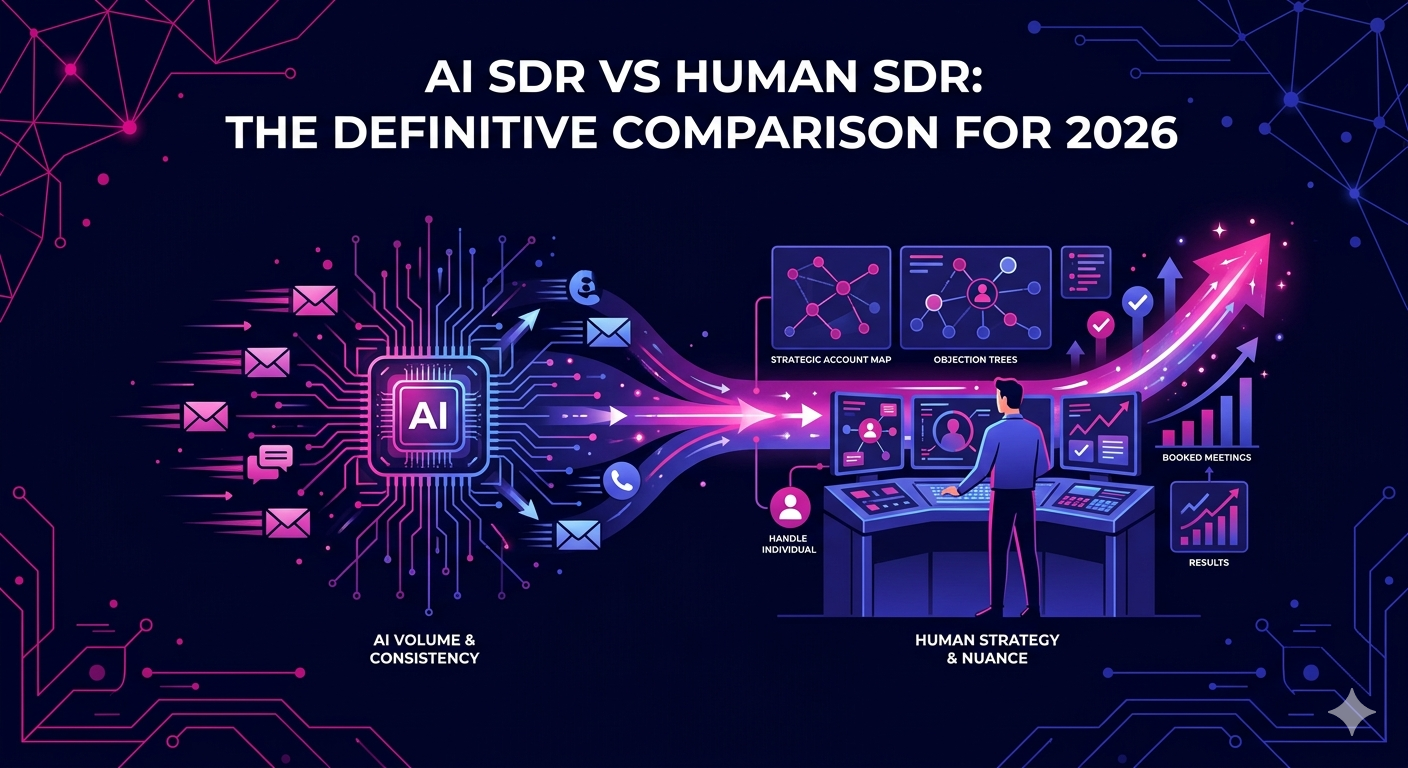
The most effective sales development teams in 2026 are not choosing between AI SDR and human SDR. They are using AI to handle the scale and mechanics of outreach while human SDRs manage strategy, personalization for high-value accounts, reply handling, and relationship development.
Here is what that looks like in practice:
- AI tools identify and enrich prospect lists automatically
- AI sequencing handles initial outreach for tier-two and tier-three accounts
- Human SDRs take over all replies, regardless of tier
- Human SDRs own all outreach for top-tier, high-ACV target accounts from the start
- Human SDRs review AI sequence performance and update messaging strategy weekly
This hybrid model captures the volume and efficiency advantages of AI while preserving the conversion quality and relationship-building that only human SDRs deliver. It is the configuration that leading sales teams across SaaS, professional services, and B2B e-commerce have adopted in 2026.
For a broader look at how AI is reshaping sales roles and productivity benchmarks across industries, Salesforce’s State of Sales research provides detailed data on AI SDR adoption trends and the evolving role of human sales professionals in 2026.
Conclusion: Make the Right Choice for Your Pipeline
The AI SDR vs human SDR question does not have a single universal answer. It depends on your market, your ACV, your sales cycle complexity, and the accounts you are targeting. What is clear in 2026 is that the businesses building the most consistent, high-quality pipeline are the ones treating AI and human SDRs as complementary rather than competing resources.
If you are ready to add skilled human SDR talent to your outreach strategy and want professionals who understand how to operate within a modern, automation-supported sales environment, explore the vetted remote SDR specialists at The Remote Reps and build the sales development team your pipeline deserves.
Frequently Asked Questions About AI SDR vs Human SDR
What is the main difference between an AI SDR and a human SDR?
The main difference in the AI SDR vs human SDR comparison is that an AI SDR is a software system that automates prospecting, outreach, and follow-up tasks, while a human SDR is a trained sales professional who brings judgment, adaptability, and genuine relationship-building to the process. AI SDRs excel at volume and consistency. Human SDRs excel at personalization quality, objection handling, and converting high-value prospects into meetings.
Is an AI SDR cheaper than a human SDR?
In terms of monthly cost, AI SDR platforms are generally less expensive than compensating a human SDR. However, cost per qualified meeting booked often tells a different story. For mid-market and enterprise outreach, human SDRs frequently achieve lower cost per meeting due to higher reply and conversion rates. For high-volume SMB outreach, AI SDR tools can be more cost-efficient. The right answer depends on your target market and deal size.
Can AI SDR tools replace human SDRs entirely?
As of 2026, AI SDR tools cannot fully replace human SDRs for complex, high-value sales development. They can replace human effort for repetitive, high-volume outreach tasks, but they fall short on nuanced objection handling, strategic account research, and the human presence that builds trust with buyers during the early sales process. The AI SDR vs human SDR debate is best resolved by using both in a coordinated hybrid model rather than treating them as substitutes.
Which industries benefit most from human SDRs over AI SDRs?
Industries with complex buying processes, long sales cycles, high average contract values, or regulatory sensitivity benefit most from human SDRs. These include enterprise SaaS, legal and compliance services, financial services, healthcare technology, and professional services firms. In these contexts, the AI SDR vs human SDR comparison consistently favors the human because relationship quality and trust have a direct impact on pipeline conversion rates.
How do top sales teams combine AI SDR and human SDR in 2026?
The most effective sales teams in 2026 use AI SDR tools to automate prospect list building, data enrichment, and initial outreach for lower-priority accounts. Human SDRs then manage all reply handling, own outreach for strategic target accounts, and continuously refine the AI-driven messaging strategy based on performance data. This hybrid AI SDR vs human SDR model delivers both the volume of automation and the conversion quality of skilled human outreach.
How quickly can a remote human SDR start generating pipeline?
A remote human SDR hired through a specialized staffing platform can typically begin generating pipeline within two to four weeks. This is faster than the 30 to 60 day ramp typical of in-house hires because remote SDR specialists hired through focused platforms bring existing tools proficiency, outreach methodology, and industry experience from day one. When paired with AI SDR tools for volume support, a remote human SDR can be operating at full capacity within the first month.