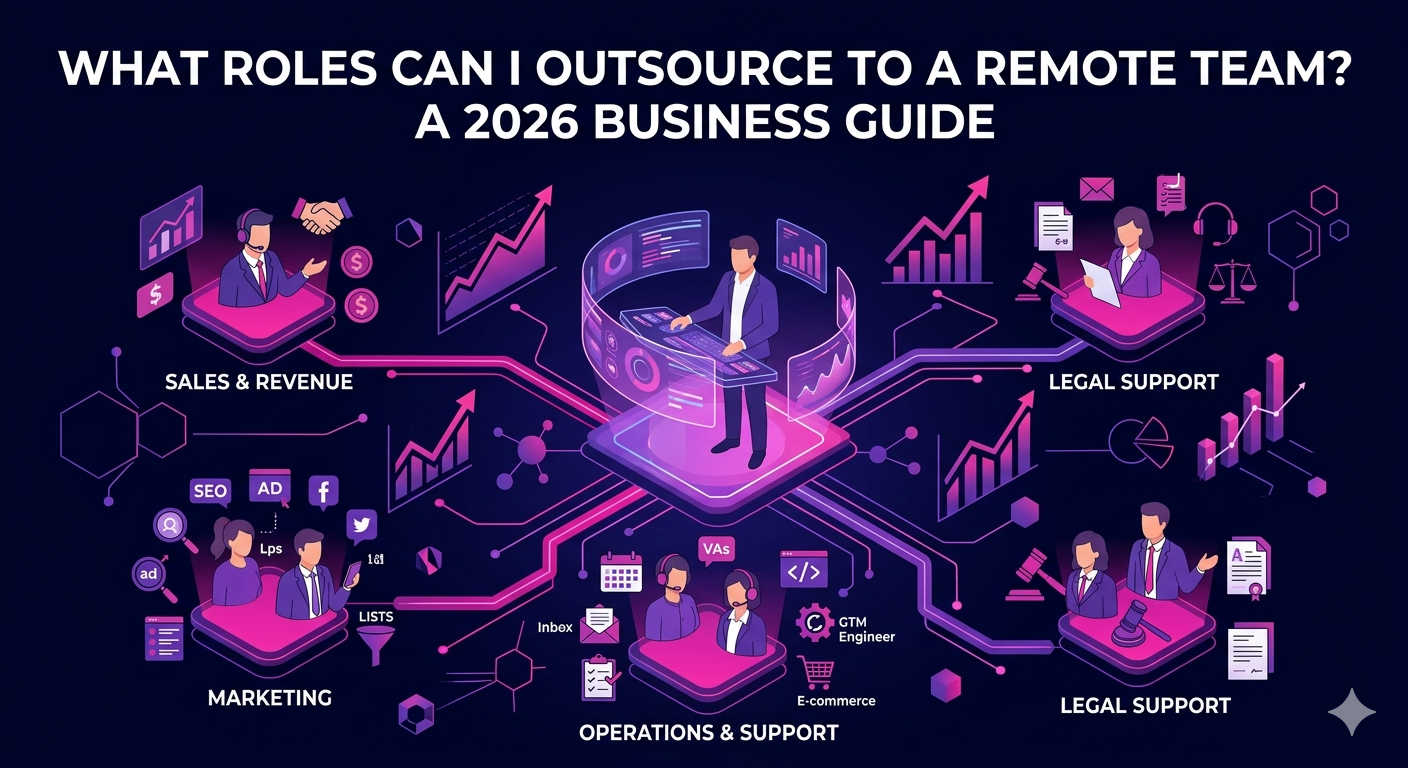
If you have ever asked yourself, what roles can I outsource to a remote team, you are not alone. In 2026, remote outsourcing has shifted from a cost-cutting workaround to a core growth strategy for businesses of every size. From early-stage startups to established mid-market companies, leaders are discovering that building a distributed team of specialists is one of the fastest ways to scale output without scaling overhead.
This guide breaks down the most valuable roles businesses are outsourcing to remote teams today, what each role delivers, and how to decide which positions make sense for your specific situation.
Why Businesses Are Outsourcing More Roles to Remote Teams in 2026
The case for remote outsourcing has never been stronger. Global talent access, improved collaboration tools, and a mature ecosystem of remote staffing agencies have made it easier than ever to build high-performing distributed teams. Businesses that outsource strategically benefit from faster hiring timelines, access to specialized skills not available locally, and significant reductions in fixed labor costs.
The key is knowing which roles translate well to a remote model and which require physical presence. The good news is that a wide range of revenue-generating, operational, and support functions can be handled just as effectively, often more so, by a well-vetted remote team.
Sales and Revenue Roles You Can Outsource to a Remote Team
Sales Development Representatives (SDRs)
SDRs are one of the most commonly outsourced roles in 2026. Their work, which involves prospecting, cold outreach, and booking qualified meetings, is entirely location-independent. A remote SDR with strong communication skills and CRM proficiency can fill a pipeline just as effectively as an in-house hire, often at a fraction of the cost.
Remote SDRs work well for companies looking to expand into new markets, test outbound channels, or scale lead generation without committing to full-time in-house headcount. If you are exploring this option, browse vetted remote SDRs available through The Remote Reps to see what a qualified placement looks like.
Remote Sales Representatives
Full-cycle sales roles, where a representative handles both prospecting and closing, are also highly outsourceable. Remote sales reps can manage discovery calls, product demos, proposals, and contract negotiations through video conferencing and digital tools. With the right onboarding and performance tracking in place, a remote sales rep can deliver results that match or exceed those of an in-office counterpart.
Cold Email Specialists
Cold email outreach is a skill in its own right. Outsourcing this role to a remote specialist means you get someone focused entirely on deliverability, copy optimization, sequence strategy, and A/B testing. For companies running outbound campaigns at scale, a dedicated cold email expert is one of the highest-ROI remote hires available.
Marketing Roles You Can Outsource to a Remote Team
Digital Marketers
Digital marketing spans a wide range of disciplines, and most of them are fully remote-compatible. Whether you need someone to own your overall growth marketing strategy or handle specific channels, remote digital marketers bring campaign execution expertise without the overhead of a full in-house department.
SEO Specialists
Search engine optimization is one of the cleanest remote roles available. Keyword research, technical audits, content strategy, link building, and performance reporting are all conducted digitally. A remote SEO specialist can manage your entire organic search program from anywhere in the world, delivering consistent output with no need for physical presence.
PPC and Paid Media Experts
Pay-per-click advertising and paid media buying require deep platform knowledge and constant optimization. Outsourcing these roles to remote specialists gives you access to experts who live inside Google Ads, Meta, LinkedIn, and programmatic platforms every day. Rather than hiring a generalist in-house, you get a focused practitioner who manages paid budgets as their primary function.
Social Media Managers
Managing social media presence, content calendars, community engagement, and performance analytics is a full-time role that many businesses under-resource internally. A remote social media manager takes this off your plate entirely, bringing both strategic and executional capability to your brand’s digital channels.
Lead Generation Experts
Beyond SDRs, dedicated lead generation specialists focus on building prospect lists, enriching data, identifying ideal customer profiles, and maintaining pipeline hygiene. This is a high-value function that pairs well with remote work since the entire workflow is data and tool-driven.
Operations and Administrative Roles to Outsource Remotely
Virtual Assistants
Virtual assistants are among the most versatile remote roles a business can outsource. A skilled VA handles calendar management, inbox organization, travel coordination, data entry, research tasks, vendor communication, and more. For founders and executives who are stretched thin, a remote VA is often the single hire that reclaims the most time.
Executive Assistants
Executive assistants operate at a higher level than general VAs, often serving as a strategic extension of a senior leader’s workflow. Remote EAs manage complex scheduling, board communications, project coordination, and confidential correspondence. With the right tooling and briefing, a remote EA can be just as effective as one sitting outside a physical office.
Customer Support Specialists
Customer support is one of the most widely outsourced remote functions across industries. Remote support specialists handle inbound inquiries, ticket resolution, live chat, onboarding assistance, and escalation management through shared helpdesk platforms. Businesses that outsource customer support remotely can also extend coverage hours without the cost of multiple in-house shifts.
Specialized and Technical Roles You Can Outsource to a Remote Team
GTM Engineers
Go-to-market engineers are a newer but rapidly growing remote role category. These specialists connect marketing, sales, and data systems to automate workflows, build prospecting infrastructure, and optimize the technical stack that drives revenue operations. Their work is entirely software-based, making it a natural fit for remote execution.
E-Commerce Marketing Experts
For businesses selling products online, remote e-commerce marketing specialists bring expertise in marketplace optimization, conversion rate improvement, email automation, and performance channel management. Whether you are running a DTC brand or a multi-channel retail operation, this role translates well to a remote team structure.
Amazon Experts
Amazon marketplace management is a specialized discipline that includes listing optimization, advertising campaign management, inventory coordination, and review strategy. Outsourcing this to a dedicated remote Amazon expert ensures your presence on the platform is actively managed by someone with category-specific knowledge and platform experience.
Legal Support Roles That Can Be Outsourced Remotely
Legal support functions are increasingly being handled by remote professionals, particularly for businesses that need legal capacity without the cost of a full-time in-house team.
- Legal Assistants: Handle document preparation, scheduling, filing, and administrative support for attorneys or legal departments.
- Legal Secretaries: Manage correspondence, court filings, billing coordination, and case documentation remotely.
- Paralegals: Conduct research, draft legal documents, assist with case preparation, and coordinate with clients under attorney supervision.
These roles are well-suited to remote delivery, provided proper confidentiality protocols and secure communication tools are in place.
How to Decide Which Roles to Outsource to Your Remote Team
Not every function is an equal candidate for remote outsourcing. The best approach is to evaluate each role against a few practical criteria:
- Is the work output-based and measurable rather than presence-based?
- Can the role operate effectively using digital communication and collaboration tools?
- Does the role require deep institutional knowledge that only comes from years in your specific company, or can it be ramped up with strong documentation and onboarding?
- Would you benefit from specialized expertise that is difficult to hire locally?
- Would a remote hire give you access to a larger talent pool at a more sustainable cost structure?
If the answer to most of these is yes, the role is likely a strong candidate for remote outsourcing. For a broader perspective on building distributed teams effectively, the Harvard Business Review’s research on remote work and distributed teams offers evidence-based frameworks that complement what staffing agencies bring to the table.
Conclusion
The question of what roles can I outsource to a remote team has a much broader answer in 2026 than it did even a few years ago. Sales, marketing, operations, technical execution, customer support, and legal functions are all viable candidates for remote outsourcing when the right vetting and onboarding processes are in place.
The businesses that move fastest are those that identify the right roles, partner with a staffing agency that has a proven vetting framework, and treat their remote team members as strategic assets rather than temporary labor. If you are ready to explore what your remote team could look like, visit The Remote Reps and start building the distributed team that fits your growth stage.
Frequently Asked Questions
What roles can I outsource to a remote team as a small business?
Small businesses typically see the most immediate impact from outsourcing administrative roles like virtual assistants, along with sales functions like SDRs and marketing roles like SEO specialists or social media managers. These are high-output positions that do not require physical presence and can be scaled up or down based on business needs, making them ideal for companies with lean internal teams.
What roles can I outsource to a remote team without losing quality?
Quality in remote outsourcing comes down to vetting and onboarding rather than location. Sales, digital marketing, customer support, legal assistance, and content roles are all regularly outsourced with strong quality outcomes when candidates are properly screened, given clear performance benchmarks, and supported with the right tools and communication rhythms.
Are there roles I should not outsource to a remote team?
Roles that require significant physical presence, such as facilities management or on-site production coordination, are not well-suited to remote outsourcing. Similarly, highly sensitive leadership roles that depend on deep institutional trust and real-time judgment may be better kept in-house initially. However, even many senior functions can be supported effectively by a skilled remote team member when the relationship is structured correctly.
How do I manage roles I outsource to a remote team?
Effective remote team management relies on clear output definitions, structured check-ins, shared project management tools, and transparent performance metrics. Setting expectations upfront, documenting workflows, and establishing regular communication cadences are the foundations of a high-performing remote team, regardless of the roles involved.
What roles can I outsource to a remote team to help with lead generation?
Lead generation is one of the most commonly outsourced functions to remote teams. Sales development representatives, cold email specialists, lead generation experts, and GTM engineers all contribute to building and maintaining a healthy sales pipeline. These roles work entirely through digital tools and outreach platforms, making them a natural fit for remote execution at any company size.
How quickly can I onboard roles I outsource to a remote team?
With a pre-vetted candidate from a specialized staffing agency, onboarding timelines for remote roles can be significantly shorter than traditional hiring. Many businesses have remote team members up and contributing within one to two weeks of placement. The key is having a clear onboarding checklist, tool access ready on day one, and an assigned internal point of contact for the new hire’s first month.