
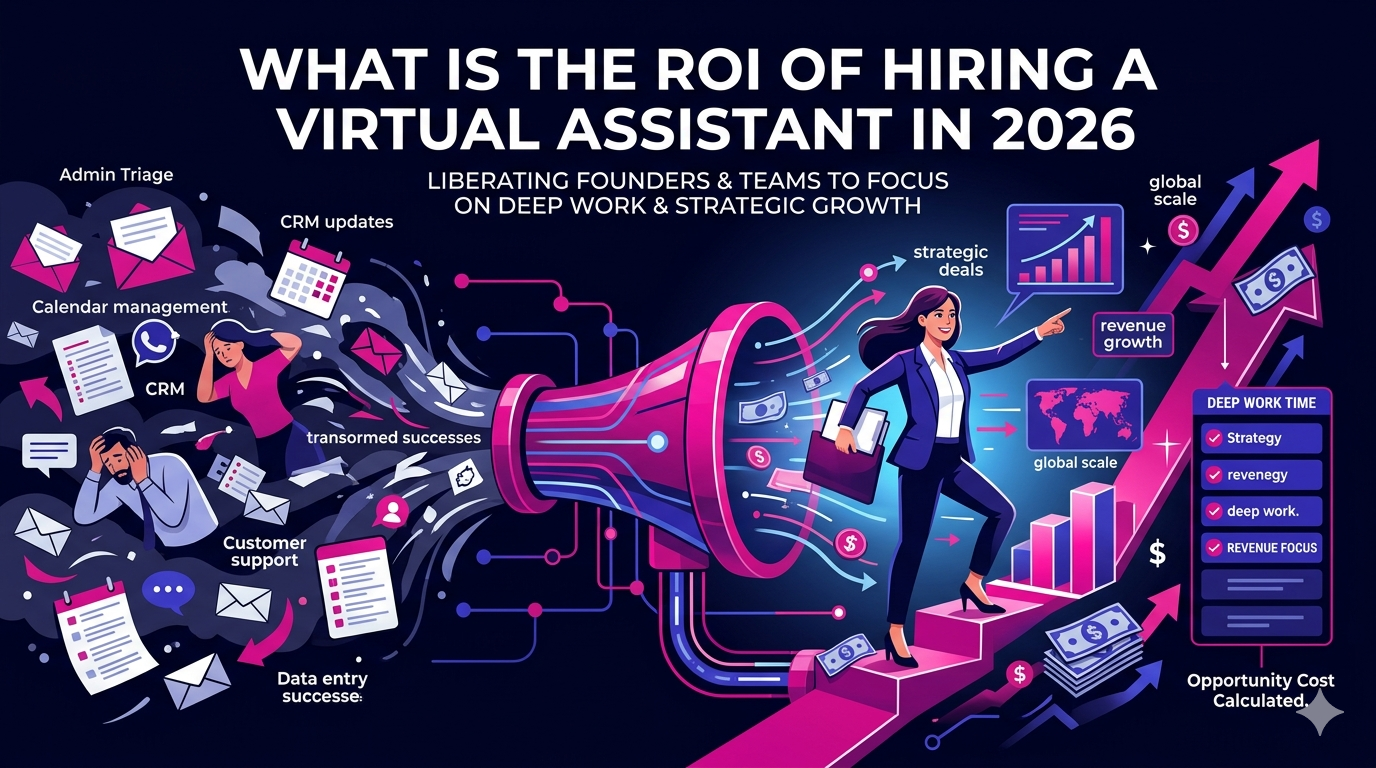
What is the ROI of hiring a virtual assistant? It is one of the most practical questions a business owner or executive can ask before making a hiring decision. In 2026, virtual assistants have moved well beyond calendar management and inbox organization. They now handle complex operational tasks, support sales pipelines, manage client communications, and keep businesses running efficiently at a fraction of the cost of a full-time in-house hire.
This guide breaks down the real return on investment you can expect when hiring a virtual assistant, how to calculate it for your specific situation, and what factors influence whether you get maximum value from the engagement.
Why Measuring the ROI of Hiring a Virtual Assistant Matters
Every business investment deserves scrutiny. Hiring a virtual assistant is no different. Without a clear understanding of the return, it is easy to either undervalue the contribution a great VA makes or continue an arrangement that is not delivering results.
The ROI of hiring a virtual assistant is measured across two primary dimensions. The first is cost savings compared to the alternative, typically a full-time employee or a senior professional spending time on tasks that fall below their pay grade. The second is the value created by freeing up high-impact team members to focus on revenue-generating and strategic activities.
Both dimensions matter, and together they paint a compelling picture for most businesses that take the time to run the numbers.
The Cost Comparison: Virtual Assistant vs. In-House Hire
To understand the ROI of hiring a virtual assistant, start with the cost side of the equation. The average fully loaded cost of an in-house administrative or executive assistant in the United States in 2026 runs between $55,000 and $75,000 per year when you factor in salary, payroll taxes, health insurance, paid leave, equipment, and office overhead.
A skilled virtual assistant from a reputable platform, by contrast, typically costs between $1,500 and $3,500 per month depending on the scope of work, experience level, and geographic location. That translates to $18,000 to $42,000 per year, representing a direct cost saving of anywhere from $13,000 to $57,000 annually before accounting for any productivity gains.
For small businesses, startups, and growing companies managing tight budgets, this cost differential alone often justifies the hire.
How to Calculate the ROI of Hiring a Virtual Assistant for Your Business
A precise ROI calculation requires three inputs: the cost of the virtual assistant, the value of the tasks they take over, and the value of what you or your team do with the time that gets freed up.
Step 1: Identify Tasks Being Delegated
Start by listing every task you plan to delegate. Common categories include email and calendar management, data entry and reporting, customer support and follow-up, research and competitor analysis, social media scheduling, travel coordination, and CRM updates. Estimate how many hours per week these tasks currently consume across your team.
Step 2: Assign a Dollar Value to Those Hours
Multiply the hours recovered by the average hourly cost of whoever is currently doing those tasks. If a founder earning the equivalent of $150 per hour is spending 10 hours per week on administrative work, that represents $1,500 in weekly opportunity cost. Over a year, that is $78,000 in time that could be redirected toward sales calls, product development, or strategic partnerships.
Step 3: Calculate Net Return
Subtract the annual cost of the virtual assistant from the value of time recovered plus any direct output value the VA generates (such as leads researched, support tickets resolved, or reports produced). The result is your net ROI. Most businesses that run this calculation honestly find the return is substantial from the first few months.
The Productivity ROI of Hiring a Virtual Assistant
Beyond the direct financial calculation, the ROI of a virtual assistant includes a less tangible but equally important benefit: the ability of key team members to operate at their highest level consistently.
Reclaiming Deep Work Time
Research consistently shows that knowledge workers perform their best work during uninterrupted blocks of focused time. When executives, salespeople, and creative professionals are pulled into low-value administrative tasks throughout the day, their capacity for high-quality deep work diminishes significantly. A virtual assistant acts as a filter and executor for routine work, protecting the cognitive bandwidth of your highest earners.
Scaling Without Hiring Full-Time Staff
Virtual assistants also provide a flexible capacity buffer that allows businesses to scale output without adding permanent headcount. During busy seasons, product launches, or growth sprints, a VA can absorb the overflow. This scalability is difficult to quantify precisely but represents real operational value that traditional hiring cannot easily match.
What Tasks Generate the Highest ROI When Delegated to a Virtual Assistant
Not all delegation is equal. The highest-return tasks to hand off to a virtual assistant are those that are time-consuming, repeatable, and do not require the specific expertise of your senior team members.
- Lead research and CRM data entry: Sales teams that outsource prospecting research to a VA can spend more time in actual selling conversations, which directly lifts revenue.
- Email triage and inbox management: Executives who reclaim even five hours per week from inbox management gain meaningful capacity for strategic work.
- Scheduling and calendar coordination: Eliminating back-and-forth scheduling alone can recover several hours per week across a team.
- Reporting and data compilation: Weekly or monthly reports that pull from multiple sources are ideal for a trained VA who can own the process end to end.
- Customer follow-up and support: Timely, consistent follow-up improves client retention, which has a direct and measurable impact on revenue.
If you are ready to see what a well-matched virtual assistant can do for your business, explore the virtual assistant services at The Remote Reps, where skilled VAs are matched to your workflow to maximize the ROI of your hiring investment.
Factors That Influence the ROI of Hiring a Virtual Assistant
The return you get from a virtual assistant is not automatic. Several factors determine whether the engagement delivers strong results or underperforms expectations.
Quality of Onboarding and Documentation
Virtual assistants perform best when they have clear processes, documented workflows, and well-defined expectations from the start. Businesses that invest time upfront in onboarding their VA properly consistently report faster time to value and higher quality output over the long term.
Alignment Between Skills and Tasks
Hiring a generalist VA for highly specialized work or assigning a specialist to tasks that fall outside their expertise both reduce ROI. The best outcomes come from matching the VA’s skill set precisely to the scope of work required.
Communication and Feedback Loops
Remote working relationships require intentional communication. Regular check-ins, clear feedback, and a defined escalation path for questions or blockers all contribute to a higher-performing VA engagement. Teams that treat their virtual assistant as a valued team member rather than an anonymous contractor consistently see better results.
Real-World ROI: What Businesses Are Seeing in 2026
Across industries, businesses that have integrated virtual assistants into their operations report consistent patterns. E-commerce companies using VAs for order management, customer service, and listing optimization report labor cost reductions of 30 to 50 percent compared to equivalent in-house teams. Professional services firms using VAs for administrative support report that senior consultants and attorneys are recovering between eight and fifteen billable hours per month. Sales-led organizations using VAs for prospecting research and CRM hygiene report measurable improvements in pipeline quality and rep productivity.
According to research featured by Harvard Business Review on the measurable productivity gains from flexible remote work arrangements including virtual assistant hiring, structured delegation to skilled remote workers produces consistent performance improvements when managed correctly.
Conclusion
The answer to what is the ROI of hiring a virtual assistant is clear for most businesses that take the time to calculate it properly. The combination of direct cost savings against in-house alternatives, the value of recovered executive and team time, and the scalability benefits adds up to a compelling business case in the vast majority of cases.
In 2026, the quality of virtual assistant talent available through specialized platforms has never been higher. The tools for managing remote working relationships have never been more effective. And the cost of not delegating, in lost focus, missed opportunities, and leadership burnout, has never been more visible.
If you are ready to unlock the ROI that comes from working with a skilled, vetted virtual assistant, The Remote Reps makes the process straightforward from day one.
Frequently Asked Questions
What is the ROI of hiring a virtual assistant for a small business?
For small businesses, the ROI of hiring a virtual assistant is often particularly strong because owners tend to spend a disproportionate amount of time on administrative tasks that pull them away from growth activities. By delegating these tasks to a VA at a fraction of the cost of a full-time hire, small business owners can redirect their time toward client acquisition, product improvement, and strategic planning, all of which contribute directly to revenue growth.
What is the ROI of hiring a virtual assistant compared to hiring a full-time employee?
When you compare the ROI of hiring a virtual assistant against a full-time employee, the VA consistently wins on cost efficiency. Full-time employees come with salary, benefits, taxes, equipment, and office costs. Virtual assistants are typically engaged on a contract basis with no additional overhead. For tasks that do not require a full-time commitment, the VA model delivers a significantly better return on the same budget.
How long does it take to see the ROI of hiring a virtual assistant?
Most businesses begin to see the ROI of hiring a virtual assistant within the first one to three months of engagement. The initial weeks involve onboarding and process documentation, which require some upfront time investment. Once the VA is fully integrated into workflows, the time savings and output benefits accumulate quickly. Businesses with well-documented processes often see positive ROI within the first month.
What is the ROI of hiring a virtual assistant for executive support?
The ROI of hiring a virtual assistant for executive support is driven primarily by the value of the executive’s time that gets recovered. When a CEO or senior leader is spending hours per week on scheduling, email management, and administrative coordination, each hour reclaimed represents the full value of their leadership capacity being redirected. For executives in high-revenue roles, recovering even a few hours per week can translate to tens of thousands of dollars in additional value annually.
What is the ROI of hiring a virtual assistant for sales support tasks?
For sales teams, the ROI of hiring a virtual assistant is tied directly to pipeline productivity. VAs who handle prospecting research, CRM data entry, follow-up scheduling, and outreach preparation allow sales reps to spend more time in active selling conversations. Since each additional selling hour has a quantifiable revenue value, even modest improvements in rep time allocation produce measurable ROI within a single quarter.
How do I measure the ROI of hiring a virtual assistant accurately?
To measure the ROI of hiring a virtual assistant accurately, track three things: the monthly cost of the VA engagement, the number of hours recovered by your team as a result of delegation, and the dollar value of those hours based on the hourly rate of the team members involved. Add any direct output value generated by the VA such as leads researched, tickets resolved, or reports delivered. Compare the total value created against the cost of the engagement to calculate your net return on a monthly or quarterly basis.