
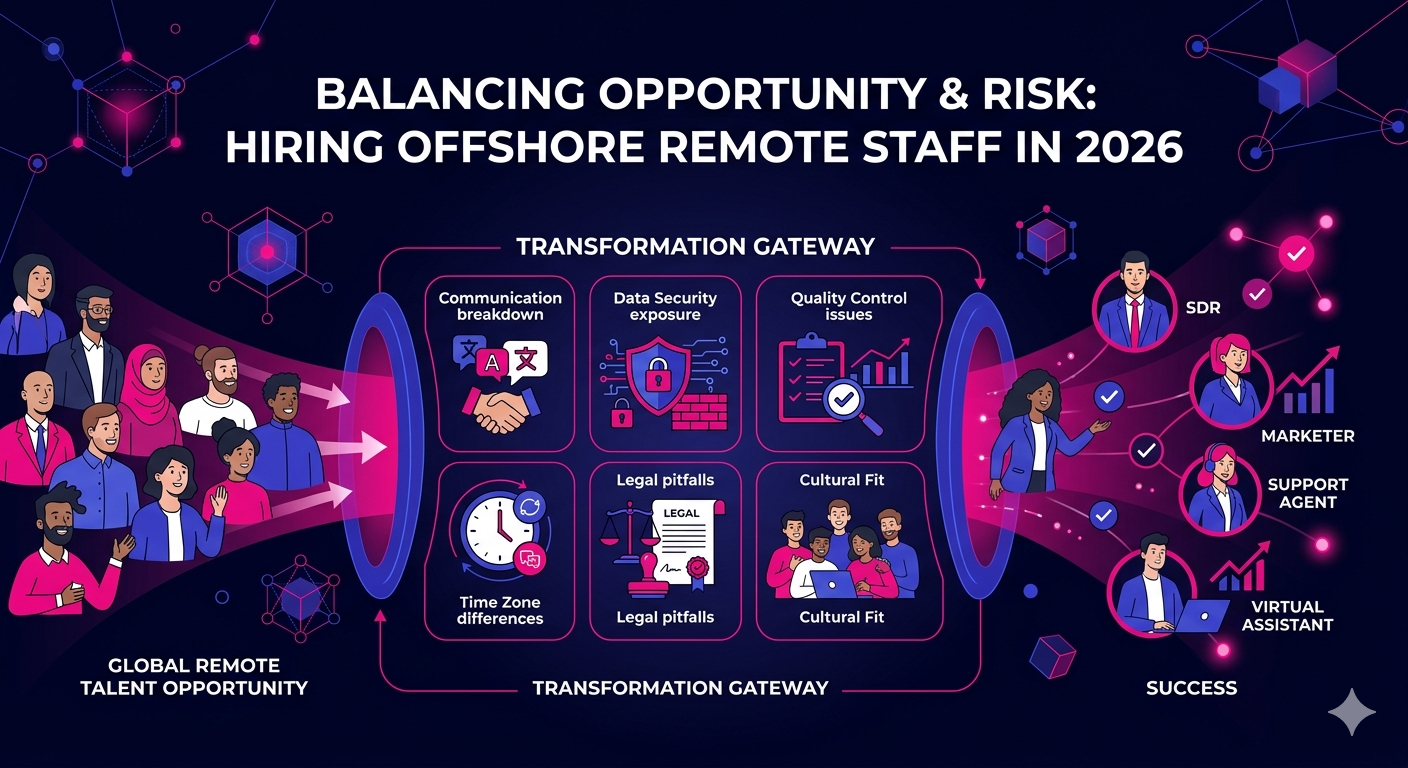
More businesses than ever are asking: what are the risks of hiring offshore remote staff? And for good reason. Offshore remote hiring has become one of the most popular strategies for scaling teams quickly and cost-effectively. In 2026, the global remote talent pool is larger and more skilled than it has ever been. But alongside the opportunities come real, practical risks that can derail a business if not managed carefully.
This guide walks through the most significant risks of hiring offshore remote staff, explains why they happen, and gives you actionable strategies to protect your business while still accessing world-class global talent.
Why Businesses Turn to Offshore Remote Staff
Before diving into the risks, it helps to understand why offshore hiring is so appealing. Businesses hire offshore remote staff primarily to:
- Reduce labor costs without sacrificing output quality
- Access specialized skills that are scarce or expensive in their home market
- Scale operations faster than local hiring timelines allow
- Maintain around-the-clock coverage across time zones
When done well, offshore remote hiring delivers all of these benefits. When done carelessly, it exposes businesses to a range of costly and avoidable problems. Understanding what the risks of hiring offshore remote staff actually are is the essential first step.
The Top Risks of Hiring Offshore Remote Staff
1. Communication Barriers and Misaligned Expectations
One of the most commonly reported risks of hiring offshore remote staff is communication breakdown. Language differences, cultural nuances, and varying professional norms can all lead to misunderstandings that quietly erode productivity and morale.
This is not just about language fluency. It also includes differences in how feedback is given and received, how urgency is communicated, and what “done” actually means in different work cultures. A team member in one country may interpret a deadline very differently from a manager in another.
To reduce this risk, businesses need documented processes, regular structured check-ins, and onboarding that explicitly sets expectations around communication standards and response times.
2. Data Security and Intellectual Property Exposure
Data security is one of the most serious risks of hiring offshore remote staff. When employees work from different jurisdictions, businesses face challenges around data protection laws, device security, and the enforceability of confidentiality agreements.
Key concerns include:
- Access to sensitive customer data, proprietary systems, or financial information
- Varying levels of cybersecurity infrastructure in different countries
- Difficulty enforcing non-disclosure agreements across international borders
- Use of personal or unsecured devices for work tasks
Businesses that hire offshore without a clear data governance policy are leaving themselves exposed. In 2026, with regulatory scrutiny on data privacy higher than ever, this is not a risk worth taking lightly.
3. Quality Control and Performance Management
Another significant risk of hiring offshore remote staff is maintaining consistent quality. Without direct oversight, it can be harder to catch performance issues early, ensure work meets brand standards, or course-correct when output falls below expectations.
This risk is amplified when businesses hire offshore workers through informal channels without proper vetting. A low hourly rate is not a bargain if the work requires constant revision or fails to meet client expectations.
Effective quality control for offshore remote staff requires clear KPIs, regular performance reviews, structured feedback loops, and ideally a hiring partner who has already vetted candidates before they reach you.
4. Legal and Compliance Risks Across Jurisdictions
Employment law varies dramatically from country to country, and misclassifying an offshore worker or failing to comply with local labor regulations can result in fines, legal disputes, or reputational damage. This is one of the most underestimated risks of hiring offshore remote staff.
Common legal pitfalls include:
- Misclassifying employees as independent contractors
- Failing to account for mandatory benefits or statutory entitlements in certain countries
- Ignoring local termination laws when ending a working relationship
- Not having contracts that are enforceable under the worker’s local jurisdiction
Working with a reputable remote staffing platform that understands international compliance significantly reduces exposure to these legal risks.
5. Time Zone and Availability Challenges
Time zone differences can be a strength or a liability depending on how they are managed. When offshore remote staff and onshore teams have little to no overlapping working hours, collaboration slows down, decisions get delayed, and projects stall.
This risk is particularly acute for roles that require real-time communication, such as sales development representatives, customer support agents, or executive assistants who need to be available during specific business hours.
Addressing this upfront during the hiring process, by specifying required working hours and overlap expectations, prevents significant friction later on.
6. Cultural Fit and Team Integration
Beyond technical skills, cultural fit matters deeply in remote teams. One of the less-discussed risks of hiring offshore remote staff is the challenge of integrating workers into company culture when there is no physical office environment to reinforce shared values and norms.
Without deliberate effort, offshore staff can feel isolated, disengaged, or disconnected from the business’s mission. This leads to higher turnover, lower motivation, and reduced loyalty, all of which cost money and momentum.
Businesses that invest in onboarding, team rituals, recognition, and inclusion consistently see better retention and performance from their offshore remote teams.
7. Over-Reliance on a Single Hire or Platform
Hiring one offshore worker to carry a critical business function without a backup plan is a structural risk that many businesses do not recognize until something goes wrong. If that worker leaves, becomes unavailable, or underperforms, the entire function can grind to a halt.
Building redundancy into offshore hiring, whether through team structures, documented processes, or relationships with staffing partners who can replace talent quickly, is a practical safeguard that mature businesses prioritize.
How to Mitigate the Risks of Hiring Offshore Remote Staff
Understanding what the risks of hiring offshore remote staff are is only half the equation. The other half is knowing how to manage them effectively. Here are the strategies that work in 2026:
- Use a vetted staffing platform: Platforms that pre-screen offshore talent for skills, communication ability, and professionalism reduce hiring risk significantly compared to sourcing through generic job boards.
- Define roles clearly before posting: Vague job descriptions attract mismatched candidates. Specificity in role requirements, deliverables, and expected outcomes sets the foundation for a successful hire.
- Implement structured onboarding: A documented onboarding process that covers tools, workflows, communication norms, and performance expectations reduces early-stage friction and misalignment.
- Use secure, standardized tools: Mandate the use of company-approved platforms for communication, file sharing, and project management to reduce data security risks.
- Review performance regularly: Monthly or bi-weekly performance check-ins keep quality standards high and create a forum for addressing issues before they escalate.
Working with a trusted partner who specializes in offshore remote staffing is one of the most effective ways to reduce risk while still accessing global talent. Explore professional offshore customer support experts who are pre-vetted for quality, communication, and reliability.
For businesses that want to understand what other clients have experienced when managing the risks of offshore remote hiring, reading real testimonials from companies who hire offshore remote staff provides grounded, first-hand perspective.
Is Offshore Remote Hiring Still Worth It in 2026?
Absolutely, but only when approached with the right structure and safeguards. The risks of hiring offshore remote staff are real, but they are also manageable. Thousands of businesses in 2026 are building high-performing, cost-effective teams with offshore remote professionals in sales, marketing, legal support, customer success, and beyond.
The difference between success and failure almost always comes down to preparation, process, and partnership. Businesses that treat offshore hiring as a strategic investment rather than a quick cost-cutting move consistently get better results.
Conclusion: Know the Risks, Hire With Confidence
So, what are the risks of hiring offshore remote staff? They range from communication breakdowns and data security vulnerabilities to legal compliance issues and cultural integration challenges. None of these risks are inevitable, and all of them can be significantly reduced with the right approach.
If you are considering building an offshore remote team in 2026, start by partnering with a staffing platform that understands both the opportunities and the pitfalls. The right partner does not just connect you with talent. They help you hire smarter, onboard faster, and manage risk from day one.
Ready to build your offshore remote team the right way? Visit The Remote Reps and discover how we help businesses hire skilled offshore remote staff with confidence, compliance, and consistency.
Frequently Asked Questions
What are the risks of hiring offshore remote staff related to data security?
Data security is one of the most serious risks of hiring offshore remote staff. Workers accessing sensitive business systems from different countries may operate under weaker cybersecurity standards, use personal devices, or fall under data protection laws that do not align with your home country’s regulations. To manage this risk, businesses should enforce the use of approved devices and platforms, implement access controls, and ensure all offshore staff sign enforceable confidentiality agreements before starting work.
What are the legal risks of hiring offshore remote staff?
The legal risks of hiring offshore remote staff include misclassifying workers as contractors instead of employees, failing to comply with local labor laws, and having contracts that are unenforceable in the worker’s jurisdiction. In 2026, these risks are especially relevant as governments in many countries have tightened enforcement of remote work regulations. Partnering with a staffing platform that understands international compliance is one of the best ways to reduce legal exposure.
How do communication issues factor into the risks of hiring offshore remote staff?
Communication barriers are among the most frequently reported risks of hiring offshore remote staff. Differences in language proficiency, cultural communication styles, and time zones can all lead to misaligned expectations, delayed decisions, and reduced team cohesion. Structured onboarding, documented workflows, and regular check-ins help bridge these gaps and ensure offshore team members are aligned with business goals and standards.
Can the risks of hiring offshore remote staff be fully eliminated?
The risks of hiring offshore remote staff cannot be fully eliminated, but they can be substantially reduced with the right strategies. Using a vetted staffing platform, defining roles clearly, implementing strong onboarding processes, and reviewing performance regularly are all proven methods for managing offshore hiring risk. The goal is not zero risk but informed, manageable risk that is far outweighed by the benefits of accessing global talent.
What are the quality control risks of hiring offshore remote staff?
Quality control is a significant risk of hiring offshore remote staff, particularly when workers are hired through informal channels without proper screening. Without clear KPIs, regular performance reviews, and structured feedback mechanisms, output quality can deteriorate without early warning signs. Businesses that hire through reputable remote staffing platforms benefit from pre-vetted candidates who have already been assessed for skill level, communication ability, and professional reliability, which reduces this risk considerably.
How does time zone difference factor into the risks of hiring offshore remote staff?
Time zone differences are a practical risk of hiring offshore remote staff that many businesses underestimate. For roles requiring real-time collaboration or specific business-hours availability, large time zone gaps can slow decision-making and reduce responsiveness. The risk is manageable by clearly specifying required overlap hours during the hiring process and choosing candidates whose availability aligns with your team’s core working hours rather than assuming flexibility after hiring.