If you have been relying on freelance virtual assistants to keep your business running, you have probably experienced the frustration of inconsistency firsthand. Missed deadlines, shifting availability, and the constant cycle of hiring and re-training are all symptoms of a model that was never designed for sustained business growth. The debate around managed remote staff vs freelance VA is one that more business owners are having in 2026, and for good reason.
This guide breaks down both models clearly, so you can make a confident decision about which approach actually supports your business goals rather than slowing them down.
What Is a Freelance VA?
A freelance virtual assistant is an independent contractor who offers administrative, creative, or technical services on a project or hourly basis. Freelance VAs typically work with multiple clients simultaneously and are sourced through platforms like Upwork, Fiverr, or Freelancer.com.
The appeal is obvious: low barrier to entry, no long-term commitment, and a wide range of skills available at various price points. However, the limitations become apparent quickly when your business requires reliability, consistency, and deep knowledge of your processes.
Common Characteristics of a Freelance VA
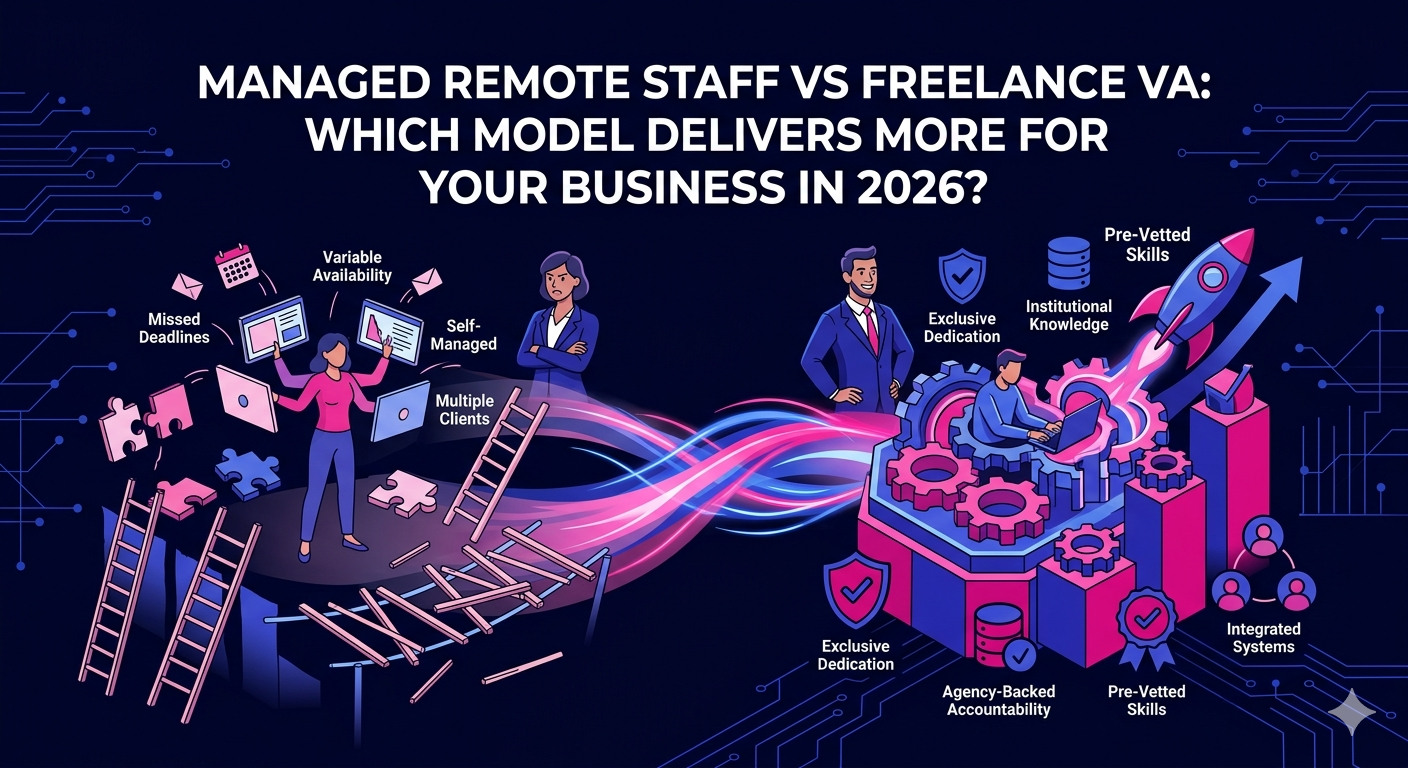
- Works with multiple clients at the same time
- No exclusive commitment to your business
- Variable availability depending on their workload
- Self-managed with minimal accountability to your standards
- Quality and output can vary significantly between tasks
What Is Managed Remote Staff?
Managed remote staff refers to dedicated professionals placed by a specialized remote staffing agency, where the agency handles vetting, onboarding support, and ongoing performance oversight. These professionals work exclusively for your business and are embedded into your workflows, tools, and team culture.
Unlike a freelance VA arrangement, managed remote staff are accountable not just to you but to the agency that placed them, creating an additional layer of quality control and performance management that freelance platforms simply do not provide.
Common Characteristics of Managed Remote Staff
- Dedicated exclusively to your business
- Pre-vetted for skills, communication, and remote readiness
- Supported by an agency that monitors and assists with performance
- Integrated into your systems, culture, and long-term goals
- Stable pricing with no unexpected rate changes mid-engagement
Managed Remote Staff vs Freelance VA: A Direct Comparison
Understanding the managed remote staff vs freelance VA distinction requires looking at several dimensions of the working relationship. Here is how the two models compare across the factors that matter most to business owners.
1. Dedication and Focus
A freelance VA splits their attention across multiple clients. Your tasks compete with the demands of everyone else they work for. Managed remote staff are dedicated to your business only, which means your priorities are always their priorities. Over time, this focused attention compounds into significantly better output quality and faster turnaround.
2. Accountability and Oversight
With a freelance VA, accountability is entirely self-imposed. If they underperform, your only recourse is to leave a review and start the hiring process over again. Managed remote staff come with agency-backed accountability. The staffing provider has a vested interest in ensuring the placement succeeds and will intervene if performance standards are not being met.
3. Institutional Knowledge
One of the biggest hidden costs in the managed remote staff vs freelance VA debate is the loss of institutional knowledge when a freelancer leaves. Every time you replace a freelance VA, you lose the context, processes, and tribal knowledge they have accumulated. Managed remote staff stay longer, learn more deeply, and become genuine assets to your operation over time.
4. Skill Specialization
Freelance VAs often position themselves as generalists to attract more clients. Managed remote staff are typically placed based on specific skill sets and role requirements. Whether you need an executive assistant, a customer support expert, or a digital marketer, a managed remote staffing model allows you to hire for exactly the competencies your business needs.
5. Cost Over Time
Freelance VAs may appear cheaper on a per-hour basis, but the true cost calculation changes significantly when you factor in re-hiring, onboarding, quality inconsistency, and lost productivity. Managed remote staff deliver a more predictable and ultimately more economical outcome for businesses that are serious about long-term operational efficiency.
The Real Cost of Relying on Freelance VAs
Most business owners underestimate how expensive the freelance model is at scale. Consider the time spent writing job posts, reviewing proposals, interviewing candidates, and onboarding a new VA, only to repeat the process three months later when they move on or become unavailable.
According to research highlighted by Forbes on the cost of staff turnover and managed vs freelance remote work models, the cost of replacing a worker can range from one-half to two times their annual compensation when all direct and indirect costs are included. Even for lower-cost freelance roles, this cycle adds up quickly and chips away at the savings that made freelancing attractive in the first place.
Managed remote staff break this cycle by providing stable, long-term placements that grow more valuable with every passing month.
When a Freelance VA Still Makes Sense
The managed remote staff vs freelance VA comparison is not entirely one-sided. There are legitimate scenarios where a freelance VA is the appropriate choice:
- You need a one-time task completed quickly without a long-term commitment
- The work is highly specialized and only required occasionally
- You are testing a new function before committing to a dedicated hire
- Budget constraints make any ongoing engagement temporarily unfeasible
That said, most businesses that start with a freelance VA as a temporary measure find themselves searching for a managed alternative within a few months once the limitations become clear.
Why Managed Remote Staff Win for Ongoing Business Operations
For any role that recurs week after week, managed remote staff deliver a level of reliability and integration that freelance arrangements simply cannot match. The ability to build processes, delegate confidently, and focus on high-level strategy depends on having remote professionals who are invested in your business’s success over the long term.
In 2026, businesses that have shifted from freelance VA arrangements to dedicated managed remote staff consistently report higher output quality, lower management overhead, and stronger alignment between remote team members and business objectives. The managed remote staff vs freelance VA comparison becomes especially clear when measured over a six to twelve month window.
If you are ready to move beyond the freelance cycle and build a dedicated remote team, explore the managed virtual assistant and remote staff placement services at The Remote Reps to find professionals who will integrate fully into your business and deliver consistent, long-term results.
How to Make the Transition from Freelance VA to Managed Remote Staff
Step 1: Document What Your Current VA Actually Does
Before making any changes, map out every task your freelance VA currently handles. This gives you a clear scope of work to hand off to a managed placement and ensures nothing falls through the gaps during the transition.
Step 2: Identify Which Tasks Need Specialization
Some tasks your freelance VA handles may require a higher level of skill than a generalist can provide. Use this transition as an opportunity to match each function to the right type of remote specialist rather than bundling everything under one generalist role.
Step 3: Partner with a Managed Remote Staffing Provider
Choose a remote staffing agency that specializes in dedicated placements rather than a freelance marketplace. Look for a provider that conducts thorough skills assessments, offers post-placement support, and has a track record of successful long-term placements in your industry.
Step 4: Run a Structured Onboarding Process
Unlike with a freelance VA, a managed remote staff member should receive proper onboarding, access to your tools, and clear KPIs from the start. The more structured this process, the faster they will reach full productivity and the longer they will stay.
Conclusion: Stop Settling for Inconsistency
The managed remote staff vs freelance VA question has a clear answer for any business that values reliability, quality, and long-term growth. Freelance VAs serve a purpose, but they are not a foundation for scalable operations. Managed remote staff are.
If you are tired of starting over every time a freelance VA moves on, it is time to invest in a model that was built for sustained performance. The Remote Reps places dedicated, fully vetted remote professionals across a wide range of roles to help businesses like yours build the remote teams they actually need.
Visit The Remote Reps executive assistant and managed remote staff services to start building a remote team that shows up, delivers, and grows with your business.
Frequently Asked Questions
What is the main difference between managed remote staff and a freelance VA?
The core difference in the managed remote staff vs freelance VA comparison is dedication and accountability. A freelance VA works independently across multiple clients with no formal oversight beyond the platform they are sourced from. Managed remote staff are placed by a staffing agency, work exclusively for your business, and are supported by ongoing performance management from the agency. This structure produces better reliability, deeper integration, and stronger long-term results.
Is managed remote staff more expensive than a freelance VA?
On a surface-level per-hour comparison, a freelance VA can appear less expensive. However, when you account for re-hiring costs, onboarding time, quality inconsistency, and lost productivity, managed remote staff typically delivers better value over a six to twelve month period. The managed remote staff vs freelance VA cost comparison shifts significantly in favor of managed placements when viewed over a longer time horizon.
Can managed remote staff handle the same tasks as a freelance VA?
Yes, and often at a higher level of quality. Managed remote staff can handle everything a freelance VA does, including administrative support, scheduling, inbox management, research, and customer communication. Because they are dedicated to your business and properly onboarded, they develop context and process knowledge that a rotating roster of freelance VAs never accumulates. This is one of the strongest arguments in the managed remote staff vs freelance VA debate.
How long does it take to transition from a freelance VA to managed remote staff?
The transition timeline depends on the complexity of your operations, but most businesses complete a managed remote staff onboarding within two to four weeks. A good remote staffing agency will support the transition process, help define the scope of work, and ensure the new placement is set up for success from day one. This is considerably faster than repeatedly hiring new freelance VAs and starting from scratch each time.
What types of roles can managed remote staff fill compared to a freelance VA?
The managed remote staff vs freelance VA comparison is especially favorable for specialized roles. While a freelance VA is often a generalist, managed remote staff can be placed as executive assistants, sales development reps, digital marketers, SEO specialists, customer support professionals, legal assistants, and more. The range of specialized roles available through a managed remote staffing provider is significantly broader than what most freelance VA platforms offer.
How do I know if managed remote staff is right for my business?
If you find yourself re-hiring VAs frequently, dealing with inconsistent output, or spending too much time managing freelancers instead of growing your business, managed remote staff is almost certainly the better model for you. The managed remote staff vs freelance VA decision comes down to whether your operations require consistency, specialization, and accountability over the long term. If the answer is yes, a managed placement is the right investment.