
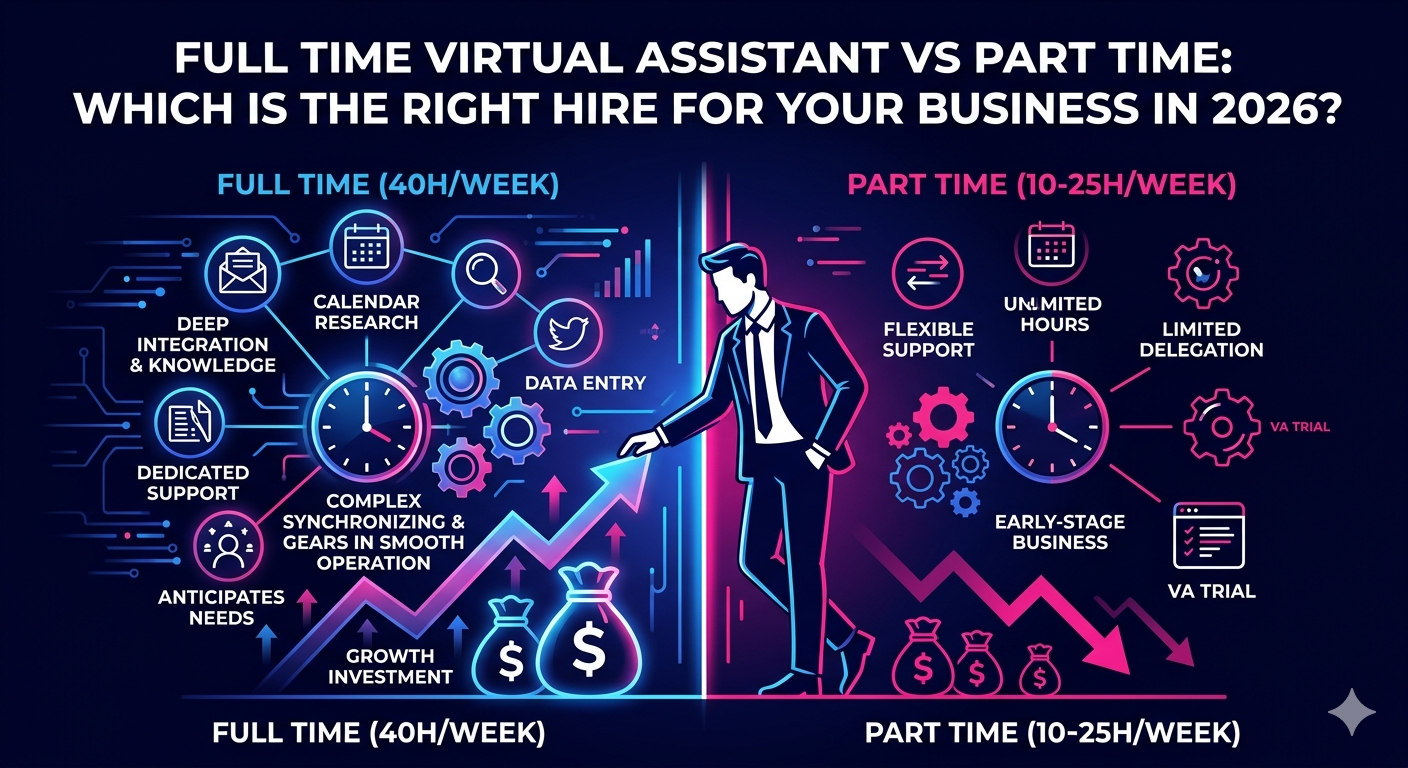
Deciding between a full time virtual assistant vs part time is one of the most common and consequential hiring decisions facing business owners and operators in 2026. Get it right, and you gain a reliable, productive team member who frees up your time and accelerates your operations. Get it wrong, and you either overpay for hours you do not need or find yourself constantly bottlenecked by a VA who simply does not have enough time to keep up with your demands.
This guide walks through everything you need to consider, from workload and cost to role complexity and long-term value, so you can make a confident, informed decision.
What Is a Full Time Virtual Assistant?
A full time virtual assistant typically works 40 hours per week, exclusively or primarily for your business. They are deeply embedded in your operations, manage recurring workflows, and develop strong familiarity with your systems, preferences, and business goals over time.
Full time VAs are suited to businesses with consistent, high-volume administrative or operational needs. They handle everything from inbox and calendar management to research, reporting, client coordination, data entry, social media scheduling, and project support.
What Is a Part Time Virtual Assistant?
A part time virtual assistant works a reduced schedule, typically anywhere from 10 to 25 hours per week. They are a good fit for business owners who have genuine but not constant VA needs, or who are at an earlier stage where full time support is not yet justified by workload or budget.
Part time VAs can handle the same range of tasks as full time VAs, but within a more limited time allocation. The challenge is ensuring their available hours align with your peak demand periods and that task volume does not regularly spill beyond their scheduled time.
Full Time Virtual Assistant vs Part Time: Key Factors to Compare
Workload and Task Volume
The single most important factor in the full time virtual assistant vs part time decision is your actual workload. Many business owners underestimate how much administrative and operational work they are either doing themselves or leaving undone.
Before deciding, audit your own time for one to two weeks. Track every task you would realistically delegate: emails, scheduling, research, follow-ups, document preparation, data management, and so on. If that delegation list consistently exceeds 20 to 25 hours per week, a part time VA will not cover it. You will either need to top up with a second hire or upgrade to full time.
Cost Comparison: Full Time VA vs Part Time VA
Cost is often the first lens through which business owners evaluate the full time virtual assistant vs part time question. Here is how the economics typically break down in 2026:
- A part time virtual assistant at 20 hours per week costs roughly half the monthly rate of a full time hire at the same hourly rate
- However, part time VAs may carry a slightly higher hourly rate than full time equivalents, particularly when hired through specialist providers, due to the shorter commitment
- A full time VA delivers better cost-per-output over time as they build institutional knowledge, reduce briefing overhead, and require less re-orientation between sessions
- Full time VAs also eliminate the productivity gap that part time VAs create when they are unavailable during your business hours
For businesses generating consistent revenue and relying on operational support to maintain that revenue, the cost of a full time virtual assistant is almost always justified by the return.
Availability and Responsiveness
One of the most underappreciated differences between a full time virtual assistant vs part time is real-time availability. If your business operates during standard working hours and you regularly need same-day responses, document turnarounds, or live calendar management, a part time VA working three days a week or limited hours per day will create friction.
A full time VA, by contrast, is available when you need them. They can respond to urgent requests, handle time-sensitive tasks, and maintain operational continuity in a way that a part time arrangement simply cannot replicate.
Depth of Knowledge and Integration
The more hours a virtual assistant works for your business, the more they learn about how you operate. A full time VA who has spent six months working within your systems, communications style, and client relationships becomes a genuinely strategic asset. They anticipate needs, catch errors before they escalate, and handle complex tasks with minimal oversight.
A part time VA, working limited hours across a wider client base, rarely reaches that level of integration. The knowledge accumulation is slower, and the output quality often reflects that. For businesses where consistency and deep process familiarity matter, full time is the stronger investment.
When a Part Time Virtual Assistant Makes More Sense
There are genuine scenarios where a part time VA is the smarter choice:
- You are a solopreneur or early-stage founder with a real but limited delegation list
- Your VA needs are project-based rather than ongoing, for example launching a new product or managing a one-off campaign
- You want to trial a VA relationship before committing to a full time arrangement
- Your business has clear low-demand periods where full time hours would not be productively filled
In these cases, starting part time is a sensible and cost-conscious decision. Many business owners begin with a part time VA and transition to full time as their workload grows and confidence in the relationship builds.
When a Full Time Virtual Assistant Is the Right Call
For most established businesses and growing teams, a full time virtual assistant delivers superior value. Consider full time when:
- You are spending more than three to four hours per day on tasks you should be delegating
- You need consistent coverage during your business hours, five days a week
- Your VA role requires managing multiple complex workflows simultaneously
- You want to build a reliable, long-term support relationship with someone who truly knows your business
- The cost of your own time far exceeds the cost of a full time VA
According to research from McKinsey’s analysis of workforce productivity and delegation in high-growth businesses, executives and business owners who effectively delegate operational tasks to dedicated support staff report significantly higher focus time on revenue-generating and strategic activities. The full time virtual assistant model is one of the most direct paths to capturing that benefit.
Executive Assistant vs Virtual Assistant: A Related Consideration
When evaluating the full time virtual assistant vs part time question, it is also worth considering whether your needs have evolved beyond a standard VA role. Some business owners find that what they truly need is an executive assistant, a professional who handles more complex, judgment-based support including stakeholder communications, project coordination, travel logistics, and confidential business matters.
If your current or planned workload falls into that territory, exploring a dedicated remote executive assistant may be more aligned with your actual requirements than either a full time or part time general VA.
How to Decide: A Simple Framework
If you are still unsure whether a full time virtual assistant vs part time is right for you, run through these questions:
- Do I have more than 25 hours per week of genuine delegation tasks? If yes, go full time.
- Do I need someone available during my working hours on most days? If yes, go full time.
- Is my workload growing consistently quarter over quarter? If yes, go full time.
- Am I just starting out or testing whether a VA adds value to my workflow? If yes, start part time.
- Are my VA needs tied to a specific project with a defined end date? If yes, start part time.
Most business owners who answer these questions honestly find that a full time arrangement is either immediately justified or only a few months away.
Finding the Right Virtual Assistant for Your Business
Whether you decide on full time or part time, the quality of your virtual assistant matters as much as the hours they work. A well-matched, professionally vetted VA will outperform an unvetted hire regardless of schedule.
Businesses looking to hire a dedicated full time or part time virtual assistant can explore rigorously vetted options through The Remote Reps virtual assistant service, which matches business owners with pre-assessed remote professionals based on skill set, working style, and operational fit.
Conclusion: Full Time vs Part Time Virtual Assistant
The full time virtual assistant vs part time decision is ultimately about matching your investment to your actual and anticipated needs. Part time works well for early-stage, limited, or project-based requirements. Full time delivers depth, consistency, availability, and compounding value for businesses with ongoing operational demands.
If you have reached the point where your own time is your scarcest resource, a full time virtual assistant is not an overhead cost. It is a growth investment. Take the time to assess your workload honestly, and then hire accordingly.
FAQ: Full Time Virtual Assistant vs Part Time
How do I know if I need a full time virtual assistant vs part time?
The best way to decide between a full time virtual assistant vs part time is to audit your delegation workload for one to two weeks. If you consistently identify more than 20 to 25 hours of tasks per week that could be handled by a VA, full time is the right choice. If your needs are lighter or project-specific, part time may be sufficient for now.
Is a full time virtual assistant more cost-effective than a part time hire?
Over the medium to long term, a full time virtual assistant typically delivers better cost-per-output than a part time equivalent. Full time VAs build deeper knowledge of your business, require less re-briefing, and reduce the productivity gaps that occur when a part time VA is unavailable. For businesses with consistent operational needs, the full time model almost always provides greater overall value.
Can I start with a part time virtual assistant and upgrade to full time later?
Absolutely. Many business owners begin with a part time virtual assistant vs full time arrangement as a way to trial the working relationship and assess the real volume of their delegation needs. As workload grows and trust is established, transitioning to full time is straightforward, particularly when working with a specialist remote staffing provider who supports that flexibility.
What tasks can a full time virtual assistant handle that a part time VA cannot?
A full time virtual assistant can handle the same types of tasks as a part time VA, but with greater depth, consistency, and responsiveness. Because they work full hours exclusively for your business, they can manage high-volume recurring workflows, provide real-time support during business hours, take on complex multi-step projects, and develop the institutional knowledge required to handle sensitive or nuanced tasks with minimal oversight.
What is the typical cost difference between a full time virtual assistant vs part time in 2026?
In 2026, a part time virtual assistant working 20 hours per week typically costs around 40% to 55% of the monthly cost of a full time VA, depending on the role, skill level, and provider. However, the hourly rate for part time VAs is often slightly higher than full time rates due to the reduced commitment. When evaluating cost, factor in not just the fee but the output value, availability, and knowledge depth each option delivers for your specific business needs.