
Hiring has always been one of the largest line items on any business budget, but in 2026 the pressure to do more with less has pushed cost efficiency to the top of every leadership agenda. For companies willing to think strategically, learning how to reduce hiring costs with remote staffing is one of the highest-leverage moves available. Done correctly, remote staffing delivers access to skilled professionals at a fraction of traditional in-office hiring costs while maintaining, and in many cases improving, the quality of work your business depends on.
This guide breaks down exactly where the savings come from, which roles are best suited for remote staffing, and how to build a cost-efficient remote hiring process that scales with your business.
Why Traditional Hiring Is So Expensive in 2026
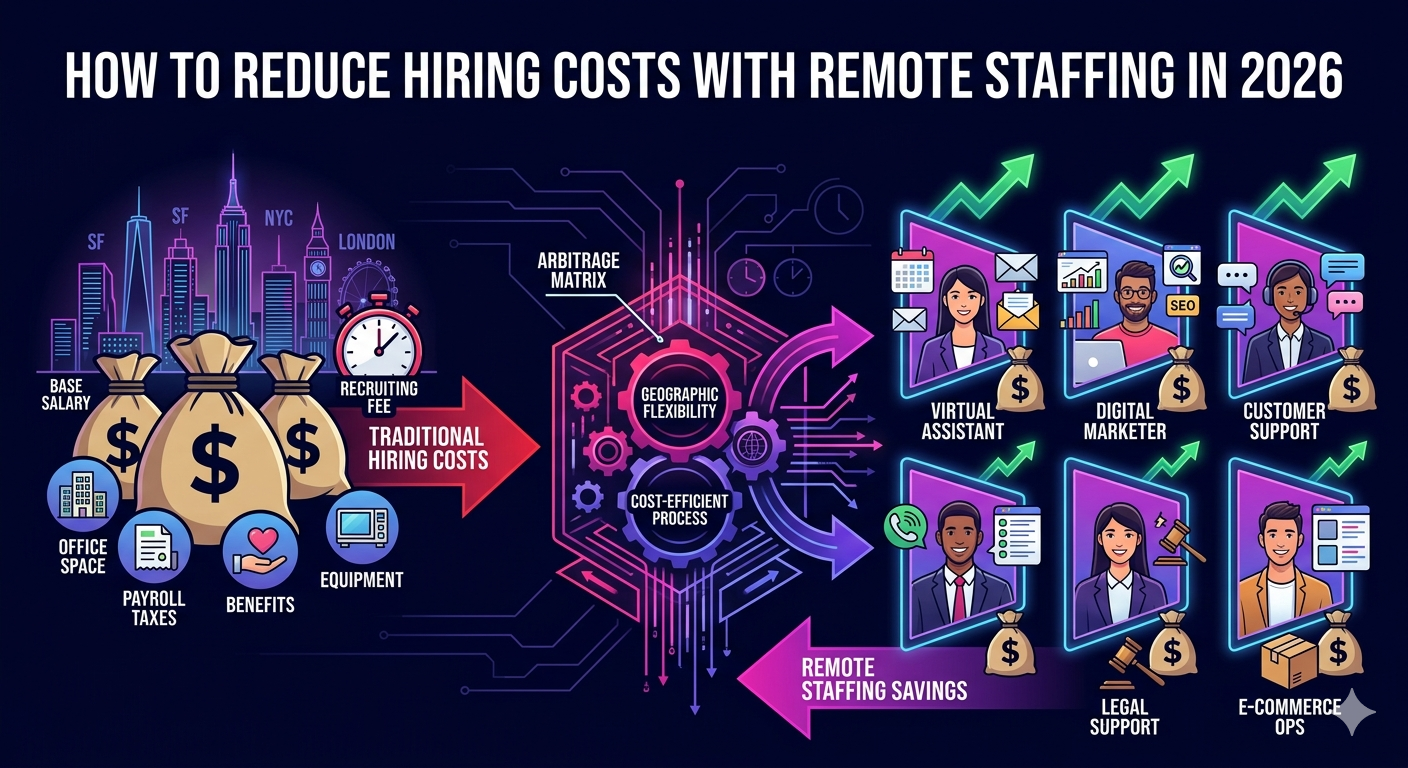
Before exploring how to reduce hiring costs with remote staffing, it helps to understand the true cost of a traditional in-house hire. Most business owners and HR leaders significantly underestimate this figure. When you factor in every line item, the total annual cost of a single full-time employee can be 1.25 to 1.4 times their base salary.
The real cost components include:
- Base salary and performance bonuses
- Payroll taxes and employer-side contributions
- Health, dental, and vision insurance premiums
- Paid time off, sick leave, and public holiday pay
- Office space, utilities, and workstation equipment
- Onboarding, training, and management time
- Recruiting fees, job board advertising, and interview hours
- Turnover costs when employees leave and the cycle restarts
In major metropolitan markets like New York, London, or San Francisco, these costs compound dramatically. A mid-level marketing manager with a $75,000 base salary can realistically cost a business over $100,000 per year in total when every expense is tallied. Remote staffing removes or significantly reduces most of these cost categories.
The Core Ways Remote Staffing Reduces Hiring Costs
The savings from remote staffing are not marginal. They are structural. Here is a breakdown of the primary cost levers that remote staffing unlocks:
Lower Compensation Costs Through Geographic Flexibility
One of the most immediate ways to reduce hiring costs with remote staffing is geographic arbitrage. When you are no longer restricted to candidates within commuting distance of your office, you open your search to skilled professionals in regions where market-rate compensation is significantly lower. A digital marketer, customer support specialist, or executive assistant in Latin America, Eastern Europe, or Southeast Asia may command 40 to 60 percent less than an equivalent professional in a major North American or Western European city, without any reduction in skill or output quality.
Elimination of Office and Equipment Overhead
Remote employees require no desk space, no office furniture, no on-site equipment provisioning, and no contribution to facilities management costs. For businesses with large teams, this saving alone can justify a move toward remote staffing. Even for smaller companies, eliminating or downsizing office space has an immediate and visible impact on the monthly budget.
Reduced Benefits and Payroll Tax Obligations
When working with remote contractors or professionals sourced through a staffing agency, your obligations around benefits, payroll taxes, and employer contributions are substantially reduced compared to hiring a full-time employee. The staffing agency typically handles payroll administration and compliance, removing both the financial burden and the administrative complexity from your operations.
Faster Time to Hire and Lower Recruiting Costs
Traditional recruiting for in-office roles can take 30 to 90 days when factoring in job posting, screening, interviewing, and negotiation. A specialized remote staffing agency maintains a pre-vetted talent pool and can typically present qualified candidates within days rather than weeks. This shorter time-to-hire means less management time spent on recruiting and a faster return on your staffing investment.
Which Roles Deliver the Best ROI When Staffed Remotely
While remote staffing can work across a wide range of functions, certain roles consistently deliver the strongest cost savings and quality results when hired remotely. These include:
- Virtual assistants and executive assistants handling scheduling, correspondence, and administrative workflows
- Digital marketers managing SEO, paid media, content, and social channels
- Customer support specialists managing email, chat, and inbound inquiries
- Sales development representatives conducting outreach and qualifying leads
- Legal support professionals including paralegals, legal assistants, and legal secretaries
- E-commerce operations specialists managing listings, fulfillment coordination, and marketplace accounts
Each of these roles requires strong communication and task execution but does not require physical presence to deliver high-quality results. They are also roles where the talent pool is significantly deeper and more cost-effective when sourced remotely rather than locally.
For businesses looking to reduce hiring costs with remote staffing across multiple functions simultaneously, The Remote Reps offers pre-vetted remote professionals across all of these categories. Whether you need a remote virtual assistant to reduce administrative overhead or specialized talent in sales, marketing, or legal support, the platform connects you with qualified professionals matched to your specific requirements and budget.
How to Build a Cost-Efficient Remote Staffing Process
Knowing the theory behind remote staffing savings is one thing. Building a repeatable process that consistently delivers quality hires at lower cost is another. Here is how to do it effectively:
Start with a Detailed Role Specification
Vague job descriptions attract unqualified applicants and waste screening time. Before you engage a staffing agency or post a listing, document the specific tasks, required tools, expected output, and performance benchmarks for the role. Precision at this stage translates directly into faster hiring and better candidate matches.
Use a Specialized Remote Staffing Agency
General job boards cast a wide net but generate significant volume of unvetted applications. A specialized remote staffing agency brings you candidates who have already been screened for skills, communication quality, and reliability. The upfront agency fee, where applicable, is almost always recovered within weeks through the time saved on screening and the reduction in bad hire risk.
Standardize Your Onboarding to Reduce Ramp-Up Costs
One of the hidden costs of hiring, whether remote or in-office, is the time it takes a new team member to reach full productivity. A well-documented onboarding process that includes written task guides, tool access instructions, and clear KPIs from day one significantly compresses the ramp-up period and reduces the productivity loss associated with every new hire.
Set Performance Metrics from the Start
Define what success looks like for every remote role before the hire begins. Clear metrics allow you to identify high performers early, course-correct underperformers quickly, and make data-driven decisions about headcount as your business grows. This accountability structure also tends to attract more professional, results-oriented candidates who are confident in their ability to deliver measurable outcomes.
The Long-Term Financial Impact of Reducing Hiring Costs with Remote Staffing
The savings from a single remote hire are meaningful. The savings from building an entire remote-first team are transformational. Consider a business that replaces five mid-level in-house roles with equivalent remote professionals. If each hire saves an average of $25,000 to $35,000 per year in combined salary, benefits, and overhead costs, the total annual saving ranges from $125,000 to $175,000. That capital can be reinvested directly into product development, marketing, or customer acquisition.
Beyond the direct financial benefit, remote staffing also reduces the operational risk associated with geographic talent shortages. When you are not limited to hiring within a single city or region, you are far less exposed to local market conditions that can drive salary inflation or create talent scarcity in specialized roles.
For additional research on cost reduction strategies through remote and flexible workforce models, the Society for Human Resource Management provides in-depth analysis on how to reduce hiring costs with remote staffing and flexible workforce planning across industries.
Frequently Asked Questions About How to Reduce Hiring Costs with Remote Staffing
How much can a business realistically save when it reduces hiring costs with remote staffing?
The savings vary by role, location, and engagement model, but most businesses that reduce hiring costs with remote staffing report saving between 40 and 70 percent per role compared to equivalent in-office hires in major metropolitan markets. This figure accounts for lower compensation costs, eliminated office overhead, reduced benefits obligations, and lower recruiting costs when using a specialized staffing agency.
Is it possible to reduce hiring costs with remote staffing without sacrificing quality?
Yes. The misconception that lower cost means lower quality does not hold when you use a structured hiring process and a reputable staffing agency. Many remote professionals bring specialist skills and deep experience that would be difficult or impossible to access within a single geographic market. When you define requirements clearly, evaluate candidates rigorously, and invest in proper onboarding, remote staffing consistently delivers comparable or superior quality to in-office hiring at a significantly lower cost.
Which business functions benefit most from reducing hiring costs with remote staffing?
Functions that are well-suited to digital workflows and asynchronous communication see the strongest results. These include marketing, customer support, sales development, legal assistance, executive and virtual assistant roles, and e-commerce operations. Any role where output is measurable and communication can be managed through digital tools is a strong candidate for cost reduction through remote staffing.
How does a remote staffing agency help reduce hiring costs compared to sourcing independently?
A remote staffing agency reduces hiring costs by maintaining a pre-vetted talent pool, handling initial screening and skills assessment, and presenting qualified candidates faster than independent sourcing. This reduces the management time spent on recruiting, shortens time-to-hire, and significantly lowers the risk of a costly bad hire. The agency fee, where applicable, is typically recovered within the first month through time savings alone.
Can small businesses reduce hiring costs with remote staffing, or is it only for larger companies?
Remote staffing is particularly valuable for small businesses and startups that need skilled support but cannot justify the full cost of in-office employment for every function. A small business owner can hire a remote virtual assistant, customer support specialist, or digital marketer at a cost that fits a lean budget while still accessing professional-grade talent. The flexibility to start part-time and scale hours as revenue grows makes remote staffing an ideal model for businesses at every stage.
What is the first step to reduce hiring costs with remote staffing for my business?
The first step is to audit your current workforce and identify roles where in-person presence is not required for strong performance. Document the tasks, tools, and output expectations for each of those roles. Then engage a specialized remote staffing agency to source pre-vetted candidates who match your requirements. Starting with one or two roles allows you to build confidence in the model before expanding your remote team further.
Start Reducing Your Hiring Costs with Remote Staffing Today
The businesses building the leanest, most capable teams in 2026 are not doing it by cutting corners. They are doing it by hiring smarter through remote staffing. When you understand how to reduce hiring costs with remote staffing at a structural level, the savings are not a one-time event. They are a compounding advantage that grows with every additional remote hire.
Define your needs, partner with the right staffing platform, and build a repeatable process. The financial case is clear. The only question is how quickly you act on it.