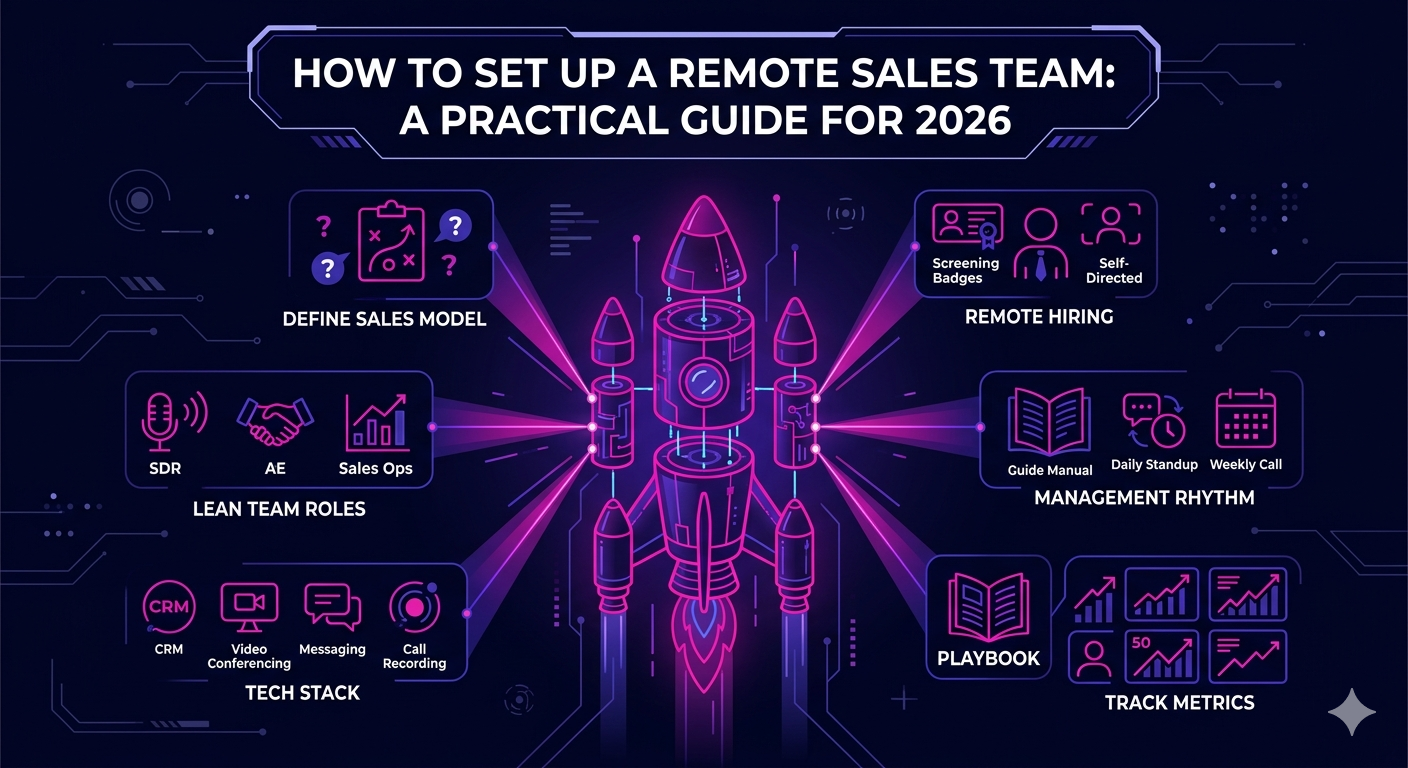
If you are trying to grow revenue without the overhead of a traditional office, learning how to set up a remote sales team is one of the highest-leverage decisions you can make. In 2026, distributed sales teams are no longer an experiment reserved for tech startups. They are the standard operating model for fast-growing companies across every industry, from SaaS and ecommerce to professional services and legal firms.
The good news is that the tools, talent, and playbooks for building remote sales teams have never been more mature. The challenge is knowing where to start, what to prioritize, and how to avoid the common mistakes that stall most teams before they hit their stride. This guide covers everything you need to get it right from day one.
Why Building a Remote Sales Team Makes Sense in 2026
Remote sales teams offer structural advantages that in-office teams cannot easily match. Before diving into the how, it is worth understanding why so many companies are choosing this model.
- Access to sales talent across global time zones without geographic limits
- Lower overhead with no office lease, equipment, or commute costs
- Ability to scale headcount up or down based on pipeline demand
- Higher candidate quality when location is not a constraint
- Proven productivity for outbound prospecting, demos, and closing calls
Research consistently shows that remote sales professionals, when given the right tools and management structure, perform at or above the level of their in-office counterparts. The key word is structure, and that is exactly what this guide will help you build.
Step 1: Define Your Sales Model Before You Hire Anyone
One of the most common mistakes founders make when setting up a remote sales team is hiring before they have clarity on the sales motion. Your hiring decisions should flow directly from your go-to-market model, not the other way around.
Questions to Answer Before You Hire
- Is your product sold inbound, outbound, or a combination of both?
- What is the average deal size and sales cycle length?
- Do you need SDRs for prospecting, closers for demos, or account managers for retention?
- What does a typical buyer journey look like from first touch to signed contract?
- Which channels drive your most qualified leads today?
Answering these questions upfront ensures that every hire has a clear role in a coherent system rather than a loosely defined job that shifts week to week.
Step 2: Build the Right Team Structure
A remote sales team does not need to be large to be effective. The most productive early-stage remote sales teams are lean, specialized, and well-coordinated. Here is how most high-performing remote sales teams are structured in 2026.
Core Roles in a Remote Sales Team
- Sales Development Representatives (SDRs): Handle top-of-funnel prospecting, cold outreach, and lead qualification. They set appointments for closers.
- Account Executives (AEs): Own the demo and closing process. They convert qualified leads into paying customers.
- Lead Generation Specialists: Research and build targeted prospect lists, enrich data, and support outbound campaigns.
- Cold Email and Outreach Experts: Craft and test multi-channel sequences across email, LinkedIn, and phone.
- Sales Operations or GTM Engineer: Manages the CRM, automates workflows, and tracks pipeline metrics.
Not every team needs all of these roles on day one. Start with SDRs and an AE if you are running outbound. Add supporting roles as volume and complexity increase.
If you are ready to hire your first SDRs as part of setting up your remote sales team, The Remote Reps SDR placement service connects you with pre-vetted sales development reps who are trained in outbound prospecting and ready to generate pipeline from week one.
Step 3: Set Up Your Sales Tech Stack
A remote sales team runs on its tools. Without a reliable tech stack, communication breaks down, data gets lost, and reps spend time on manual work instead of selling. Here are the core categories your stack needs to cover.
Essential Tools for a Remote Sales Team
- CRM: HubSpot, Salesforce, or Pipedrive for pipeline management and contact tracking
- Sales engagement platform: Outreach, Salesloft, or Apollo for sequencing and cadence management
- Prospecting and data tools: Apollo, Clay, or ZoomInfo for building and enriching lead lists
- Video conferencing: Zoom or Google Meet for demos and team calls
- Communication: Slack for async team communication and quick updates
- Call recording and coaching: Gong or Chorus for reviewing calls and improving rep performance
- Project management: Notion or ClickUp for onboarding, playbooks, and process documentation
Do not over-invest in tools before your process is proven. Start with the minimum viable stack and add complexity as your team grows and your needs become clearer.
Step 4: Hire for Remote Sales Specifically
Remote sales roles require a distinct profile compared to traditional inside sales. When you set up a remote sales team, you need people who are self-directed, disciplined, and strong communicators in writing as well as on calls.
What to Screen for in Remote Sales Candidates
- A track record of meeting quota in a remote or hybrid environment
- Strong written communication for async updates and outreach copy
- Comfort with CRM hygiene and data entry without being reminded
- Experience with the tools in your stack or demonstrable ability to learn them quickly
- Self-reported daily structure and time management habits
Using a Trial Period
Even experienced remote sales hires benefit from a structured two to four week paid trial. Assign real prospecting tasks, review their output, and assess how they communicate blockers and ask for feedback. The trial period reveals work habits that no interview can.
Step 5: Create a Remote Sales Playbook
A playbook is the single most important document for a new remote sales team. It captures everything a rep needs to perform independently: your ideal customer profile, messaging frameworks, objection handling scripts, sequence templates, and escalation paths.
What Your Remote Sales Playbook Should Include
- Ideal customer profile with firmographic and behavioral attributes
- Positioning and value propositions by buyer persona
- Approved email and LinkedIn outreach sequences with copy templates
- Call talk tracks for cold calls, discovery, and demos
- Common objections and recommended responses
- CRM standards including stage definitions and required fields
- Escalation process for deals above a certain size or complexity
The playbook does not need to be perfect before launch. A working draft that gets refined through real calls and feedback is far more valuable than a polished document that takes months to produce.
Step 6: Establish a Management Rhythm
Managing a remote sales team requires more intentionality than an in-office environment where casual check-ins happen naturally. Build a lightweight but consistent rhythm that keeps the team aligned without creating meeting overload.
Recommended Cadence for Remote Sales Teams
- Daily: Async standup in Slack with activities completed, pipeline updates, and blockers
- Weekly: Short team call to review pipeline, share wins, and address challenges
- Bi-weekly: One-on-one between manager and each rep to review metrics, calls, and development goals
- Monthly: Full pipeline review tied to quota attainment and forecast accuracy
The goal of this rhythm is visibility and accountability without micromanagement. Reps should feel supported and coached, not monitored.
Step 7: Track the Right Metrics from Day One
Data is the backbone of a high-performing remote sales team. Without clear metrics, it is impossible to diagnose problems, coach reps effectively, or forecast revenue with confidence.
Key Metrics for a Remote Sales Team
- Outbound activities per rep per day: calls, emails, and LinkedIn touches
- Connection and reply rates by channel and sequence
- Meetings booked per SDR per week
- Show rate for booked meetings
- Conversion rate from meeting to opportunity
- Average deal size and sales cycle length
- Quota attainment by rep and by team
Review these metrics weekly at the team level and bi-weekly at the individual level. Trends matter more than single-week snapshots, so track over rolling four-week periods when possible.
For additional frameworks on building and managing distributed sales teams, HubSpot’s guide to managing a remote sales team offers research-backed strategies used by thousands of revenue teams worldwide.
Conclusion: Build Your Remote Sales Team the Right Way
Knowing how to set up a remote sales team is only the beginning. The teams that outperform in 2026 are the ones that combine the right structure, the right people, and the right management habits into a repeatable system. Start lean, document your process, hire specialists rather than generalists, and build a culture where accountability and autonomy coexist.
Whether you are launching your first remote sales function or rebuilding an underperforming one, explore The Remote Reps lead generation and sales specialists to find pre-vetted remote sales talent ready to contribute from day one.
Frequently Asked Questions
How do I start to set up a remote sales team from scratch?
To set up a remote sales team from scratch, begin by defining your sales motion and ideal customer profile before making any hires. Decide whether you need outbound SDRs, inbound closers, or a combination, and map those needs to specific roles. Then build your tech stack around a CRM and sales engagement platform, write a basic playbook, and hire your first rep with a structured trial period built into the process.
What size team do I need when first setting up a remote sales team?
Most companies can test and validate their remote sales model with two to three people: one or two SDRs handling prospecting and one account executive closing the meetings they book. This lean structure is enough to generate data on conversion rates, messaging effectiveness, and quota capacity before you invest in a larger team. Scaling too fast before the model is proven is one of the most common and costly mistakes in remote sales.
What tools are essential when you set up a remote sales team?
The core tools for a remote sales team include a CRM for pipeline management, a sales engagement platform for outbound sequencing, a prospecting tool for list building, a video conferencing platform for demos, and a communication tool like Slack for async coordination. Call recording software for coaching becomes valuable once you have more than two reps on the team. Start with this foundation and add tools only as specific needs emerge.
How do you manage performance when you set up a remote sales team?
Performance management for a remote sales team depends on clear metrics, consistent review cadences, and a coaching culture rather than surveillance. Track activity metrics daily, review pipeline weekly, and hold bi-weekly one-on-ones with each rep. Use call recording tools to review outreach quality and give specific, actionable feedback. The goal is to create a system where reps know exactly what is expected and have the support to reach it.
How long does it take to set up a remote sales team and see results?
With the right structure in place, a remote sales team can begin generating qualified pipeline within the first four to six weeks. Outbound SDRs typically need two to three weeks to ramp through onboarding, tool setup, and initial sequence testing before their first meetings start booking consistently. Realistic quota attainment usually becomes measurable by the end of the first full quarter, which is also when you will have enough data to refine messaging and targeting.
Should I use a staffing agency to help set up a remote sales team?
Using a specialized staffing agency to set up a remote sales team can significantly reduce time-to-hire and improve candidate quality, especially if you are hiring your first remote sales professionals. Agencies that specialize in remote sales roles maintain active pipelines of pre-vetted candidates, reducing the time you spend on sourcing and initial screening. The placement fee is typically offset by the speed and quality of the hire compared to running the process independently through job boards.