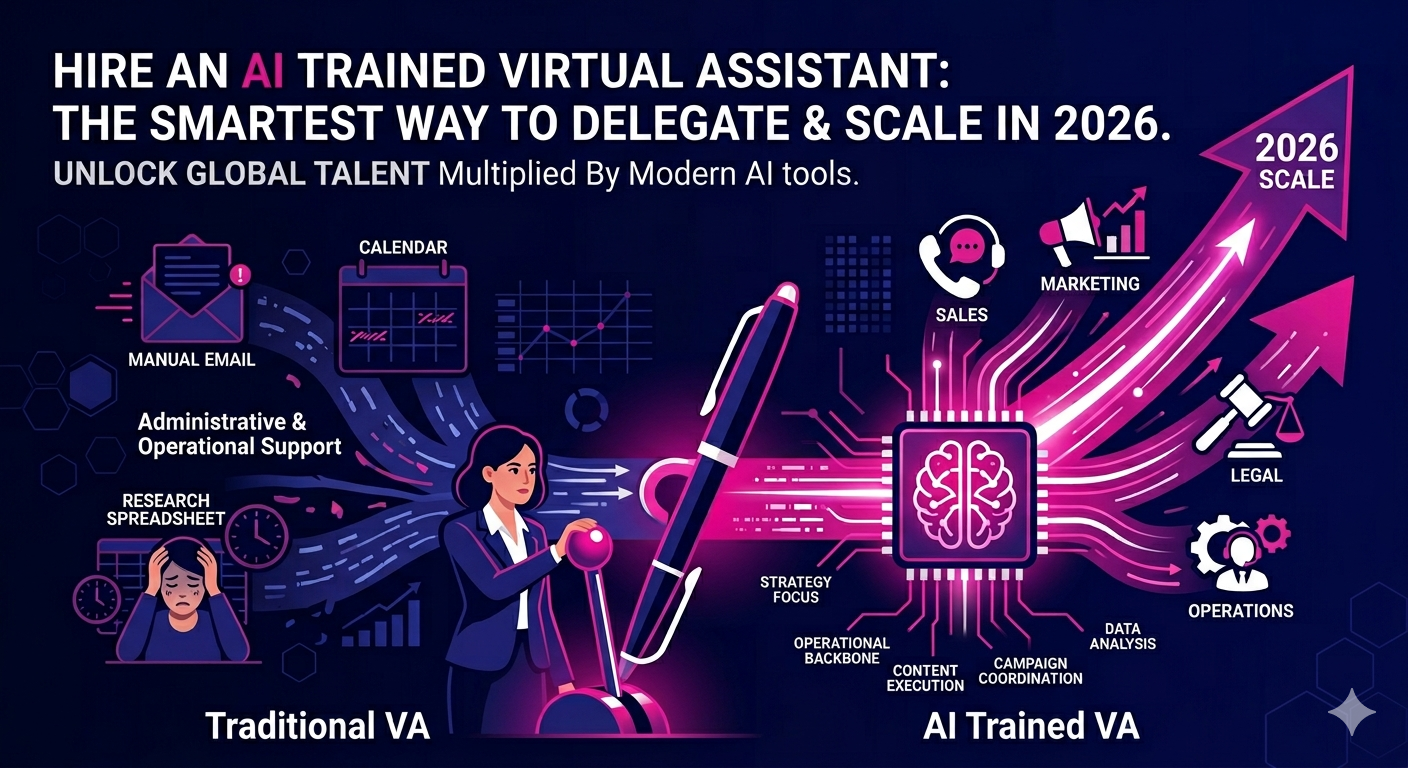
Not all virtual assistants are the same. In 2026, the difference between a traditional VA and an AI trained virtual assistant is the difference between a professional who can do what you ask and one who can do what you ask at two to five times the speed, with higher output quality, and across a broader range of tasks than manual effort alone would allow. When you hire an AI trained virtual assistant, you are not just getting someone to manage your calendar and answer emails. You are getting a skilled remote professional who integrates modern AI tools, including large language models, automation platforms, and AI-powered research and content tools, into every aspect of their workflow to deliver more value per hour than any traditional VA can match.
This guide covers everything you need to know about hiring an AI trained virtual assistant in 2026: what the role involves, what tasks an AI-enabled VA handles better than a traditional one, how to evaluate genuine AI proficiency during the hiring process, how much it costs, and how to build a working relationship that gets the most from this superior class of remote talent.
What Is an AI Trained Virtual Assistant?
An AI trained virtual assistant is a remote professional who has developed practical proficiency in using AI tools as a core part of their daily work. They are not just aware that AI tools exist. They use them systematically, strategically, and skillfully to accelerate research, draft and refine written content, automate repetitive workflows, generate reports, analyze data, and handle a range of tasks that would require significantly more time if performed by manual effort alone.
The AI training component is not a credential or a certification. It is a demonstrated habit of tool use and a developed judgment about when and how to apply AI tools for maximum quality and efficiency in a virtual assistant context. An AI trained VA is a professional who has committed to working at the frontier of what modern tools make possible, rather than defaulting to manual methods that were standard before AI tools became mainstream.
How an AI Trained Virtual Assistant Differs From a Traditional VA
- Output volume: An AI trained VA can produce significantly more work per hour than a traditional VA on tasks that involve writing, research, data organization, and content creation, because AI tools compress the time required for these tasks dramatically
- Output quality: AI tools allow an AI trained VA to apply an additional quality layer to their work, using AI to review, improve, and verify their output before delivery, reducing errors and improving consistency
- Task range: An AI trained VA can handle a broader range of tasks competently, including drafting professional emails, compiling research reports, creating first-draft content for review, generating data visualizations, and building structured documents, tasks that would exceed the efficient scope of a traditional VA working manually
- Adaptability: AI trained VAs who stay current with evolving tools continuously expand their capability set, becoming more valuable over time as new tools emerge and their proficiency deepens
What Tasks Does an AI Trained Virtual Assistant Handle That Traditional VAs Cannot Match
The gap in output quality and volume between an AI trained virtual assistant and a traditional VA is most pronounced in specific task categories. Here is where AI-enabled VA support delivers the clearest advantage.
Research and Information Synthesis
Traditional VAs conducting research manually gather information from individual sources and compile it over hours. An AI trained VA uses AI-powered research tools including Perplexity, Claude, and ChatGPT to gather, synthesize, and organize information from multiple sources simultaneously, producing comprehensive research reports in a fraction of the time. For businesses that rely on competitive intelligence, market research, prospect research, or industry analysis, this speed difference is material.
Written Content and Communication Drafting
Drafting emails, proposals, meeting summaries, standard operating procedures, social media captions, blog post outlines, and customer correspondence manually is slow and cognitively demanding. An AI trained virtual assistant uses large language models to generate high-quality first drafts that are then refined and personalized, producing polished written content in minutes rather than hours. The result is a higher volume of better-written communication delivered faster.
Data Organization and Reporting
Organizing, cleaning, and interpreting data from spreadsheets, CRM exports, or analytics dashboards is time-consuming when done manually. An AI trained VA uses AI-assisted data tools and structured prompting to accelerate data organization, identify key patterns, and produce formatted reports that would take a traditional VA significantly longer to compile at the same quality level.
Workflow Automation and Process Documentation
An AI trained virtual assistant can use tools such as Zapier, Make, and AI-assisted workflow builders to design and document automation workflows that eliminate recurring manual tasks for both themselves and the team they support. They can also use AI to rapidly generate comprehensive standard operating procedure documents, onboarding guides, and process maps that would take a traditional VA hours to write manually.
Social Media and Marketing Content Support
AI trained VAs produce social media content calendars, caption drafts, hashtag research, and basic marketing copy far faster than traditional VAs using manual writing processes. They use AI to generate content variations, test different messaging angles, and maintain a consistent brand voice across multiple platforms without the slow pace of pure manual content creation.
Why Hire an AI Trained Virtual Assistant Rather Than a Traditional One in 2026
The business case for hiring an AI trained virtual assistant over a traditional one is straightforward in 2026. You get more output, higher quality, and a broader task capability set at the same or comparable cost. Here is the full argument.
Greater Return on the Same VA Investment
If two virtual assistants charge the same monthly rate but one produces twice the output volume at equal or higher quality because of AI tool integration, the AI trained VA is delivering twice the value per dollar invested. This is not a hypothetical. Research consistently shows that professionals using AI tools for writing, research, and data tasks produce measurably higher output volume than those performing the same tasks manually. When you hire an AI trained virtual assistant, you are accessing that productivity multiplier without paying a premium for it.
Future-Proof Investment in Capability
The AI tools landscape evolves rapidly and shows no signs of slowing. An AI trained VA who stays current with emerging tools continuously expands their capability without requiring you to hire additional specialists. The investment you make in an AI trained virtual assistant compounds over time as their tool fluency deepens and new capabilities become accessible through the evolving AI ecosystem.
Reduction in Your Own AI Tool Management Burden
Many business owners recognize the potential of AI tools but lack the time and expertise to integrate them effectively into their workflows. An AI trained VA takes that burden off your plate: they identify the right tools for each task, manage the tool usage within their own workflow, and deliver polished, AI-assisted outputs without requiring you to understand or direct every step of the process.
Access to AI-Enhanced Capability at Offshore Rates
One of the most compelling aspects of hiring an AI trained virtual assistant through a specialist remote staffing partner is that you access AI-enhanced productivity at the same offshore rate tiers as traditional VAs. You do not pay a premium for AI capability when sourcing from global talent markets where motivated, technically proficient professionals develop AI skills as a competitive career advantage. That combination of AI productivity and offshore cost efficiency produces exceptional value that domestic in-house AI-capable hires cannot approach.
How to Evaluate Genuine AI Proficiency When You Hire an AI Trained Virtual Assistant
In 2026, many candidates claim AI proficiency without being able to demonstrate it meaningfully. Here is how to separate genuinely AI trained virtual assistants from those who list AI skills on a resume without practical depth.
Ask for Specific Tool Examples and Workflow Descriptions
Ask every candidate to name the specific AI tools they use in their daily VA workflow and describe how they use each one for tasks relevant to the role. A genuinely AI trained virtual assistant will have a detailed, specific answer: “I use Claude for drafting professional correspondence and creating research summaries, Perplexity for quick factual research and competitive intelligence, and Zapier with AI-connected steps for automating recurring administrative workflows.” Vague answers about “using AI tools generally” indicate surface-level awareness rather than genuine workflow integration.
Request a Live or Recorded AI-Assisted Task Demonstration
Ask candidates to complete a brief role-relevant task using their AI workflow during or shortly after the interview. A research summary for a given topic, a draft email from a brief, or a structured report outline from raw information all reveal genuine AI proficiency quickly. The quality and speed of the output and the fluency of the process demonstrate authentic capability in a way that resume claims cannot.
Assess Judgment About When Not to Use AI
The most genuinely AI trained virtual assistants understand the limitations of AI tools as clearly as they understand their advantages. Ask candidates to describe situations where they would not use AI output directly and what human review or modification they apply to AI-generated content. A sophisticated answer demonstrates the professional judgment that distinguishes a truly capable AI trained VA from one who uses AI uncritically and delivers unreviewed output.
How Much Does It Cost to Hire an AI Trained Virtual Assistant in 2026?
AI trained virtual assistants typically command a modest premium over traditionally skilled VAs at equivalent experience levels, reflecting the additional capability and productivity they deliver. Monthly investment ranges for a dedicated AI trained virtual assistant placed through a quality offshore staffing partner in 2026 include:
- Entry-level AI trained VA: $1,000 to $1,800 per month for candidates with 1 to 3 years of VA experience and genuine fluency in core AI tools including ChatGPT, Claude, and basic automation platforms
- Experienced AI trained virtual assistant: $1,800 to $3,200 per month for candidates with 3 to 5 years of VA experience and deep, workflow-integrated AI tool proficiency across research, writing, data, and automation tasks
- Senior AI trained VA or AI-enhanced specialist: $3,200 to $5,000 per month for highly experienced professionals with advanced AI workflow design capability and a track record of delivering measurably higher output than traditional VA equivalents
When you are ready to hire an AI trained virtual assistant who delivers measurably more value per hour than a traditional VA, explore The Remote Reps’ virtual assistant placement service and connect with pre-vetted AI-capable VA professionals ready to integrate into your business from day one. You can also hire an AI trained remote executive assistant for senior-level administrative and coordination support with the same AI productivity advantage.
How to Onboard and Get Maximum Value From an AI Trained Virtual Assistant
Hiring the right AI trained virtual assistant is the essential first step. Setting them up to apply their AI capabilities to your specific business needs requires a thoughtful onboarding experience.
Provide a Comprehensive Brand and Preferences Brief
An AI trained VA uses your brand voice and preferences as the foundation for all AI-assisted content they produce. The richer your brief about your communication style, tone, preferred formats, target audience, and quality standards, the more accurately your AI trained VA can prompt AI tools to produce outputs that genuinely reflect your brand rather than generic AI-generated content.
Share Your Existing Content and Communication Samples
Give your AI trained VA examples of your best emails, reports, social posts, and documents so they can use these as style references when prompting AI tools for your tasks. Good examples dramatically improve the quality and brand accuracy of AI-assisted output from day one.
Allow Them to Identify AI Automation Opportunities in Your Workflow
One of the highest-value activities you can give an AI trained virtual assistant in their first month is an open mandate to identify recurring tasks in your business that could be partially or fully automated using AI tools and then propose and implement solutions. Their AI workflow expertise, applied to your specific operational context, often surfaces time-saving opportunities that you would not identify without deep AI tool knowledge yourself.
According to Anthropic’s research on AI trained virtual assistant productivity and Claude usage patterns across knowledge work roles, professionals who systematically integrate AI tools into their daily workflow on tasks involving writing, research, and data management achieve average productivity gains of 30 to 50 percent on those task categories compared to performing the same work through manual effort, with the largest gains in roles that involve high volumes of structured communication and research synthesis.
Conclusion: Hire an AI Trained Virtual Assistant and Experience the Next Level of Remote Productivity in 2026
Every business that hires a traditional VA is getting support. Every business that hires an AI trained virtual assistant is getting support multiplied by the productivity leverage of modern AI tools. In 2026, that multiplier is significant, measurable, and accessible at affordable remote staffing rates that make the decision straightforward for any business that values output quality, efficiency, and long-term capability growth in their remote team.
The Remote Reps places pre-vetted AI trained virtual assistants for businesses across every industry and operational stage. Our candidates are assessed for genuine AI tool proficiency, real workflow integration capability, and the professional judgment that distinguishes truly AI-capable VAs from those who merely claim AI familiarity.
Read what our clients say about working with AI-capable remote professionals through The Remote Reps, or visit theremotereps.com to start your AI trained virtual assistant search today.
FAQ: Hire AI Trained Virtual Assistant
What is an AI trained virtual assistant and how are they different from a regular VA?
An AI trained virtual assistant is a remote professional who systematically integrates AI tools including large language models such as Claude and ChatGPT, AI-powered research tools such as Perplexity, and workflow automation platforms such as Zapier into their daily work to deliver higher output volume and quality than traditional manual methods allow. A regular VA performs the same tasks through manual effort alone, producing comparable quality at significantly lower speed and volume. When you hire an AI trained virtual assistant, you access the same professional support with the productivity multiplier of modern AI tools applied consistently across research, writing, data management, and workflow tasks.
How much does it cost to hire an AI trained virtual assistant in 2026?
An AI trained virtual assistant placed through a quality offshore staffing partner in 2026 typically costs between $1,000 and $5,000 per month depending on experience level and the depth of AI tool integration they bring. Entry-level AI trained VAs with core tool fluency cost $1,000 to $1,800 per month. Experienced AI trained virtual assistants with deep workflow-integrated AI capability fall in the $1,800 to $3,200 range. Senior AI-enhanced specialists are priced at $3,200 to $5,000 per month. These rates include the AI productivity multiplier at offshore cost levels, representing exceptional value compared to domestic AI-capable hires at significantly higher salary requirements.
How do I verify that a candidate is genuinely AI trained before hiring?
When you hire an AI trained virtual assistant, verify genuine AI proficiency through three approaches: ask the candidate to name the specific AI tools they use daily and describe exactly how they use each one for VA-relevant tasks; request a live or recorded demonstration of a role-relevant task completed using their AI workflow; and ask them to describe situations where they would not use AI output directly and what human review they apply. Candidates who answer these questions with specific, practical detail are genuinely AI trained. Those who describe AI proficiency in vague terms are likely overstating their actual workflow integration.
What tasks are best suited to an AI trained virtual assistant vs. a traditional VA?
When you hire an AI trained virtual assistant, the tasks where the advantage is most pronounced are those involving significant writing volume, including email drafting, report writing, document creation, and social media content; research and information synthesis from multiple sources; data organization and summary report generation; and workflow automation design and documentation. For tasks that are primarily relational or judgment-based, such as managing sensitive client relationships or making strategic decisions, the advantage narrows. An AI trained VA still handles these well, but the productivity multiplier is smaller for tasks that cannot be meaningfully accelerated by AI tools.
Will hiring an AI trained virtual assistant replace the need for other specialized hires?
An AI trained virtual assistant significantly expands the range of tasks a single VA can handle competently, often reducing or delaying the need for additional specialist hires in areas such as basic content creation, research, data analysis, and workflow design. However, a genuinely AI trained VA is not a replacement for deep specialist roles such as a dedicated SEO expert, a PPC manager, or a GTM engineer who brings years of domain-specific expertise that AI tools alone cannot substitute. Think of an AI trained virtual assistant as a highly capable generalist who applies AI to extend their effective range, not as a substitute for every specialized function your business may eventually need.
How quickly can an AI trained virtual assistant start delivering results for my business?
When you hire an AI trained virtual assistant through a specialist staffing partner with an active pre-vetted pipeline, you can expect to receive qualified candidate profiles within 5 to 10 business days. After selection and onboarding, most AI trained virtual assistants deliver their first meaningful outputs within the first week, particularly on writing and research tasks where AI tools accelerate the ramp time compared to traditional VAs who need to build manual process familiarity from scratch. Full productivity, where the VA is working autonomously on your defined task scope with deep brand knowledge and tool integration tailored to your workflow, typically develops over 30 to 45 days of consistent engagement.