
Customer experience is one of the most measurable drivers of retention, referrals, and long-term revenue. In 2026, businesses that consistently deliver fast, empathetic, and effective customer support grow faster and lose fewer customers than those that treat support as an afterthought. Yet building and managing an in-house customer support team is expensive, operationally demanding, and difficult to scale quickly in response to changing demand. That is exactly why a growing number of businesses are turning to outsourced customer support as the most practical, cost-effective, and scalable way to deliver the support experience their customers deserve without the overhead of a fully in-house operation.
This guide covers everything you need to know about outsourced customer support in 2026: what the model involves, why it works, what to look for in a provider, how much it costs, and how to structure an outsourced support engagement that genuinely improves your customer experience and protects your brand.
What Is Outsourced Customer Support?
Outsourced customer support is the practice of engaging an external partner to manage some or all of your customer-facing support operations. Rather than building, hiring, and managing an in-house support team entirely on your own, you work with a specialist staffing or service provider who places skilled support professionals to handle your customer inquiries, resolve issues, manage returns, and maintain the quality of communication your customers expect.
In 2026, the most effective form of outsourced customer support is the dedicated remote model: skilled support professionals who work exclusively for your business, use your brand voice, follow your processes, and are measured against your customer experience standards, rather than a shared agent pool that handles multiple brands’ inquiries simultaneously without meaningful brand integration.
Outsourced Customer Support vs. Shared Call Centre Models
- Dedicated outsourced customer support: Skilled professionals placed exclusively with your business who develop deep product knowledge, represent your brand consistently, and deliver personalized customer experiences. The closest model to an in-house support team, with the cost and flexibility advantages of remote staffing.
- Shared call centre: Agents who handle inquiries for multiple clients simultaneously, with shallow product knowledge, scripted responses, and high staff turnover. Lower cost per ticket at the expense of brand consistency, product accuracy, and customer satisfaction quality.
For businesses where customer experience is a meaningful competitive differentiator, the dedicated outsourced model consistently produces better customer outcomes and stronger long-term brand health than shared call centre arrangements.
What Does Outsourced Customer Support Actually Cover?
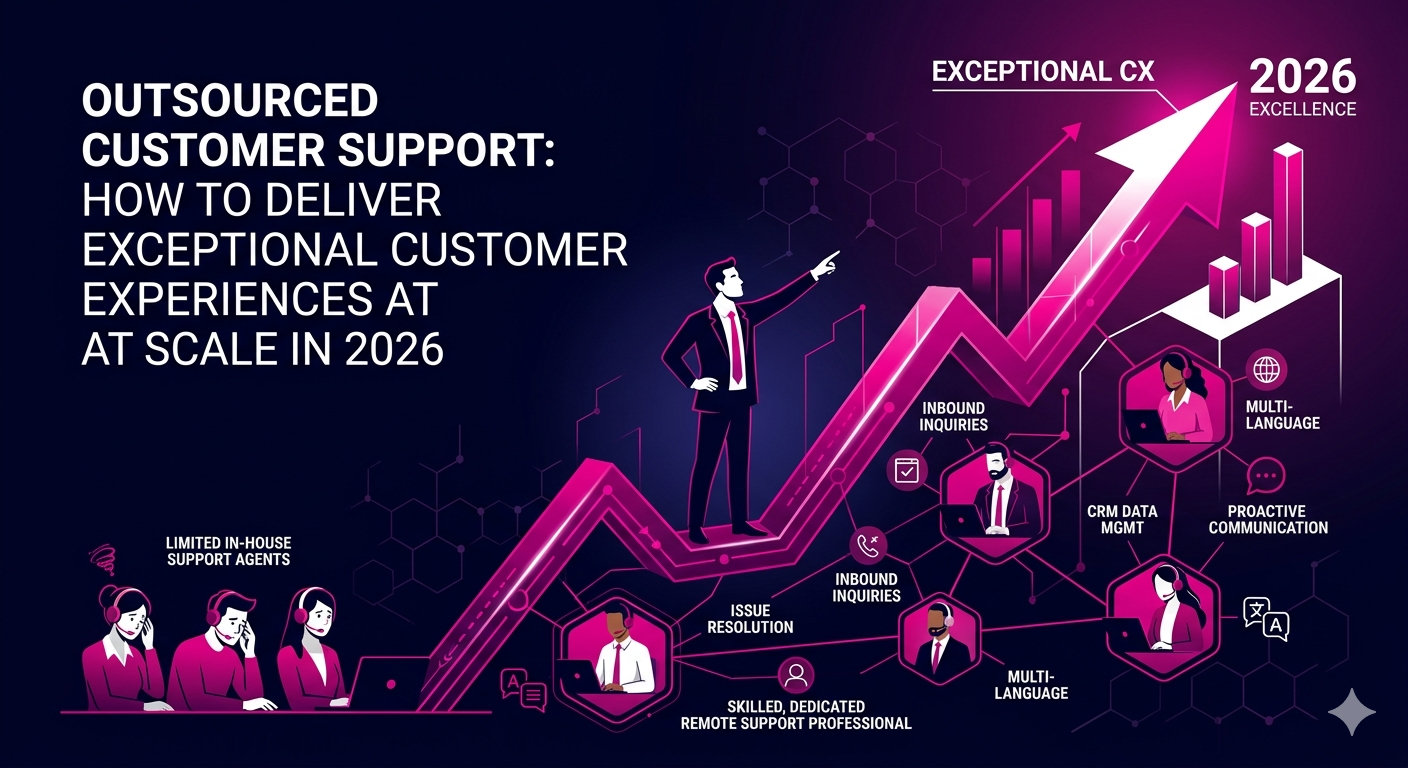
The scope of outsourced customer support in 2026 is broader than many businesses initially assume. A skilled, dedicated outsourced support professional can handle the full range of customer-facing interactions across multiple channels and contact types.
Inbound Inquiry Management
- Responding to customer inquiries via email, live chat, phone, and social media messaging
- Answering product questions, providing usage guidance, and resolving pre-purchase uncertainty
- Handling account-related inquiries including password resets, account updates, and subscription changes
- Providing shipping status updates, tracking information, and delivery issue resolution
- Managing high volumes of inbound queries during peak periods such as product launches, promotions, and seasonal surges
Issue Resolution and Complaint Handling
- Diagnosing product or service issues accurately and resolving them efficiently within defined authority levels
- Processing returns, refunds, replacements, and account credits in compliance with your policies
- De-escalating frustrated or upset customers with empathy, patience, and effective problem-solving
- Escalating complex technical or billing issues to appropriate internal team members with full context
- Following up with customers to confirm issue resolution and satisfaction
CRM and Data Management
- Logging all customer interactions, issues, and resolutions in your CRM or helpdesk system
- Maintaining accurate customer records and interaction histories
- Tagging and categorizing tickets to enable trend analysis and proactive issue identification
- Identifying recurring customer complaints or product issues and surfacing them to product or operations teams
Proactive Customer Communication
- Sending proactive order confirmations, shipping notifications, and delivery updates
- Following up with customers post-purchase to drive review generation and satisfaction feedback
- Managing loyalty program inquiries and reward redemption support
- Notifying customers of service disruptions, policy changes, or product updates that affect their account
Why Outsourced Customer Support Delivers Exceptional Value in 2026
The business case for outsourcing customer support has strengthened considerably as remote work infrastructure has matured and global talent markets have deepened. Here is why the decision makes such compelling sense for businesses in 2026.
Dramatic Cost Reduction Without Quality Compromise
Building an in-house customer support team in the United States in 2026 is expensive. The fully loaded annual cost of a single in-house support agent, including base salary of $38,000 to $55,000, benefits, payroll taxes, equipment, and office space, ranges from $50,000 to $75,000. When you outsource customer support through a specialist offshore staffing partner, you access equally skilled support professionals at 40 to 65 percent lower total cost. For businesses managing high inquiry volumes, those savings allow you to staff more agents, cover more hours, and deliver faster response times without proportionally increasing your support budget.
Extended Coverage Hours at Sustainable Cost
Customers do not submit support requests only during your local business hours. With outsourced customer support professionals based in different time zones, businesses can extend their support coverage window to 16 or even 24 hours per day without paying expensive shift premiums for local hires. That extended availability reduces customer wait times, improves satisfaction scores, and strengthens the overall service experience at a cost that a purely in-house model cannot match.
Scalability to Match Demand Fluctuations
Customer inquiry volumes are rarely constant. A product launch, a major marketing campaign, a peak seasonal period, or an unexpected service disruption can suddenly multiply inbound contact volume. Outsourced customer support allows you to scale your support capacity up quickly through your staffing partner when demand spikes and right-size it when demand normalizes, without the HR, legal, and financial complexity of rapidly hiring and then laying off in-house staff.
Access to Multilingual and Multicultural Support Talent
Global businesses serving multilingual customer bases benefit enormously from outsourced customer support models that can source bilingual or multilingual support professionals from global talent markets. Many outsourced support professionals are fluent in two or more languages, allowing businesses to serve diverse customer populations without hiring expensive bilingual staff in each target market.
Reduced Management Burden on Internal Teams
Building and managing a customer support operation takes significant management bandwidth: recruiting and training agents, managing schedules and coverage, monitoring quality, handling escalations, and continuously improving processes. Outsourced customer support, structured through a dedicated remote staffing model, allows you to maintain quality control and brand standards while significantly reducing the management overhead required to operate the function effectively.
What to Look for When You Outsource Customer Support
Outsourced customer support quality varies significantly across providers and models. Here is what to evaluate rigorously before committing to a partner.
Candidate Vetting and Communication Quality
The most important quality standard in any outsourced customer support engagement is the communication ability of the agents who will represent your brand. Ask your provider to demonstrate their communication quality assessment process: how do they evaluate written English in email and chat contexts? How do they assess telephone manner and verbal clarity for phone support? How do they test empathy and de-escalation capability under pressure? A provider that answers these questions with specifics and evidence is worth trusting. One that offers vague assurances about “highly trained agents” without demonstrating the vetting rigor behind that claim is not.
Brand Voice and Product Knowledge Integration
The best outsourced customer support does not feel outsourced to the customer. Agents who speak in your brand voice, know your products thoroughly, and handle inquiries with genuine ownership of the customer experience are indistinguishable from in-house staff. Evaluate how the provider approaches brand training and product knowledge development for new placements, and ask for evidence of how their agents have successfully represented other brands at a high standard.
Technology and Platform Compatibility
Confirm that your outsourced support professionals are experienced with your helpdesk or CRM platform. The most commonly used platforms in 2026 include Zendesk, Freshdesk, Intercom, HubSpot Service Hub, Gorgias, and Salesforce Service Cloud. Agents who arrive familiar with your platform can begin handling tickets productively within days rather than weeks, reducing your ramp cost and getting the customer experience benefit faster.
Performance Metrics and Reporting Transparency
A quality outsourced customer support arrangement comes with clear, transparent performance reporting. Expect regular reporting on first response time, average resolution time, first contact resolution rate, customer satisfaction (CSAT) scores, ticket volume handled, and escalation rates. Modern helpdesk platforms generate these metrics automatically, and your outsourced support partner should be delivering them to you weekly without needing to be prompted.
Replacement Guarantee and Ongoing Support
Confirm the provider’s replacement guarantee terms before committing. A reputable outsourced customer support partner stands behind their placements with a 30 to 90 day replacement guarantee if a placed agent does not meet your standards. Also assess the quality of ongoing account management support, which is a strong indicator of how invested the provider is in the long-term success of your outsourced support function.
At The Remote Reps, we specialize in placing dedicated, pre-vetted outsourced customer support experts for businesses across every industry. Our candidates are rigorously assessed for communication quality, helpdesk tool proficiency, empathy, and the professional discipline that excellent customer experience demands. You can pair your outsourced support team with a remote virtual assistant for operational overflow support, or an outsourced ecommerce marketing expert to reduce inbound inquiry volume through proactive customer communication and clearer product documentation.
How Much Does Outsourced Customer Support Cost in 2026?
Monthly investment levels for dedicated outsourced customer support professionals placed through a quality offshore staffing partner in 2026 typically include:
- Entry-level outsourced support agent: $750 to $1,500 per month for candidates with foundational customer service experience handling standard inquiry types across email and chat channels
- Experienced outsourced support specialist: $1,500 to $2,800 per month for agents with strong helpdesk platform proficiency, excellent CSAT track records, and experience with more complex inquiry types including billing, technical troubleshooting, or returns management
- Senior outsourced support specialist or team lead: $2,800 to $4,500 per month for highly experienced professionals capable of handling complex escalations, quality coaching for junior agents, or managing multi-channel support operations with significant volume and complexity
These rates generate per-agent annual savings of $25,000 to $55,000 or more compared to the fully loaded cost of equivalent in-house support agents in the United States.
How to Onboard Outsourced Customer Support for Fast Results
A structured onboarding experience is critical for outsourced customer support because the quality of the customer experience your agents deliver from week one directly reflects on your brand. Here is a proven three-week onboarding framework.
Week One: Brand, Product, and System Immersion
Walk your outsourced support agents through your product or service in detail, your support policies and escalation procedures, your helpdesk and communication tool setup, your brand voice and communication standards, and any common inquiry types they will encounter. Provide a comprehensive knowledge base, a library of approved response templates for common issues, and access to all relevant systems. The depth of this foundation determines how confidently and accurately your agents handle real customer interactions from day one.
Week Two: Supervised Ticket Handling and Quality Review
Have your outsourced support agents handle real tickets under close review. Assess their responses against your brand voice guidelines and resolution quality standards before they are sent, where practical, and provide specific written feedback on tone, accuracy, and process adherence. This supervised period is critical for identifying any gaps in product knowledge or communication style before agents work fully independently.
Week Three and Beyond: Independent Operation and Performance Tracking
By week three, your outsourced customer support team should be handling their full ticket queue independently. Begin tracking formal performance metrics including first response time, CSAT scores, resolution rates, and escalation rates. Hold a weekly performance review to discuss what is working, address recurring issue types, and update knowledge base materials as your product and policies evolve.
According to Zendesk’s Customer Experience Trends Report on outsourced customer support performance and customer expectations, customers in 2026 place speed of first response, issue resolution on first contact, and agent empathy as the three highest drivers of satisfaction with support interactions. A well-selected and well-onboarded outsourced customer support team delivers on all three of these priorities consistently.
Conclusion: Outsource Customer Support and Deliver the Experience Your Customers Deserve in 2026
Your customers judge your brand not just by your product but by every interaction they have with your support team. In 2026, outsourced customer support gives businesses the ability to staff skilled, dedicated, brand-aligned support professionals at a cost that makes financial sense, at the scale their customer base demands, and with the flexibility to grow rapidly without the overhead of traditional in-house hiring. The result is a customer experience that builds loyalty, generates referrals, and protects the brand equity you have worked hard to build.
The Remote Reps places pre-vetted outsourced customer support professionals for businesses across e-commerce, SaaS, professional services, and every other industry where customer experience matters. Our candidates are assessed for real communication skills, real tool proficiency, and the empathy and professionalism that customer-facing roles demand.
Read what our clients say about the customer experience results they have achieved through The Remote Reps, or visit theremotereps.com to start building your outsourced customer support team today.
FAQ: Outsourced Customer Support
What is outsourced customer support and how does the dedicated model work?
Outsourced customer support is the practice of engaging an external staffing or service partner to place skilled support professionals who handle your customer-facing inquiries, issue resolution, and communication on your behalf. In the dedicated remote model, which is the most effective approach for businesses where brand consistency matters, outsourced support agents work exclusively for your business, follow your processes, use your helpdesk system, and represent your brand voice in every customer interaction. They are not shared across multiple clients. The staffing partner handles sourcing, vetting, employment compliance, and ongoing placement support. You direct the work, set the quality standards, and measure the results.
How much does outsourced customer support cost in 2026?
Dedicated outsourced customer support professionals placed through a specialist offshore staffing partner in 2026 typically cost between $750 and $4,500 per month depending on experience level and specialization. Entry-level agents handling standard email and chat inquiries cost $750 to $1,500 per month. Experienced specialists with strong CSAT track records and complex inquiry handling capability fall in the $1,500 to $2,800 range. Senior specialists or team leads are priced at $2,800 to $4,500 per month. These rates generate per-agent annual savings of $25,000 to $55,000 or more compared to the fully loaded cost of equivalent in-house support agents in the United States.
How do I ensure my outsourced customer support team represents my brand accurately?
Brand voice accuracy in outsourced customer support starts with thorough onboarding. Provide your outsourced support agents with a detailed communication style guide covering your preferred tone, approved language, phrases to avoid, and examples of excellent and poor responses for common inquiry types. Build a library of approved response templates for your most frequent ticket types that agents can personalize and deploy. Review early responses closely and provide specific written feedback on tone and brand alignment. Over time, a well-briefed outsourced support team will internalize your brand voice and apply it naturally across every customer interaction with increasing confidence and accuracy.
What channels can outsourced customer support professionals handle?
In 2026, dedicated outsourced customer support professionals can manage customer inquiries across every major contact channel including email, live chat, phone, social media direct messaging, WhatsApp and SMS support, marketplace messaging platforms such as Amazon Seller Messaging and Etsy Conversations, and community forums or review platform responses. The specific channels your outsourced team manages depend on where your customers primarily reach out and the channel expertise of the agents placed with your business. When briefing your staffing partner, specify your priority channels and confirm that candidates have experience managing those specific contact types before placement.
How do I measure the success of outsourced customer support?
The most important performance metrics for outsourced customer support are first response time, which measures how quickly agents reply to new customer inquiries; average resolution time, which measures how long it takes to fully resolve an issue; first contact resolution rate, which measures the percentage of issues resolved without requiring a follow-up; customer satisfaction score (CSAT), typically collected through post-interaction surveys; and ticket volume handled per agent per shift. Modern helpdesk platforms including Zendesk, Freshdesk, and HubSpot Service Hub generate these metrics automatically, giving you real-time visibility into your outsourced support team’s performance without requiring manual reporting from the agents themselves.
Can outsourced customer support handle sensitive or complex customer interactions?
Yes, when agents are thoroughly trained on your policies, escalation procedures, and authority levels for different interaction types. Sensitive interactions such as billing disputes, product safety concerns, accessibility needs, and high-value customer complaints require clear guidelines on what the outsourced support agent can resolve independently and what must be escalated to an internal team member with greater authority or specialist knowledge. Define these escalation criteria explicitly during onboarding, document them in your knowledge base, and include realistic examples so your outsourced support team can apply the escalation logic confidently and consistently. Well-defined escalation protocols actually improve the customer experience by ensuring that the right person handles each issue at the right level.