
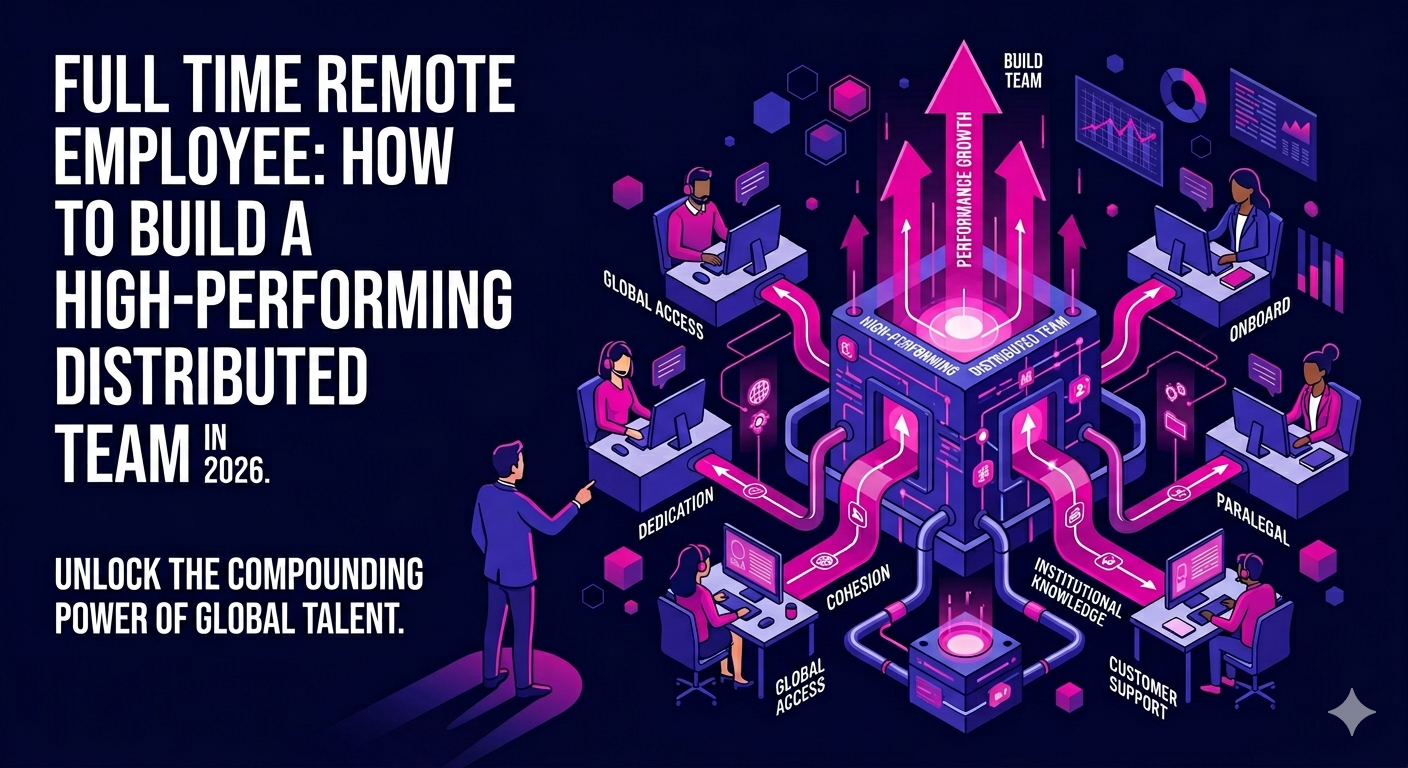
The shift to remote work is no longer a trend or an experiment. In 2026, hiring a full time remote employee is a mainstream, well-understood strategy that businesses of every size use to access better talent, reduce overhead, and build the teams they need without geographic constraints or the escalating costs of domestic in-office hiring. Whether you are hiring your first full time remote employee or scaling a distributed team across multiple functions, the principles of finding, placing, and managing full time remote employees effectively are well-established and, when followed, consistently produce excellent outcomes for both the business and the employee.
This guide covers everything you need to know about hiring a full time remote employee in 2026: how the model works, what advantages it delivers, how to find the right candidates, what to evaluate during hiring, how to onboard effectively, and how to build the management practices that make full time remote employees perform at their best over the long term.
What Is a Full Time Remote Employee?
A full time remote employee is a professional who works exclusively for your business on a full-time basis, typically 40 hours per week, from a location outside your physical office, usually from their own home or a co-working space in a different city, country, or time zone. They are not a freelancer who works for multiple clients simultaneously, not a contractor engaged for a defined project, and not a shared resource from an outsourcing vendor. They are a dedicated team member whose full professional attention and working hours belong to your business.
The full time remote employee model is particularly valuable when paired with a specialist staffing partner who sources and vets candidates from global talent markets. This combination gives you the depth of commitment and integration that comes with a full-time team member, combined with access to a far wider talent pool and significantly lower labor costs than domestic in-office hiring allows.
Full Time Remote Employee vs. Part-Time vs. Freelancer
- Full time remote employee: Works 40 hours per week exclusively for your business. Builds deep institutional knowledge over time. Fully integrated into your team, culture, tools, and workflows. The highest level of commitment and integration available in the remote staffing model.
- Part-time remote employee: Works a defined number of hours per week, typically 20 to 30, exclusively for your business. Appropriate when the role does not justify full-time hours or when budget requires a staged approach to building capacity.
- Freelancer: Works for multiple clients simultaneously on project-based or hourly arrangements. No commitment to your business beyond the current engagement. Limited brand knowledge and divided attention. Appropriate for one-off projects, not for ongoing operational functions.
Why Hiring a Full Time Remote Employee Makes Powerful Business Sense in 2026
The advantages of building your team with full time remote employees rather than local in-office hires or fragmented freelancer arrangements are substantial and well-evidenced. Here is why the model makes such compelling sense in 2026.
Dramatic Cost Savings Without Sacrificing Commitment
The fully loaded annual cost of a full-time in-office employee in the United States in 2026 including salary, benefits, payroll taxes, office space, and equipment significantly exceeds the base salary figure alone. Depending on the role and seniority level, total in-office employment costs range from $70,000 to $200,000 per year for professional roles. A full time remote employee sourced through a quality offshore staffing partner delivers the same level of full-time dedication and professional capability at 40 to 70 percent lower total cost, depending on the role and the talent market they are sourced from. That cost difference, compounded across a team of five or ten full time remote employees, funds significant additional growth investment.
Access to the Best Talent for Every Role, Not Just the Best Available Locally
Local hiring constrains your talent search to candidates within commuting distance of your office or willing to relocate. In many markets and for many specialized roles, the supply of genuinely excellent local candidates is thin, expensive, or both. Hiring full time remote employees removes those constraints and opens your search to the global talent market, allowing you to find the most capable professional for each specific role rather than the best available within an arbitrary geographic boundary.
Full-Time Commitment That Compounds Into Deep Brand Knowledge
The critical advantage of a full time remote employee over a part-time or freelance arrangement is the depth of immersion and institutional knowledge that accumulates over time. A full time remote employee who works 40 hours per week exclusively for your business develops comprehensive understanding of your product, your customers, your competitive positioning, your culture, and your quality standards. That compounding knowledge makes them progressively more effective and valuable with each passing month, producing returns that no fragmented or shared arrangement can replicate.
Team Cohesion and Cultural Integration
Full time remote employees, when managed well, integrate into your team culture as fully as any in-office hire. They attend team meetings, participate in company communications, contribute to strategic discussions, celebrate wins, and build the kind of working relationships with colleagues that sustain motivation and performance over the long term. That cultural integration requires intentional effort from your side, but the returns in engagement, retention, and collaborative output are significant.
Scalability at the Speed of Business
Traditional in-office hiring cycles of 8 to 16 weeks per role mean that building a team of five full time employees through conventional local recruitment can take a year or more. When you hire full time remote employees through a specialist staffing partner with an active pre-vetted talent pipeline, you can place multiple roles simultaneously within weeks, building team capacity at the speed your business growth actually demands rather than the pace your recruitment process allows.
Which Roles Work Best as Full Time Remote Employees
In 2026, the vast majority of professional knowledge work roles are well-suited to the full time remote employee model. The clearest candidates are roles that are performed primarily on a computer, involve digital communication as the primary mode of collaboration, and do not require daily physical presence in a specific location. This covers virtually every function in sales, marketing, operations, legal support, and administration.
Sales and Revenue Roles
- Full time remote SDRs for outbound prospecting and pipeline building
- Full time remote sales representatives for full-cycle deal management and account growth
- Full time remote lead generation specialists for top-of-funnel infrastructure
- Full time remote cold email experts for outbound campaign execution
Marketing Roles
- Full time remote digital marketers for multi-channel marketing strategy and execution
- Full time remote SEO specialists for organic search growth
- Full time remote social media managers for brand presence and community engagement
- Full time remote PPC experts and media buyers for paid advertising management
Operations and Administrative Roles
- Full time remote virtual assistants for broad administrative and operational support
- Full time remote executive assistants for senior leadership coordination
- Full time remote customer support specialists for professional customer experience management
- Full time remote GTM engineers for revenue technology infrastructure
Legal Support Roles
- Full time remote legal assistants for law firm administrative and case support
- Full time remote paralegals for substantive legal support under attorney supervision
How to Hire a Full Time Remote Employee: A Step-by-Step Approach
Hiring a full time remote employee through a specialist staffing partner is considerably faster and less operationally demanding than building the same team through traditional local recruitment. Here is how the process works.
Step 1: Define the Role and Requirements Precisely
Document the specific responsibilities, required skills, experience level, working hours, collaboration requirements, and performance expectations for the full time remote employee role you are hiring. The more precisely you define the role, the faster and more accurately your staffing partner can match you with candidates who genuinely fit your needs. Vague briefs produce mismatched placements. Specific briefs produce accurate ones.
Step 2: Partner with a Specialist Remote Staffing Provider
Choose a staffing partner with specific expertise in the role type you are hiring for and a rigorous, transparent vetting process. Ask about their candidate sourcing channels, assessment methodologies, communication quality evaluation, and replacement guarantee terms. A quality partner will answer all of these questions clearly and confidently.
Step 3: Review Pre-Vetted Candidates and Conduct Final Interviews
A specialist partner with an active talent pipeline should present pre-screened, interview-ready candidates within 5 to 14 business days. Review their profiles, work samples, and assessment results, then conduct your own final interviews to evaluate cultural fit, role-specific skills, and communication quality before making a selection.
Step 4: Structure a Comprehensive Onboarding Plan
Before your full time remote employee’s first day, prepare their tool access, document key processes, and plan the first four weeks of structured onboarding. A well-onboarded full time remote employee reaches full productivity significantly faster than one who is left to figure things out independently.
Step 5: Establish Performance Expectations and Management Rhythm
Set clear, measurable KPIs from day one. Establish a regular weekly check-in cadence and a defined escalation path for issues requiring urgent attention. Review performance data consistently and provide specific, constructive feedback that helps your full time remote employee understand and continuously improve against your standards.
How to Manage Full Time Remote Employees for Outstanding Long-Term Performance
Hiring the right full time remote employee is the essential first step. Managing them well over time is what determines whether the model delivers its full potential for your business.
Communication With Structure and Consistency
Remote teams thrive when communication is intentional and regular. Establish clear daily async update channels, weekly synchronous check-ins, monthly performance reviews, and a defined process for escalating urgent issues. The communication structure you build in the first 30 days sets the rhythm for the entire working relationship.
Genuine Cultural Inclusion
Include your full time remote employees in team meetings, company announcements, and win celebrations. Give them opportunities to share their perspectives and contribute to decisions beyond their immediate task scope. Remote professionals who feel genuinely included in the team’s culture and direction consistently outperform those managed purely as task executors.
Investment in Professional Development
The full time remote employees who stay longest and deliver the highest compounding value are the ones whose managers invest in their growth. Share resources, provide coaching, create opportunities for skill development, and recognize strong performance explicitly and publicly. A full time remote employee who grows with your business becomes progressively more valuable over time in ways that a rotating freelancer or short-term contractor never can.
According to Buffer’s annual State of Remote Work report on full time remote employee engagement and satisfaction, full time remote employees who receive regular manager communication, clear goal-setting, and genuine cultural inclusion report engagement and job satisfaction levels that match or exceed their in-office counterparts, and consistently lower voluntary turnover rates than in-office equivalents in comparable roles and industries.
What Does a Full Time Remote Employee Cost in 2026?
Monthly cost varies significantly by role type, experience level, and the talent market the employee is sourced from. Here are representative monthly ranges across key function areas for full time remote employees placed through a quality offshore staffing partner in 2026:
- Administrative and operations roles: $800 to $3,500 per month for full time remote virtual assistants, customer support specialists, and executive assistants
- Sales and revenue roles: $1,500 to $5,500 per month for full time remote SDRs, sales reps, and lead generation specialists
- Marketing specialist roles: $1,200 to $6,000 per month for full time remote digital marketers, SEO specialists, social media managers, and PPC experts
- Technical roles: $2,500 to $9,000 per month for full time remote GTM engineers and senior technical specialists
- Legal support roles: $1,000 to $5,500 per month for full time remote legal assistants and paralegals
In all categories, full time remote employees placed through a specialist offshore staffing partner cost 40 to 70 percent less than equivalent full time in-office hires in the United States, United Kingdom, or Australia when total employment costs are factored in.
You can read verified testimonials from clients who have built high-performing teams of full time remote employees through The Remote Reps, or visit theremotereps.com to explore our full range of remote staffing services and start building your full time remote team today.
Conclusion: Build Your Team of Full Time Remote Employees and Compete at a Higher Level in 2026
The businesses that will win in their markets over the next several years are the ones building capable, dedicated, engaged teams right now. In 2026, the most effective way to do that for the majority of professional roles is to hire full time remote employees: skilled, dedicated professionals who work exclusively for your business, integrate deeply into your culture, and deliver compounding value as their knowledge of your business grows.
The Remote Reps specializes in placing full time remote employees across sales, marketing, operations, legal support, and administrative roles for businesses at every stage of growth. Our candidates are rigorously vetted, rapidly placed, and supported throughout the engagement.
Visit theremotereps.com to explore our full range of remote staffing services and start building your full time remote team today.
FAQ: Full Time Remote Employee
What is the difference between hiring a full time remote employee and using a freelancer?
A full time remote employee works exclusively for your business 40 hours per week, integrates fully into your team and culture, builds deep institutional knowledge of your product and processes over time, and is committed to your business goals with no divided attention across other clients. A freelancer works for multiple clients simultaneously, engages on a project or hourly basis with no ongoing team commitment, and develops minimal brand or product familiarity. For any function where continuity, consistency, and compounding institutional knowledge matter, a full time remote employee consistently delivers superior results compared to a freelancer arrangement.
How much does a full time remote employee cost in 2026?
The monthly cost of a full time remote employee placed through a specialist offshore staffing partner in 2026 ranges from $800 for entry-level administrative roles to $9,000 for senior technical specialists, depending on the function, experience level, and talent market. Most professional roles fall in the $1,200 to $5,500 per month range. These rates represent 40 to 70 percent cost savings compared to the fully loaded cost of equivalent full time in-office employees in the United States, United Kingdom, or Australia, generating per-position annual savings of $25,000 to $90,000 depending on the role.
How do I manage a full time remote employee effectively?
Effective management of a full time remote employee requires clear KPIs set from day one, a structured weekly check-in cadence for performance review and coaching, transparent daily async communication channels, genuine cultural inclusion in team meetings and company communications, and regular investment in the employee’s professional development. The most important management behavior is consistent, structured engagement rather than either micromanagement or hands-off neglect. Full time remote employees who receive clear expectations, regular feedback, and genuine inclusion in their team’s culture consistently deliver high performance and long-term retention.
How quickly can I hire a full time remote employee through a specialist staffing partner?
A specialist remote staffing partner with an active pre-vetted talent pipeline can typically present qualified full time remote employee candidates within 5 to 14 business days for most standard professional roles. After candidate selection, documentation, and access setup, your new full time remote employee can begin working within 2 to 3 weeks of initial engagement. This compares very favorably to the 8 to 16 week timelines typical of traditional local in-office hiring for equivalent roles. For businesses building multiple roles simultaneously, a quality partner can manage parallel searches and deliver candidates for all roles within the same compressed timeline.
How do I onboard a full time remote employee successfully?
Successful onboarding of a full time remote employee requires four things: advance preparation of tool access, system credentials, and process documentation before day one; a structured first-week orientation covering company culture, role expectations, key collaborators, and priority tasks; a supervised execution period in weeks two and three where the employee’s work is reviewed and specific feedback is provided; and a regular weekly check-in cadence from week four onward that maintains alignment, surfaces questions, and provides ongoing coaching. Businesses that invest in thorough structured onboarding consistently achieve faster ramp times and higher sustained performance from their full time remote employees.
What is a replacement guarantee and why does it matter when hiring a full time remote employee?
A replacement guarantee is a commitment from your staffing partner to source and place a new candidate at no additional cost if a full time remote employee placement does not work out within a defined period, typically 30 to 90 days after the employee starts. This guarantee matters because it reduces the financial and operational risk of the hiring decision significantly. Even with rigorous vetting, not every placement is a perfect fit, and a meaningful replacement guarantee ensures you are not left bearing the full cost and delay of restarting the search if the initial placement needs to be replaced. Always confirm replacement guarantee terms in writing before engaging any remote staffing partner.