
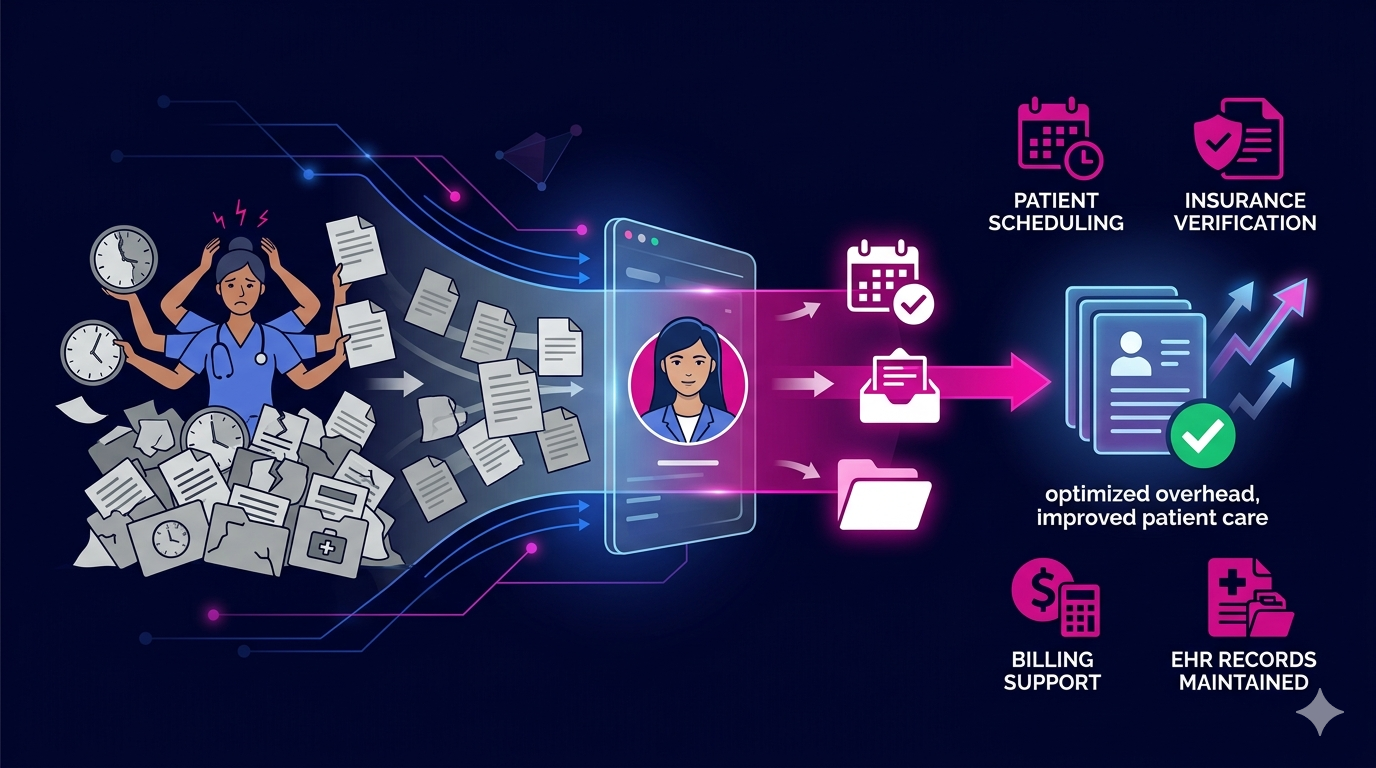
Healthcare practices in 2026 are under more administrative pressure than ever before. Between appointment scheduling, insurance verification, billing follow-ups, patient communications, and compliance documentation, your front desk and clinical support staff are constantly stretched thin. The solution more practice owners and office managers are turning to is remote admin support for healthcare practice operations. This guide explains what remote administrative support looks like in a healthcare setting, what tasks it covers, and how to implement it without disrupting your workflow or compromising patient privacy.
Why Healthcare Practices Are Adopting Remote Administrative Support in 2026
The staffing challenges facing healthcare practices have not eased. According to the American Medical Association’s 2025 workforce report, administrative burden remains one of the top drivers of clinician burnout, with physicians and nurse practitioners spending an average of 15 hours per week on non-clinical administrative tasks. That time has a direct cost in lost patient appointments, delayed referrals, and reduced practice revenue.
At the same time, in-office administrative staff are expensive to recruit, train, and retain. Turnover in healthcare administration roles runs high, and the cost of replacing a single front desk employee averages $4,000 to $7,000 when you account for recruiting, onboarding, and lost productivity during the transition period.
Remote admin support for healthcare practice operations solves both problems. You get access to experienced, trained professionals who handle your administrative workload at a lower cost per hour than local hires, with far less turnover and the flexibility to scale hours up or down based on your practice’s needs.
What Tasks Can Remote Admin Support Handle for a Healthcare Practice?
A common concern among practice managers is whether remote workers can meaningfully contribute to a healthcare environment. The answer is yes, across a wide range of non-clinical functions. Here is a detailed breakdown:
Patient Scheduling and Appointment Management
- Booking, rescheduling, and canceling appointments through your practice management software
- Sending appointment reminders via text, email, or patient portal messages
- Managing waitlists and filling last-minute cancellations to maximize your schedule
- Coordinating multi-provider schedules for group practices and specialty clinics
Insurance Verification and Prior Authorization
- Verifying patient insurance eligibility before appointments to reduce claim denials
- Submitting prior authorization requests to insurance carriers on behalf of your providers
- Tracking authorization statuses and following up with payers on pending approvals
- Updating patient insurance records in your EHR or practice management system
Medical Billing and Revenue Cycle Support
- Posting charges and payments in your billing system
- Following up on unpaid claims and denied remittances
- Managing patient statements and responding to billing inquiries
- Preparing accounts receivable aging reports for your billing manager or practice owner
Patient Communication and Intake
- Responding to patient inquiries via phone, email, or patient portal within defined response windows
- Sending new patient intake forms and following up on incomplete submissions
- Collecting and verifying demographic information before visits
- Handling post-visit follow-up communications including care instructions and referral coordination
Administrative and Compliance Support
- Maintaining accurate and organized patient records in your EHR system
- Preparing reports and documentation for audits, accreditation, or regulatory reviews
- Managing provider credentialing documentation and re-credentialing timelines
- Handling referral tracking and coordination with external specialists
If your practice also needs help managing patient-facing communication and support requests at scale, a remote customer support expert for healthcare practice teams can provide dedicated, trained coverage that complements your clinical staff.
HIPAA Compliance and Data Security for Remote Healthcare Admin Support
This is the question every practice owner asks first, and rightly so. Hiring remote admin support for healthcare practice work does not mean compromising patient privacy. It does mean putting the right protections in place.
Any remote worker handling protected health information (PHI) must operate under a signed Business Associate Agreement (BAA) as required by HIPAA. This agreement establishes the remote worker’s responsibility to protect patient data and outlines the consequences of a breach. Without a BAA, you cannot legally share PHI with an external support worker.
Beyond the legal framework, practical security measures include:
- Providing remote workers with HIPAA training before granting access to any patient data or systems
- Using role-based access controls in your EHR so remote staff only see the data necessary for their specific tasks
- Requiring the use of a VPN or secure remote desktop protocol when accessing your systems
- Enabling multi-factor authentication on all accounts accessed by remote support staff
- Logging and auditing remote access to patient records on a regular basis
When you work with a vetted staffing partner that specializes in healthcare administrative support, these compliance requirements are typically built into the hiring and onboarding process, reducing the burden on your practice to manage them independently.
Cost Comparison: Remote Admin Support vs. In-Office Staff for Healthcare Practices
Let us look at what the numbers actually look like in 2026. A full-time in-office medical receptionist or administrative coordinator in the United States earns an average of $38,000 to $50,000 per year. Add employer-side payroll taxes (approximately 7.65 percent), health insurance contributions, paid time off, and any benefits, and your all-in cost reaches $52,000 to $68,000 or more annually per employee.
Remote admin support for healthcare practice operations typically runs $12 to $22 per hour for experienced professionals. A 25-hour-per-week engagement costs approximately $15,600 to $28,600 per year. Even a full-time 40-hour engagement at the higher rate comes in under $46,000 with no benefits overhead.
For practices with tight margins, a multi-provider clinic running three or four administrative staff positions, or a solo practitioner looking to cut overhead without sacrificing quality, that cost differential is transformative.
How to Successfully Implement Remote Admin Support in Your Healthcare Practice
The transition to remote administrative support works best when it is structured and phased. Here is a practical framework based on what high-performing healthcare practices are doing in 2026:
Start with an Administrative Audit
Before hiring, spend one week tracking where your in-office staff and providers are spending time on administrative tasks. Identify which tasks are fully remote-compatible (no physical presence required), which require on-site access, and which are highest-priority for delegation. This audit typically reveals that 60 to 75 percent of administrative work can be handled remotely.
Select a Staffing Partner with Healthcare Experience
General virtual assistant services may not be equipped for the compliance requirements and workflow specifics of a healthcare environment. Prioritize staffing partners who have experience placing remote workers in medical, dental, or behavioral health practice settings and who can provide references from similar practices.
Execute a BAA Before Day One
Do not allow any remote worker to access patient data or your EHR until a signed BAA is in place. This is a non-negotiable compliance step, not an administrative formality.
Integrate Remote Staff into Your Communication Workflows
Remote admin workers should be reachable through the same communication channels your in-office team uses. Whether that is Slack, Microsoft Teams, or a practice-specific messaging platform, remote staff should feel like part of the team rather than external contractors. Daily check-in calls or end-of-day summaries work well during the first 30 days.
Measure Performance with Clear Metrics
Define what success looks like before your remote worker starts. Common KPIs for healthcare administrative support include same-day appointment fill rates, claim denial rates, prior authorization turnaround times, and patient portal response times. Reviewing these metrics monthly gives you objective data to guide feedback and role expansion.
For a broader look at how remote work models are transforming healthcare administration, the Health Affairs workforce research hub provides in-depth analysis on remote healthcare support staffing trends and their impact on practice efficiency and patient outcomes.
Conclusion: The Smartest Investment Your Practice Can Make This Year
Administrative overhead is one of the most controllable cost centers in any healthcare practice. In 2026, the tools, platforms, and talent infrastructure for effective remote admin support for healthcare practice operations are more mature and accessible than ever. Whether you run a solo family medicine practice, a multi-provider specialty group, or a behavioral health clinic, there is a remote support model that can reduce your overhead, protect your staff from burnout, and create a better experience for your patients.
The practices that act on this now will build leaner, more resilient operations. Start small, document your processes, and hire a remote admin professional who understands the healthcare environment. The results will be measurable within 60 days.
Frequently Asked Questions About Remote Admin Support for Healthcare Practice
What is remote admin support for healthcare practice and how does it work?
Remote admin support for healthcare practice refers to trained administrative professionals who handle non-clinical tasks for a medical, dental, or behavioral health practice from a remote location. They access your practice management software, EHR, and communication tools through secure connections and complete tasks like scheduling, insurance verification, billing support, and patient communication under a HIPAA-compliant framework including a signed Business Associate Agreement.
Is remote admin support for healthcare practice HIPAA compliant?
Yes, when implemented correctly. For remote admin support for healthcare practice work to be HIPAA compliant, the remote worker must sign a Business Associate Agreement, complete HIPAA training, use secure access protocols such as VPN or encrypted remote desktop, and operate under role-based access controls that limit exposure to only the patient data required for their specific tasks. Working with a vetted staffing partner familiar with healthcare compliance simplifies this process considerably.
What types of healthcare practices benefit most from remote admin support?
Remote admin support for healthcare practice operations delivers strong results across primary care, specialty medicine, dental, chiropractic, physical therapy, mental health, and behavioral health practices. Solo practitioners and small group practices benefit most from cost savings, while larger multi-provider practices gain the most from the ability to scale support hours flexibly without adding to their fixed staffing overhead.
Can remote admin support for healthcare practice handle EHR systems like Epic or Athenahealth?
Yes. Many experienced remote healthcare administrative professionals are trained on major EHR platforms including Epic, Athenahealth, eClinicalWorks, NextGen, Kareo, and others. When evaluating candidates for remote admin support for healthcare practice roles, ask specifically about their EHR experience and request a practical demonstration of their proficiency before making a hiring decision.
How long does it take to onboard remote admin support for a healthcare practice?
Most remote admin professionals with healthcare experience reach productive independence within two to three weeks when given clear process documentation and structured access to your systems. The first week typically covers system access, compliance training, and observation of existing workflows. Weeks two and three involve supervised task execution with daily check-ins. By the end of the first month, most practices report their remote admin support is fully contributing to daily operations.
How do I protect patient data when using remote admin support for my healthcare practice?
Protecting patient data when using remote admin support for healthcare practice work requires a layered approach. Start with a signed BAA, enforce multi-factor authentication on all system access, use role-based permissions in your EHR, require VPN use for all remote sessions, and conduct quarterly access audits. Train your remote worker on your practice’s specific data handling policies in addition to general HIPAA requirements, and maintain logs of all remote access activity for audit purposes.