Hiring the right remote talent has never been more important, or more competitive. The Remote Reps hiring process is specifically designed to remove the friction, guesswork, and wasted time that businesses typically experience when building remote teams. Whether you are filling a single specialized role or staffing an entire department, understanding how this process works gives you a clear path from need to placement without the usual headaches.
This guide walks you through each stage of the Remote Reps hiring process, explains what makes it different from standard recruitment, and shows you exactly what to expect as a business partner in 2026.
Why the Remote Reps Hiring Process Is Built for the Modern Workforce
Remote work has matured considerably. In 2026, businesses are not just experimenting with distributed teams; they are building their entire growth strategies around them. That shift demands a hiring process that is faster, more targeted, and more reliable than traditional staffing methods.
The Remote Reps hiring process addresses three core pain points that businesses face when hiring remotely:
- Speed: Traditional recruiting cycles can stretch for months. The Remote Reps process compresses that timeline dramatically by working from a pre-screened talent pool.
- Quality: Generic job boards flood inboxes with unqualified applicants. Remote Reps only presents candidates who have already passed structured vetting.
- Fit: Role-specific screening ensures that candidates are matched not just on skills but on remote work readiness and cultural alignment.
The result is a hiring experience that saves time, reduces hiring risk, and delivers talent that performs from day one.
Step-by-Step Breakdown of the Remote Reps Hiring Process
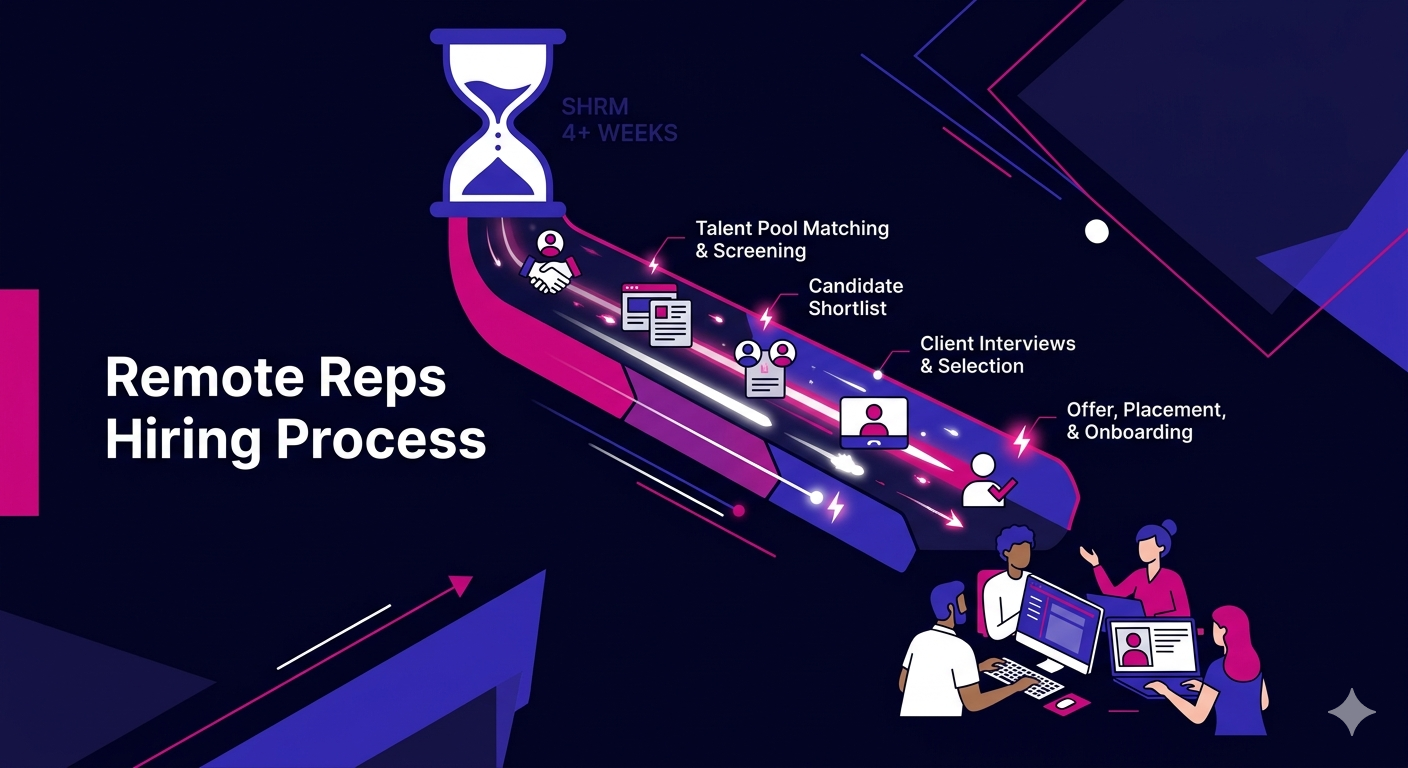
Understanding the full flow of the Remote Reps hiring process helps businesses set expectations and prepare effectively. Here is how each stage works from start to finish.
Step 1: Initial Discovery and Role Definition
Every successful placement starts with a clear understanding of what a business actually needs. The first step in the Remote Reps hiring process is a discovery conversation where the team learns:
- The specific role or roles you need to fill
- The skills, experience level, and tools required
- Your team structure, culture, and communication style
- Your timeline and expected start date
- Whether you need full-time, part-time, or contract-based support
This intake phase is critical because it ensures that the matching process is precise rather than generic. A poorly defined role leads to poor candidates. Remote Reps invests time upfront to avoid that outcome.
Step 2: Talent Pool Matching
Once the role requirements are clearly defined, the Remote Reps team searches its pre-screened talent pool for candidates who fit your criteria. This is where the agency’s specialization becomes a major advantage.
Rather than posting a job and waiting for applications, Remote Reps actively identifies candidates from a network of professionals who have already been evaluated. These include specialists across sales, marketing, operations, legal support, and more. For example, if you need a high-performing outbound specialist, the team can draw from its pool of vetted SDRs placed through Remote Reps who are experienced in modern pipeline-building techniques.
This proactive matching approach means businesses receive qualified candidates significantly faster than through traditional job postings.
Step 3: Structured Candidate Screening
Before any candidate is presented to a client, they go through a structured screening process. This is a core differentiator in the Remote Reps hiring process and one of the main reasons placement quality is consistently high.
The screening process typically evaluates candidates across several dimensions:
- Role-specific skills: Does the candidate have the technical or functional skills the role requires?
- Remote work experience: Has the candidate successfully worked in distributed team environments before?
- Communication and responsiveness: Can they communicate clearly and professionally in async and real-time settings?
- Track record and references: Do their past results and professional references validate their capabilities?
- Tool proficiency: Are they familiar with the platforms and software commonly used in their field?
Only candidates who meet the required standards across these areas are moved forward to the client presentation stage.
Step 4: Candidate Shortlist Presentation
After screening, the Remote Reps team presents a curated shortlist of qualified candidates to the client. This is not a dump of dozens of resumes. It is a focused selection of professionals who have been matched to the role based on the discovery conversation and the screening results.
Each candidate profile typically includes a summary of their background, relevant experience, remote work history, and why they were selected as a match for the specific role. This makes the evaluation process much more efficient for hiring managers.
Step 5: Client Interviews and Selection
At this stage, the business conducts interviews with shortlisted candidates. The Remote Reps hiring process does not remove the client from this decision; it simply ensures that by the time interviews happen, every candidate sitting across the virtual table is worth the conversation.
Clients are encouraged to evaluate not just technical skills but also communication style, working preferences, and alignment with team culture during this stage. Remote Reps can provide guidance on interview structure for remote roles if needed.
Step 6: Offer, Placement, and Onboarding Support
Once the client selects a candidate, Remote Reps supports the offer and placement logistics. The team also assists with onboarding to ensure the new hire integrates smoothly into the client’s workflows, tools, and team culture.
This onboarding support is an often-overlooked but critical part of the Remote Reps hiring process. A strong placement can still underperform if the transition is handled poorly. Remote Reps bridges that gap to protect the investment both parties have made in the placement.
Roles Available Through the Remote Reps Hiring Process
One of the strengths of working with Remote Reps is the breadth of roles the agency can fill through its hiring process. Businesses do not need to work with multiple vendors for different functions. The agency covers:
- Sales roles: SDRs, full-cycle sales reps, cold email experts, and lead generation specialists
- Marketing roles: digital marketers, SEO specialists, social media managers, PPC experts, media buyers, and e-commerce marketing experts
- Operations roles: virtual assistants, executive assistants, customer support experts, and GTM engineers
- Legal support: legal assistants, legal secretaries, and paralegals
- Specialized roles: Amazon experts and other platform-specific professionals
This range means that a business scaling multiple departments can run several parallel hiring tracks through the same trusted agency and the same reliable process.
How Long Does the Remote Reps Hiring Process Take?
One of the most common questions businesses ask is about timeline. The Remote Reps hiring process is designed for efficiency, and most clients receive a shortlist of qualified candidates within a few business days of the initial discovery conversation. The total time from inquiry to placement varies depending on role complexity, but it is consistently faster than traditional recruiting.
For context, according to research published by the Society for Human Resource Management (SHRM) on modern talent acquisition practices, the average time-to-fill for a position using traditional methods in 2026 runs well over four weeks. The Remote Reps hiring process routinely outperforms that benchmark by a significant margin.
Who Is the Remote Reps Hiring Process Designed For?
The hiring process at Remote Reps works well across a wide range of business profiles, including:
- Startups that need to move fast and cannot afford a prolonged search
- Growth-stage companies scaling a revenue or marketing team
- Established businesses replacing key remote roles or expanding capacity
- Agencies and service firms needing specialized support staff
- Companies new to remote hiring who want expert guidance throughout the process
Regardless of size or industry, any business that values quality, speed, and reliability in remote hiring will find the Remote Reps process a strong fit. You can explore available current openings and learn more by visiting the Remote Reps job openings page, or read what other businesses have experienced on the Remote Reps client testimonials page.
Start the Remote Reps Hiring Process Today
If your business needs skilled remote talent in 2026, there is no reason to rely on slow, outdated recruiting methods. The Remote Reps hiring process is built for speed, precision, and results. From the first discovery call to successful onboarding, every step is designed to make your experience as efficient and effective as possible.
Visit theremotereps.com to get started, explore services, or book your discovery call today.
Frequently Asked Questions About the Remote Reps Hiring Process
How does the Remote Reps hiring process begin for a new client?
The Remote Reps hiring process begins with a discovery call where the team learns about your business, the specific role you need to fill, your team culture, required skills, and your timeline. This intake conversation forms the foundation for accurate candidate matching and ensures the process is tailored to your exact needs from the start.
How long does the Remote Reps hiring process typically take from start to placement?
The Remote Reps hiring process is designed for speed. Most clients receive a curated shortlist of pre-vetted candidates within a few business days of the discovery call. The total timeline from inquiry to placement depends on the complexity of the role, but it consistently outperforms the industry average for remote hiring timelines in 2026.
What makes the Remote Reps hiring process different from using a general job board?
The Remote Reps hiring process is proactive rather than reactive. Instead of posting a job and waiting for applications, the agency matches clients with professionals from a pre-screened talent pool. Every candidate presented has already been evaluated for role-specific skills, remote work experience, communication ability, and professional track record, so clients spend their time on qualified conversations rather than filtering noise.
Does the Remote Reps hiring process support contract or part-time placements, or only full-time hires?
The Remote Reps hiring process supports flexible engagement models. Whether you need a full-time remote team member, a part-time specialist, or a contract-based professional for a specific project or season, the agency can structure the placement to fit your business needs. This flexibility makes the process useful for businesses at any stage of growth.
What happens after placement? Does the Remote Reps hiring process include onboarding support?
Yes. The Remote Reps hiring process extends beyond the offer stage. The team provides onboarding support to help new hires integrate smoothly into the client’s workflows, tools, and team culture. This post-placement support is a key part of why placements made through Remote Reps tend to perform well from the start rather than requiring a lengthy adjustment period.
Can the Remote Reps hiring process fill multiple roles across different departments at the same time?
Absolutely. The Remote Reps hiring process is built to handle simultaneous placements across different functions. Businesses can run parallel hiring tracks for roles in sales, marketing, operations, legal support, and other areas through the same agency. This consolidated approach simplifies remote hiring and ensures consistency in quality across all placements.