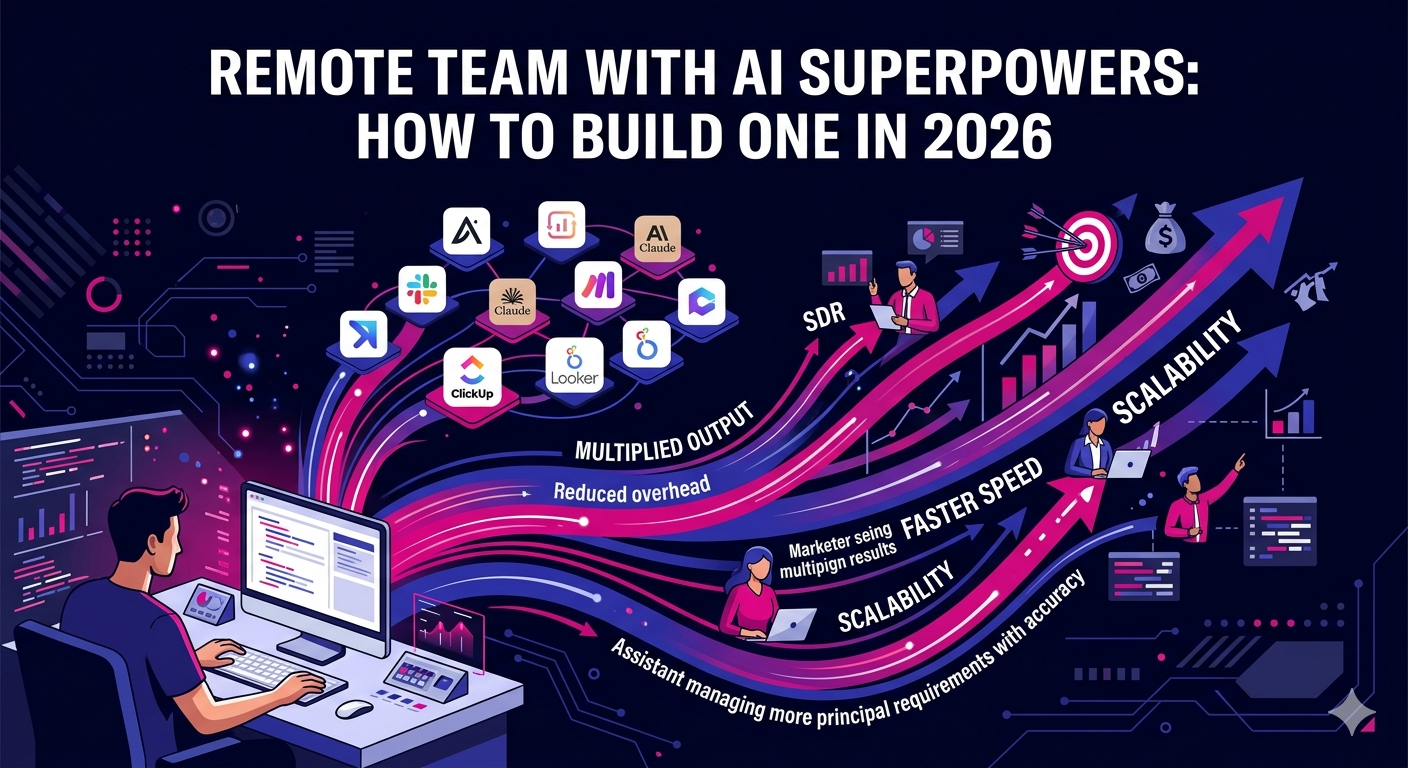
The most productive businesses operating in 2026 are not necessarily the largest or the best-funded. They are the ones that have figured out how to run a remote team with AI superpowers. That means combining skilled remote professionals with intelligent automation tools in a way that multiplies output, reduces overhead, and allows the business to move faster than traditionally structured competitors ever could.
This is not a futuristic concept. It is happening right now across sales, marketing, operations, customer support, and beyond. If you are not building this kind of team yet, this guide will show you exactly how to start.
What It Actually Means to Give Your Remote Team AI Superpowers
The phrase sounds exciting, but what does it mean in practice? A remote team with AI superpowers is one where every team member has access to AI tools that eliminate the repetitive, low-value parts of their job so they can spend more time on the work that actually drives results.
Think of it this way. A remote SDR without AI tools spends a large portion of their day on list building, data enrichment, and sending manual follow-ups. A remote SDR operating with AI superpowers uses automated prospecting tools to handle all of that in the background and focuses exclusively on replies, conversations, and booking meetings. The output is dramatically higher with no increase in hours worked.
This same principle applies across every remote role. Marketers using AI content and analytics tools produce more campaigns in less time. Virtual assistants using AI scheduling and research tools handle more executives with greater accuracy. Support specialists using AI triage systems resolve more tickets at a higher satisfaction rate.
The goal is not to replace your remote team with AI. It is to make each person on your remote team exponentially more capable than they would be working alone.
The AI Tools Powering Remote Teams in 2026
The tooling landscape has matured significantly. In 2026, the most impactful AI tools for remote teams fall into a few clear categories.
Prospecting and Outreach Automation
Platforms like Apollo, Instantly, and Clay allow remote sales and marketing staff to build targeted prospect lists, enrich contact data automatically, and run personalized outreach sequences at scale. Your remote team members focus on strategy and conversations rather than data work.
Content Creation and SEO
AI writing assistants and SEO tools such as Surfer SEO, Jasper, and Claude allow remote content and marketing teams to research, draft, and optimize content significantly faster than manual workflows permit. A two-person remote content team operating with these tools can produce the output of a five-person in-house team.
Workflow Automation and Integration
Tools like Make and Zapier connect the platforms your remote team uses every day and automate the handoffs between them. When a lead replies to an outreach email, the CRM updates automatically. When a new client signs, the onboarding workflow triggers without anyone lifting a finger. These integrations are the connective tissue of a remote team with AI superpowers.
Communication and Project Management
AI-enhanced project management tools like ClickUp and Notion now include features that summarize meeting notes, suggest task prioritization, and flag blockers before they become problems. For remote teams operating across time zones, this kind of asynchronous intelligence is genuinely valuable.
Analytics and Reporting
Dashboards powered by tools like Looker and Databox pull live data from every platform your business uses and surface insights automatically. Your remote digital marketers and GTM engineers spend their time acting on data rather than compiling it.
Which Remote Roles Benefit Most from AI Superpowers
Not every role is transformed equally by AI tools. These are the positions where the combination of human skill and AI capability creates the most measurable impact.
Remote SDRs and Sales Reps
AI prospecting and sequencing tools turn a single skilled remote SDR into a pipeline-generating machine. When your SDR is focused entirely on live conversations and meetings rather than administrative outreach tasks, the number of qualified opportunities they create per week increases substantially. If you are building this function from scratch, working with specialists in remote SDR placement ensures you hire people who already know how to operate within an AI-powered sales workflow.
Remote Digital Marketers
AI tools for keyword research, audience segmentation, ad copy generation, and campaign performance analysis give remote marketers the ability to manage more channels, run more tests, and iterate faster than was possible in previous years. A remote digital marketer with access to the right AI stack in 2026 operates at a level that would have required a team of three just two years ago.
Remote GTM Engineers
GTM engineers are the architects of the AI-powered remote team. They build and maintain the integrations, automation workflows, and data pipelines that allow every other team member to operate with maximum efficiency. Having a skilled remote GTM engineer on your team is one of the highest-leverage hires a growth-focused business can make in 2026.
Virtual Assistants and Executive Assistants
AI scheduling tools, research assistants, and document summarization tools allow remote VAs and executive assistants to support more principals with greater precision. Tasks that once required an hour of manual work, such as preparing briefing documents, researching vendors, or managing complex calendar logistics, can now be completed in a fraction of the time.
Remote Customer Support Specialists
AI triage systems handle tier-one support volume automatically. Remote support specialists focus on complex, high-value interactions where empathy, judgment, and problem-solving ability make a real difference. Customer satisfaction scores consistently improve when AI handles the routine and humans handle the nuanced.
How to Build Your Remote Team with AI Superpowers Step by Step
Building this kind of team is a deliberate process. Here is a practical sequence that works in 2026.
Step 1: Audit Your Current Bottlenecks
Before adding tools or people, identify where your business is losing time and output. Map every core workflow and flag the steps that are manual, repetitive, and do not require human judgment. These are your automation targets.
Step 2: Build Your AI Tool Layer First
Select and configure the automation tools that address your biggest bottlenecks. Get these running before you hire, so your remote team members step into a system that is already working for them rather than spending their first weeks doing manual work that should not exist.
Step 3: Hire Remote Specialists Who Are AI-Native
In 2026, the best remote professionals are not just skilled in their discipline. They are also comfortable operating with AI tools as a core part of their workflow. When evaluating candidates, ask specifically about the tools they use and how they integrate automation into their daily work. Specialists hired through focused remote staffing platforms tend to bring this fluency as a baseline expectation.
Step 4: Define Clear Output Metrics for Every Role
A remote team with AI superpowers should be measurably more productive than a traditional team. Set specific KPIs for every role tied to the business outcomes your automation is designed to improve. Review these weekly during the first 90 days and adjust both the tooling and the role expectations based on what the data shows.
Step 5: Create Documentation for Every Automated Workflow
Your AI-powered workflows are only as reliable as the documentation behind them. Every remote team member should understand how each automated system works, what triggers it, where it hands off to a human, and what to do when it breaks. Good documentation is what separates a remote team with AI superpowers from a remote team with AI confusion.
The Competitive Advantage of Moving Now
The window for early adoption is still open in 2026, but it is narrowing. Businesses that build AI-powered remote teams this year will have compounding advantages in speed, cost, and output quality that competitors trying to catch up in 2027 will struggle to close.
The cost of entry has never been lower. The talent pool of AI-native remote professionals has never been deeper. And the tools available have never been more capable or more accessible to businesses of any size.
For a comprehensive view of how AI tool adoption is reshaping workforce productivity and remote team structures across industries, McKinsey’s research on AI-powered teams and generative AI productivity gains provides detailed benchmarks and adoption data relevant to building remote teams with AI superpowers in 2026.
Conclusion: Start Building Your AI-Powered Remote Team Today
A remote team with AI superpowers is not a nice-to-have in 2026. It is the operating model of the businesses that are winning. The combination of skilled remote professionals and intelligent automation tools creates a level of output and efficiency that traditional team structures simply cannot match at comparable cost.
You do not need to overhaul everything at once. Pick your highest-leverage bottleneck, automate it, hire the right remote specialist to own the results, and build from there. The compounding effect of each improvement will become visible within weeks.
Ready to hire the remote professionals who already know how to operate with AI tools at the center of their workflow? Explore the full range of vetted remote specialists at The Remote Reps and take the first step toward building your remote team with AI superpowers.
Frequently Asked Questions About Building a Remote Team with AI Superpowers
What does a remote team with AI superpowers actually look like?
A remote team with AI superpowers is one where skilled remote professionals use AI tools to handle the repetitive, low-value parts of their roles automatically so they can focus on high-judgment, high-impact work. For example, a remote SDR uses AI prospecting tools to build lists and send initial outreach while they focus on replies and meetings. A remote marketer uses AI analytics tools to surface campaign insights while they focus on strategy and creative. Every role is amplified by the tooling around it.
How is a remote team with AI superpowers different from just using automation?
Automation alone handles tasks. A remote team with AI superpowers uses automation as infrastructure and employs skilled humans to act on the output. The distinction matters because automation cannot handle judgment, relationship-building, strategic adaptation, or creative problem-solving. Remote professionals bring those capabilities. AI tools handle the volume, speed, and consistency that humans alone cannot sustain. Together they produce results that neither can achieve independently.
Which AI tools should I prioritize when building a remote team with AI superpowers?
The right tools depend on your business model, but the highest-impact categories for most businesses building a remote team with AI superpowers in 2026 are outreach automation such as Apollo or Instantly, workflow integration tools such as Make or Zapier, AI-enhanced project management such as ClickUp, and analytics dashboards such as Databox or Looker. Start with the tool category that addresses your biggest operational bottleneck and build from there.
Does building a remote team with AI superpowers require a large budget?
No. The accessibility of AI tools in 2026 means that businesses of almost any size can build a remote team with AI superpowers without enterprise-level budgets. Many of the most effective automation tools start at under $100 per month. Remote staffing through specialized platforms is significantly more cost-efficient than in-house hiring. The combination of affordable tooling and remote talent means this model is within reach for startups, small businesses, and growing mid-market companies alike.
How do I find remote professionals who can work effectively within an AI-powered workflow?
The best approach is to hire through platforms that specialize in remote talent for roles where AI tool fluency is a baseline expectation. When evaluating candidates for your remote team with AI superpowers, ask specifically about the tools they use daily, how they have integrated automation into past roles, and what results they achieved as a result. Professionals hired through focused remote staffing platforms tend to bring AI-native working habits as a standard part of their skill set rather than something they need to be trained on.
How long does it take to build a fully operational remote team with AI superpowers?
Most businesses can have their first AI-powered remote workflow operating within two to four weeks. Hiring and onboarding a remote specialist through a dedicated staffing platform typically adds another two to four weeks on top of that. A fully functional remote team with AI superpowers covering core business functions such as sales development, marketing, and operations is achievable within 60 to 90 days for most organizations starting from scratch in 2026.