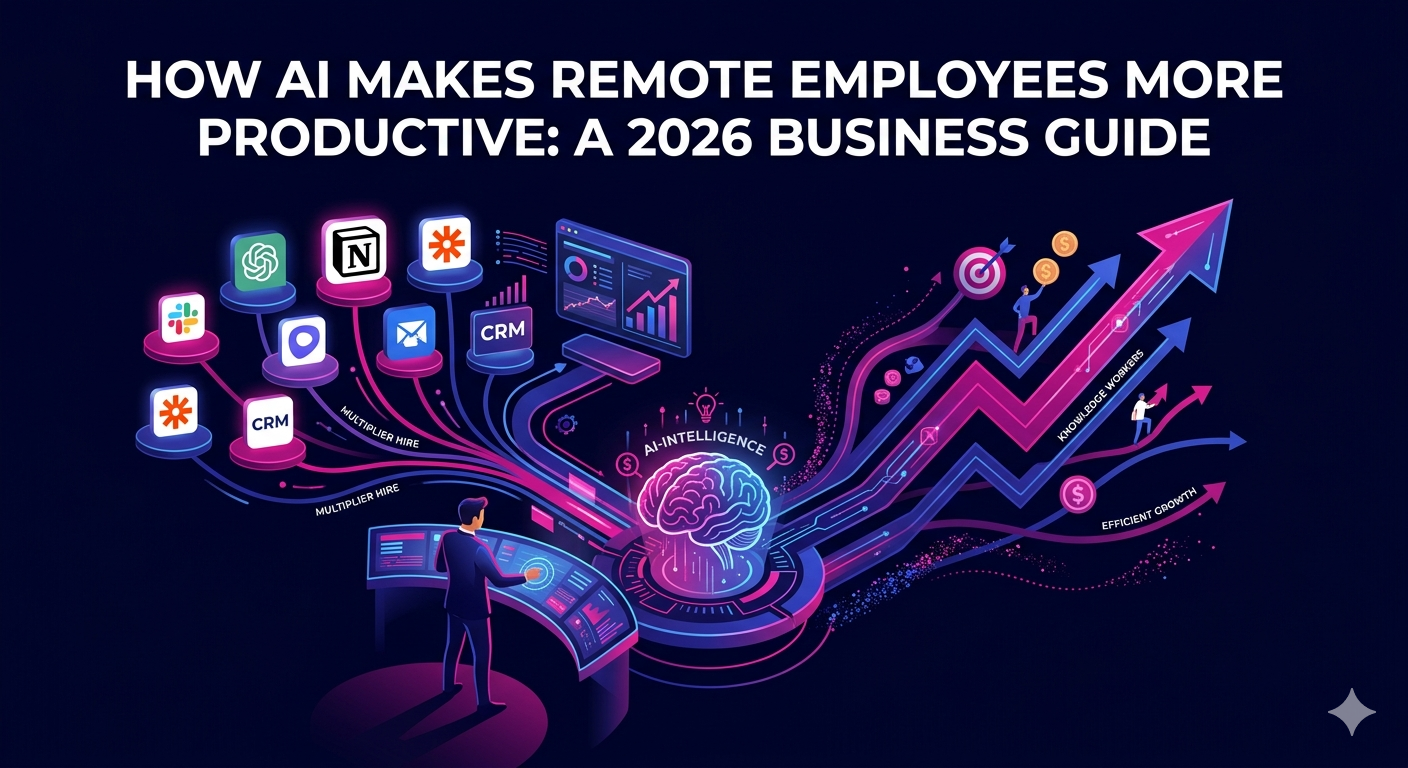
Remote work is no longer an experiment. It is the operating model for thousands of businesses worldwide. But the biggest shift happening right now is not about where people work. It is about how they work. Understanding how AI makes remote employees more productive is becoming one of the most important things a business leader can learn in 2026.
AI tools have fundamentally changed what a single remote professional can accomplish in a day. Tasks that once took hours are now completed in minutes. Entire workflows that required multiple team members can now be handled by one skilled individual with the right AI stack. This guide breaks down the mechanics of that shift and explains what it means for your business when you hire and manage remote talent.
The Core Ways AI Makes Remote Employees More Productive
The productivity gains AI delivers to remote workers are not vague or theoretical. They show up in specific, measurable ways across every major business function. Here is where the impact is most significant.
Automating Repetitive Tasks
One of the clearest ways AI makes remote employees more productive is by eliminating the manual, repetitive work that drains time and energy. Data entry, scheduling, report formatting, email sorting, and status updates can all be handled by AI automation tools without human input once the systems are set up.
A remote employee who previously spent two to three hours per day on administrative tasks can now redirect that time toward higher-value work. Over the course of a month, that adds up to dozens of additional productive hours per person.
Accelerating Research and Information Retrieval
Remote employees often work without the ability to turn to a colleague and ask a quick question. AI tools solve this by giving remote workers instant access to research, summarization, and knowledge retrieval capabilities. Whether it is pulling competitive intelligence, summarizing a long document, or finding relevant data for a proposal, AI dramatically reduces the time it takes to get from question to answer.
Improving Output Quality at Speed
AI writing assistants, editing tools, and content generation platforms help remote professionals produce higher-quality work faster. A remote marketer drafting campaign copy, a remote SDR writing personalized outreach, or a remote assistant preparing executive summaries can all use AI to refine their work in real time without slowing down.
The result is not just more output but better output. AI catches errors, suggests improvements, and helps remote staff maintain consistent quality across a high volume of work.
Enabling Smarter Decision-Making
AI-powered analytics and reporting tools give remote employees access to insights that used to require a dedicated data analyst. Sales staff can see which leads are most likely to convert. Marketers can identify which content is driving results. Support teams can spot patterns in customer issues before they escalate. When remote employees have this kind of intelligence built into their workflow, they make better decisions faster.
How AI Boosts Productivity Across Specific Remote Roles
Understanding how AI makes remote employees more productive is most useful when applied role by role. Here is how the gains play out across the positions businesses hire most often.
Remote Sales Development Representatives
AI has transformed outbound sales. Remote SDRs now use AI tools to identify ideal prospects, enrich contact data, personalize outreach at scale, and automate follow-up sequences. What used to require hours of manual research and email writing can now be executed in a fraction of the time. The result is a larger pipeline with better personalization and more consistent follow-through. If you want to see how AI productivity applies to outbound sales, explore AI-productive remote SDRs at The Remote Reps who are already operating with these tools built into their process.
Remote Digital Marketers
Digital marketing involves a constant stream of content creation, campaign analysis, audience research, and platform management. AI tools allow remote digital marketers to produce more content, test more variables, and analyze more data than was ever possible manually. A single remote marketer with a strong AI toolkit can now manage what previously required a small team.
Remote Virtual Assistants and Executive Assistants
For remote VAs and executive assistants, AI is the difference between keeping up and getting ahead. These professionals use AI to draft communications, manage calendars intelligently, research topics, prepare briefings, and handle administrative workflows that would otherwise consume significant time from the leaders they support. The productivity gains here directly free up senior staff to focus on strategic work. Discover how remote executive assistants who use AI can multiply your own output as a founder or executive.
Remote Customer Support Specialists
AI-assisted customer support tools give remote support staff the ability to handle higher ticket volumes without sacrificing response quality. Suggested replies, intelligent ticket routing, and AI-generated knowledge base summaries all reduce handle time and improve first-contact resolution rates. Remote support teams using AI consistently outperform traditional support setups on both speed and satisfaction scores.
Remote Lead Generation Experts
Lead generation in 2026 is driven by AI prospecting tools that identify intent signals, enrich lead data automatically, and prioritize outreach based on conversion likelihood. Remote lead generation professionals who understand how to work with these tools build pipelines that are not only larger but significantly more qualified. Learn more about how AI-powered remote lead generation experts can accelerate your pipeline growth.
The Business Impact of AI-Productive Remote Teams
When you understand how AI makes remote employees more productive, the business case becomes clear very quickly. Here is what companies are experiencing in 2026 when they build remote teams around AI-skilled professionals.
- Lower cost per output: AI-enabled remote staff produce more in fewer hours, which directly reduces your cost per deliverable, per lead, or per customer interaction.
- Faster time to results: Onboarding an AI-skilled remote employee means faster ramp time and earlier contribution because they bring their own proven tools and workflows.
- Reduced management overhead: Remote staff who use AI to self-organize, track their work, and document their processes require less day-to-day supervision.
- Greater scalability: One AI-equipped remote professional can scale their output as your business grows without proportional increases in cost or complexity.
- Improved consistency: AI tools help remote employees maintain quality and tone standards across high volumes of work, reducing errors and the need for rework.
What the Research Confirms About AI and Remote Productivity
The evidence supporting how AI makes remote employees more productive is well-documented. According to Boston Consulting Group’s research on AI and workforce productivity, professionals who use generative AI tools on knowledge-based tasks consistently outperform those who do not, with gains in both speed and output quality measured across multiple role types. For remote workers, who already operate with greater autonomy, these gains compound because AI extends that autonomy further and reduces the friction points that slow down distributed teams.
Practical Steps to Build an AI-Productive Remote Team
Hire for AI Fluency, Not Just Role Experience
When recruiting remote staff, ask directly about their AI tool experience. Find out which platforms they use, how they have integrated AI into past roles, and what measurable productivity improvements they have achieved. A candidate who can point to specific examples of how AI made them more productive in a previous role is far more valuable than one who simply lists AI tools on their resume.
Standardize Your AI Tool Stack
Choose a set of AI tools that align with your business functions and make them available to your remote team from day one. Having a consistent stack reduces onboarding time, makes collaboration easier, and allows you to measure productivity improvements against a clear baseline.
Set Output-Based Performance Metrics
Because AI makes remote employees more productive, you can hold them to higher output standards than you might with traditional hires. Define KPIs in terms of results, such as leads generated, content pieces produced, or tickets resolved, rather than hours worked. This aligns incentives and gives remote staff the autonomy to use AI however it works best for their individual workflow.
Create Space for Continuous AI Learning
AI tools evolve quickly. Remote teams that stay current with new capabilities maintain their productivity advantage. Build in time for your remote staff to explore new tools, share what is working, and update their workflows as better options become available.
FAQ: How AI Makes Remote Employees More Productive
How AI makes remote employees more productive compared to in-office workers?
The core ways AI makes remote employees more productive apply equally to in-office workers, but remote staff often see greater gains because they operate with more autonomy and fewer opportunities for informal knowledge sharing. AI fills the information gaps that remote work creates, gives remote professionals the tools to self-manage more effectively, and reduces the coordination overhead that can slow distributed teams down. The result is a remote employee who is often more productive than an in-office counterpart doing the same role.
What specific AI tools explain how AI makes remote employees more productive?
The tools vary by role, but the categories that explain how AI makes remote employees more productive include AI writing and editing assistants, workflow automation platforms, CRM-integrated prospecting tools, AI-powered analytics dashboards, intelligent scheduling systems, and AI-assisted customer communication tools. Remote professionals who are proficient across several of these categories consistently outperform peers who rely on manual processes.
Does understanding how AI makes remote employees more productive change how I should hire?
Yes, significantly. Once you understand how AI makes remote employees more productive, you start evaluating candidates differently. AI fluency becomes a primary hiring criterion rather than a secondary one. You look for candidates who can demonstrate real workflow improvements through AI, not just familiarity with tools. And you recognize that a slightly smaller team of AI-skilled remote professionals will often outperform a larger team of traditional hires on both output volume and quality.
How quickly does AI make remote employees more productive after they join?
Remote employees who already have AI skills and tools built into their workflow can begin demonstrating productivity gains within their first one to two weeks. The ramp time is shorter than with traditional hires because AI tools help them get up to speed faster, organize their work more efficiently, and produce results before they have fully internalized all the context of the role. Most businesses report seeing measurable ROI from AI-skilled remote hires within the first 30 days.
Are there roles where AI makes remote employees significantly more productive than others?
Yes. The roles where AI makes remote employees most productive tend to be those involving high volumes of communication, content, research, or data work. This includes sales development, digital marketing, lead generation, executive assistance, customer support, and cold outreach. These are also among the most commonly hired remote roles, which means the opportunity to apply AI productivity gains is available to most businesses regardless of their size or industry.
How do I measure whether AI is actually making my remote employees more productive?
The most reliable approach is to define output-based KPIs before the hire starts and track them consistently over time. Metrics such as number of qualified leads generated per week, content pieces produced per month, support tickets resolved per day, or outreach sequences launched per campaign give you a clear picture of whether AI is making your remote employees more productive. Compare these figures against your previous benchmarks to measure the true impact.
The Takeaway: AI-Productive Remote Teams Are a Strategic Advantage
The question is no longer whether AI makes remote employees more productive. The evidence is clear that it does. The real question is whether your business is capturing that advantage or leaving it on the table.
Building a remote team that combines professional expertise with genuine AI fluency is one of the highest-leverage moves available to growth-focused businesses in 2026. Start by exploring the full range of AI-skilled remote professionals available through The Remote Reps and take the first step toward a team that delivers more, costs less, and scales with your goals.