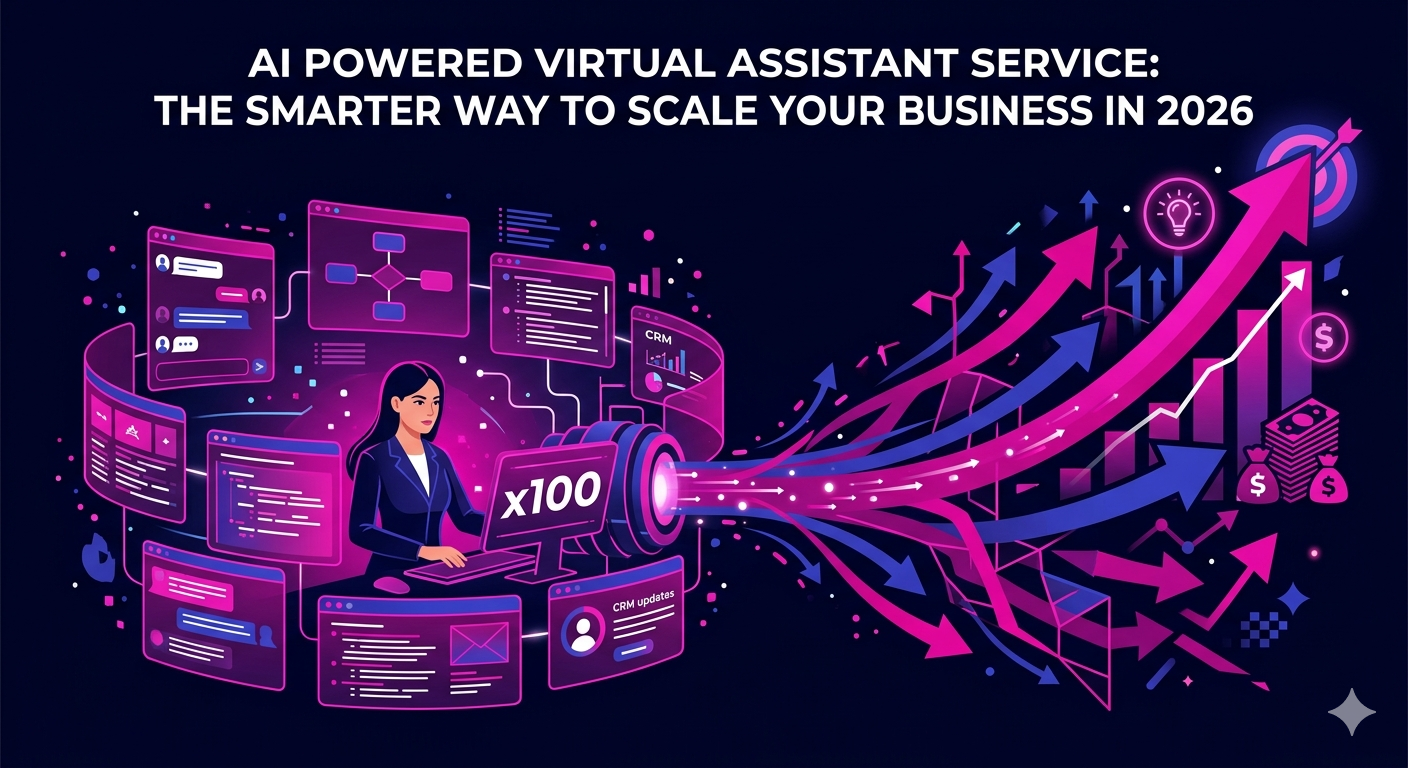
Running a business in 2026 means managing more tasks, more tools, and more complexity than ever before. The good news is that an AI powered virtual assistant service gives you a genuine competitive edge, combining the adaptability of a skilled human assistant with the speed and efficiency of modern AI tools. The result is a support system that handles more work in less time, at a fraction of the cost of a traditional in-house hire.
Whether you are a solo founder drowning in administrative work or a growing company that needs to scale operations without scaling headcount, this guide breaks down exactly what an AI powered virtual assistant service delivers, what to look for, and how to get started.
What Is an AI Powered Virtual Assistant Service?
An AI powered virtual assistant service pairs a skilled human virtual assistant with proficiency in AI tools to handle a wide range of business tasks remotely. Unlike a basic VA who relies only on manual effort, an AI powered assistant uses tools like ChatGPT, Notion AI, Zapier, and other automation platforms to complete work faster, more accurately, and at greater volume.
This is not about replacing humans with bots. It is about giving talented remote professionals the tools to do ten times more in the same number of working hours. For the business owner, that means better output, faster turnaround times, and more tasks handled per dollar spent.
Common Tasks Handled by an AI Powered Virtual Assistant
- Email management, drafting, and inbox organization using AI writing tools
- Calendar scheduling, meeting coordination, and travel planning
- Research, summarization, and report creation using AI research tools
- Social media content drafting, scheduling, and engagement tracking
- Data entry, CRM updates, and database management with AI-assisted workflows
- Customer support responses and ticketing system management
- Document creation, formatting, and proofreading
- Lead research and outreach list building using AI prospecting tools
Why Businesses Are Switching to AI Powered Virtual Assistant Services in 2026
The traditional virtual assistant model still has value, but the gap between a standard VA and an AI powered one has grown significantly. Businesses that have made the switch consistently report the same benefits.
Speed and Output Volume
An AI powered virtual assistant service can complete tasks that would take hours manually in a fraction of the time. Research that used to take a half day can be done in under an hour. Email drafts that required careful manual composition are now produced in minutes and then refined by the VA before sending. The throughput per assistant is genuinely higher, which means more gets done each week without any additional cost to you.
Cost Efficiency Without Sacrificing Quality
Hiring a full-time in-house executive assistant in the United States costs between $55,000 and $80,000 per year when you factor in salary, benefits, and overhead. A remote AI powered virtual assistant service can deliver comparable or superior productivity at a significantly lower monthly investment, often between $1,500 and $4,000 per month depending on hours and scope.
Scalability on Demand
Business needs are not static. You might need 10 hours of support one week and 40 the next. An AI powered virtual assistant service scales with you rather than locking you into a rigid arrangement. You can expand the scope of tasks, increase hours, or add additional assistants as your business grows.
Access to a Broader Skill Set
AI tools allow virtual assistants to operate competently across a wider range of tasks. An assistant with strong AI tool proficiency can handle content research, competitive analysis, basic data visualization, and process documentation without requiring specialized training in each individual discipline.
How to Evaluate an AI Powered Virtual Assistant Service Provider
Not every VA service that claims to offer AI powered support actually delivers it. Here is how to separate credible providers from those who simply use the term as a marketing label.
Ask About Tool Proficiency
A genuine AI powered virtual assistant service should be able to tell you exactly which tools their assistants are trained on. Ask specifically about proficiency with AI writing tools, automation platforms like Zapier or Make, project management tools, and CRM systems. Candidates should be able to demonstrate workflows, not just name tools.
Review Real Work Samples
Request examples of work completed using AI-assisted workflows. A research report, a social media calendar, or a set of drafted emails can tell you a lot about whether the assistant produces polished, professional output or rough drafts that require heavy editing.
Assess Communication Standards
Remote work depends entirely on clear communication. Evaluate how quickly candidates respond during the hiring process, how clearly they explain their workflows, and whether they ask smart clarifying questions. An AI powered virtual assistant service is only as valuable as the human behind it, and communication quality is a direct indicator of how the working relationship will function.
Look for Industry Experience Where Relevant
Some tasks are universal. Others require context. If you need support with legal document management, e-commerce operations, or B2B sales outreach, look for an AI powered virtual assistant who has worked in those areas before. Domain familiarity shortens the ramp-up time and reduces the chance of errors in specialized tasks.
The Right Tasks to Delegate to an AI Powered Virtual Assistant
Knowing what to delegate is as important as knowing who to hire. The highest-value use cases for an AI powered virtual assistant service fall into a few clear categories.
High-Volume Repetitive Work
Any task that follows a repeatable process is a strong candidate for delegation. Email sorting and responses, data entry, appointment scheduling, and social media posting all fit this profile. AI tools make these tasks faster and more consistent, freeing you to focus on strategic priorities.
Research and Information Processing
Competitive research, industry news summarization, prospect list building, and content research are time-consuming for founders and executives but well-suited for a skilled assistant with access to AI research tools. The output quality is high and the time savings are significant.
Content Support
An AI powered virtual assistant is not a content strategist, but they can be an excellent content support resource. First-draft creation, blog post outlines, social media captions, email sequences, and newsletter curation are all tasks where AI-assisted VA support adds real value.
Administrative Coordination
Calendar management, travel arrangements, vendor coordination, invoice tracking, and meeting preparation all benefit from an organized, AI-equipped assistant who can move quickly and stay on top of details without requiring your constant input.
How The Remote Reps Delivers AI Powered Virtual Assistant Services
Finding a high-quality virtual assistant on a generic freelance platform is a hit-or-miss process. The Remote Reps takes a different approach by pre-vetting every candidate for both core professional skills and AI tool proficiency before they ever connect with a client.
Every VA placed through The Remote Reps is evaluated on communication quality, task management systems, AI tool fluency, and domain experience. The result is a faster onboarding process and a higher baseline of performance from day one.
If you are ready to delegate more and grow faster, explore The Remote Reps AI powered virtual assistant service to find the right remote professional for your business needs. For businesses that need executive-level support, you can also review options for remote executive assistants who bring the same AI-enhanced skill set to higher-stakes responsibilities.
For a broader perspective on how AI tools are reshaping the virtual assistant industry, Harvard Business Review’s coverage of AI-powered business services and productivity tools offers well-researched insight into how organizations are integrating human and AI capabilities effectively.
Getting Started: What to Expect in the First 30 Days
The first 30 days with an AI powered virtual assistant service are about building systems and establishing trust. Here is a realistic timeline for what that looks like.
Week 1: Onboarding and Access
Your assistant gets access to the tools and platforms they need. You document your key workflows, communication preferences, and task priorities. A short onboarding call or document goes a long way toward setting clear expectations from the start.
Week 2 and 3: Building Rhythm
Your assistant starts completing tasks and you provide feedback. The AI-assisted workflows get calibrated to your preferences. Response templates, research formats, and scheduling processes get refined through real use.
Week 4: Full Productivity
By the end of the first month, a well-matched AI powered virtual assistant should be running independently on most delegated tasks with minimal oversight. You start to see meaningful time savings and the mental load of administrative work begins to lift.
Conclusion: AI Powered Support Is No Longer Optional for Growing Businesses
The businesses scaling efficiently in 2026 are not doing it alone and they are not doing it with outdated support models. An AI powered virtual assistant service gives you leverage, letting a skilled remote professional handle the operational work that slows you down so you can focus on the decisions that drive growth.
The investment is low relative to the return, the setup is fast, and the right assistant can transform how your business operates within weeks. Connect with The Remote Reps today and find your AI powered virtual assistant.
Frequently Asked Questions
What is an AI powered virtual assistant service and how is it different from a standard VA?
An AI powered virtual assistant service combines a skilled human remote assistant with proficiency in AI tools like ChatGPT, Zapier, and Notion AI. Unlike a standard VA who completes tasks manually, an AI powered assistant uses these tools to work faster, handle higher volumes, and deliver more consistent output. The result is greater productivity per hour and a broader range of tasks that can be delegated effectively.
What tasks can I delegate to an AI powered virtual assistant service?
An AI powered virtual assistant service can handle a wide range of tasks including email management, calendar scheduling, research and summarization, social media content drafting, data entry, CRM updates, customer support responses, document creation, and lead list building. The specific scope depends on the assistant’s skill set and the tools they are trained on, so it is worth clarifying your top priorities during the hiring or onboarding process.
How much does an AI powered virtual assistant service cost in 2026?
Costs for an AI powered virtual assistant service in 2026 typically range from $1,500 to $4,000 per month for part-time to full-time remote support, depending on the level of experience, the complexity of tasks, and the number of hours required. This is significantly more cost-effective than hiring an in-house assistant, which can cost $55,000 to $80,000 annually when factoring in salary and overhead.
How do I know if an AI powered virtual assistant service provider is legitimate?
To verify that an AI powered virtual assistant service is genuinely AI-capable, ask candidates to walk you through their workflows and demonstrate the tools they use. Request work samples produced using AI-assisted processes. Platforms like The Remote Reps pre-screen assistants for AI tool fluency, which removes much of the guesswork from the hiring process and ensures you are working with someone who can actually deliver the efficiency gains you are looking for.
How long does it take to see results from an AI powered virtual assistant service?
Most businesses start seeing meaningful time savings within two to three weeks of onboarding a well-matched AI powered virtual assistant. The first week is typically spent on setup and access. By the end of the first month, a skilled assistant should be running independently on most delegated tasks. The ramp-up period is shorter than with a traditional hire because AI tools allow for faster learning curves and more consistent task execution from early on.
Is an AI powered virtual assistant service suitable for small businesses and startups?
An AI powered virtual assistant service is particularly well-suited for small businesses and startups because it provides enterprise-level support capacity without the cost or commitment of a full-time hire. Founders and small teams benefit most from delegating high-volume administrative and research tasks, freeing up time for strategy, sales, and product development. The flexible engagement models available through staffing platforms like The Remote Reps make it easy to start small and scale as your needs grow.