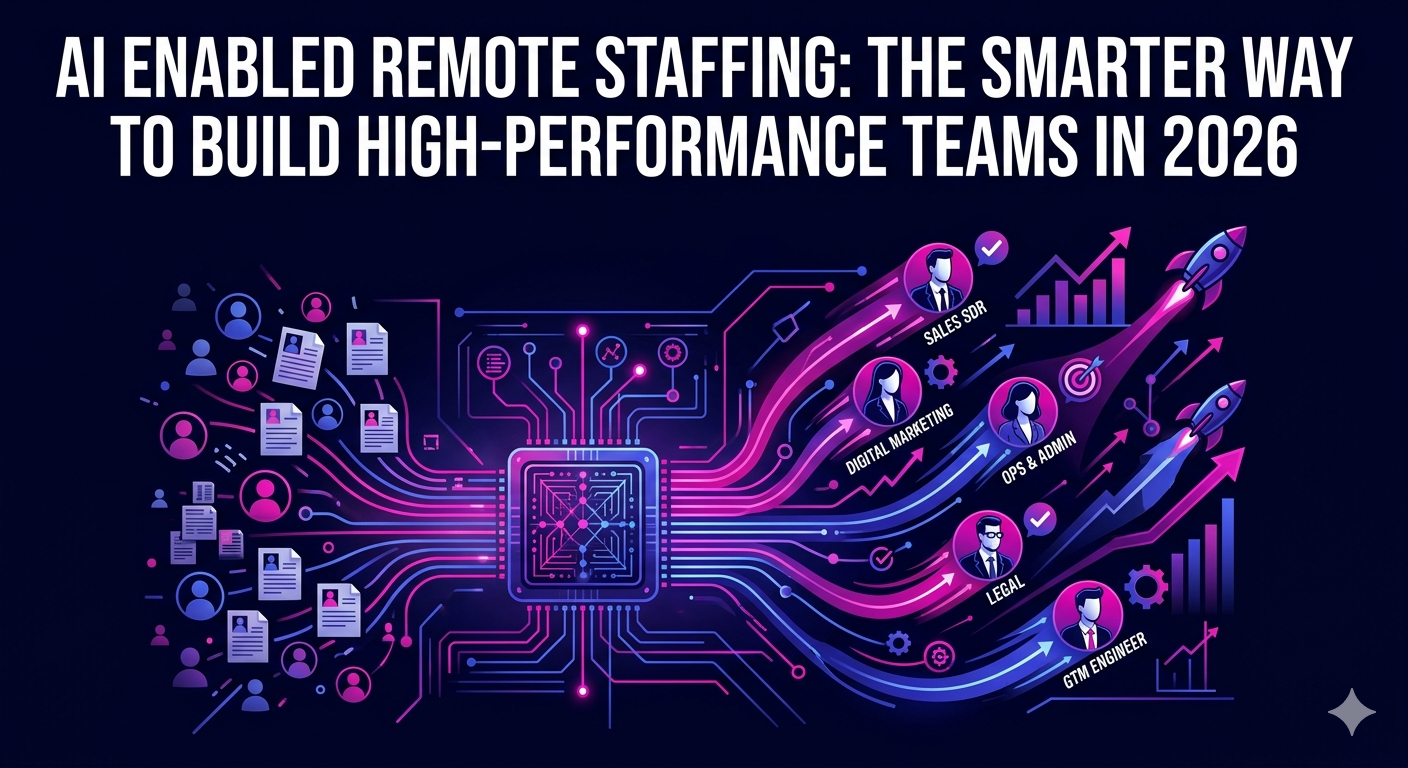
The way businesses hire has changed permanently. In 2026, companies that rely solely on traditional recruitment are losing ground to competitors who have embraced AI enabled remote staffing. By combining the power of artificial intelligence with a global talent pool, forward-thinking businesses are cutting hiring timelines, reducing overhead, and landing candidates who actually deliver results.
Whether you are scaling a startup or optimizing an enterprise operation, AI enabled remote staffing is no longer a luxury. It is a competitive necessity.
What Is AI Enabled Remote Staffing?
AI enabled remote staffing refers to the use of artificial intelligence tools and platforms throughout the remote hiring process. This includes candidate screening, skills assessment, performance prediction, onboarding automation, and ongoing workforce management, all applied to remote talent across global markets.
Unlike traditional staffing, this approach removes the guesswork. AI systems analyze thousands of data points to match the right person to the right role faster and with greater accuracy than any manual process can achieve.
Key Components of an AI Driven Staffing Model
- Automated resume parsing and skills matching
- AI-powered candidate scoring and ranking
- Behavioral and cognitive assessment tools
- Predictive analytics for long-term performance
- Intelligent onboarding workflows
- Real-time productivity and performance tracking
Why AI Enabled Remote Staffing Is Dominating in 2026
Several forces have converged to make AI enabled remote staffing the dominant model for scaling teams in 2026. Remote work infrastructure is more mature than ever. AI hiring tools have reached a level of accuracy and affordability accessible to businesses of all sizes. And global talent markets have expanded dramatically, giving companies access to skilled professionals in every time zone.
The Numbers Tell the Story
According to Gartner’s research on talent management and AI-enabled workforce strategies, organizations using AI in their talent acquisition process report up to a 40 percent reduction in time-to-hire and a significant improvement in candidate quality scores. These are not marginal gains. They represent a structural advantage that compounds over time.
When businesses cut time-to-hire by nearly half, they reduce the revenue impact of unfilled roles. When candidate quality improves, retention rates climb and training costs fall. The ROI of AI enabled remote staffing extends far beyond the initial hire.
Cost Efficiency Without Compromising Quality
One of the most powerful benefits of AI enabled remote staffing is the ability to access world-class talent at a fraction of the cost of local hiring in high-expense markets. A skilled sales development representative, digital marketer, or virtual assistant based in a lower cost region can deliver the same output as a domestic hire at a significantly reduced salary cost.
AI tools ensure these remote hires are not just affordable but genuinely qualified. Assessments, structured interviews, and performance benchmarks built into the staffing process filter out underqualified candidates before they ever reach your desk.
Roles Best Suited for AI Enabled Remote Staffing
AI driven remote staffing works exceptionally well across a wide range of business functions. The common thread is that these roles have measurable outputs, can operate asynchronously or in flexible time windows, and benefit from specialized skills that are more abundant in global talent markets than in any single local market.
Sales and Revenue Teams
Sales development representatives, account executives, and lead generation experts are among the most in-demand remote roles in 2026. With AI tools now capable of matching candidates to specific industry verticals, communication styles, and performance histories, companies can build high-output sales teams remotely without the expense of a large in-house team.
If you are looking to scale your pipeline without scaling your office costs, explore AI enabled remote staffing solutions for sales development representatives that deliver qualified leads and consistent outreach from day one.
Marketing and Digital Growth Roles
Digital marketers, SEO specialists, social media managers, PPC experts, media buyers, and e-commerce marketing professionals are ideally suited to remote work. These roles are project-based, output-measurable, and increasingly AI-augmented themselves, making them a natural fit for an AI enabled remote staffing model.
Operations and Administrative Support
Virtual assistants, executive assistants, customer support specialists, and GTM engineers are seeing strong demand in remote-first organizations. These roles benefit from AI-powered task management tools, asynchronous communication platforms, and intelligent workflow automation, all of which make remote delivery as effective as in-office work.
Legal and Compliance Support
Even specialized functions like legal assistance are moving remote. Paralegals, legal secretaries, and legal assistants with verified credentials and AI-assisted research tools can support law firms and corporate legal teams efficiently from anywhere in the world.
How the AI Enabled Staffing Process Works
Understanding the workflow behind AI enabled remote staffing helps businesses set realistic expectations and get the most from the model.
Step 1: Role Definition and Requirements Analysis
The process begins with a detailed intake of the role requirements, including technical skills, soft skills, performance benchmarks, and cultural fit indicators. AI tools use this data to build a precise candidate profile.
Step 2: Intelligent Candidate Sourcing
AI platforms search curated talent databases, job boards, and professional networks simultaneously. Algorithms score candidates against the defined profile in real time, surfacing the top matches within hours rather than weeks.
Step 3: Automated Screening and Assessment
Shortlisted candidates complete standardized assessments that test for role-specific competencies. AI scores these assessments objectively, removing human bias from the early screening stage.
Step 4: Human Review and Final Selection
The hiring team reviews a curated shortlist of pre-vetted, high-scoring candidates. Structured interviews and reference checks complete the selection process. At this stage, AI has already done the heavy lifting.
Step 5: Onboarding and Performance Management
AI powered onboarding systems deliver role-specific training, compliance documentation, and tool access in a structured sequence. Ongoing performance tracking tools give managers visibility into remote team productivity without micromanagement.
Common Misconceptions About AI Enabled Remote Staffing
Misconception 1: AI Replaces Human Judgment
AI augments human decision-making rather than replacing it. The best AI enabled staffing models combine algorithmic efficiency with human intuition. AI handles the volume and the data. Humans make the final call.
Misconception 2: Remote Teams Are Harder to Manage
With modern project management, communication, and performance tracking tools, remote teams in 2026 are often easier to manage than traditional office teams. Visibility is built into the workflow, not left to hallway conversations.
Misconception 3: Only Tech Companies Benefit
AI enabled remote staffing delivers value across industries including legal services, financial services, e-commerce, healthcare administration, real estate, and professional services. Any business that relies on knowledge workers can benefit from this model.
Choosing the Right AI Enabled Remote Staffing Partner
Not all staffing solutions are created equal. When evaluating a remote staffing partner for 2026 and beyond, look for these qualities:
- A proven track record of placing candidates in your specific role categories
- Transparent use of AI tools in the screening and vetting process
- Clear performance guarantees and replacement policies
- Ongoing support beyond the initial placement
- Access to a diverse, pre-vetted global talent pool
The right partner does not just find candidates. They act as a strategic talent advisor who understands your business goals and builds your team accordingly.
The Future of Work Is Already Here
AI enabled remote staffing is not a trend on the horizon. It is the operating model of the most competitive businesses running today. In 2026, companies that have integrated intelligent remote staffing into their growth strategy are outperforming those that have not across virtually every metric: cost per hire, time to productivity, employee retention, and revenue per headcount.
The question is no longer whether to adopt AI enabled remote staffing. The question is how quickly you can implement it before your competitors get further ahead.
Ready to build a smarter remote team? Start by exploring the full range of AI enabled remote staffing solutions at The Remote Reps and discover how intelligent talent matching can transform your hiring results.
Frequently Asked Questions About AI Enabled Remote Staffing
What makes AI enabled remote staffing different from traditional remote hiring?
Traditional remote hiring relies on manual resume reviews, unstructured interviews, and recruiter intuition. AI enabled remote staffing uses algorithmic screening, standardized assessments, and predictive analytics to match candidates to roles with far greater speed and accuracy. The result is a shorter hiring cycle, a higher quality shortlist, and better long-term retention outcomes.
Is AI enabled remote staffing suitable for small businesses?
Absolutely. In fact, small businesses often see the greatest return from AI enabled remote staffing because they lack large internal HR teams. AI tools level the playing field by giving smaller companies access to the same quality of talent identification and vetting that enterprise organizations use, without the need for a dedicated recruitment department.
How does AI enabled remote staffing handle data privacy and compliance?
Reputable AI enabled remote staffing platforms are built with data privacy regulations in mind, including GDPR and regional labor compliance standards. Candidate data is handled securely, assessments are administered ethically, and hiring decisions are documented in ways that meet legal requirements across jurisdictions.
What types of roles can be filled through AI enabled remote staffing?
AI enabled remote staffing covers a wide range of functions including sales, digital marketing, SEO, social media management, PPC and media buying, customer support, virtual and executive assistance, lead generation, e-commerce marketing, cold email outreach, GTM engineering, legal support, and more. If a role can be performed remotely with measurable outputs, it is a strong candidate for this model.
How long does it take to hire through an AI enabled remote staffing platform?
With AI enabled remote staffing, most roles can be filled within one to three weeks depending on the complexity of the position and the depth of the talent pool. This compares favorably to traditional recruitment timelines of four to eight weeks or longer. AI automation in the screening and assessment stages accounts for most of the time savings.
How do I ensure quality control when managing an AI enabled remote staffing team?
Quality control in an AI enabled remote staffing model is built into the process from the start. Pre-hire assessments establish baseline competency benchmarks. Structured onboarding aligns remote hires with your workflows and expectations. Ongoing performance tracking tools provide real-time visibility into output quality, allowing managers to address issues early and recognize high performers.