
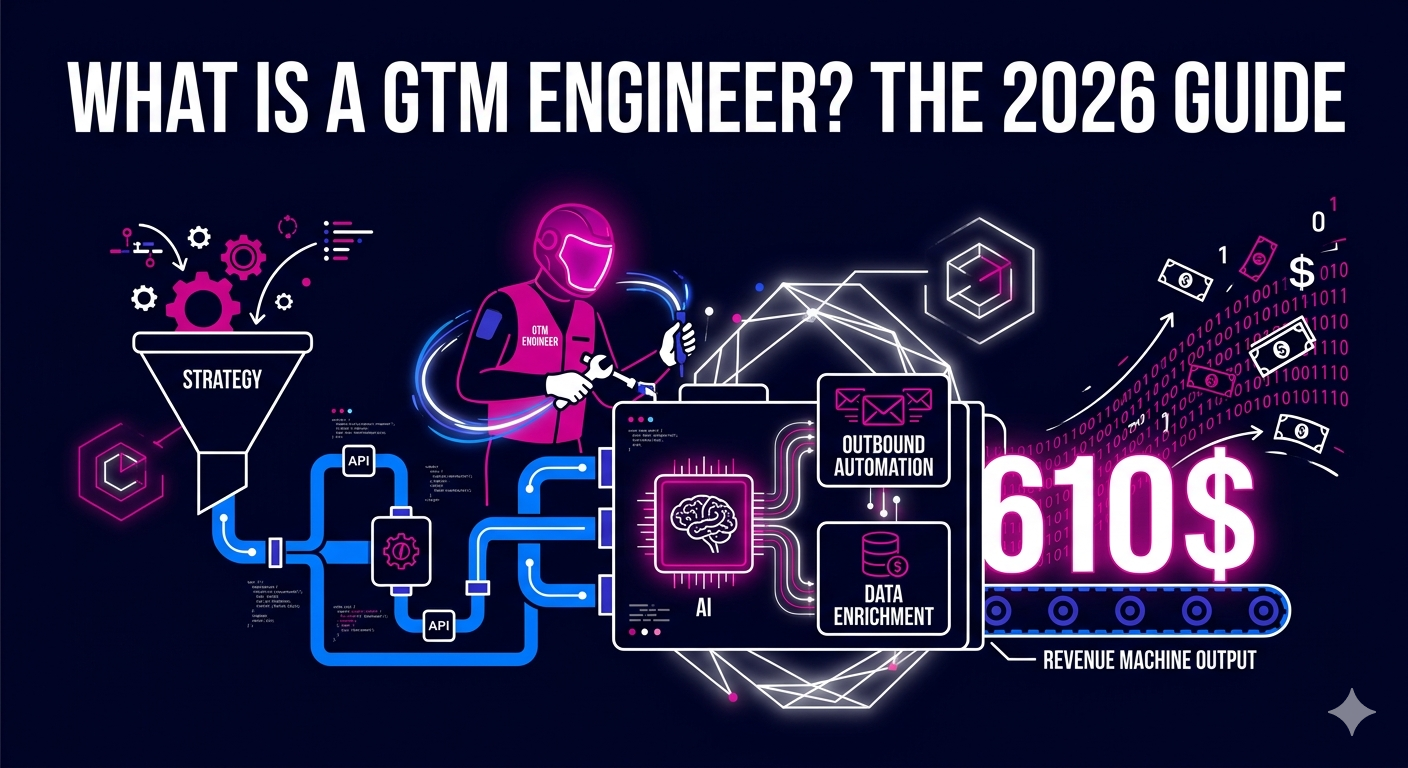
If you have been hearing the term “GTM engineer” more often lately, you are not imagining things. In 2026, this role has quickly become one of the most sought-after positions in B2B sales and marketing. But what is a GTM engineer, exactly, and why are forward-thinking companies racing to hire one?
This guide breaks down everything you need to know: the definition, core responsibilities, must-have skills, tools, and how a GTM engineer can directly impact your revenue. Whether you are a startup founder, a sales leader, or simply curious about the evolving go-to-market landscape, read on.
Defining the GTM Engineer Role
A GTM (Go-To-Market) engineer sits at the intersection of sales, marketing, and technology. Unlike a traditional sales development representative or a pure developer, a GTM engineer uses technical skills to build, automate, and optimize the systems that drive revenue growth.
Think of them as the person who turns your go-to-market strategy into a well-oiled machine. They write code, configure APIs, build workflows, and analyze data, all in service of helping your sales and marketing teams work faster and smarter.
GTM Engineer vs. Sales Engineer: What Is the Difference?
Many people confuse a GTM engineer with a sales engineer. Here is the key distinction:
- Sales engineers focus on helping prospects understand and evaluate a product during the sales cycle. They are reactive and customer-facing.
- GTM engineers are proactive and internally focused. They build the infrastructure, automations, and data pipelines that make the entire go-to-market motion more efficient.
In short, a sales engineer closes deals by explaining the product. A GTM engineer builds the systems that generate more opportunities to close.
What Does a GTM Engineer Actually Do?
The day-to-day work of a GTM engineer can vary by company size and stage, but most responsibilities fall into these key areas:
1. Outbound Automation and Sequencing
GTM engineers build and maintain outbound sales infrastructure. This includes setting up cold email systems, configuring sending domains, managing IP warming, and building multi-step sequences that run at scale without losing personalization.
2. Data Enrichment and Lead Scoring
They pull data from sources like Clay, Apollo, LinkedIn, and Clearbit to enrich CRM records and build accurate ideal customer profiles (ICPs). They then layer in scoring logic so sales reps focus on the highest-intent prospects first.
3. CRM Architecture and Workflow Automation
A GTM engineer owns the technical layer of your CRM, whether that is HubSpot, Salesforce, or another platform. They build custom fields, automation rules, and reporting dashboards that give leadership a clear picture of pipeline health.
4. AI-Powered Personalization at Scale
One of the biggest trends in 2026 is using large language models (LLMs) to write hyper-personalized outreach at scale. GTM engineers connect tools like Clay or n8n to AI models, enabling teams to send messages that feel one-to-one even when they are sent to thousands of prospects.
5. Attribution and Revenue Analytics
GTM engineers build attribution models that track which campaigns, channels, and touchpoints actually drive revenue. This data helps leadership make smarter decisions about where to invest marketing spend.
Skills Every GTM Engineer Needs in 2026
So what makes someone qualified for this role? The best GTM engineers combine technical depth with a sharp commercial mindset. Here are the core competencies:
Technical Skills
- Proficiency in Python, JavaScript, or similar scripting languages
- Experience with APIs, webhooks, and data integrations
- Familiarity with SQL for data querying and analysis
- Hands-on experience with workflow automation tools (n8n, Zapier, Make)
- Understanding of DNS, email deliverability, and domain infrastructure
GTM and Sales Operations Skills
- Deep knowledge of the B2B sales funnel and buyer journey
- Experience with CRM platforms (Salesforce, HubSpot)
- Understanding of outbound prospecting and cold email best practices
- Ability to build and interpret revenue dashboards
Soft Skills
- Strong problem-solving mindset
- Excellent communication skills to bridge technical and non-technical teams
- Self-directed and comfortable with ambiguity in fast-moving environments
The GTM Engineer Tech Stack in 2026
GTM engineers work across a wide range of tools. Here are the platforms that appear most frequently in their workflows:
- Data and Enrichment: Clay, Apollo, Clearbit, ZoomInfo
- Outreach and Sequencing: Instantly, Smartlead, Lemlist, Outreach
- Automation: n8n, Zapier, Make (formerly Integromat)
- CRM: HubSpot, Salesforce
- AI and LLMs: OpenAI API, Anthropic Claude, Groq
- Analytics: Looker, Metabase, Google Looker Studio
The ability to connect these tools into a seamless, automated revenue engine is what separates a great GTM engineer from an average one.
Why Companies Are Hiring GTM Engineers Now
The rise of the GTM engineer is not a trend. It is a structural shift in how B2B companies go to market. Here is why:
Outbound Has Gotten Harder
Inboxes are more crowded than ever. Buyers are more skeptical. Generic mass emails no longer work. GTM engineers solve this by building systems that deliver the right message to the right person at the right time, with data-driven precision.
Sales and Marketing Teams Are Resource-Constrained
Most startups and scale-ups cannot afford to hire large sales and marketing departments. A single skilled GTM engineer can often replace the output of several specialists by automating repetitive processes and building scalable systems.
AI Has Changed the Game
The proliferation of AI tools in 2025 and 2026 has created a new kind of leverage. GTM engineers who can harness AI for research, personalization, and workflow automation deliver compounding returns that were simply not possible three years ago.
If you are ready to hire a skilled GTM engineer for your team, explore The Remote Reps’ dedicated GTM engineer staffing service and get matched with a vetted, high-performance specialist.
How a GTM Engineer Fits Into Your Revenue Team
A GTM engineer works best when embedded within or closely alongside your revenue team. They are not a replacement for salespeople or marketers. They are the technical backbone that makes those teams significantly more effective.
In a typical setup, a GTM engineer will work with:
- SDRs and BDRs to build and optimize outbound sequences
- Account executives to create personalized account-based plays
- Marketing teams to align demand generation with outbound strategy
- RevOps leaders to ensure data integrity and reporting accuracy
According to Gartner’s latest research on sales technology trends, companies that invest in integrated sales technology and automation see significantly higher win rates and shorter sales cycles than those that do not.
Is a GTM Engineer the Right Hire for Your Business?
Not every company needs a full-time GTM engineer on day one. Here is a quick framework to help you decide:
- You should hire a GTM engineer if: You are running outbound at scale, your CRM is a mess, your team is wasting time on manual tasks, or you want to use AI to accelerate prospecting.
- You might not need one yet if: You are pre-product-market-fit, still figuring out your ICP, or have fewer than 5 people in your go-to-market motion.
For many companies, the most cost-effective approach is to work with a remote GTM engineer on a fractional or contract basis before committing to a full-time hire.
FAQ: What Is a GTM Engineer?
What is a GTM engineer in simple terms?
A GTM engineer is a technical professional who builds and optimizes the systems, automations, and data infrastructure that support a company’s go-to-market strategy. They combine coding skills with deep knowledge of sales and marketing operations to help revenue teams work more efficiently and effectively.
How is a GTM engineer different from a sales operations manager?
A sales operations manager typically focuses on strategy, process design, and reporting within the sales function. A GTM engineer is more technically hands-on, writing code, building integrations, and creating automated workflows. In many organizations, the two roles complement each other closely.
What tools does a GTM engineer use?
GTM engineers commonly work with tools like Clay, Apollo, HubSpot, Salesforce, Instantly, n8n, OpenAI API, and various data enrichment platforms. The specific stack varies by company, but the common thread is using technology to automate and scale go-to-market activities.
How much does a GTM engineer earn in 2026?
Salaries for GTM engineers vary widely depending on experience, location, and company size. In the United States, experienced GTM engineers typically earn between $90,000 and $160,000 per year in full-time roles. Remote and fractional options can offer more flexibility at a lower cost for early-stage companies.
Can a small business benefit from hiring a GTM engineer?
Yes. Small businesses can benefit significantly from a GTM engineer, especially if they are trying to scale outbound sales or automate marketing processes. Many small businesses start by hiring a part-time or remote GTM engineer to build their initial systems before transitioning to a full-time role as they grow.
Where can I hire a vetted GTM engineer?
There are several platforms where you can find skilled GTM engineers, including specialized staffing firms and freelance marketplaces. For companies looking for pre-vetted, remote-ready GTM talent, working with a dedicated staffing partner is often the fastest and most reliable path.
Final Thoughts
The question is no longer whether your company needs a GTM engineer. In 2026, the question is how quickly you can bring one on board. As competition for attention in the B2B market intensifies and AI continues to reshape the sales landscape, companies with skilled GTM engineers will consistently outperform those without.
Whether you are building your first outbound system or scaling an existing go-to-market motion, a GTM engineer brings the technical leverage to make it work at scale. If you are ready to take that next step, explore your options and start building smarter today.