
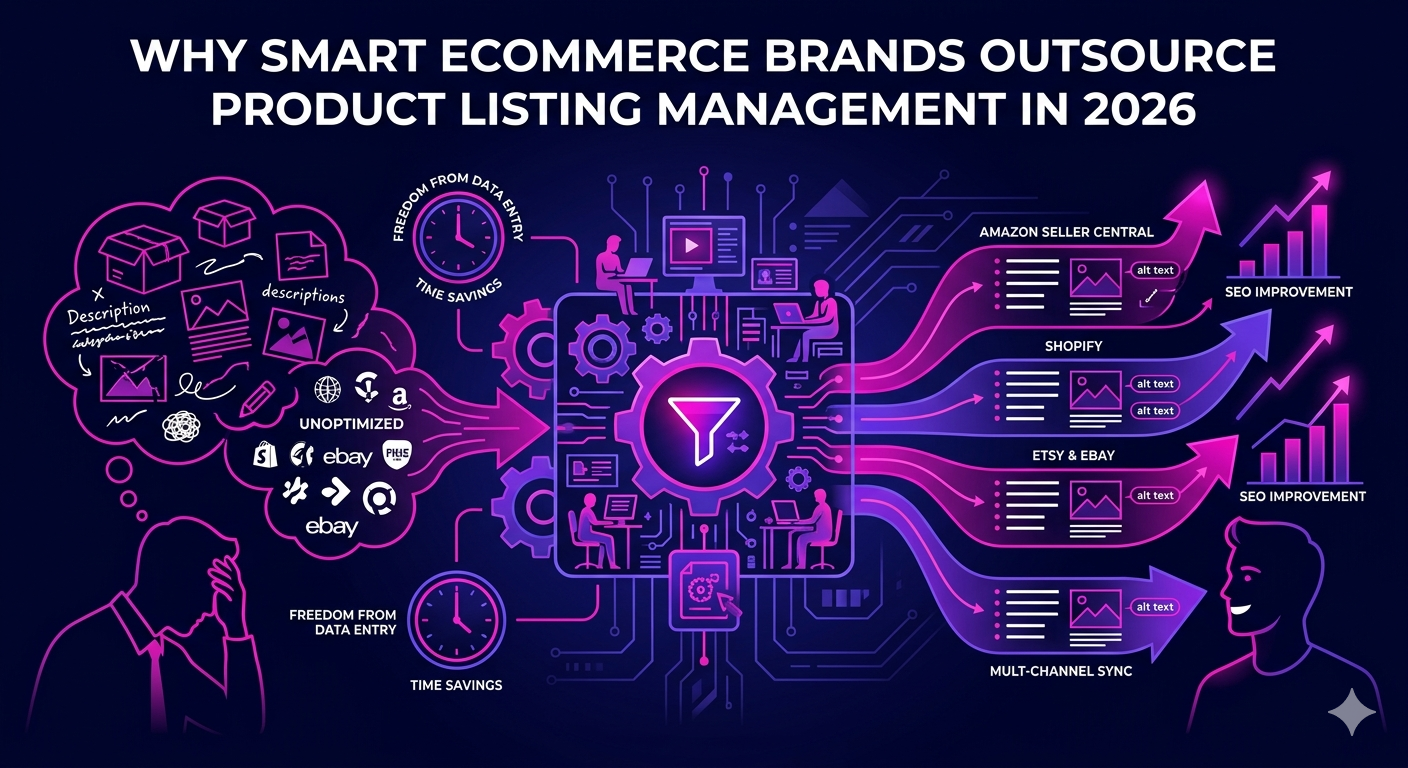
If you run an ecommerce store with more than a handful of products, you already know how time-consuming catalog management can be. Writing descriptions, uploading images, setting attributes, optimizing titles, and keeping listings accurate across multiple platforms is a never-ending job. That is exactly why more growing brands are choosing to outsource product listing management to skilled remote professionals in 2026.
Outsourcing this work does not just free up your time. It actively improves the quality and consistency of your catalog, which directly impacts search rankings, conversion rates, and customer satisfaction. This guide walks you through everything you need to know to make outsourcing work for your business.
What Does It Mean to Outsource Product Listing Management?
When you outsource product listing management, you delegate the creation, optimization, and ongoing maintenance of your product catalog to a remote professional or team. This covers everything from writing and formatting new listings to updating existing ones, managing variations, and ensuring accuracy across every sales channel.
Rather than spending your own time or hiring a full-time in-house employee, you work with a remote specialist who handles this operational layer on your behalf. The result is a cleaner catalog, faster publishing timelines, and a business owner who can focus on growth instead of data entry.
What Tasks Are Included in Outsourced Product Listing Management?
The scope of outsourced product listing work covers a wide range of responsibilities. Here is what a qualified remote listing specialist typically handles:
Product Content Creation
- Writing keyword-optimized product titles and descriptions
- Crafting compelling bullet points and feature highlights
- Developing SEO-friendly content tailored to each platform’s requirements
- Adapting tone and style to match brand voice guidelines
Image Management and Upload
- Uploading and organizing product images according to platform specifications
- Writing descriptive alt text for accessibility and SEO
- Managing image galleries, zoom views, and lifestyle shots
- Resizing and formatting images to meet platform size requirements
Catalog Organization and Maintenance
- Setting up and managing product categories and subcategories
- Creating and maintaining parent-child variation relationships
- Updating pricing, stock availability, and promotional details
- Auditing existing listings for errors, missing fields, or outdated information
Multi-Channel Listing Management
- Publishing and syncing listings across Shopify, Amazon, Etsy, eBay, and WooCommerce
- Adapting listings to meet the specific format rules of each marketplace
- Managing bulk uploads and catalog imports using CSV files or platform tools
- Monitoring listing health and resolving suppressed or inactive listings
Why Brands Choose to Outsource Product Listing Management in 2026
Ecommerce competition has intensified significantly in recent years. Consumers expect accurate, detailed, visually rich product pages, and search algorithms reward listings that are complete and well-optimized. Here is why outsourcing this function has become a strategic priority for ecommerce brands in 2026:
- Time savings: Managing listings manually for even a mid-size catalog can consume 20 or more hours per week. Outsourcing reclaims that time for higher-value work.
- Improved listing quality: Dedicated specialists produce more consistent, optimized content than busy founders or generalist staff trying to fit listings into their day.
- Faster time to market: A focused remote professional can publish new products significantly faster than an internal team juggling multiple responsibilities.
- Lower cost than in-house hiring: Outsourcing product listing management typically costs 50 to 70 percent less than hiring a full-time local employee for the same work.
- Scalability on demand: As your catalog grows or seasonal volume increases, you can scale outsourced support up or down without the friction of hiring or layoffs.
According to BigCommerce’s ecommerce guide to optimizing product listings, well-structured and detailed listings are one of the most reliable drivers of organic traffic and conversion rate improvement for online stores.
Platforms Where Remote Listing Management Makes the Biggest Impact
Every ecommerce platform has its own listing requirements, character limits, and optimization best practices. When you outsource product listing management, you benefit most from specialists who understand the nuances of each platform your business uses.
Amazon Seller Central
Amazon listings require precise keyword placement, backend search term optimization, A+ Content creation, and strict compliance with category-specific style guides. Even small errors can suppress listings or hurt rankings. A remote specialist focused on Amazon understands these rules deeply and manages them proactively.
Shopify
Shopify listings benefit from SEO-optimized descriptions, well-structured collections, clean URL structures, and proper metadata. A remote listing manager familiar with Shopify can also coordinate with apps like Yotpo, Klaviyo, and Judge.me to ensure product pages support your full marketing ecosystem.
Etsy and eBay
Marketplace platforms like Etsy and eBay have unique tagging systems, category structures, and buyer search behaviors. Outsourcing listing management for these channels ensures your products are formatted to perform within each platform’s specific algorithm.
WooCommerce and Other Open Platforms
Open-source platforms require more hands-on configuration, including schema markup, custom attribute setup, and plugin compatibility. A skilled remote listing specialist can handle these technical elements alongside content creation.
How to Successfully Outsource Product Listing Management
Getting strong results from outsourced listing management requires more than simply handing over a spreadsheet. Here is how to structure the engagement for maximum efficiency and quality:
Create a Detailed Style Guide
Before your remote specialist starts publishing, document your brand voice, title formatting rules, preferred description length, tone guidelines, and any product information standards your brand uses. A clear style guide reduces revisions and ensures consistency across your entire catalog.
Provide Structured Product Data
Give your listing manager organized product information to work from, including dimensions, materials, SKUs, supplier descriptions, and any existing images. The more structured your input, the faster and more accurate the output.
Set Up Access and Tools
Grant your remote listing specialist the appropriate platform access using staff account features on Shopify, Amazon’s user permissions system, or similar controls on other platforms. Use shared tools like Google Sheets, Notion, or Airtable to track listing status, feedback, and project progress.
Establish a Review and Approval Process
For new product categories or initial batches of listings, build in a review step before publishing. Over time, as quality and consistency improve, you can reduce oversight and allow your specialist to publish directly with minimal friction.
If you are ready to find a qualified professional, explore the remote ecommerce experts at TheRemoteReps who specialize in product listing management and catalog optimization for growing online brands.
How Much Does It Cost to Outsource Product Listing Management in 2026?
Pricing varies based on the complexity of your catalog, the platforms involved, and the level of optimization required. Here is a general rate guide for 2026:
- Entry-level listing assistant (data entry, basic uploads): $8 to $15 per hour
- Mid-level listing specialist (SEO writing, multi-platform management): $15 to $30 per hour
- Senior ecommerce content specialist (complex catalogs, A+ Content, full audits): $30 to $55 per hour
- Agency-placed listing manager (vetted, managed, scalable): Monthly retainer pricing based on catalog size and scope
For most small to mid-size ecommerce brands, a mid-level remote listing specialist at 10 to 20 hours per week delivers the best combination of quality and value.
FAQ: Outsource Product Listing Management
What does it mean to outsource product listing management for an ecommerce store?
To outsource product listing management means to delegate the creation, optimization, and ongoing maintenance of your product catalog to a remote professional. This includes writing product titles and descriptions, uploading images, organizing categories, managing variations, and keeping listings accurate and optimized across every sales channel you use.
How do I know if it is the right time to outsource product listing management?
If you are spending several hours each week on catalog updates, struggling to keep listings consistent, or falling behind on publishing new products, it is time to outsource product listing management. It is also a strong move when you are expanding to new platforms or scaling your catalog beyond what your current team can manage efficiently.
Can I outsource product listing management across multiple platforms at once?
Yes. Many remote listing specialists are experienced with multiple ecommerce platforms including Amazon, Shopify, Etsy, eBay, and WooCommerce. When hiring, confirm which platforms the candidate has direct experience with and ask to see examples of listings they have created or managed on each one.
Will outsourcing product listing management hurt the quality of my listings?
When done correctly, outsourcing product listing management improves listing quality. A dedicated specialist who focuses entirely on catalog work tends to produce more consistent and better-optimized listings than a founder or generalist employee fitting the task in between other responsibilities. The key is providing clear brand guidelines and structured product information upfront.
How do I protect my account when I outsource product listing management?
Most ecommerce platforms offer staff account or user permission systems that let you grant limited access to your remote listing manager without sharing your main owner credentials. On Shopify, you can assign staff accounts with specific permissions. On Amazon, you can add users through the Account Settings panel with defined access levels. These controls keep your account secure while giving your specialist the access they need.
What information does a remote specialist need to outsource product listing management effectively?
To outsource product listing management effectively, your remote specialist needs clear product data including dimensions, materials, key features, target keywords, pricing, and images. A brand style guide covering tone, formatting preferences, and naming conventions will also dramatically improve output quality and reduce the need for revisions.
Take Your Catalog to the Next Level With Remote Listing Support
In 2026, a well-managed product catalog is not just an operational necessity. It is a competitive advantage. When you outsource product listing management to a skilled remote professional, you get faster publishing, better-optimized content, and a catalog that performs at a higher level without consuming your most valuable resource, which is your time.
TheRemoteReps connects ecommerce brands with pre-vetted remote specialists who are ready to manage your listings from day one. Whether you need part-time support or a full-time catalog manager, the right professional is within reach. Start building a stronger catalog today.