
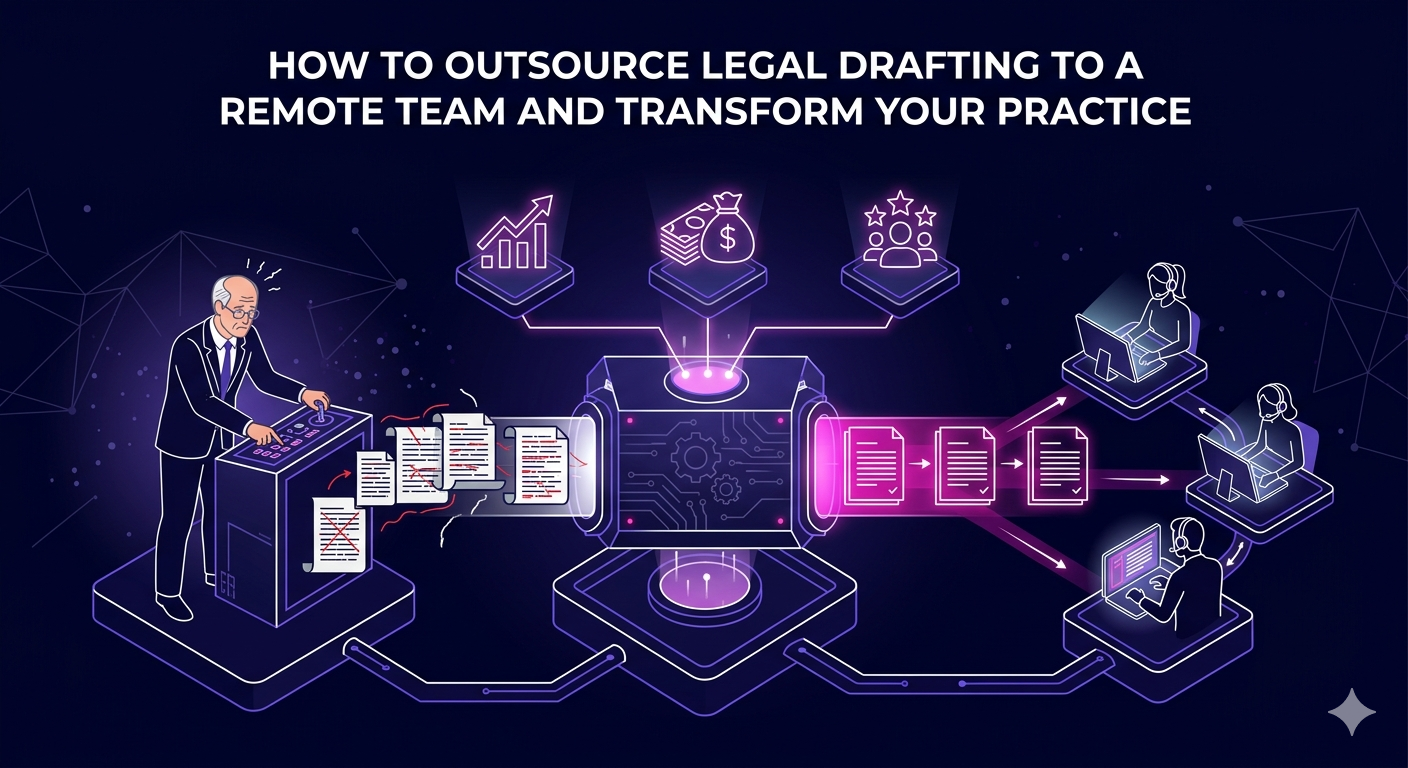
Legal drafting is one of the most time-consuming tasks in any law firm or legal department. Contracts, pleadings, motions, demand letters, and agreements all require precision, legal knowledge, and significant billable time. In 2026, more attorneys and in-house counsel are choosing to outsource legal drafting to a remote team as a practical way to reduce workload, control costs, and maintain quality without adding headcount.
If you have been considering this move but are not sure where to start, this guide walks you through exactly what remote legal drafting involves, what benefits it delivers, and how to do it the right way.
What Does It Mean to Outsource Legal Drafting to a Remote Team?
When you outsource legal drafting to a remote team, you are delegating the preparation of legal documents to trained professionals who work off-site, typically on a contractual or retainer basis. These professionals may include remote paralegals, legal assistants, or document specialists with expertise in specific practice areas.
The documents they handle can range from routine contracts and NDAs to more complex litigation documents, depending on their background and your supervision structure. Work is completed using secure cloud platforms, communicated through defined workflows, and delivered on agreed timelines.
Types of Legal Documents Commonly Outsourced
- Client contracts and service agreements
- Non-disclosure and confidentiality agreements
- Demand letters and legal correspondence
- Lease agreements and real estate documents
- Corporate resolutions and formation documents
- Discovery requests and responses
- Legal research memos and case summaries
- Settlement agreements and releases
Why Law Firms Are Choosing to Outsource Legal Drafting in 2026
The shift toward remote legal support has accelerated steadily since 2020, and by 2026 it has become a standard operating model for many firms. Several factors are driving the decision to outsource legal drafting to a remote team rather than keep everything in-house.
Significant Cost Reduction
Hiring a full-time legal drafter or paralegal in the United States carries a fully loaded annual cost that can exceed $80,000 when you account for salary, benefits, office space, and equipment. Remote legal drafting professionals, particularly those sourced through specialized staffing platforms, can be engaged at a fraction of that cost. For firms handling a high volume of routine documents, this cost difference is substantial over a 12-month period.
Faster Turnaround on Routine Documents
When attorneys spend their time drafting routine contracts and correspondence, client-facing and strategy work suffers. A dedicated remote drafting team focused entirely on document production can turn around standard agreements and templates significantly faster than an overloaded associate or paralegal juggling multiple responsibilities.
Scalable Capacity Without Permanent Headcount
Deal flow and litigation volume are rarely consistent. When you outsource legal drafting to a remote team, you can scale capacity up during busy periods and reduce it during slower months without the legal and financial risk that comes with hiring and terminating employees.
Access to Specialized Drafting Expertise
Remote legal staffing platforms give you access to professionals with specific practice area experience. Need someone who understands commercial real estate leases? Or a drafter with a background in technology licensing agreements? Outsourcing opens up a wider talent pool than local hiring alone.
Key Considerations Before You Outsource Legal Drafting
Moving drafting work to a remote team is not simply a matter of forwarding documents. Getting it right requires upfront planning around supervision, security, and quality control.
Attorney Supervision and Ethical Compliance
In most jurisdictions, attorneys remain responsible for all work product even when it is prepared by non-attorney staff. When you outsource legal drafting to a remote team, you must maintain proper supervisory structures, review all final documents before use, and ensure your remote team understands the boundaries of their role. Consult your state bar’s rules on outsourcing and non-attorney assistance before proceeding.
Confidentiality and Data Security
Legal documents contain sensitive client information. Any remote drafting arrangement must include signed confidentiality agreements, secure file transfer protocols, and clearly defined data handling policies. Providers with documented security standards and compliance frameworks are strongly preferred.
Clear Drafting Instructions and Templates
The quality of outsourced legal drafting is directly tied to the quality of your instructions. Provide detailed briefs, sample documents, style guides, and jurisdiction-specific requirements at the start of every engagement. The more context your remote team has, the less revision time you will need.
Quality Review Processes
Build a review step into every workflow. This does not mean reviewing every word yourself, but it does mean having a defined checklist and sign-off process before any outsourced document is finalized or sent to a client. Over time, a reliable remote drafter will require less review, but the process should always exist.
How to Find and Hire a Remote Legal Drafting Team
Choosing the right partner is the most important decision in this process. Here is a practical approach.
Use a Specialized Legal Staffing Platform
General freelance marketplaces are not the best fit for legal work. Specialized platforms vet candidates for legal knowledge, confidentiality awareness, and professional standards. Look for providers that focus specifically on legal roles and can match you with candidates who have relevant practice area experience.
For firms looking to outsource legal drafting to a remote team of vetted professionals, The Remote Reps remote paralegal and legal drafting services provide access to experienced legal support staff ready to integrate into your existing workflows.
Assess Drafting Samples and Practice Area Fit
Before committing to any remote drafter, request work samples relevant to your practice area. Evaluate clarity, structure, legal accuracy, and formatting standards. A strong drafter will produce clean, well-organized documents with minimal direction.
Start With a Defined Pilot Project
Rather than handing over a large batch of work immediately, begin with a single project or document type. This gives you a low-risk way to evaluate quality, responsiveness, and fit before scaling the engagement.
Establish a Communication Cadence
Even the most experienced remote legal drafter needs regular feedback and alignment. Set up a weekly check-in, use a shared project management tool, and define response time expectations from the start. Clear communication reduces errors and accelerates the working relationship.
What Remote Legal Drafting Can and Cannot Replace
It is important to be realistic about the scope of what you can delegate. Remote legal drafting professionals are highly capable, but they work within defined limits.
What Remote Drafters Handle Well
- Routine and templated agreements with standard terms
- First drafts of more complex documents based on your detailed brief
- Research memos and issue summaries
- Document formatting, proofreading, and citation checking
- Redlining and comparing contract versions
What Still Requires Attorney Judgment
- Legal strategy and risk assessment
- Final review and approval of all documents
- Client counseling and negotiation
- Jurisdiction-specific legal advice
- Novel or highly complex legal issues without established precedent
The goal when you outsource legal drafting to a remote team is not to remove attorney judgment from the process. It is to ensure that attorney time is reserved for the tasks that actually require it.
The ROI of Remote Legal Drafting in 2026
Firms that have successfully integrated remote drafting support consistently report measurable improvements across several dimensions. Attorneys recover two to four billable hours per day that were previously consumed by administrative drafting. Document turnaround times decrease. Junior attorney burnout drops. And overall profitability per partner improves.
For a firm billing at $300 per hour, recovering just two hours of attorney time per day translates to $600 in additional revenue potential daily. Over a full working year, that is a significant figure relative to the cost of a remote drafting professional.
The American Bar Association’s research on remote legal work and outsourcing consistently shows that firms leveraging remote support models report higher efficiency and reduced overhead compared to those relying entirely on in-house staffing.
If your current staffing model also relies on remote support for client-facing or administrative functions, it is worth reviewing how broader remote legal assistant services can complement your drafting team to create a fully integrated remote legal operations model.
FAQ: Outsource Legal Drafting to a Remote Team
Is it ethical to outsource legal drafting to a remote team?
Yes, provided you follow your jurisdiction’s rules on outsourcing and non-attorney supervision. When you outsource legal drafting to a remote team, the supervising attorney remains responsible for all work product. Most state bars permit this arrangement as long as proper supervision, confidentiality, and disclosure obligations are met. Always review applicable ethics opinions before proceeding.
What types of legal documents can I outsource to a remote team?
When you outsource legal drafting to a remote team, you can typically delegate routine contracts, NDAs, demand letters, corporate documents, real estate agreements, discovery documents, and research memos. The specific scope depends on the experience level of your remote professionals and the supervisory framework you put in place.
How do I protect client confidentiality when I outsource legal drafting?
Protecting confidentiality when you outsource legal drafting to a remote team requires signed NDAs with all remote staff, encrypted file sharing platforms, clearly defined data retention policies, and regular security audits. Work only with providers who have documented confidentiality protocols and who can demonstrate compliance with professional responsibility standards.
How much does it cost to outsource legal drafting to a remote team?
Costs vary based on experience level, volume, and engagement model. Most firms find that when they outsource legal drafting to a remote team, they pay between $20 and $50 per hour depending on the complexity of the work and the background of the professional. This compares favorably to the fully loaded cost of an in-house hire, especially for firms with variable drafting volumes.
How long does it take to onboard a remote legal drafting team?
When you outsource legal drafting to a remote team through a specialized provider, onboarding typically takes one to three weeks. The timeline depends on how quickly you can provide document templates, drafting guidelines, and system access. Most remote drafters reach full productivity within the first 30 days when onboarding materials are clear and well-organized.
Can a remote legal drafting team handle jurisdiction-specific documents?
Yes. When you outsource legal drafting to a remote team, many providers allow you to specify jurisdictional requirements during the matching process. Experienced remote legal drafters familiar with state-specific statutes, court rules, and document formatting standards can be matched to your firm’s primary practice jurisdictions.