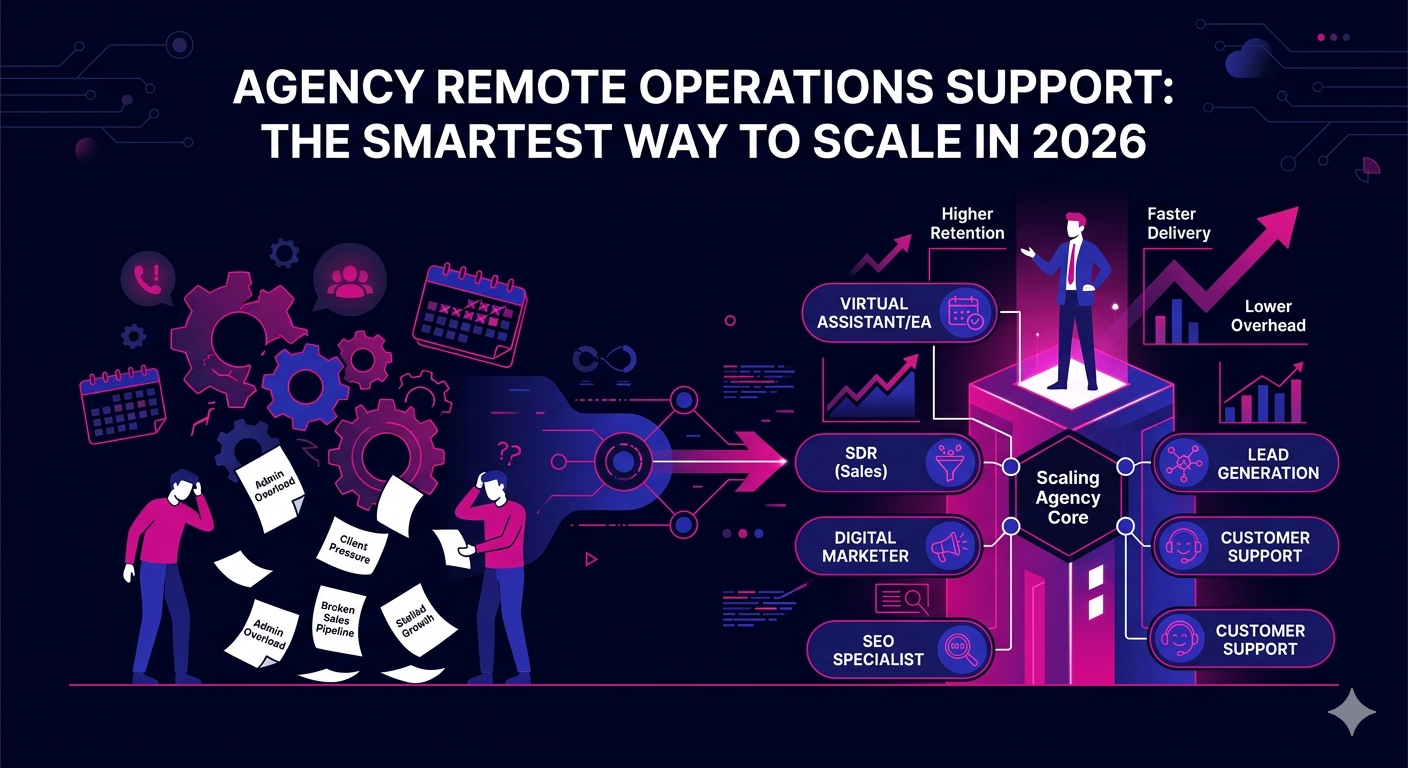
Running a modern agency means juggling client deliverables, managing teams, chasing leads, and keeping the back office humming, all at once. For most agency owners, that pressure eventually hits a breaking point. The solution that is reshaping how agencies operate in 2026 is not hiring more full-time staff or leasing a bigger office. It is agency remote operations support, a strategic approach that embeds skilled remote professionals directly into your workflows so your agency can grow without the overhead.
Whether you run a digital marketing agency, a legal services firm, or a sales-driven operation, remote operations support gives you access to specialized talent on demand. This guide breaks down what it means, why it works, and how to get started.
What Is Agency Remote Operations Support?
Agency remote operations support refers to the use of remote professionals to handle the day-to-day operational, administrative, and client-facing functions that keep an agency running. Rather than hiring in-house employees for every role, agencies tap into a network of vetted remote workers who integrate into existing systems and processes.
This can include:
- Administrative and scheduling support through virtual assistants
- Lead generation and outbound sales development
- Content creation, SEO, and digital marketing execution
- Customer support and client communication
- Executive-level administrative assistance
- Legal and compliance support for law firms and agencies
The goal is simple: remove operational bottlenecks so your leadership team can focus on strategy, client relationships, and growth.
Why Agencies Are Prioritizing Remote Operations in 2026
The shift toward remote-first operations has moved far beyond a pandemic-era trend. In 2026, agencies that have adopted structured remote operations support are consistently outperforming those that have not, and the reasons are straightforward.
Cost Efficiency Without Sacrificing Quality
Hiring a full-time, in-house employee for every operational function is expensive. When you factor in salary, benefits, office space, equipment, and onboarding time, the real cost of a single hire can exceed two to three times the listed salary. Remote operations support allows agencies to access the same caliber of talent at a fraction of that cost.
Studies from Global Workplace Analytics on remote work cost savings consistently show that remote staffing reduces operational overhead significantly, with some businesses saving over $11,000 per remote worker annually.
Access to Specialized Talent Across Every Function
When you hire locally, you are limited to what is available in your market. Remote operations support eliminates that constraint entirely. Need a cold email specialist to fill your pipeline? A GTM engineer to streamline your go-to-market process? A PPC expert to manage paid campaigns? All of these roles can be filled remotely with professionals who bring deep, function-specific expertise.
Explore the full range of agency remote operations support roles at The Remote Reps, from virtual assistants to executive assistants, SDRs, and beyond.
Flexibility to Scale Up or Down
Agency workloads are rarely linear. You win a major client and suddenly need three more people. You lose a contract and now you are overstaffed. Remote operations support gives you the flexibility to scale your team in line with your actual workload, without the risk of layoffs or long hiring cycles.
Key Roles That Power Agency Remote Operations Support
Not all remote support is the same. The most effective agency remote operations support models assign specialized professionals to specific functions rather than asking one generalist to handle everything. Here are the roles that deliver the highest impact.
Sales Development Representatives (SDRs)
Outbound prospecting is one of the highest-leverage activities for any agency, and it is also one of the most time-consuming. Remote SDRs handle cold outreach, qualification calls, and pipeline building so your senior team can focus on closing deals and managing client relationships.
Virtual Assistants and Executive Assistants
From calendar management and inbox handling to research, reporting, and project coordination, virtual assistants and executive assistants form the operational backbone of a well-run agency. They eliminate the low-value tasks that drain leadership bandwidth every day.
Digital Marketers and SEO Specialists
If your agency provides marketing services but struggles to keep its own marketing consistent, remote digital marketers and SEO specialists can fill that gap. They handle content calendars, on-page optimization, keyword research, and campaign execution without requiring full-time overhead.
Lead Generation Experts
Remote lead generation experts use a combination of outbound prospecting, data enrichment, and multi-channel outreach to build a steady stream of qualified opportunities for your agency. They work within your systems and report directly to your sales or growth team.
Customer Support Specialists
Client retention depends heavily on responsiveness. Remote customer support specialists ensure that client inquiries, requests, and issues are handled quickly and professionally, protecting your agency’s reputation without adding headcount to your core team.
How to Build an Effective Remote Operations Support Model
Transitioning to a remote operations model requires more than just hiring a few freelancers. Here is a practical framework for doing it right.
1. Audit Your Current Operations
Start by identifying which tasks consume the most time and which are lowest in strategic value. These are your best candidates for remote delegation. Common examples include data entry, scheduling, lead research, social media posting, and routine client communication.
2. Define Clear Roles and Responsibilities
Vague job scopes lead to poor performance. Before bringing on remote support, document exactly what each role is responsible for, what tools they will use, what success looks like, and how their work will be tracked and measured.
3. Choose a Vetted Staffing Partner
The quality of your remote team depends entirely on how well candidates are sourced and screened. Working with a specialized remote staffing provider like The Remote Reps ensures you are getting professionals who have been vetted for skills, communication, and reliability, not just warm bodies filling a seat.
4. Onboard with Structure
Even experienced remote professionals need context. Create an onboarding process that covers your agency’s workflows, communication norms, tools, and client expectations. The first two weeks of onboarding typically determine whether a remote hire becomes a long-term asset or a short-term frustration.
5. Measure and Iterate
Remote operations support works best when it is treated as a living system, not a one-time hire. Set KPIs for each role, review performance regularly, and adjust scope as your agency evolves.
Industries and Agency Types That Benefit Most
While virtually any agency can benefit from remote operations support, certain types see outsized results:
- Digital marketing agencies that need to scale content, SEO, and paid media execution
- Sales agencies and outsourced sales teams that require consistent outbound pipeline activity
- Legal firms and agencies that need paralegal, legal assistant, or legal secretary support without full-time costs
- E-commerce brands and agencies managing Amazon, paid social, and product marketing
- Consulting firms that need executive assistance and research support
What Sets The Remote Reps Apart
The Remote Reps is a specialized remote staffing platform built specifically to serve agencies and growth-focused businesses. Every candidate is rigorously vetted, matched to your specific operational needs, and supported through a structured placement process.
From SDRs and cold email experts to GTM engineers, social media managers, and executive assistants, The Remote Reps covers every operational function your agency needs to compete at the highest level in 2026.
If you are ready to stop being buried in operational tasks and start building the agency you envisioned, explore the full range of agency remote operations support services at The Remote Reps and find your first hire today.
Frequently Asked Questions About Agency Remote Operations Support
What does agency remote operations support actually include?
Agency remote operations support covers any remote professional who helps an agency run more efficiently. This includes roles like virtual assistants, executive assistants, SDRs, lead generation specialists, customer support reps, digital marketers, SEO specialists, PPC experts, and legal support staff. The specific scope depends on your agency’s size and operational needs.
How is agency remote operations support different from hiring a freelancer?
Freelancers typically work project-by-project and manage their own schedules independently. Agency remote operations support, by contrast, involves dedicated professionals who are embedded in your workflows, attend your team meetings, use your tools, and operate as genuine extensions of your in-house team. The commitment level and integration are significantly deeper.
How quickly can I get agency remote operations support in place?
With the right staffing partner, you can have a vetted remote professional onboarded and operational within one to two weeks. Platforms like The Remote Reps maintain a pipeline of pre-screened candidates so you are not starting from scratch every time you have a hiring need.
Is agency remote operations support cost-effective for small agencies?
Absolutely. In fact, small agencies often benefit the most because they lack the budget to hire full-time specialists for every function. Remote operations support lets small agency teams punch above their weight by accessing senior-level talent at a cost structure that works for their revenue stage.
What tools do remote operations support staff typically use?
Most remote operations professionals are fluent in common tools like Slack, Notion, HubSpot, Asana, Google Workspace, Zoom, and CRM platforms. When you onboard through a specialized provider, you can specify your tech stack during the matching process to ensure alignment from day one.
How do I measure the performance of agency remote operations support staff?
Performance measurement should be tied to role-specific KPIs established during onboarding. For SDRs, that might be meetings booked per week. For virtual assistants, it could be task completion rate and response times. For SEO specialists, it is typically organic traffic growth and keyword ranking improvements. Clear metrics set expectations and create accountability on both sides.