Growing a SaaS company without a dedicated sales team is like launching a product without a go-to-market strategy. You might get lucky with word of mouth early on, but sustainable, predictable revenue growth requires people who wake up every day focused on filling your pipeline and closing deals. The smartest decision most SaaS founders and revenue leaders make in 2026 is to hire a remote sales team for SaaS rather than build an expensive, office-bound sales floor from scratch.
This guide walks you through every dimension of that decision: the roles you need, how to evaluate candidates, what it costs, and how to structure a remote SaaS sales team that actually delivers results.
Why SaaS Companies Choose to Hire Remote Sales Teams
The case for building a remote sales team has never been stronger. By 2026, the infrastructure for remote selling is mature, the talent pool is deep, and the cost advantages over traditional in-house models are well documented. Here is why SaaS companies at every stage are making this choice.
Lower Cost Per Hire Without Lower Performance
When you hire a remote sales team for SaaS, you eliminate the overhead costs that come with physical office space, equipment provisioning, and local-only recruiting. Remote sales professionals bring the same skills and often more specialized experience than their in-house counterparts, at a total cost structure that is significantly more favorable for SaaS companies managing growth-stage burn rates.
Access to Sales Talent With SaaS-Specific Experience
Hiring locally means you are limited to what is available within commuting distance. Remote hiring opens your search to sales professionals who have sold SaaS products in your exact category, understand your buyer’s technical objections, and know how to navigate multi-stakeholder enterprise buying committees. That specificity of experience translates directly into shorter ramp times and higher win rates.
Speed to Pipeline
Building an in-house sales team from scratch can take six months or more before you are generating meaningful pipeline. Hiring a remote sales team for SaaS through a specialized staffing platform compresses that timeline dramatically. Pre-vetted candidates can be onboarded and producing qualified opportunities in a matter of weeks, not quarters.
Scalability That Matches Your Growth Curve
SaaS revenue growth is rarely linear. A product launch, a new vertical, or a successful demand generation campaign can double your pipeline requirements overnight. Remote sales teams scale up and down far more efficiently than office-based teams, giving you the flexibility to match headcount to actual revenue opportunity without the HR and operational friction of rapid in-house hiring or layoffs.
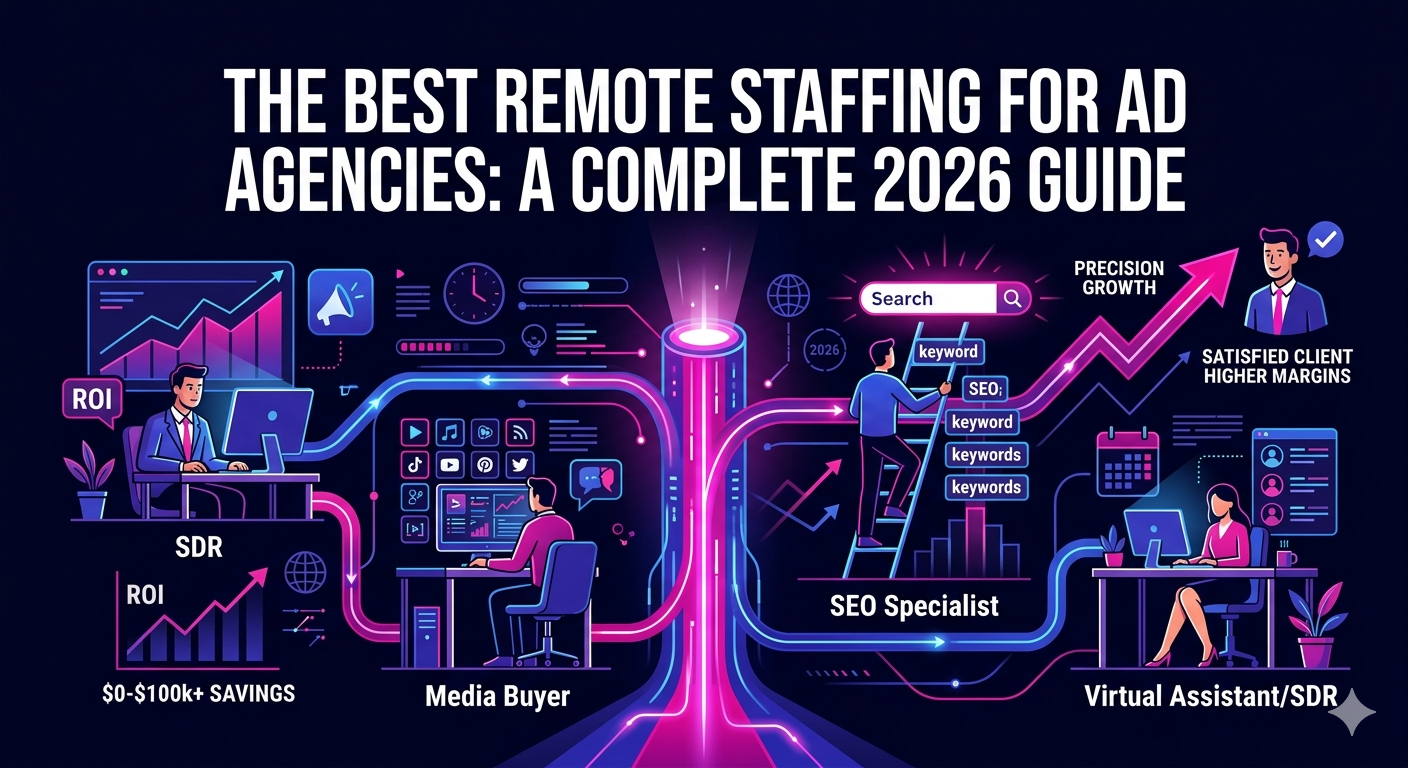
The Core Roles When You Hire a Remote Sales Team for SaaS
A high-performing remote SaaS sales team is not a single role. It is a set of specialized functions working in sequence to move prospects from awareness to closed-won. Here are the positions that make up a complete remote sales team for a SaaS company.
Sales Development Representatives
SDRs are the engine of your outbound pipeline. They research target accounts, execute multi-channel outreach sequences, handle initial objections, and book qualified discovery calls for account executives. In a remote SaaS context, SDRs must be proficient in tools like Apollo, Outreach, LinkedIn Sales Navigator, and your CRM. Their primary metric is qualified meetings booked per month.
Account Executives
Account executives own the sales cycle from first discovery call to closed-won deal. In a SaaS context, this involves running product demos, preparing proposals, negotiating terms, and building relationships with multiple stakeholders within a prospect organization. Remote AEs need strong video presence, excellent written communication, and the ability to manage complex deals asynchronously across time zones.
Lead Generation Specialists
While SDRs execute outreach, lead generation specialists build the infrastructure behind it. They source contact data, enrich prospect records, maintain list quality, and identify new segments and verticals for the sales team to target. This role is often overlooked but has a disproportionate impact on SDR productivity and outreach quality.
Cold Email Specialists
Cold email remains one of the highest ROI outbound channels for SaaS companies in 2026, but it requires genuine expertise to execute well. Cold email specialists handle sequence strategy, copy optimization, deliverability management, and A/B testing. They operate at the intersection of sales and marketing and directly influence how many qualified conversations your SDRs are able to generate each month.
Sales Representatives for Expansion and Renewals
Net revenue retention is the metric that separates great SaaS businesses from average ones. Dedicated remote sales representatives focused on account expansion and renewal management protect your existing revenue base while identifying upsell and cross-sell opportunities within the customer base your AEs worked so hard to close.
What to Look for When You Hire a Remote Sales Team for SaaS
Role-specific skills matter, but remote SaaS sales also demands a distinct set of behavioral competencies that not all sales professionals possess. Here is what to evaluate during your hiring process.
Demonstrated Remote Work Discipline
Remote sales is harder to manage than in-person sales because there is no floor manager to walk over and course-correct. Look for candidates who have a track record of hitting quota in fully remote roles and who can articulate how they structure their day, track their own metrics, and flag blockers without being prompted.
Technical Fluency With the Modern Sales Stack
Your remote sales team needs to operate confidently within your technology infrastructure from day one. CRM proficiency, comfort with sales engagement platforms, and familiarity with video selling tools are baseline requirements. Ask candidates to walk you through their typical tech stack during interviews rather than just listing tools on their resume.
SaaS Buyer Empathy
SaaS buyers in 2026 are more informed and more skeptical than ever. The best remote SaaS sales professionals lead with genuine curiosity about the buyer’s situation rather than pitching features. Look for candidates who ask sharp discovery questions and can articulate why a prospect might not be a good fit, not just why they are.
Coachability and Growth Orientation
The best remote sales professionals in SaaS markets are continuous learners who actively seek feedback and adapt their approach based on what the data tells them. Coachability is especially important in remote environments where informal coaching moments are less frequent and structured feedback is the primary development mechanism.
How to Structure and Manage Your Remote SaaS Sales Team
Hiring the right people is only the beginning. How you structure and manage your remote sales team determines whether those hires produce at their potential or stall out.
Build a Clear Sales Process Before You Hire
Remote sales professionals execute best when they have a well-defined process to work within. Before making your first hire, document your ideal customer profile, your outreach sequence framework, your discovery call structure, your demo flow, and your qualification criteria. This documentation is what allows remote team members to onboard fast and produce early.
Set Transparent Metrics and Review Cadences
Every role on your remote SaaS sales team should have clearly defined KPIs that are reviewed on a consistent schedule. SDRs should know exactly how many touches per day, meetings per week, and pipeline dollars per month they are expected to generate. AEs should have clear quota expectations, activity benchmarks, and win rate targets. Visible metrics create accountability and remove ambiguity in remote environments.
Invest in Weekly Coaching and Team Alignment
Remote sales teams that meet regularly as a group and receive individual coaching consistently outperform those managed purely through async communication. Schedule weekly team calls for pipeline reviews, messaging alignment, and shared learning, alongside individual one-on-ones focused on development and obstacle removal.
According to research from Gartner’s sales research on building high-performing remote sales teams for SaaS, companies that provide structured weekly coaching to remote sales staff see up to 28 percent higher quota attainment compared to those using ad hoc management approaches.
If you are ready to hire a remote sales team for SaaS that hits the ground running, The Remote Reps has the network and the process to make it happen. From SDRs and account executives to cold email experts and lead generation specialists, every candidate is pre-screened for remote readiness and SaaS sales competency. Explore our remote sales representative services for SaaS companies and start building your pipeline team today.
Frequently Asked Questions About How to Hire a Remote Sales Team for SaaS
How long does it take to hire a remote sales team for SaaS?
When you hire a remote sales team for SaaS through a specialized staffing platform, you can typically have your first hires onboarded and active within two to four weeks. This is significantly faster than traditional recruiting cycles, which often take two to three months per role. The key is working with a provider that maintains a pipeline of pre-vetted SaaS sales candidates rather than starting the sourcing process from scratch each time.
How much does it cost to hire a remote sales team for SaaS?
The cost to hire a remote sales team for SaaS varies by role, experience level, and region. In 2026, remote SDRs typically range from $2,000 to $4,500 per month, while experienced account executives with a proven SaaS track record can range from $5,000 to $10,000 per month depending on quota expectations and deal complexity. In every case, total remote team costs remain substantially lower than equivalent in-house builds when overhead is included in the comparison.
What is the best structure for a remote sales team for SaaS?
The most effective structure when you hire a remote sales team for SaaS separates the prospecting function from the closing function. SDRs or lead generation specialists handle top-of-funnel prospecting and qualification, while account executives own the sales cycle from discovery to close. This specialization allows each role to develop deep competency in its specific function and prevents your AEs from spending time on low-value prospecting activity that dilutes their closing capacity.
How do I manage performance when I hire a remote sales team for SaaS?
Managing a remote sales team for SaaS effectively requires a combination of clear KPIs, regular review cadences, and structured coaching. Set daily and weekly activity benchmarks for each role, review pipeline data weekly as a team, and conduct individual one-on-ones focused on development at least bi-weekly. CRM hygiene is also critical because your ability to identify performance issues early depends entirely on the accuracy of the data your remote team logs.
Can a remote sales team for SaaS replace an in-house sales team entirely?
Yes, and many successful SaaS companies operate with fully remote sales teams in 2026. The tools, processes, and management frameworks required to run high-performing remote sales teams are mature and well established. Some companies maintain a hybrid model with a small in-person leadership layer and a fully remote execution team, but there is no functional reason why a remote sales team for SaaS cannot match or exceed the performance of an equivalent in-house team when properly structured and managed.
What tools does a remote sales team for SaaS need to operate effectively?
A remote sales team for SaaS needs a core stack that includes a CRM such as HubSpot or Salesforce, a sales engagement platform such as Apollo or Outreach for sequencing, LinkedIn Sales Navigator for prospecting, a video conferencing tool for demos and discovery calls, and a communication platform such as Slack for internal coordination. Additional tools like conversation intelligence platforms and data enrichment services significantly accelerate ramp time and improve ongoing performance across the team.