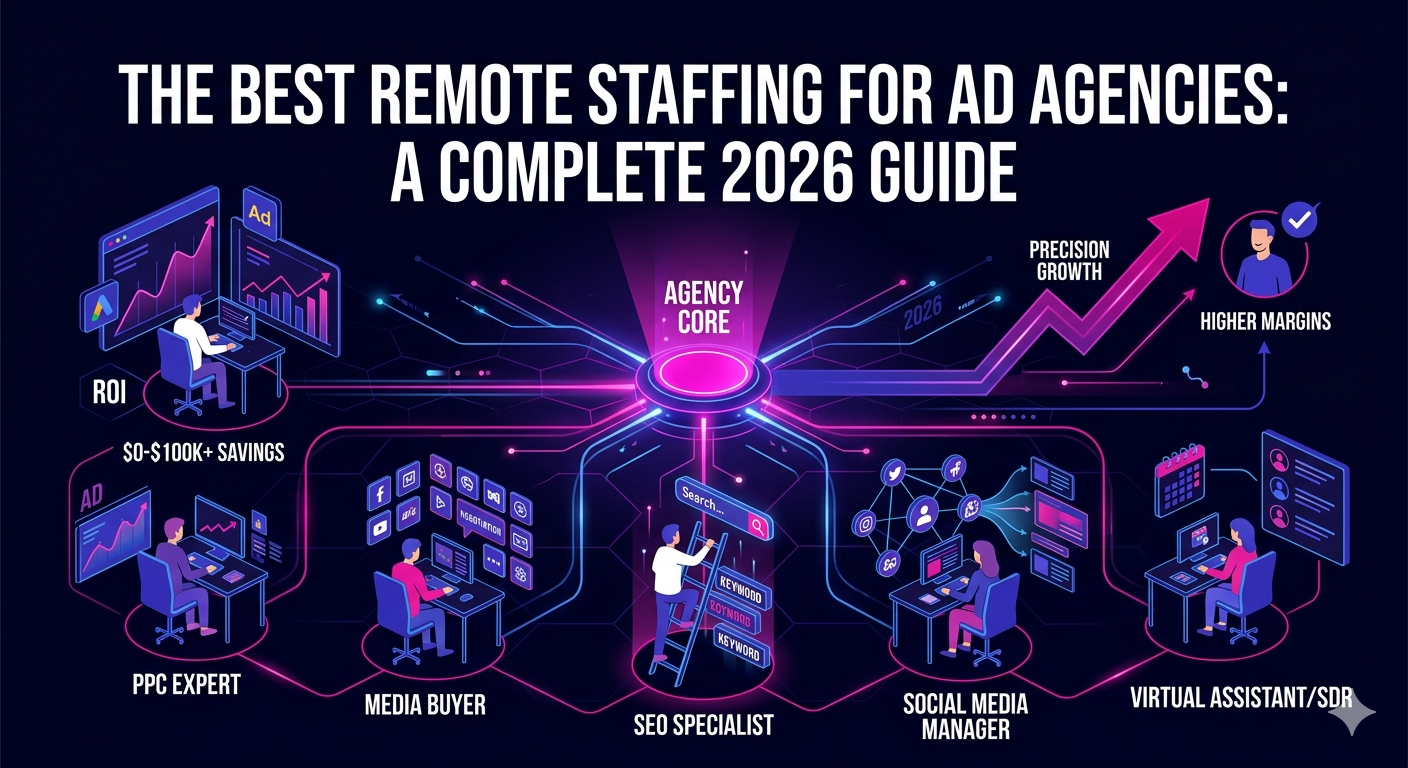
Ad agencies are under more pressure than ever to deliver faster, spend leaner, and compete for talent in an increasingly tight market. The agencies pulling ahead in 2026 are not the ones with the biggest offices or the highest local payroll. They are the ones who have invested in the best remote staffing for ad agencies, building distributed teams that operate with precision, flexibility, and significantly lower overhead than traditional hiring models allow.
Whether you run a boutique creative shop, a performance marketing agency, or a full-service firm, this guide covers exactly what remote staffing looks like for ad agencies in practice, which roles deliver the highest return, how to evaluate and hire the right talent, and what separates a high-performing remote agency team from one that underdelivers.
Why Ad Agencies Are Prioritizing Remote Staffing in 2026
The shift toward remote staffing in the advertising industry is not a temporary response to market conditions. It is a permanent structural change driven by concrete business advantages that local-only hiring simply cannot match.
Ad agencies that invest in remote staffing consistently report:
- Lower talent acquisition costs: Remote hiring eliminates relocation packages, reduces time-to-hire, and cuts out the premium typically charged by local candidates in competitive markets.
- Access to specialized skill sets: The best PPC managers, media buyers, SEO strategists, and social media specialists are scattered across the globe, not concentrated in any one city.
- Faster scalability: Remote staffing allows agencies to add capacity quickly when new accounts land without committing to long-term fixed cost increases.
- Improved delivery speed: Teams distributed across time zones can maintain near-continuous production cycles, turning around client deliverables faster than a single-location team.
- Stronger margins: Replacing even two local hires with equivalent remote talent typically saves an ad agency between $60,000 and $100,000 per year in fully loaded employment costs.
The Best Remote Staffing Roles for Ad Agencies
Not every agency function is equally well suited to remote execution. The roles that consistently deliver the strongest results when staffed remotely are those where output is measurable, work can be completed asynchronously, and deep specialized expertise is more important than physical proximity.
Remote PPC Experts and Paid Media Specialists
Paid advertising is one of the most high-value and remote-friendly disciplines in the ad agency world. Remote PPC experts manage Google Ads, Meta campaigns, and programmatic placements entirely from their own setup, optimizing budgets, testing creatives, and reporting on performance with the same rigor as any in-house hire. For agencies billing on paid media management, this role has one of the clearest ROI profiles of any remote hire.
Remote Media Buyers
Effective media buying requires sharp analytical skills and platform fluency, not a desk in your office. Remote media buyers plan and execute buys across digital and traditional channels, negotiate placements, and optimize spend allocation based on live performance data. Agencies that add strong remote media buyers consistently see better campaign outcomes and more efficient budget utilization.
Remote SEO Specialists
For ad agencies that offer or want to offer organic search as a service, remote SEO talent is the most cost-efficient staffing option available. Keyword research, technical audits, on-page optimization, and link building are all highly asynchronous by nature. A skilled remote SEO specialist can manage multiple client accounts simultaneously and deliver measurable results without ever needing to be in the same location as your team.
Remote Social Media Managers
Managing social media for multiple agency clients is time-intensive, platform-specific work that translates naturally to a remote model. Remote social media managers handle content calendars, community management, performance reporting, and platform strategy across all major channels. Adding dedicated remote social talent frees your account managers from day-to-day social execution and improves consistency across client accounts.
Remote Digital Marketers
Full-spectrum remote digital marketers are one of the most versatile staffing options for growing ad agencies. They can manage integrated campaigns, develop multi-channel strategies, oversee analytics, and support client reporting across the entire digital marketing mix. For agencies looking to expand their service offering without a proportional headcount increase, a skilled remote digital marketer delivers exceptional leverage.
Remote Lead Generation Experts and SDRs
Agency growth requires a consistent flow of new business. Remote lead generation specialists and sales development representatives keep your pipeline active by prospecting, qualifying, and nurturing new business opportunities so your principals can focus on pitching and closing rather than cold outreach.
Remote Virtual and Executive Assistants
Administrative overhead is one of the biggest hidden costs in agency operations. Remote virtual assistants and executive assistants take on scheduling, inbox management, research, reporting coordination, and operational tasks that should not be consuming the time of your senior team. This is consistently one of the highest-ROI hires an agency can make, regardless of size.
What Makes Remote Staffing the Best Choice for Ad Agencies Specifically
Ad agencies have characteristics that make them particularly well suited to the remote staffing model. Understanding these advantages helps agency owners make a stronger internal case for building distributed teams.
Deliverable-Based Work Culture
Agency work is fundamentally deliverable-based. Clients pay for outputs: campaigns, reports, content, strategy decks, and media placements. This means performance management is naturally aligned with remote work, where accountability is measured by results rather than hours at a desk.
Tool-Native Workflows
Most ad agencies already operate on cloud-based tools: project management platforms, shared asset libraries, analytics dashboards, ad platforms, and communication tools. This digital-first infrastructure makes integrating remote team members straightforward compared to industries that rely on physical resources or in-person collaboration.
Multi-Client Capacity Requirements
Agencies serving multiple clients simultaneously need flexible capacity that can scale up or down as accounts shift. Remote staffing gives agencies the ability to add a specialist for a specific account, scale back during a slow period, or bring in additional support during a pitch cycle without the lag time and cost of traditional hiring.
How to Evaluate Remote Staffing Solutions for Your Ad Agency
The quality of your remote staffing outcomes depends heavily on how you source and evaluate talent. The best remote staffing for ad agencies comes from platforms and processes that go beyond a resume and a video call. Here is what a rigorous evaluation process looks like:
- Role-specific vetting: Generic remote workers and agency-specialized professionals are very different hires. Look for platforms that vet candidates specifically for the ad agency environment, including familiarity with ad platforms, reporting tools, and client communication standards.
- Portfolio and performance evidence: Ask for campaign results, account case studies, and examples of reporting or strategy work. Strong remote candidates have measurable outcomes to show, not just job titles.
- Communication assessment: Written communication is the primary medium in remote work. Evaluate candidates on the clarity, tone, and professionalism of their written responses throughout the hiring process.
- Paid trial assignment: Run a short paid trial on a real or simulated agency project before committing. This produces far more reliable data than any interview.
- Platform accountability: Choose a staffing partner that stands behind their placements with replacement guarantees and ongoing support, not just an introduction fee.
The Remote Reps is built specifically for agencies and revenue-focused teams. Their pre-vetted talent pool covers every key ad agency role, from paid media and SEO to virtual assistants and sales support, so you spend less time filtering and more time growing.
For further context on industry benchmarks, research from the Interactive Advertising Bureau on remote staffing trends for ad agencies highlights that distributed workforce models are now the preferred hiring strategy among the fastest-growing digital advertising firms in North America and Europe.
Building a High-Performance Remote Agency Team: Practical Steps
Even the best remote staffing for ad agencies requires the right internal structure to deliver consistent results. Here is a proven setup process:
- Define roles with precision before hiring. Vague briefs produce mismatched candidates. Specify tools, deliverables, communication cadence, and performance KPIs upfront.
- Build a structured onboarding workflow that covers your agency’s brand standards, client communication protocols, and tool access. Deliver this in a repeatable format so every new remote hire gets the same foundation.
- Set clear performance benchmarks at 30, 60, and 90 days. Measurable milestones create shared accountability and make it easy to identify and address performance gaps early.
- Invest in communication rhythm. Weekly team syncs, daily async updates in Slack, and monthly performance reviews keep remote staff aligned without micromanaging.
- Treat remote staff as full team members. Include them in agency culture moments, celebrate wins publicly, and give them a clear growth path. Engaged remote employees outperform disengaged ones by a significant margin.
FAQ: Best Remote Staffing for Ad Agencies
What makes remote staffing the best option for ad agencies compared to local hiring?
The best remote staffing for ad agencies offers a combination of cost efficiency, access to specialized global talent, and operational flexibility that local hiring cannot match. Ad agencies benefit particularly from remote staffing because their work is deliverable-based, tool-native, and does not require physical presence for most key functions including paid media, SEO, social, and account coordination.
Which roles offer the best ROI when using remote staffing for ad agencies?
The roles that consistently deliver the best ROI when ad agencies invest in remote staffing include PPC specialists, media buyers, SEO professionals, social media managers, digital marketers, and virtual assistants. These roles have clearly measurable outputs, operate well asynchronously, and are available at significantly lower cost through remote channels than through local hiring markets.
How do I know if a remote staffing provider is the best fit for my ad agency?
The best remote staffing providers for ad agencies go beyond generic job boards. Look for platforms that specialize in agency roles, pre-vet candidates for relevant experience and communication skills, offer replacement guarantees, and provide onboarding support. A provider who understands the pace and demands of ad agency work will produce far better placement outcomes than a generalist staffing marketplace.
How long does it take to see results after investing in the best remote staffing for an ad agency?
Most ad agencies that use best-in-class remote staffing solutions see measurable operational improvements within 30 to 60 days of a well-structured hire. Time-to-productivity depends on role complexity, onboarding quality, and how clearly the agency has defined deliverables and success metrics. Straightforward execution roles like social media management and virtual assistance tend to ramp up the fastest.
Can small ad agencies benefit from the best remote staffing solutions as much as large ones?
Absolutely. Small ad agencies often see the most dramatic impact from the best remote staffing because every new capacity addition directly affects their ability to take on more clients and deliver better work. A two or three-person agency with one skilled remote specialist in a high-leverage role can significantly outperform a local competitor with a larger but less efficient in-house team.
How should ad agencies manage remote staff to get the best results from their staffing investment?
Getting the best results from remote staffing for ad agencies requires clear role briefs, measurable KPIs, reliable project management tools, and a consistent communication rhythm. Weekly check-ins, async status updates, and monthly performance reviews provide the structure remote staff need to perform at a high level without requiring constant oversight or micromanagement from agency leadership.