
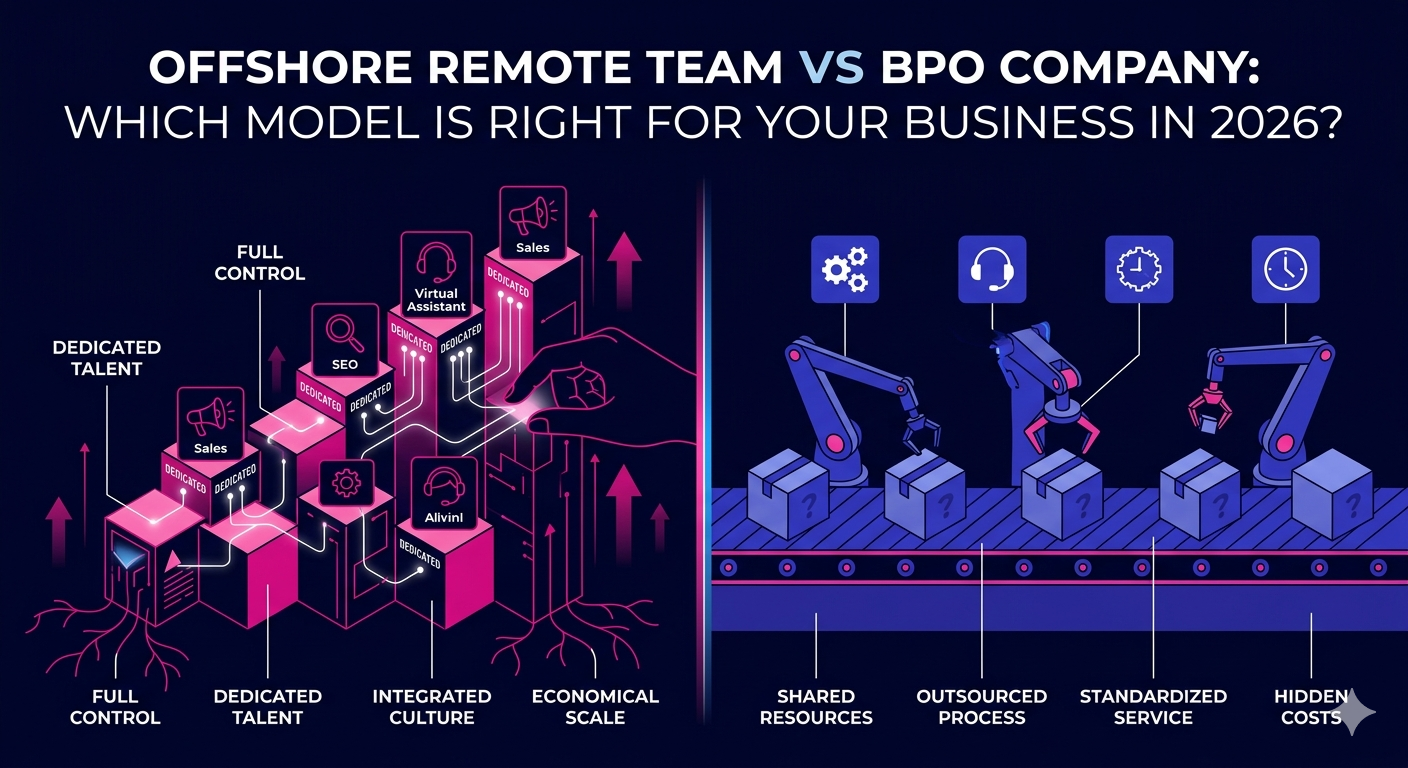
When businesses look to cut costs and scale operations, two options consistently come up: building an offshore remote team or partnering with a BPO company. On the surface, both seem like smart ways to access global talent without bloating your local payroll. But the differences between them run deep, and choosing the wrong model can cost you far more than you save.
This guide breaks down the offshore remote team vs BPO company debate with clarity, so you can make a confident, informed decision for your business.
What Is an Offshore Remote Team?
An offshore remote team is a group of dedicated professionals hired from another country who work exclusively for your business. These individuals are integrated into your company’s processes, culture, and workflows. They report to you directly, use your tools, and represent your brand.
Unlike contractors or shared resources, dedicated offshore team members are focused entirely on your business goals. They grow with your company, develop institutional knowledge, and become a true extension of your in-house staff.
Key Characteristics of an Offshore Remote Team
- Dedicated to your business only
- Managed directly by your team leads or managers
- Operates within your company’s culture and workflows
- Long-term engagement with room for growth
- Higher level of accountability and brand alignment
What Is a BPO Company?
A Business Process Outsourcing (BPO) company is a third-party service provider that handles specific business functions on your behalf. You outsource a task or process, and the BPO assigns its own staff to complete it, often serving multiple clients at the same time.
BPO providers are common in customer support, data entry, back-office operations, and IT helpdesk services. They offer standardized processes and fast ramp-up times, but the resources they assign to your account may shift without notice.
Key Characteristics of a BPO Company
- Shared resources across multiple clients
- You outsource the process, not the people
- Less visibility into day-to-day operations
- Standardized service packages, less customization
- Contract-based pricing, often bundled in tiers
Offshore Remote Team vs BPO Company: A Side-by-Side Comparison
1. Control and Oversight
With an offshore remote team, you retain full control. You set the KPIs, assign the tasks, and manage performance directly. With a BPO company, you hand over the process and trust the provider to deliver against an SLA. If something goes wrong, you have limited ability to intervene at the individual level.
2. Cost Structure
BPO companies often appear cheaper upfront because pricing is bundled and predictable. However, as your volume grows, BPO costs scale up quickly. An offshore remote team may require more initial setup, but the per-head cost remains stable and often becomes more economical at scale.
3. Quality and Consistency
Because your offshore remote team members work exclusively for you, they develop deep product knowledge over time. BPO agents, on the other hand, handle multiple clients and typically follow scripts, which can limit the quality and personalization of their output.
4. Flexibility and Customization
Remote offshore teams can be tailored to your exact needs. You hire for the specific skills you need, whether that is a sales rep, an SEO specialist, or a virtual assistant. BPO contracts are structured around predefined service scopes, leaving little room for customization.
5. Communication and Culture Fit
When you build a dedicated offshore team, you invest in onboarding, training, and cultural alignment. These team members become part of your internal communications, attend your meetings, and align with your brand voice. BPO teams often operate in silos, with limited interaction with your internal staff.
When Should You Choose an Offshore Remote Team?
An offshore remote team is the right choice if:
- You need dedicated, long-term talent integrated into your business
- Your work requires specialized skills such as sales, digital marketing, SEO, or lead generation
- You want direct control over quality, pace, and output
- You are building for scale and want institutional knowledge to stay in-house
- Brand voice and customer experience are priorities
Platforms like The Remote Reps specialize in placing dedicated offshore remote sales professionals who are fully vetted, trained, and ready to integrate with your team, making the offshore remote team vs BPO company comparison a straightforward one for sales-focused businesses.
When Does a BPO Company Make Sense?
BPO providers are better suited for:
- High-volume, repetitive tasks that do not require strategic thinking
- Short-term or seasonal demands with no need for continuity
- Businesses that lack the capacity to manage remote workers directly
- Compliance-heavy industries where processes are already standardized
That said, even in these scenarios, many businesses find that a dedicated offshore team delivers better long-term value once proper systems are in place.
The Hidden Costs of BPO That No One Talks About
The offshore remote team vs BPO company debate often ignores the hidden costs buried in BPO contracts. These include:
- Ramp-up fees every time your account rep changes
- Loss of institutional knowledge during staff rotations
- Poor customer experience due to scripted, generic responses
- Limited reporting transparency and data ownership concerns
- Contractual lock-ins that prevent agile pivots
According to Deloitte’s Global Outsourcing Survey, cost reduction remains the primary driver for outsourcing, but businesses increasingly cite agility, access to skilled talent, and operational control as deciding factors in how they structure their offshore or outsourced teams.
Why Dedicated Offshore Remote Teams Are Winning in 2026
The remote work infrastructure that accelerated from 2020 onward has matured significantly. In 2026, managing a distributed offshore team is easier than ever. Tools like Slack, Notion, HubSpot, and asynchronous communication platforms have eliminated most of the operational friction that once made BPO the default choice.
Businesses that have made the switch from BPO to dedicated offshore remote teams report faster turnaround times, higher employee retention, and a stronger alignment between offshore staff and company goals. The offshore remote team vs BPO company gap in performance has never been wider.
If your business needs specialized roles such as lead generation experts, SDRs, or digital marketers, a dedicated offshore model gives you access to talent that is loyal to your brand and invested in your success.
Conclusion: Make the Right Call for Your Business
The offshore remote team vs BPO company debate comes down to one core question: do you want to outsource a process, or do you want to grow a team?
If you are a growth-focused business that values quality, accountability, and long-term performance, an offshore remote team is the superior choice. BPO providers have their place, but they are built for volume, not for vision.
Ready to build your dedicated offshore remote team? Explore the full range of offshore sales and marketing talent at The Remote Reps and find the professionals who will grow with your business.
Frequently Asked Questions
What is the main difference between an offshore remote team and a BPO company?
The core difference in the offshore remote team vs BPO company comparison is ownership and dedication. An offshore remote team works exclusively for your business and is managed by you, while a BPO company assigns shared resources to your account alongside other clients. This distinction directly impacts quality, control, and long-term value.
Is an offshore remote team more expensive than a BPO company?
Not necessarily. In the offshore remote team vs BPO company cost comparison, BPO contracts may look cheaper at first, but they often include hidden fees, volume-based pricing, and ramp-up costs. A dedicated offshore team tends to become more cost-effective as the engagement matures and institutional knowledge grows.
Which is better for sales and marketing roles: an offshore remote team or a BPO company?
For sales and marketing functions, an offshore remote team is almost always the better option. Sales requires relationship-building, brand knowledge, and strategic thinking, qualities that are hard to replicate through a BPO model. Dedicated offshore reps can be trained on your product and calibrated to your sales process in ways that BPO agents typically cannot.
How do I manage an offshore remote team effectively?
Managing an offshore remote team effectively requires clear onboarding, regular check-ins, shared project management tools, and defined KPIs. Unlike working with a BPO company, you have direct access to your offshore team members, which makes it easier to coach, realign, and optimize performance over time. Most platforms that specialize in offshore remote teams also offer support during the onboarding phase.
Can I switch from a BPO company to an offshore remote team?
Yes, and many businesses make this transition as they scale. Switching from a BPO company to an offshore remote team involves auditing the processes currently handled by the BPO, identifying the roles you want to build in-house offshore, and partnering with a provider that specializes in dedicated offshore talent. The offshore remote team vs BPO company switch typically delivers noticeable improvements in quality and team cohesion within the first few months.
What roles can be filled by an offshore remote team?
The roles suited to an offshore remote team are broader than most businesses expect. Beyond customer support, offshore remote teams can include sales development reps, digital marketers, SEO specialists, PPC experts, virtual assistants, legal assistants, e-commerce managers, and more. This variety makes the offshore remote team vs BPO company comparison even more favorable for businesses with diverse operational needs.