Marketing teams in 2026 are expected to produce more content, manage more channels, analyze more data, and engage more audiences than ever before, often with the same headcount or less. The gap between what a lean marketing team can realistically execute and what the business needs to grow is where a remote marketing assistant delivers its most immediate and measurable value. Whether you are a solo founder trying to establish a marketing presence, a small team struggling to keep up with content demands, or a growing brand looking to expand marketing capacity without proportionally expanding your payroll, a skilled remote marketing assistant gives you the execution bandwidth your marketing strategy needs without the overhead of a traditional in-office hire.
This guide covers everything you need to know about hiring a remote marketing assistant in 2026: what the role involves, what tasks they handle, what skills and qualities to evaluate, how much it costs, and how to build a working relationship that genuinely accelerates your marketing output.
What Is a Remote Marketing Assistant?
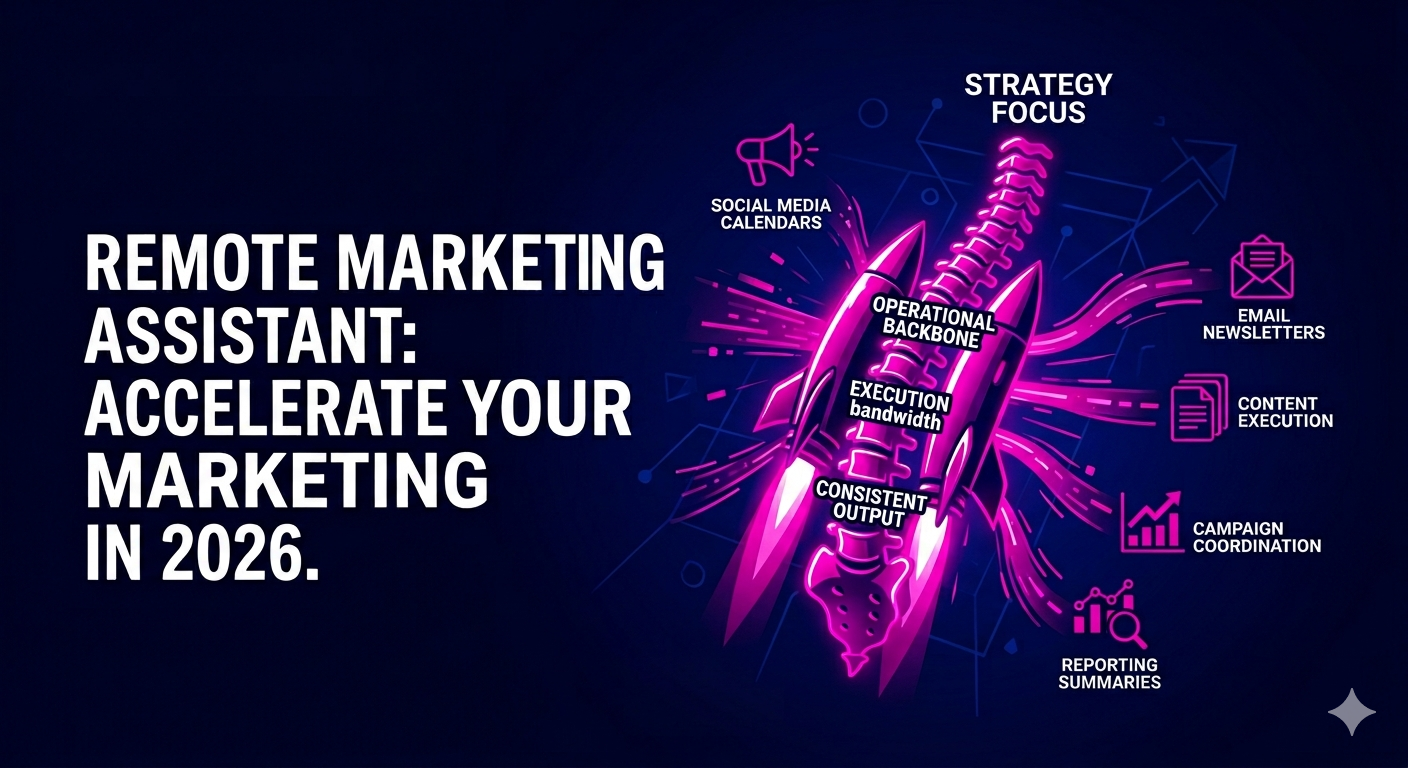
A remote marketing assistant provides broad marketing execution and support to businesses and marketing teams from a remote location. They are the operational backbone of a marketing function: the person who takes strategy and turns it into scheduled content, tracked campaigns, organized assets, drafted copy, and consistent execution across the channels their organization uses to reach its audience.
A remote marketing assistant is not a marketing strategist, though they may support strategic planning work. They are the execution layer: disciplined, organized, detail-oriented, and capable of managing multiple marketing tasks simultaneously across different platforms and channels without needing constant direction on every step.
Remote Marketing Assistant vs. Remote Digital Marketer
- Remote marketing assistant: Focused on marketing execution, coordination, and operational support. Schedules content, manages social media calendars, drafts copy under direction, updates website content, coordinates campaigns, researches competitors, and manages marketing data and reporting. Works best within a defined strategy set by a marketing leader.
- Remote digital marketer: A more senior, strategy-capable role that takes ownership of channel strategy, develops campaigns independently, manages performance optimization, and makes strategic decisions about how to allocate marketing effort and budget for maximum impact.
For businesses that already have a clear marketing direction and need skilled hands to execute it consistently, a remote marketing assistant is the right hire. For businesses that need someone to own strategy and execution together, a dedicated remote digital marketer is the more appropriate choice.
What Does a Remote Marketing Assistant Do?
The day-to-day work of a remote marketing assistant spans content management, campaign coordination, data tracking, and communication support across multiple marketing channels and tools.
Content Creation and Management
- Drafting blog post outlines, social media captions, email newsletters, and short-form copy under direction from a marketing lead or brand brief
- Scheduling and publishing content across social media platforms using tools such as Buffer, Hootsuite, Later, or Sprout Social
- Uploading and formatting blog posts, landing pages, and product updates in your CMS such as WordPress or Webflow
- Managing content calendars and ensuring consistent publication across all active channels
- Sourcing, editing, and organizing visual assets including graphics, stock images, and branded templates using tools such as Canva
- Repurposing long-form content into shorter format pieces for social, email, and other distribution channels
Campaign Coordination and Support
- Setting up and managing email campaign drafts in platforms such as Klaviyo, Mailchimp, HubSpot, or ActiveCampaign under direction
- Coordinating marketing campaign timelines, asset deadlines, and stakeholder approvals
- Managing campaign tracking links, UTM parameters, and landing page setup for attribution accuracy
- Monitoring campaign performance dashboards and compiling data into organized reporting summaries
- Coordinating with designers, copywriters, or external vendors to gather assets and approvals on schedule
Research and Competitive Intelligence
- Conducting competitor analysis including social media activity, content themes, ad approaches, and messaging positioning
- Researching industry trends, audience insights, and keyword opportunities to inform content planning
- Monitoring brand mentions, industry news, and relevant conversations across social platforms and online communities
- Building lists of media contacts, influencer prospects, or partnership opportunities for outreach initiatives
- Compiling market research reports, content performance summaries, and competitive landscape analyses
Data, Reporting, and Administrative Marketing Support
- Compiling weekly and monthly marketing performance reports from analytics platforms such as Google Analytics 4, social media dashboards, and email performance tools
- Maintaining marketing databases, contact lists, and CRM records with accurate, up-to-date information
- Managing marketing asset libraries including brand files, photography, video footage, and design templates
- Coordinating marketing team calendars, meetings, and vendor communications
- Processing invoices and tracking marketing spend against budget allocations
Why Hiring a Remote Marketing Assistant Is a Smart Investment in 2026
The value of a remote marketing assistant comes from what they free your marketing team to focus on. Here is the business case for making this hire in 2026.
Eliminates the Execution Bottleneck That Slows Marketing Output
Most marketing leaders and business owners have more marketing ideas, strategies, and campaigns planned than they have the execution capacity to bring to life. The result is a constant backlog of delayed posts, unsent emails, unfinished campaigns, and unrealized content. A remote marketing assistant provides the execution bandwidth that turns your marketing plan from a list of intentions into a calendar of consistent, delivered output. That consistency is what builds audience, brand authority, and over time, compounding organic growth.
Significant Cost Savings vs. Local Marketing Hiring
A local marketing coordinator or marketing assistant in the United States in 2026 typically costs $45,000 to $65,000 per year in base salary plus benefits, payroll taxes, and equipment. When you hire a remote marketing assistant through a specialist offshore staffing partner, you access equivalent execution capability at $1,000 to $2,500 per month, representing annual savings of $30,000 to $50,000 compared to the fully loaded cost of a local equivalent. For businesses managing tight marketing budgets, those savings fund additional ad spend, software subscriptions, or creative production that directly expands marketing reach.
Frees Senior Marketing Talent for High-Value Strategic Work
Every hour a senior marketer or business owner spends scheduling social posts, formatting blog content, updating CRM records, or compiling performance reports is an hour not spent developing campaigns, building strategic partnerships, or analyzing data to make better decisions. A remote marketing assistant absorbs the execution layer of marketing work, returning strategic capacity to the people best positioned to use it and accelerating the overall marketing function’s impact on the business.
Consistent Daily Execution That Compounds Into Audience Growth
Marketing is a discipline where consistency compounds. Audiences grow when content is published regularly. Email lists warm up when they receive consistent, quality communication. SEO improves when content is published and updated on a reliable schedule. A remote marketing assistant provides the daily operational discipline that keeps all of these marketing investments growing rather than stagnating during busy periods when execution would otherwise fall behind.
Access to Global Marketing Talent at Competitive Cost
Marketing execution skills are globally practiced and available at highly competitive rates outside of high-cost domestic markets. A remote marketing assistant sourced through a quality offshore staffing partner brings the same platform proficiency, content coordination capability, and marketing tool literacy as a domestic equivalent, often at 40 to 60 percent lower cost, making dedicated marketing execution support accessible to businesses at every stage of growth.
What to Look for When You Hire a Remote Marketing Assistant
The skills and attributes that define a strong remote marketing assistant are specific and worth evaluating rigorously before making a hire.
Marketing Platform and Tool Proficiency
- Hands-on experience with social media scheduling tools such as Buffer, Hootsuite, Later, or Sprout Social
- Proficiency with email marketing platforms relevant to your stack including Klaviyo, Mailchimp, HubSpot, or ActiveCampaign
- Ability to work in your CMS including WordPress, Webflow, Squarespace, or Shopify for content publishing and basic page updates
- Experience with Canva or Adobe Express for creating basic branded graphics and social media templates
- Familiarity with Google Analytics 4 and social media analytics dashboards for basic performance data extraction
- Experience with project management tools such as Asana, Trello, Notion, or Monday.com for task tracking and campaign coordination
Writing and Communication Skills
- Strong written English for drafting social media captions, email copy outlines, and blog post drafts under direction
- Ability to adapt writing style and tone to match your brand voice across different platforms and formats
- Clear, proactive internal communication about task status, questions, and any blockers
- Responsiveness and professional conduct in all communications including client-facing coordination tasks
Organizational and Execution Skills
- Strong attention to detail for formatting accuracy, link checking, brand consistency, and campaign asset completeness
- Ability to manage multiple concurrent tasks and content streams without letting any fall through the cracks
- Self-direction and the ability to work from a content calendar or task list without requiring constant micromanagement
- Proactivity in flagging scheduling conflicts, approaching deadlines, or missing assets before they become problems
How Much Does a Remote Marketing Assistant Cost in 2026?
Monthly investment levels for a dedicated remote marketing assistant placed through a quality offshore staffing partner in 2026 typically include:
- Entry-level remote marketing assistant: $800 to $1,500 per month for candidates with 1 to 2 years of marketing coordination experience and solid social media and email platform familiarity
- Experienced remote marketing assistant: $1,500 to $2,500 per month for candidates with 3 to 5 years of broad marketing execution experience, strong platform proficiency, and a track record of supporting multi-channel marketing programs independently
- Senior remote marketing assistant or coordinator: $2,500 to $3,800 per month for highly experienced professionals capable of independently managing complex content calendars, multi-platform campaign coordination, and basic performance reporting across a full-scale marketing function
These rates represent annual savings of $30,000 to $50,000 or more compared to the fully loaded cost of equivalent local marketing coordinators in the United States, making dedicated marketing execution support financially accessible at earlier stages of business growth.
When you are ready to hire a remote marketing assistant who can take your marketing execution from backlog to consistent, high-quality output, explore The Remote Reps’ remote marketing talent placement services and connect with pre-vetted marketing professionals ready to support your brand from day one. If your marketing needs extend beyond execution support into specialized channel management, you can also hire a dedicated remote social media manager or a remote SEO specialist to go deeper in the channels most critical to your growth.
How to Onboard a Remote Marketing Assistant for Fast Results
A structured onboarding experience ensures your remote marketing assistant can contribute productively from the very beginning rather than spending weeks trying to figure out what they should be working on and in what format.
Week One: Tools, Brand, and Priority Channel Orientation
Grant your remote marketing assistant access to all marketing platforms, your CMS, your social media scheduling tool, your email platform, your project management system, and your analytics dashboards. Provide a comprehensive brand brief covering your visual identity, brand voice guidelines, target audience profiles, and examples of marketing content you are proud of and content you want to move away from. Walk them through your current content calendar and explain the priority channels and content types they will be managing.
Week Two: Supervised Execution and Quality Calibration
Have your remote marketing assistant begin producing content and coordinating tasks under close review. Check drafted social captions, review formatted blog posts before they are published, and review email drafts before they are scheduled. Provide specific written feedback on brand voice, formatting standards, and quality expectations. This supervised period calibrates the quality baseline your remote marketing assistant will maintain independently going forward.
Week Three and Beyond: Independent Operation and Performance Review
By week three, your remote marketing assistant should be managing their content calendar and task queue independently. Establish a regular weekly check-in to review upcoming content and priorities, discuss any creative questions, and share performance data that helps your assistant understand what content and campaigns are resonating with your audience. This rhythm of consistent execution, performance feedback, and collaborative planning is what builds a high-performing remote marketing support relationship over time.
According to the Content Marketing Institute’s research on remote marketing assistant roles and content operations efficiency, marketing teams that invest in dedicated operational and execution support consistently produce higher content volume, maintain more consistent publishing schedules, and report lower burnout rates among senior marketers than those relying on senior marketers to handle both strategy and execution simultaneously.
Complementary Roles That Work Best Alongside Your Remote Marketing Assistant
A remote marketing assistant handles marketing execution and coordination. Many businesses find that pairing their marketing assistant with specialist remote marketing roles creates a comprehensive, fully capable marketing function at a fraction of the cost of a large in-house team. Consider adding:
- Remote digital marketers to own channel strategy and campaign planning that your marketing assistant then executes
- Remote SEO specialists for organic search strategy that your marketing assistant helps implement through content publishing and optimization
- Remote social media managers for platforms where strategic community management and growth require more depth than a marketing assistant provides
- Remote PPC experts for paid advertising management that complements the organic content your marketing assistant coordinates
- Remote lead generation specialists to build prospect pipelines from the content and campaigns your marketing assistant manages
Conclusion: Hire a Remote Marketing Assistant and Close the Gap Between Your Marketing Strategy and Its Execution in 2026
The best marketing strategy in the world delivers no results if the execution falls behind. In 2026, a dedicated remote marketing assistant is the most cost-effective way to ensure your marketing plans actually become marketing output: consistent, high-quality, on-brand content and campaigns that build your audience, generate leads, and grow your business month over month. The investment is modest. The compounding impact on your marketing program’s consistency and output is significant.
The Remote Reps places pre-vetted remote marketing assistants for businesses at every stage of growth. Our candidates are assessed for real platform proficiency, real content coordination capability, and the organizational discipline and brand adaptability that marketing execution roles demand.
Read what our clients say about the marketing results they have achieved through The Remote Reps, or visit theremotereps.com to start your remote marketing assistant search today.
FAQ: Remote Marketing Assistant
What does a remote marketing assistant do on a daily basis?
On a typical day, a remote marketing assistant schedules and publishes social media content across your active platforms, drafts or formats upcoming blog posts and email newsletters for review, updates your content calendar with upcoming publishing dates and asset requirements, monitors social media and email analytics for basic performance data, coordinates with any designers or external vendors on outstanding assets or approvals, conducts brief competitor or industry research to inform content planning, and compiles any data or reporting summaries that are due for the week. The exact mix of daily tasks varies based on your business’s channel priorities and current campaign schedule, but consistent daily execution across these areas is the foundation of what a remote marketing assistant provides.
How much does a remote marketing assistant cost in 2026?
A dedicated remote marketing assistant placed through a specialist offshore staffing partner in 2026 typically costs between $800 and $3,800 per month depending on experience level. Entry-level remote marketing assistants with 1 to 2 years of experience cost $800 to $1,500 per month. Experienced candidates with 3 to 5 years of multi-channel marketing support experience fall in the $1,500 to $2,500 range. Senior remote marketing assistants or coordinators capable of independently managing complex marketing programs are priced at $2,500 to $3,800 per month. These rates represent annual savings of $30,000 to $50,000 compared to the fully loaded cost of equivalent local marketing coordinators in the United States.
What is the difference between a remote marketing assistant and a remote digital marketer?
A remote marketing assistant focuses on execution, coordination, and operational support within a marketing function, working from a strategy or direction that a marketing leader has set. They are skilled at managing content calendars, scheduling posts, drafting copy under direction, coordinating campaigns, and tracking performance data. A remote digital marketer is a more senior role that takes ownership of marketing strategy and channel performance, making independent decisions about where to invest marketing effort and how to optimize campaigns for better results. If you need someone to execute an existing strategy reliably and consistently, hire a remote marketing assistant. If you need someone to own the strategy and execution together, hire a remote digital marketer.
How long does it take for a remote marketing assistant to become fully productive?
Most remote marketing assistants hired through a specialist staffing partner reach solid operational productivity within 2 to 3 weeks of starting, assuming a structured onboarding experience that covers platform access, brand guidelines, content calendar management, and quality standards for their primary responsibilities. The time required to reach the level of deep brand familiarity and autonomous execution where they anticipate needs and manage their workflow without prompting typically takes 30 to 60 days. Businesses that invest in detailed written standard operating procedures and close review during the first two weeks consistently achieve faster ramp times and higher sustained quality from their remote marketing assistants.
Can a remote marketing assistant manage multiple social media platforms at once?
Yes. Most experienced remote marketing assistants are comfortable managing content scheduling, publishing, and basic community monitoring across multiple social media platforms simultaneously using scheduling tools such as Buffer, Later, or Hootsuite. The typical capacity for a full-time remote marketing assistant is 3 to 5 active social platforms depending on posting frequency and the complexity of content production required for each. When briefing a staffing partner on your needs, specify which platforms are active priorities and the posting frequency for each so they can match you with a candidate whose experience and platform knowledge fits your specific social media landscape.
What tools should a remote marketing assistant be familiar with in 2026?
In 2026, a capable remote marketing assistant should have hands-on experience with social media scheduling platforms such as Buffer, Later, Hootsuite, or Sprout Social; email marketing platforms such as Klaviyo, Mailchimp, HubSpot, or ActiveCampaign; a CMS such as WordPress or Webflow for content publishing; basic graphic design tools such as Canva or Adobe Express; project management tools such as Asana, Trello, or Notion; Google Analytics 4 for basic performance data; Google Workspace or Microsoft 365 for document management and collaboration; and a communication platform such as Slack for team coordination. Confirm your candidate’s experience with the specific tools in your existing marketing stack during the interview process before making a hiring decision.