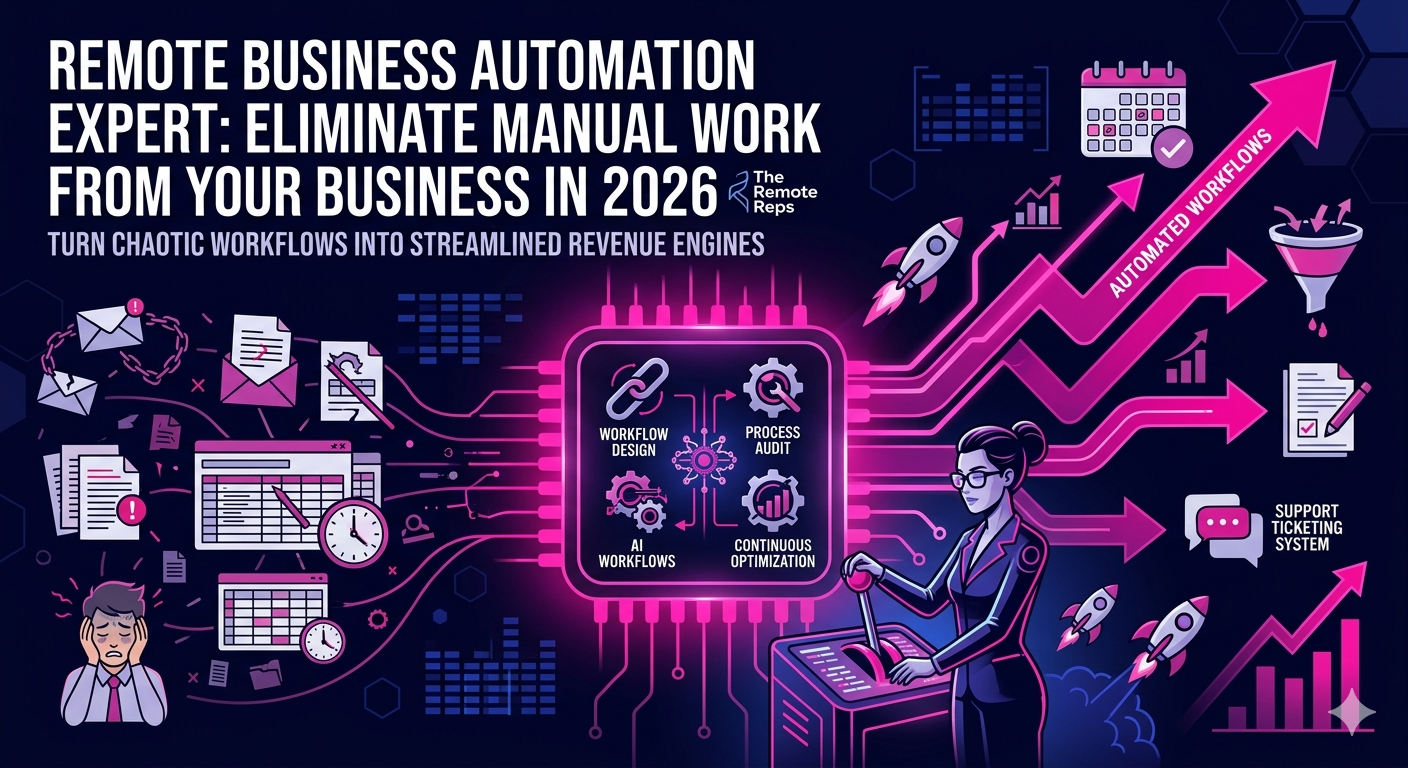
Every hour your team spends on repetitive manual tasks is an hour not spent on the strategic, creative, or relationship-driven work that drives genuine business growth. In 2026, the most operationally efficient businesses are not the ones with the most staff. They are the ones that hired a skilled remote business automation expert to systematically identify, design, and implement automated workflows that replace time-consuming manual processes with reliable, scalable systems that run without constant human intervention. Whether you are losing hours to manual data entry, repetitive email tasks, fragmented reporting, or disconnected software systems, a dedicated remote business automation expert turns those bottlenecks into streamlined workflows that free your team to focus on what actually matters.
This guide covers everything you need to know about finding and hiring a remote business automation expert in 2026: what the role involves, which business functions benefit most from automation expertise, what skills and experience to evaluate, how much it costs, and how to onboard your remote automation specialist for maximum impact.
What Is a Remote Business Automation Expert?
A remote business automation expert is a specialist who analyzes your business workflows, identifies opportunities to eliminate or reduce manual work through technology, and designs and implements automated systems that perform those tasks reliably without human intervention. They work from a remote location using cloud-based automation platforms, API integrations, AI tools, and scripting to build the operational infrastructure that makes your business run more efficiently at scale.
A remote business automation expert is not a software developer building custom applications from scratch. They are specialists in the tooling layer between your business software systems: the integrations, triggers, conditions, and actions that connect your applications and make them work together automatically to complete tasks that currently require manual steps by real people.
What Makes a Remote Business Automation Expert Different From a General Tech Hire
- Focus: A remote business automation expert is focused specifically on workflow efficiency, process improvement, and operational automation, not general software development or IT infrastructure management.
- Tooling: They specialize in automation platforms such as Zapier, Make (Integromat), n8n, Workato, and Microsoft Power Automate, along with AI workflow tools and CRM automation capabilities, rather than traditional programming languages and frameworks.
- Business orientation: A remote business automation expert thinks first about the business problem and the desired outcome, then designs the technical solution. They translate operational needs into automated systems, not technical requirements into code.
- Speed of delivery: Because they work with established no-code and low-code automation platforms, a skilled remote business automation expert can build and deploy working automated workflows in days rather than the weeks or months required for custom software development.
What Does a Remote Business Automation Expert Do?
The scope of a remote business automation expert’s work spans process analysis, automation design, implementation, and ongoing optimization across every area of your business operations.
Process Analysis and Automation Opportunity Identification
- Auditing your current business workflows to identify tasks that are manual, repetitive, time-consuming, or error-prone
- Mapping end-to-end processes across sales, marketing, operations, customer support, and finance to identify where automation would deliver the highest return
- Calculating the time and cost of current manual processes to prioritize automation investment by ROI potential
- Interviewing team members to understand pain points, workarounds, and bottlenecks that are slowing daily operations
- Documenting current workflows as the foundation for redesigning them with automation in mind
Workflow Design and Automation Architecture
- Designing automated workflow logic including triggers, conditions, actions, error handling, and exception routing
- Selecting the most appropriate automation tools and integration approaches for each specific workflow requirement
- Building API integrations between your existing software systems using both native connectors and custom API connections
- Designing data flow architecture that ensures accurate, consistent information moves between systems without manual intervention
- Creating documentation for all automated workflows so your team understands what is running and can troubleshoot basic issues independently
Implementation Across Key Automation Tools
- Building workflows in platforms such as Zapier, Make, n8n, Workato, or Microsoft Power Automate
- Configuring CRM automation within Salesforce, HubSpot, or Pipedrive to automate lead routing, follow-up sequences, and pipeline stage triggers
- Implementing email marketing automation in platforms such as Klaviyo, ActiveCampaign, or HubSpot
- Building AI-assisted automation workflows using tools such as OpenAI API, Claude API, or specialized AI workflow platforms for content generation, data classification, and intelligent routing
- Creating automated reporting and data dashboards that compile and distribute business intelligence without manual compilation
Testing, Optimization, and Ongoing Maintenance
- Testing all automated workflows thoroughly before deployment to verify accuracy, error handling, and edge case management
- Monitoring live automations for errors, failures, and performance degradation over time
- Updating and adapting automated workflows when the underlying business processes or software systems change
- Identifying new automation opportunities as the business grows and operations evolve
- Training team members on how to use automated tools and workflows effectively without inadvertently breaking them
Which Business Functions Benefit Most from a Remote Business Automation Expert
Business automation can improve efficiency across virtually every department, but some functions see particularly transformative gains when a remote business automation expert applies their expertise systematically.
Sales and Revenue Operations
Sales operations are filled with repetitive, time-sensitive tasks that are perfect targets for automation. A remote business automation expert can build automated lead routing systems that assign new leads to the right sales rep within seconds, automated follow-up sequences that trigger based on prospect behavior, CRM data enrichment workflows that populate contact records automatically from third-party databases, and deal stage update automations that keep pipeline data accurate without manual updates from your sales team. These automations allow your remote SDRs and remote sales representatives to focus entirely on conversations and relationships rather than administrative CRM hygiene.
Marketing Operations
Marketing functions generate enormous volumes of repetitive operational tasks: list imports and exports, campaign performance report compilations, UTM tracking link creation, social media post scheduling coordination, and email list segmentation updates. A remote business automation expert can automate all of these workflows, freeing your remote digital marketers and lead generation specialists to focus on strategy, creative, and performance optimization rather than operational overhead.
Customer Support Operations
Customer support teams benefit from automation in ticket routing, priority assignment, response template triggering, escalation alerts, and customer communication sequences. A remote business automation expert can build intelligent ticketing workflows that automatically classify, route, and acknowledge incoming inquiries, reducing first response times and freeing your remote customer support specialists to focus on the complex, relationship-critical interactions that require genuine human judgment.
Finance and Administrative Operations
Finance and administrative workflows including invoice processing, expense report collection, approval chain management, and data reconciliation between accounting systems and CRM records are ideal automation targets. A remote business automation expert can eliminate hours of monthly manual work by building automated financial data flows that keep your systems in sync and your approval processes moving without manual follow-up.
HR and Onboarding Processes
Employee and contractor onboarding involves dozens of repetitive steps: sending welcome emails, provisioning tool access, scheduling orientation meetings, collecting documentation, and distributing training materials. A remote business automation expert can design onboarding workflow automations that trigger the entire sequence automatically when a new team member’s record is created, ensuring a consistent, complete onboarding experience every time without manual coordination from your HR or operations team.
What to Look for When You Hire a Remote Business Automation Expert
Business automation expertise is a specialized skill that combines process thinking, technical platform knowledge, and a systematic approach to workflow design. Here is what to evaluate when you hire a remote business automation expert.
Essential Platform and Technical Skills
- Hands-on experience with at least two or three major automation platforms such as Zapier, Make, n8n, Workato, or Microsoft Power Automate with demonstrable proficiency in complex multi-step workflow design
- Experience building API integrations between common business software systems including CRMs, email platforms, helpdesks, accounting tools, and e-commerce platforms
- Familiarity with AI integration tools and APIs for incorporating intelligent automation capabilities such as content generation, data classification, and smart routing
- Ability to work with data structures including JSON, webhooks, and REST API responses for custom integration work
- Experience with database tools or spreadsheet automation for data management workflows
Process Analysis and Problem-Solving Approach
- Demonstrated ability to analyze and map business workflows before designing automation solutions
- Systematic thinking about error handling, edge cases, and failure scenarios in automation design
- Experience communicating technical automation concepts to non-technical stakeholders clearly and practically
- A portfolio of automation projects with documented results including time saved, error rates reduced, or operational costs eliminated
Remote Work and Project Management Discipline
- Proven ability to manage complex automation projects independently with clear milestone tracking and stakeholder communication
- Proactive documentation of all workflows built so the team can maintain and understand automations after the initial build
- Responsiveness to questions, changes in scope, and new automation requests from business stakeholders
How Much Does a Remote Business Automation Expert Cost in 2026?
Monthly investment levels for a dedicated remote business automation expert placed through a quality offshore staffing partner in 2026 typically include:
- Mid-level remote business automation specialist: $2,000 to $3,500 per month for candidates with 2 to 4 years of experience building automation workflows across common platforms with a solid portfolio of business process improvement projects
- Experienced remote business automation expert: $3,500 to $5,500 per month for candidates with 4 to 7 years of hands-on experience, complex integration architecture capability, and documented operational impact from their automation work
- Senior remote automation strategist: $5,500 to $8,500 per month for highly experienced professionals capable of architecting enterprise-level automation strategies, leading complex multi-system integration projects, and building AI-assisted automation workflows for sophisticated operational environments
These rates represent compelling value relative to the $90,000 to $140,000 annual cost of equivalent in-house automation engineers or operations technologists in the United States, generating per-position annual savings of $50,000 to $90,000 while accessing equivalent or superior automation expertise.
When you are ready to hire a remote business automation expert who can systematically eliminate manual work and build the operational infrastructure your business needs to scale efficiently, explore The Remote Reps’ remote GTM engineer and automation specialist placement services and connect with pre-vetted automation professionals ready to transform your operational efficiency from day one.
How to Onboard a Remote Business Automation Expert for Maximum Impact
The onboarding experience you provide to a remote business automation expert shapes how quickly they can start delivering value and how deeply they can embed automation into your core operations.
Week One: Process Audit and Priority Identification
Before building any automations, give your remote business automation expert full access to your software stack, your current process documentation if it exists, and the time to conduct a thorough workflow audit. Have them interview key team members across departments to understand where manual work is most painful, most time-consuming, and most error-prone. The audit findings form a prioritized automation roadmap that your expert will work through systematically.
Week Two and Three: High-Priority Automation Builds
With a clear prioritized roadmap, your remote business automation expert should begin building the highest-impact automations first: typically the workflows that save the most time, eliminate the most errors, or unblock the most important operational processes for your business. Have them present each completed automation to you and relevant team members before going live so you can verify the logic, test the outputs, and confirm the automation does exactly what it was designed to do.
Month Two Onward: Systematic Build-Out and Continuous Improvement
Work through the automation roadmap systematically, adding new workflows in priority order and refining existing ones based on real-world performance. Establish a monthly review where your remote business automation expert presents the status of all active automations, any errors or failures encountered and resolved, new automation opportunities identified, and their planned priorities for the coming month. This regular review rhythm keeps your automation infrastructure growing and improving continuously rather than stagnating after the initial build phase.
According to Zapier’s State of Business Automation report on remote business automation expert impact and workflow efficiency, businesses that invest in dedicated automation expertise report an average of 9 to 14 hours per week saved per team member affected by automation, with the most significant gains in customer-facing and sales operations workflows where repetitive task volume is highest and error rates from manual work carry the greatest business consequence.
Complementary Roles That Benefit Most From Your Remote Business Automation Expert’s Work
A remote business automation expert builds the operational infrastructure that makes every other role in your business more efficient. The roles that see the most direct and immediate benefit include:
- Remote virtual assistants whose administrative workload is dramatically reduced when repetitive data management and communication tasks are automated
- Remote SDRs and lead generation specialists whose CRM and outreach workflows are streamlined by automated lead routing, enrichment, and follow-up sequences
- Remote customer support specialists whose ticket handling is accelerated by automated classification, routing, and response triggering
- Remote digital marketers whose reporting and campaign coordination workflows are simplified by automated data aggregation and distribution
Conclusion: Hire a Remote Business Automation Expert and Build the Operational Foundation Your Business Needs to Scale in 2026
Manual work is expensive, error-prone, and scalability-limited. Every repetitive task your team performs manually is a constraint on how fast your business can grow without proportionally increasing headcount. In 2026, a dedicated remote business automation expert is the most direct investment you can make in sustainable operational scalability: the kind that lets your business do more with the team you already have and onboard new team members faster when you do need to grow.
The Remote Reps places pre-vetted remote business automation experts for businesses across every industry and operational complexity. Our candidates are assessed for real platform expertise, real workflow design capability, and the systematic process thinking that turns operational inefficiency into automated competitive advantage.
Read what our clients say about the operational results they have achieved through The Remote Reps, or visit theremotereps.com to start your remote business automation expert search today.
FAQ: Remote Business Automation Expert
What is a remote business automation expert and what do they do?
A remote business automation expert is a specialist who analyzes your business workflows, identifies opportunities to replace manual tasks with automated systems, and builds and implements those automations using no-code and low-code automation platforms, API integrations, and AI workflow tools. They work remotely using cloud-based tools to connect your business software systems, create automated data flows, design trigger-based workflows, and build the operational infrastructure that reduces manual work, eliminates errors, and allows your business to scale without proportionally increasing headcount. The role focuses on operational efficiency and workflow design rather than traditional software development.
How much does a remote business automation expert cost in 2026?
A dedicated remote business automation expert placed through a specialist offshore staffing partner in 2026 typically costs between $2,000 and $8,500 per month depending on experience level and specialization. Mid-level automation specialists cost $2,000 to $3,500 per month. Experienced automation experts with complex integration capability fall in the $3,500 to $5,500 range. Senior automation strategists capable of enterprise-level project leadership are priced at $5,500 to $8,500 per month. These rates represent per-position annual savings of $50,000 to $90,000 compared to the $90,000 to $140,000 annual cost of equivalent in-house automation engineers in the United States.
Which automation platforms should a remote business automation expert be proficient in?
In 2026, the most widely used automation platforms that a strong remote business automation expert should have hands-on experience with include Zapier for broad SaaS integration and workflow automation; Make (formerly Integromat) for more complex, multi-step automation with advanced data transformation; n8n for self-hosted workflow automation with greater flexibility; Workato for enterprise-grade integration and automation; and Microsoft Power Automate for organizations within the Microsoft 365 ecosystem. Many automation experts also work with AI integration tools including OpenAI API and AI-connected workflow platforms, as well as CRM-native automation features in Salesforce, HubSpot, and Pipedrive. Confirm that your candidate has specific, demonstrable experience with the platforms most relevant to your existing tech stack.
What business processes are the best candidates for automation?
The best candidates for business automation are processes that are highly repetitive, follow consistent rules and logic, involve moving data between two or more software systems, occur at high volume, and are currently performed manually by skilled people who would be better utilized on higher-value work. Specific examples include lead routing from form fills to CRM, new customer onboarding sequences, invoice generation and delivery, performance report compilation and distribution, social media scheduling coordination, email follow-up sequences based on prospect behavior, ticket classification and routing in helpdesk systems, inventory reorder alerts, and CRM data enrichment from third-party databases. A remote business automation expert will identify the highest-value opportunities in your specific workflow environment through an initial process audit.
How long does it take to see results from a remote business automation expert?
Most businesses begin seeing measurable operational improvements within 2 to 4 weeks of their remote business automation expert starting work. The first automations to be built are typically the highest-priority, highest-volume workflows that save the most time immediately: lead routing, follow-up sequences, and data synchronization between key systems. These early automations often save 5 to 15 hours per week for the team members whose manual work they replace. More complex automation projects involving multi-system integration architectures or AI-assisted workflows typically take 4 to 8 weeks to build and deploy fully. A well-organized automation roadmap worked through systematically produces compounding efficiency gains that become increasingly significant as the number of active automations in your business grows.
Can a remote business automation expert work with the software systems my business already uses?
Yes. A skilled remote business automation expert is experienced working with the full range of common business software including CRMs such as Salesforce, HubSpot, and Pipedrive; helpdesk platforms such as Zendesk and Freshdesk; email marketing platforms such as Klaviyo and Mailchimp; e-commerce platforms such as Shopify and WooCommerce; accounting software such as QuickBooks and Xero; project management tools such as Asana and Monday.com; communication platforms such as Slack and Microsoft Teams; and hundreds of other SaaS applications through standard API integrations and automation platform connectors. When briefing a staffing partner, document your complete software stack so they can match you with a candidate whose integration experience directly covers your specific systems.