
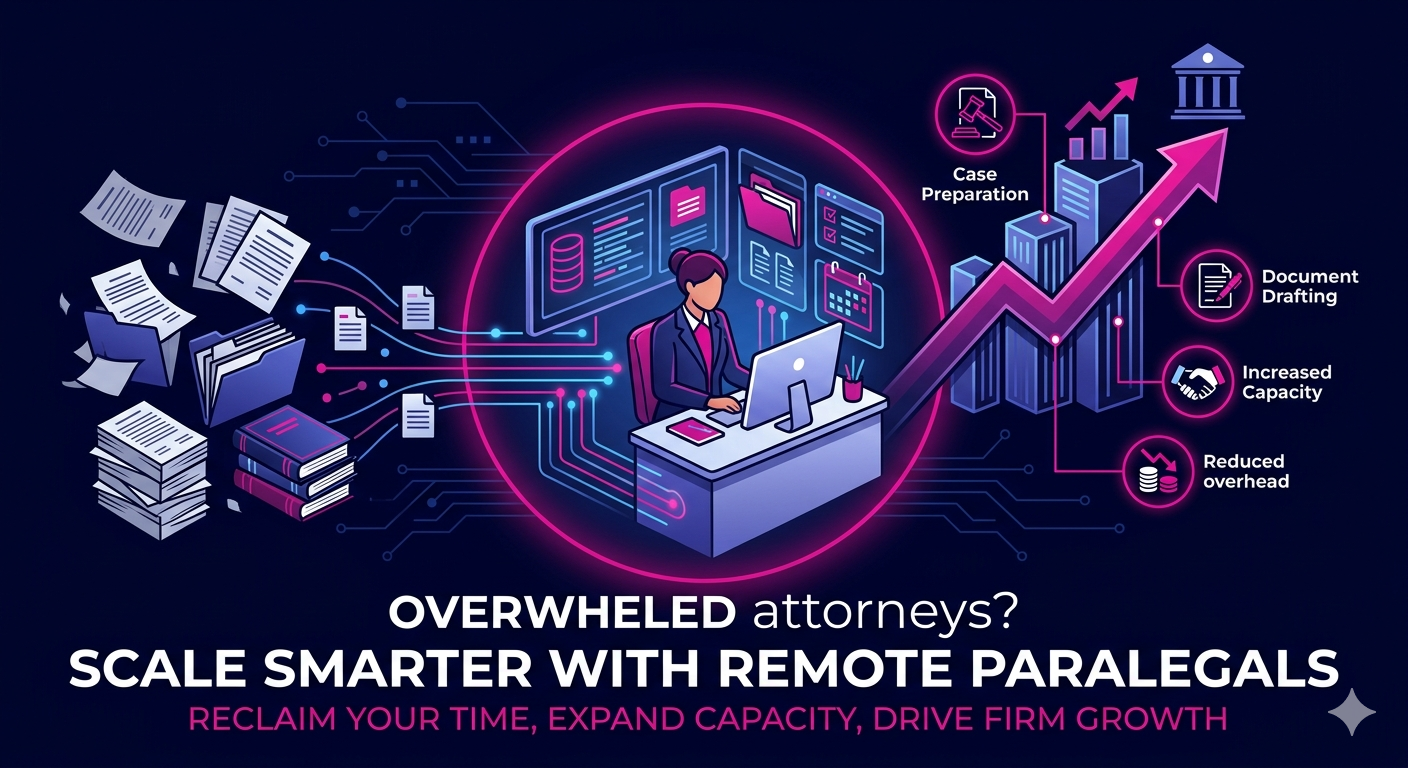
Legal work is demanding, documentation-heavy, and time-sensitive. Attorneys and legal professionals who spend their highest-value hours on research compilation, document drafting, case file organization, and administrative follow-up are leaving significant capacity on the table. In 2026, a growing number of law firms and in-house legal teams are solving this problem by leveraging remote paralegal services to handle the essential but time-intensive support work that keeps legal operations running without requiring the overhead of additional full-time, in-office staff. If your practice is carrying more work than your current team can comfortably manage, remote paralegal services may be the most efficient solution available to you.
This guide covers everything you need to know about remote paralegal services in 2026: what they include, how they differ from traditional in-house paralegal hiring, what to look for when choosing a provider, and how to integrate remote paralegal support into your legal operation effectively and securely.
What Are Remote Paralegal Services?
Remote paralegal services provide law firms, solo practitioners, in-house legal departments, and legal tech companies with qualified paralegal support delivered entirely remotely. Rather than hiring a full-time in-office paralegal with the associated salary, benefits, and overhead costs, you engage a skilled remote professional who handles defined legal support functions from their own location using secure digital tools and communication platforms.
The remote model does not diminish the quality or scope of paralegal support available. A properly vetted, experienced remote paralegal can perform the same substantive work as an in-office counterpart, often with greater flexibility in working hours and at a significantly lower total cost to the practice.
Remote Paralegal Services vs. Traditional In-House Paralegal Hiring
- Cost: Remote paralegal services typically cost 40 to 65 percent less than the fully loaded annual cost of an in-house paralegal when salary, benefits, payroll taxes, office space, and equipment are factored in.
- Speed to deployment: A specialist staffing partner can place a pre-vetted remote paralegal within 5 to 14 business days. Traditional in-house recruitment for a legal professional typically takes 8 to 16 weeks.
- Flexibility: Remote paralegal services can be engaged on a part-time, full-time, or project basis and scaled up or down based on caseload demands without the complexity of restructuring permanent employment contracts.
- Geographic access: Traditional in-office hiring limits you to candidates within commuting distance. Remote paralegal services open access to a global pool of trained legal professionals with diverse practice area backgrounds.
- Overhead: Remote paralegal services eliminate the need for dedicated office space, equipment, and in-country compliance obligations in your local market.
What Remote Paralegal Services Typically Cover
The scope of work available through remote paralegal services is broad and spans the most time-intensive support functions across multiple areas of legal practice. Here is a comprehensive view of what experienced remote paralegals can handle.
Legal Research and Case Preparation
- Case law research using platforms such as Westlaw, LexisNexis, and Casetext
- Statutory and regulatory research relevant to specific practice areas
- Summarizing research findings into clear, structured memoranda for attorney review
- Identifying relevant precedents, filing deadlines, and jurisdictional requirements
- Preparing litigation timelines and case chronologies
Document Drafting and Management
- Drafting routine legal documents including contracts, demand letters, discovery requests, and pleadings under attorney supervision
- Preparing and formatting court filings in compliance with local court rules
- Organizing, indexing, and maintaining digital case files and document management systems
- Reviewing documents for completeness, accuracy, and formatting consistency
- Managing document version control and client correspondence records
Client Intake and Case Administration
- Managing new client intake forms, conflict checks, and engagement letter preparation
- Scheduling client consultations, depositions, hearings, and attorney meetings
- Maintaining case status tracking systems and flagging upcoming deadlines
- Communicating case status updates to clients under attorney direction
- Processing incoming mail, managing correspondence logs, and maintaining organized client files
Discovery and Litigation Support
- Organizing and reviewing discovery documents and preparing privilege logs
- Coordinating e-discovery processes and managing document production timelines
- Preparing deposition summaries and witness preparation materials
- Assisting with trial preparation including exhibit organization and binder preparation
- Coordinating with court reporters, process servers, and expert witnesses
Specialized Practice Area Support
- Corporate transactions including due diligence support, entity formation, and contract management
- Real estate closings, title searches, and transaction document preparation
- Immigration case preparation including form completion and supporting document organization
- Family law matter preparation including financial disclosure statements and custody documentation
- Intellectual property support including trademark research and filing assistance
Why Law Firms Are Turning to Remote Paralegal Services in 2026
The adoption of remote paralegal services has accelerated significantly across the legal industry. Here is what is driving that shift and why it represents a genuine structural improvement for most legal practices.
Rising In-House Paralegal Costs
The fully loaded cost of an in-house paralegal in a major U.S. legal market in 2026 ranges from $65,000 to $95,000 per year when base salary, benefits, malpractice insurance contributions, continuing education support, office space, and technology are included. Remote paralegal services from a quality offshore staffing partner can deliver equivalent support at $18,000 to $42,000 per year depending on experience level and specialization, generating per-paralegal annual savings of $25,000 to $75,000.
Caseload Flexibility Without Permanent Headcount Commitments
Legal caseloads are not constant. A litigation firm handling a major class action may need four times the paralegal support during discovery that it needs during a quieter period. Remote paralegal services allow practices to scale their support capacity dynamically based on actual caseload rather than carrying expensive permanent headcount through slow periods or turning away work during peaks.
Access to Specialized Expertise Across Practice Areas
Not every practice area requires the same paralegal skill set. A transactional corporate firm needs paralegals with due diligence and contract management expertise. A personal injury firm needs litigation support specialists. Remote paralegal services allow firms to access specialized expertise on demand rather than hiring generalists who may not have the depth required for specific matter types.
Technology Has Made Remote Legal Work Fully Viable
In 2026, the technology infrastructure that supports remote legal work is mature, secure, and widely adopted. Cloud-based document management systems, encrypted file sharing, VPN-secured access to firm systems, legal research platforms accessible from any location, and video conferencing tools for attorney-paralegal collaboration have made geographic distance largely irrelevant for most paralegal functions. Remote paralegal services operate within this infrastructure comfortably and securely.
Competitive Pressure to Reduce Client Billing Costs
Clients in 2026 are increasingly cost-conscious and willing to push back on legal billing rates. Practices that leverage remote paralegal services to reduce their support cost structure can pass some of those savings on to clients in the form of competitive billing rates, improving client retention and positioning themselves more effectively in price-sensitive markets.
How to Choose a Remote Paralegal Services Provider
The quality of remote paralegal services varies significantly across providers. Here is what to evaluate before you commit to a partner.
1. Legal Specialization and Vetting Standards
A provider that specializes in legal staffing applies fundamentally different vetting standards than a generalist staffing agency. Legal-specialist providers assess candidates on substantive paralegal competencies including research skills, document drafting quality, knowledge of legal procedures and terminology, and familiarity with legal technology platforms. Ask your potential provider to explain their paralegal-specific assessment process in detail before engaging.
2. Practice Area Alignment
Confirm that the provider can source remote paralegals with experience in your specific practice areas. A provider with a broad but shallow candidate pool may present candidates who are adequate generalists but lack the depth your specific matter types require. Ask for examples of placements in your practice area and verify the candidates’ substantive legal experience through the interview process.
3. Data Security and Confidentiality Standards
Legal work involves privileged, confidential, and often sensitive client information. Your remote paralegal services provider must be able to demonstrate clear data security protocols including secure file transfer systems, non-disclosure agreements with all placed candidates, and documented policies for handling confidential legal documents. Confirm these standards explicitly before any placement proceeds.
4. Technology Compatibility
Confirm that remote paralegal candidates are proficient with your practice management system, document management platform, legal research tools, and communication infrastructure. Common platforms in 2026 include Clio, MyCase, NetDocuments, iManage, Westlaw, LexisNexis, and Microsoft Teams. A remote paralegal who cannot work effectively within your existing technology stack will require significant additional training time.
5. Verified Client References in the Legal Sector
Ask specifically for references from law firms or legal departments that have used the provider’s remote paralegal services for at least six months. Short-term placements can appear successful before quality or reliability issues emerge. References from long-term legal clients give you the most reliable signal of consistent provider performance.
At The Remote Reps, we provide dedicated remote paralegal services for law firms and legal departments across every major practice area. We also offer placement of remote legal assistants and remote legal secretaries to build out a fully capable remote legal support team at every level of responsibility.
What Does It Cost to Access Remote Paralegal Services in 2026?
Cost varies based on practice area specialization, experience level, and the talent market the paralegal is sourced from. Typical monthly investment ranges for remote paralegal services placed through a quality offshore staffing partner in 2026 include:
- Entry-level remote paralegal: $1,200 to $2,200 per month for candidates with foundational paralegal training and 1 to 3 years of experience in standard matter types
- Experienced remote paralegal: $2,200 to $3,800 per month for candidates with 3 to 7 years of practice area-specific experience and strong technology proficiency
- Senior specialist remote paralegal: $3,800 to $5,500 per month for highly experienced candidates with deep specialization in complex litigation, transactional work, or specialized practice areas
These rates represent exceptional value relative to the $65,000 to $95,000 fully loaded annual cost of equivalent in-house paralegals in the United States, generating substantial per-position savings that compound significantly as firms expand their remote paralegal services engagement over time.
How to Integrate Remote Paralegal Services Effectively Into Your Practice
The transition to remote paralegal services is straightforward when approached with a clear integration plan. Here is a proven framework for the first 30 days.
Week One: Access, Systems, and Orientation
Grant your remote paralegal secure access to your practice management system, document management platform, legal research tools, and communication channels. Walk them through your file naming conventions, document formatting standards, deadline tracking systems, and communication protocols. Provide a clear written overview of their initial responsibilities, priority matters, and the attorneys they will be supporting directly.
Week Two: Supervised Task Handoff
Begin assigning real tasks with attorney oversight. Have the supervising attorney review completed work before it is finalized and provide specific, constructive feedback on research quality, document accuracy, and procedural adherence. This supervised period is critical for identifying any knowledge gaps early and refining your remote paralegal’s understanding of your practice’s standards and preferences.
Week Three and Four: Independent Operation and Rhythm Building
By week three, your remote paralegal should be handling their defined task scope with increasing independence. Establish a regular check-in cadence with the supervising attorney and a clear escalation protocol for issues requiring immediate attorney judgment. Begin tracking output metrics such as documents completed, research turnaround times, and deadline adherence to establish a performance baseline for ongoing review.
According to the American Bar Association’s resources on remote paralegal services and legal support staffing, law firms that establish clear supervision protocols, secure technology access, and structured onboarding for remote legal professionals consistently report high satisfaction with remote paralegal performance and significant reductions in administrative burden on attorneys.
Conclusion: Remote Paralegal Services Are the Smart Capacity Solution for Law Firms in 2026
Your attorneys should be practicing law, not managing document backlogs or chasing filing deadlines. In 2026, remote paralegal services give law firms and legal departments a practical, cost-effective, and operationally sound way to expand their support capacity without expanding their overhead. Whether you need a dedicated remote paralegal for a specific practice area, flexible support for fluctuating caseloads, or a complete remote legal support team, the right provider makes it faster and simpler than traditional hiring has ever been.
The Remote Reps places experienced, thoroughly vetted remote paralegals for law firms and legal departments across every practice area. Our candidates are assessed for substantive legal knowledge, technology proficiency, communication quality, and the professional discipline that legal work demands.
Read what our clients say about their experience with remote legal staffing through The Remote Reps, or visit theremotereps.com to start building your remote legal support team today.
FAQ: Remote Paralegal Services
What are remote paralegal services and how do they work?
Remote paralegal services provide law firms, solo practitioners, and in-house legal departments with qualified paralegal support delivered entirely remotely. A specialist staffing partner sources, vets, and places experienced paralegals who work from their own location using secure digital tools, practice management platforms, and legal research databases. They perform the same substantive support functions as in-office paralegals, including legal research, document drafting, case file management, and client intake coordination, under the supervision of the attorneys they support. The remote model is equally effective and significantly more cost-efficient than traditional in-office paralegal hiring for most practice types.
Are remote paralegal services secure enough for confidential legal work?
Yes, when accessed through a reputable provider that applies proper data security protocols. Reputable remote paralegal services providers require all placed candidates to sign comprehensive non-disclosure and confidentiality agreements before beginning any client work. Additional security measures include encrypted file transfer systems, VPN-secured access to firm systems, role-based document access permissions that restrict the remote paralegal to only the files they need, and cloud-based practice management platforms such as Clio or NetDocuments that maintain full audit trails of document access and edits. These protections, consistently applied, make remote paralegal work as secure as in-office work for the vast majority of legal matter types.
What practice areas can remote paralegal services support?
Remote paralegal services are available across a wide range of practice areas in 2026. The most commonly supported areas include civil litigation, corporate transactions and due diligence, real estate closings and title research, family law, immigration, intellectual property, employment law, personal injury, bankruptcy, and estate planning. When engaging a remote paralegal services provider, confirm that they have candidates with documented experience in your specific practice area rather than assuming all paralegals have equivalent breadth across disciplines.
How much do remote paralegal services cost compared to in-house paralegals?
Remote paralegal services in 2026 typically cost between $1,200 and $5,500 per month depending on experience level and specialization, representing an annual investment of $14,400 to $66,000. This compares to the fully loaded annual cost of $65,000 to $95,000 for an equivalent in-house paralegal in a major U.S. legal market when salary, benefits, payroll taxes, office space, equipment, and continuing education support are included. The resulting per-position annual savings range from $25,000 to $75,000, which compounds significantly as a firm expands its use of remote paralegal services over time.
Can a remote paralegal work across multiple attorneys or practice groups simultaneously?
Yes. Many remote paralegal services engagements involve a single paralegal supporting multiple attorneys within the same firm, particularly in smaller practices where full-time dedicated support for each attorney is not economically justified. The key to making this work effectively is clear prioritization protocols that define whose work takes precedence when multiple urgent requests arrive simultaneously, a shared visibility system such as a practice management platform where all attorneys can see the remote paralegal’s current task queue, and a defined escalation path for conflicts that the paralegal cannot resolve independently. With these systems in place, a skilled remote paralegal can effectively support two to four attorneys at once depending on caseload intensity.
How quickly can remote paralegal services be deployed for an urgent staffing need?
A specialist provider with an active pre-vetted pipeline of legal professionals can typically present qualified remote paralegal candidates within 5 to 10 business days for most standard practice area requirements. After candidate selection and security onboarding, a remote paralegal can be actively supporting your attorneys within 2 to 3 weeks of initial engagement. This is dramatically faster than the 8 to 16 week timeline typical of traditional in-house paralegal recruitment, making remote paralegal services a particularly valuable option for firms managing sudden caseload increases, attorney departures, or the need for specialized expertise on a specific complex matter.