
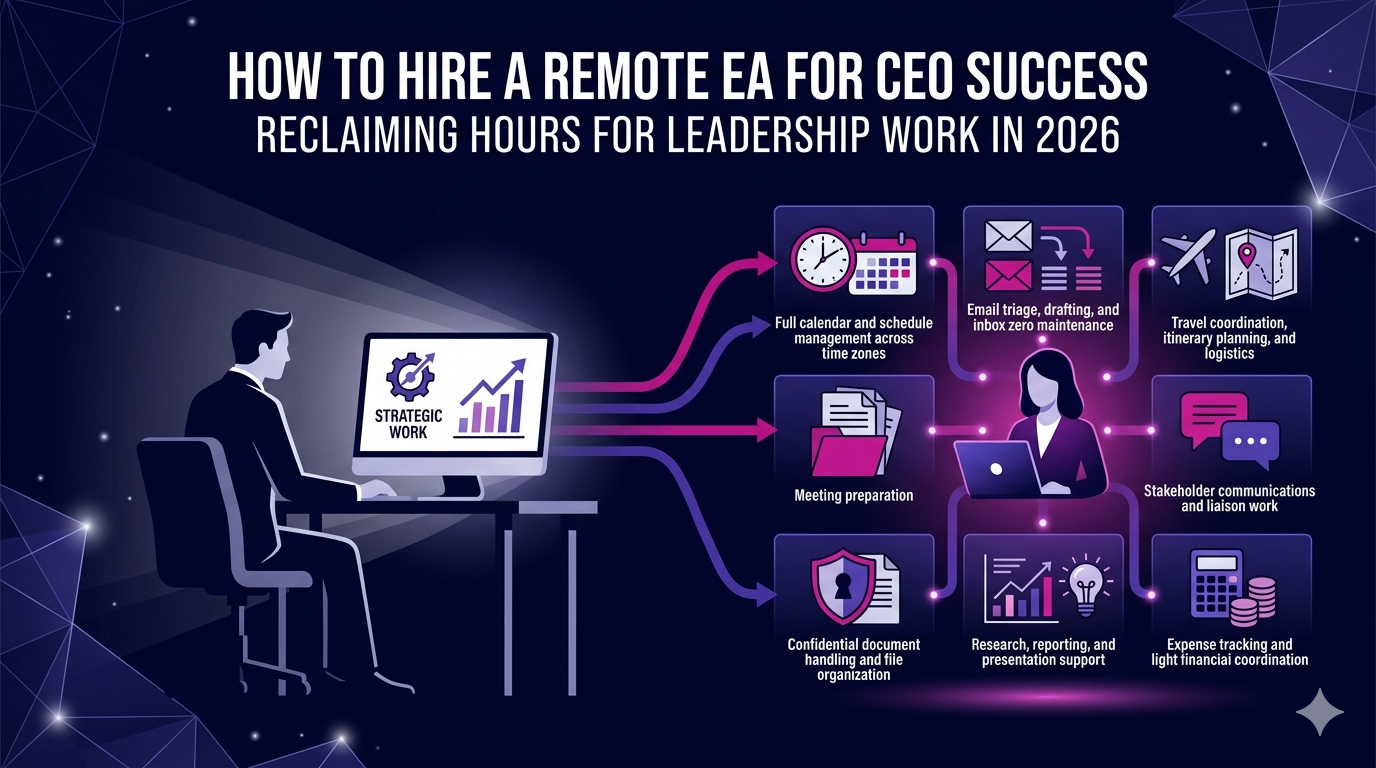
Running a company in 2026 means your time is your most valuable asset. If you are still managing your own calendar, inbox, travel bookings, and meeting prep, you are leaving serious productivity on the table. The smartest move a CEO can make this year is to hire a remote executive assistant for CEO-level operations and reclaim those hours for high-impact leadership work.
This guide walks you through everything you need to know: what a remote executive assistant actually does, why the remote model works, how to find the right fit, and what to expect from the hiring process.
What Does a Remote Executive Assistant for a CEO Actually Do?
A remote executive assistant is not a generalist virtual helper. This is a senior-level support professional who manages the operational complexity that surrounds a CEO’s day. Their work directly protects your focus and ensures nothing critical slips through the cracks.
Core Responsibilities
- Full calendar and schedule management across time zones
- Email triage, drafting, and inbox zero maintenance
- Travel coordination, itinerary planning, and logistics
- Meeting preparation: agendas, briefings, and follow-up notes
- Stakeholder communications and liaison work
- Confidential document handling and file organization
- Research, reporting, and presentation support
- Expense tracking and light financial coordination
When you hire a dedicated remote executive assistant, you get someone operating as a true extension of your leadership, not just a task-taker.
Why CEOs Are Going Remote for Executive Assistance in 2026
The shift to remote executive support has accelerated for good reasons. Companies that have moved away from in-office-only EA models are seeing measurable improvements in cost efficiency, talent quality, and operational flexibility.
The Cost Advantage
A full-time, in-office executive assistant in a major US city costs between $70,000 and $100,000 per year when you factor in salary, benefits, office overhead, and onboarding. A skilled remote executive assistant, sourced through a dedicated placement firm, typically costs 40 to 60 percent less with no reduction in capability. For a growing company, that difference is meaningful.
Access to a Wider Talent Pool
When geography is not a constraint, you can hire the best person for the role rather than the best person within commuting distance. Remote hiring opens up access to experienced executive assistants across the country and globally, including professionals with backgrounds in specific industries like legal, finance, or tech.
Scalability and Flexibility
Remote EAs can work across time zones, which is a genuine operational advantage for CEOs managing international teams or investors. You can scale hours up or down based on business cycles without the friction of a traditional employment contract.
Key Qualities to Look for When You Hire a Remote Executive Assistant for CEO Support
Not every virtual assistant is equipped to support a CEO. The expectations are higher, the pace is faster, and the stakes of a missed detail are greater. Here is what separates an excellent remote executive assistant from an average one.
1. Proactive Communication
Great remote EAs do not wait to be told what to do next. They anticipate needs, flag potential issues before they become problems, and keep you informed without overwhelming your inbox.
2. Discretion and Professionalism
A CEO’s assistant is exposed to confidential information daily. Board communications, personnel decisions, financial data, and strategic plans all pass through their hands. Trust is non-negotiable.
3. Tech Proficiency
In 2026, a remote EA should be fluent in tools like Google Workspace, Microsoft 365, Slack, Zoom, project management platforms like Asana or Notion, and AI productivity tools. They should be able to get up to speed on your internal systems quickly.
4. Strong Writing and Communication Skills
From drafting executive emails to preparing board summaries, strong written communication is essential. A remote EA who represents you in writing is representing your brand and your voice.
5. Time Management and Prioritization
Managing a CEO’s schedule means making constant judgment calls about what gets time and what gets delegated or declined. The best remote executive assistants are outstanding prioritizers.
How to Hire a Remote Executive Assistant for CEO Roles: A Step-by-Step Process
Step 1: Define the Role Clearly
Before you post a job or reach out to a staffing firm, document exactly what you need. List your top pain points, the tools you use, your preferred communication style, and the hours you expect coverage. The clearer your brief, the better your match.
Step 2: Choose the Right Hiring Channel
You can hire directly through job boards, work with a freelance platform, or use a dedicated remote staffing agency. For executive-level support, a staffing agency that specializes in remote placements tends to deliver better-vetted candidates faster. Agencies screen for professionalism, communication skills, and technical capability before you ever speak to a candidate.
Step 3: Conduct a Skills-Based Interview
Ask scenario-based questions. How would they handle a last-minute calendar conflict with a board member? How do they prioritize when three urgent requests hit at the same time? A practical skills test, such as drafting a sample email or organizing a mock itinerary, reveals more than a resume.
Step 4: Start with a Trial Period
Even a strong interview does not guarantee a great fit. Build in a structured 30 to 60 day trial period with clear performance markers. This protects both sides and gives you real data on compatibility.
Step 5: Invest in Onboarding
The fastest path to a high-performing remote EA is a thorough onboarding process. Share your communication preferences, calendar rules, email style guide, and any non-negotiable operating standards up front. Time spent here saves significant time later.
For more information on how remote professionals are matched to executive roles, visit client testimonials from TheRemoteReps to see real-world results from CEOs who have made this shift.
What to Expect From a Remote Executive Assistant in the First 90 Days
The first three months are a calibration period. Expect some back-and-forth as your EA learns your preferences and workflow. By day 30, they should have a solid handle on your calendar and communication style. By day 60, they should be operating with minimal supervision on routine tasks. By day 90, a good remote EA is anticipating your needs and functioning as a genuine operational partner.
According to research from the Harvard Business Review on executive productivity, CEOs who delegate operational tasks effectively gain an average of several hours per week for strategic work. A well-onboarded remote executive assistant is one of the highest-leverage investments a CEO can make.
Remote Executive Assistant vs. Virtual Assistant: What Is the Difference?
This is a common point of confusion. A virtual assistant typically handles lower-complexity, task-based work such as data entry, basic scheduling, or social media management. A remote executive assistant is a more senior professional with experience supporting C-suite leaders, managing complex logistics, and handling sensitive communications. The skill level, judgment, and compensation are all higher.
If you are a CEO, you need the executive level. A standard VA will not be equipped to manage the pace, complexity, or confidentiality requirements of your role.
FAQ: Hire Remote Executive Assistant for CEO
What is the average cost to hire a remote executive assistant for a CEO?
The cost to hire a remote executive assistant for CEO support varies based on experience, hours, and placement channel. In 2026, most remote EAs supporting CEOs cost between $25 and $55 per hour, or between $40,000 and $70,000 annually for full-time engagements. This is typically 40 to 60 percent less than an in-office equivalent when overhead is factored in.
How long does it take to hire a remote executive assistant for CEO-level work?
Through a dedicated remote staffing agency, the process typically takes two to four weeks from initial brief to placement. Direct hiring through job boards may take longer depending on volume and screening processes. Using a specialized firm shortens the timeline significantly because candidates are pre-vetted.
Can a remote executive assistant for a CEO handle confidential information securely?
Yes, provided you have proper agreements in place. Any professional remote executive assistant hired for CEO support should sign a non-disclosure agreement before starting. Reputable staffing agencies also conduct background checks and professional reference verifications. Using encrypted communication tools and access management platforms adds an additional layer of security.
What tools does a remote executive assistant for CEO work typically require?
Most remote executive assistants supporting CEOs in 2026 work across tools including Google Workspace or Microsoft 365, Slack or Teams, Zoom, a calendar scheduling tool like Calendly, a project management platform such as Asana or Notion, and expense management tools like Expensify or Ramp. Many also have experience with AI productivity assistants that help with drafting and research tasks.
Is it better to hire a remote executive assistant for a CEO through an agency or independently?
For most CEOs, working with a specialized agency is the better option. Agencies handle sourcing, vetting, background checks, and in many cases provide replacement guarantees if the initial placement is not a fit. Independent hiring gives you more control but requires significantly more time investment in sourcing and screening, time that is better spent leading your company.
How do I know if I am ready to hire a remote executive assistant for CEO support?
If you are spending more than two hours a day on tasks that do not require your direct judgment, you are ready. Common signs include a constantly overflowing inbox, missed meetings or double bookings, delayed responses to key stakeholders, and a general feeling that administrative work is crowding out strategic thinking. A remote executive assistant solves all of these immediately.
Final Thoughts: Make the Move in 2026
The decision to hire a remote executive assistant for CEO operations is one of the most impactful investments you can make in your own effectiveness as a leader. The cost savings, talent quality, and flexibility of the remote model make it the clear choice in 2026. Stop spending your best hours on tasks that belong on someone else’s plate.
Ready to get started? Explore the full range of remote executive assistant services at TheRemoteReps and find the right support for your leadership team today.