
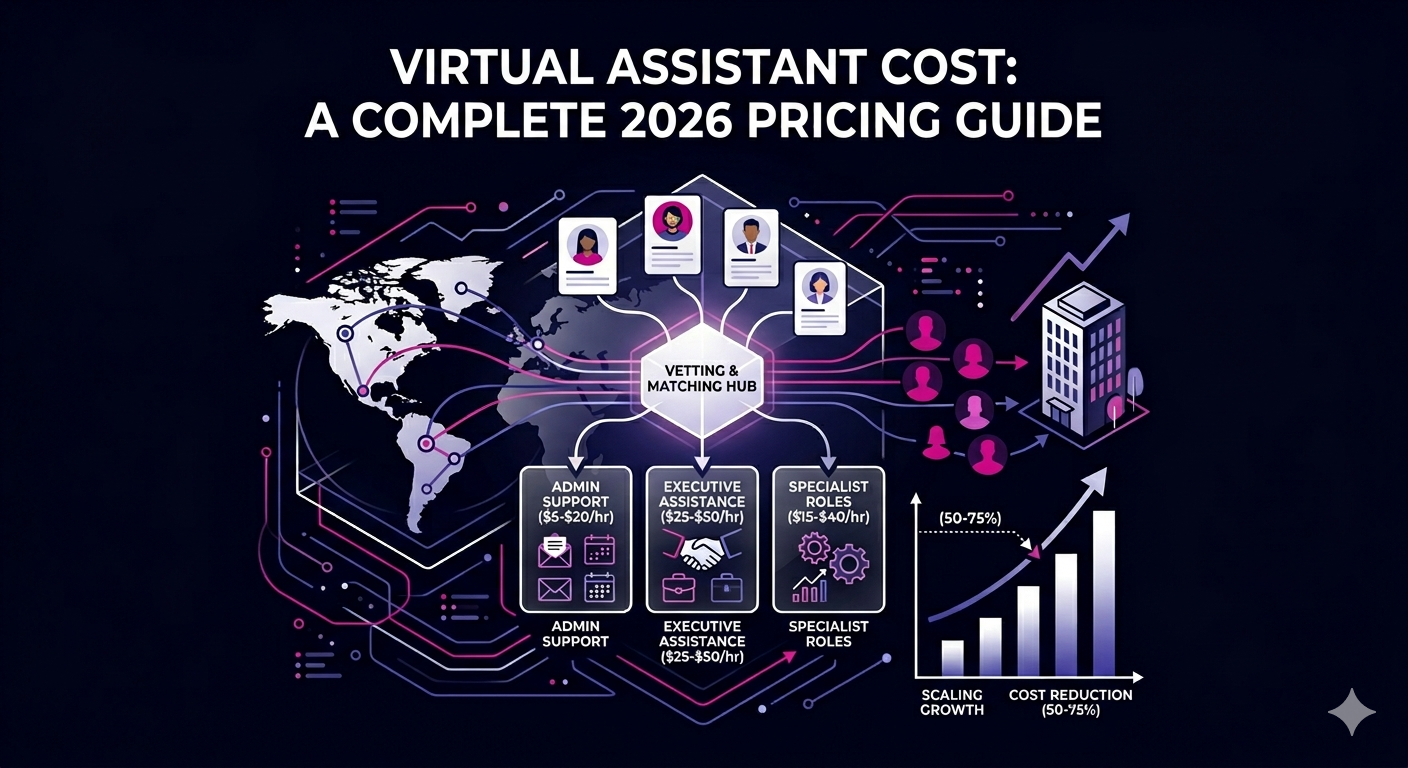
If you have been thinking about hiring remote help, one of the first questions you need answered is: how much does a virtual assistant cost? The honest answer is that pricing varies considerably depending on skills, location, experience, and the type of tasks involved. But the good news is that in 2026, there has never been more flexibility in how you hire, what you pay, and what you get in return. This guide breaks it all down so you can make a confident, informed decision.
Virtual Assistant Cost Overview: What to Expect in 2026
Virtual assistant pricing typically falls into one of three models: hourly rates, monthly retainers, or project-based fees. Each has its place depending on how much support you need and how consistently you need it.
Hourly Rates
Hourly pricing is the most common structure, especially for part-time or ad hoc support. Here is what the market looks like in 2026:
- Entry-level VAs (basic admin tasks): $5 to $15 per hour, typically based in South or Southeast Asia
- Mid-level VAs (skilled tasks, good English): $15 to $30 per hour, often based in Latin America, Eastern Europe, or the Philippines
- Specialist VAs (executive support, project management): $30 to $60 per hour, often based in the US, UK, Canada, or Australia
Monthly Retainer Pricing
For businesses that need consistent support, a monthly retainer is usually more cost-effective. Typical retainer structures look like this:
- Part-time (20 hours per week): $600 to $2,000 per month depending on skill level and location
- Full-time (40 hours per week): $1,200 to $4,500 per month for a dedicated remote VA
These figures represent direct hire or agency-placed VAs. Freelance marketplace rates can vary more widely but often come with less reliability and vetting.
What Factors Affect How Much a Virtual Assistant Costs?
The virtual assistant cost you pay is shaped by several key variables. Understanding these helps you budget accurately and avoid paying for more than you actually need.
Location of the Virtual Assistant
Geography is the single biggest driver of virtual assistant pricing. A highly skilled VA based in the Philippines or Colombia will typically cost 50 to 70 percent less than an equivalent hire in the United States. This is not a reflection of quality. Many internationally based VAs hold degrees, speak fluent English, and have extensive experience working with North American and European clients.
Skill Level and Specialization
A VA handling basic calendar management costs significantly less than one managing your CRM, running your inbox, preparing reports, or supporting executive-level decision making. Specialized virtual assistants, such as executive assistants or those with industry-specific knowledge, command higher rates because the value they deliver is higher.
Hours and Commitment Level
Part-time VAs often carry a slightly higher per-hour cost than full-time placements. If you have predictable and consistent workload, committing to full-time hours usually brings the effective hourly rate down considerably.
Hiring Channel
How you hire affects the total cost of your virtual assistant:
- Freelance platforms: Lower upfront cost but more time spent vetting, managing inconsistency, and replacing poor fits
- Direct hire: Can reduce ongoing costs but requires your own sourcing, screening, and onboarding infrastructure
- Remote staffing agencies: Higher initial cost but faster placement, pre-vetted candidates, and replacement guarantees that protect your investment
When you factor in the time cost of hiring, training, and rehiring, working with a remote staffing agency is often the most cost-efficient path overall. To see what affordable, pre-vetted virtual assistant support looks like in practice, browse the virtual assistant services at The Remote Reps, where dedicated professionals are matched to your exact needs.
Virtual Assistant Cost by Task Type
Not all VA work is priced the same. Here is how virtual assistant costs break down by common task category in 2026:
Administrative and General Support
Data entry, scheduling, inbox management, travel booking, and document organization fall into this category. These tasks are best handled by entry to mid-level VAs at $5 to $20 per hour. They are high-volume, repeatable, and do not require specialized knowledge.
Executive Assistance
Executive assistants handle more complex responsibilities: board communication, project coordination, stakeholder management, and confidential correspondence. This level of support typically runs $25 to $50 per hour or $2,000 to $4,000 per month for a full-time placement.
Customer Support
Remote customer support VAs who handle live chat, email tickets, or phone support typically cost $10 to $25 per hour. Bilingual agents or those with specialized product knowledge sit at the higher end of that range.
Research and Data Management
Market research, lead list building, competitor analysis, and CRM data management require analytical thinking and attention to detail. Budget $15 to $35 per hour for reliable research-focused VAs.
E-commerce and Amazon Support
VAs who manage product listings, inventory updates, customer reviews, and platform analytics for e-commerce businesses require platform-specific training. Expect to pay $15 to $40 per hour depending on the complexity of the account and the platforms involved.
Is a Virtual Assistant Cost-Effective Compared to a Full-Time Employee?
This is the question that makes the numbers really come into focus. When you hire a full-time local employee in the United States, the true cost goes well beyond salary. Factor in employer-side payroll taxes, health insurance, office space or equipment, paid time off, onboarding, and benefits, and the real cost of a $50,000 salary employee is closer to $70,000 to $80,000 annually.
A full-time remote virtual assistant through a staffing agency, by contrast, might cost $15,000 to $30,000 per year all-in, with no hidden employment costs. That is a saving of 50 to 75 percent on comparable work, which is a significant difference for any business operating with tight margins or in a growth phase.
According to a 2025 analysis by the Remote Work Association, businesses that replaced local administrative hires with remote virtual assistants reported an average annual saving of $22,000 per role while maintaining or improving output quality. The cost argument for virtual assistants is very strong.
For a broader perspective on virtual assistant pricing trends and workforce research, the U.S. Bureau of Labor Statistics guide to administrative support roles and compensation provides a useful benchmark for comparing virtual assistant costs against traditional employment.
How to Get the Most Value from Your Virtual Assistant Budget
Knowing how much a virtual assistant costs is only half the equation. Getting full value from that investment requires the right approach from day one.
- Document your processes: The faster your VA understands your workflows, the faster they become productive. Standard operating procedures (SOPs) dramatically shorten ramp-up time.
- Start with a defined scope: Be specific about tasks, hours, and priorities. Vague expectations lead to wasted hours and frustration on both sides.
- Use async communication tools: Platforms like Slack, Loom, and Notion keep communication efficient across time zones without requiring constant real-time meetings.
- Review output regularly: Weekly check-ins and task reviews in the first 30 days help align expectations and identify gaps early.
- Hire through a vetted source: Pre-screened candidates from a reputable remote staffing agency save you significant time and reduce turnover risk.
Frequently Asked Questions: How Much Does a Virtual Assistant Cost?
How much does a virtual assistant cost per hour on average?
The average virtual assistant cost per hour in 2026 ranges from $5 to $60 depending on location, skills, and experience. Entry-level administrative VAs based in Asia typically cost $5 to $15 per hour, while specialist or executive-level VAs in higher-cost regions can reach $40 to $60 per hour. Most businesses find strong value in the $15 to $30 per hour range for mid-level talent based in Latin America or Southeast Asia.
How much does a full-time virtual assistant cost per month?
A full-time virtual assistant typically costs between $1,200 and $4,500 per month depending on skill level and location. When placed through a remote staffing agency, the monthly fee often covers the professional’s compensation plus agency support, vetting, and replacement guarantees. This is still considerably less than the total cost of an equivalent local, in-office hire.
Does the virtual assistant cost include taxes and benefits?
In most remote staffing and agency models, the virtual assistant cost you pay does not include employer-side taxes or benefits because the VA is not classified as your direct employee. The agency or the VA themselves handles tax obligations in their home country. This is one of the key reasons virtual assistants are so much more affordable than local hires for many business functions.
How much does a virtual assistant cost compared to hiring locally?
Hiring a full-time local employee in the United States costs $70,000 to $90,000 per year when you include salary, taxes, benefits, and overhead. A comparable remote virtual assistant through a staffing agency typically costs $15,000 to $35,000 per year all-in. The savings range from 50 to 75 percent depending on role complexity and the VA’s location.
What affects how much a virtual assistant costs?
The main factors that affect virtual assistant cost include the VA’s geographic location, experience level, specialization, and the number of hours required. The hiring channel also plays a significant role. Freelance platforms can appear cheaper upfront but carry higher turnover and management costs. Agency-placed VAs typically cost more per month but deliver faster results, better reliability, and lower total cost of ownership.
Is there a minimum engagement when hiring a virtual assistant through an agency?
Minimum engagement terms vary by agency. Many remote staffing agencies require a one to three month initial commitment to cover onboarding and placement costs. This is standard practice and protects both parties. Some offer flexible month-to-month terms after an initial period. Always clarify the commitment structure and any replacement guarantees before signing an agreement.