If you have been searching for a way to hire someone to manage Salesforce remotely, you are already ahead of most businesses still relying on overburdened sales reps to maintain their own CRM data. Salesforce is the most widely used customer relationship management platform in the world, but its power is only realized when someone is actively managing it. In 2026, that someone does not need to sit in your office. Skilled remote Salesforce administrators are available globally, cost significantly less than in-house hires, and can start delivering results within days.
This guide covers everything you need to know before making that hire, from what the role actually involves to how to onboard and measure your remote Salesforce manager effectively.
What It Means to Manage Salesforce Remotely
Managing Salesforce remotely is not a simplified version of the job. A remote Salesforce administrator handles the same responsibilities as an in-house one, just from a different location. In fact, because Salesforce is entirely cloud-based, geography is irrelevant to the quality of work.
Key Responsibilities of a Remote Salesforce Manager
- Configuring and maintaining custom objects, fields, and page layouts
- Building and managing automation through Flow, Process Builder, and approval processes
- Cleaning and enriching contact, lead, account, and opportunity records
- Creating and maintaining reports and dashboards for sales leadership
- Managing user accounts, roles, permission sets, and security configurations
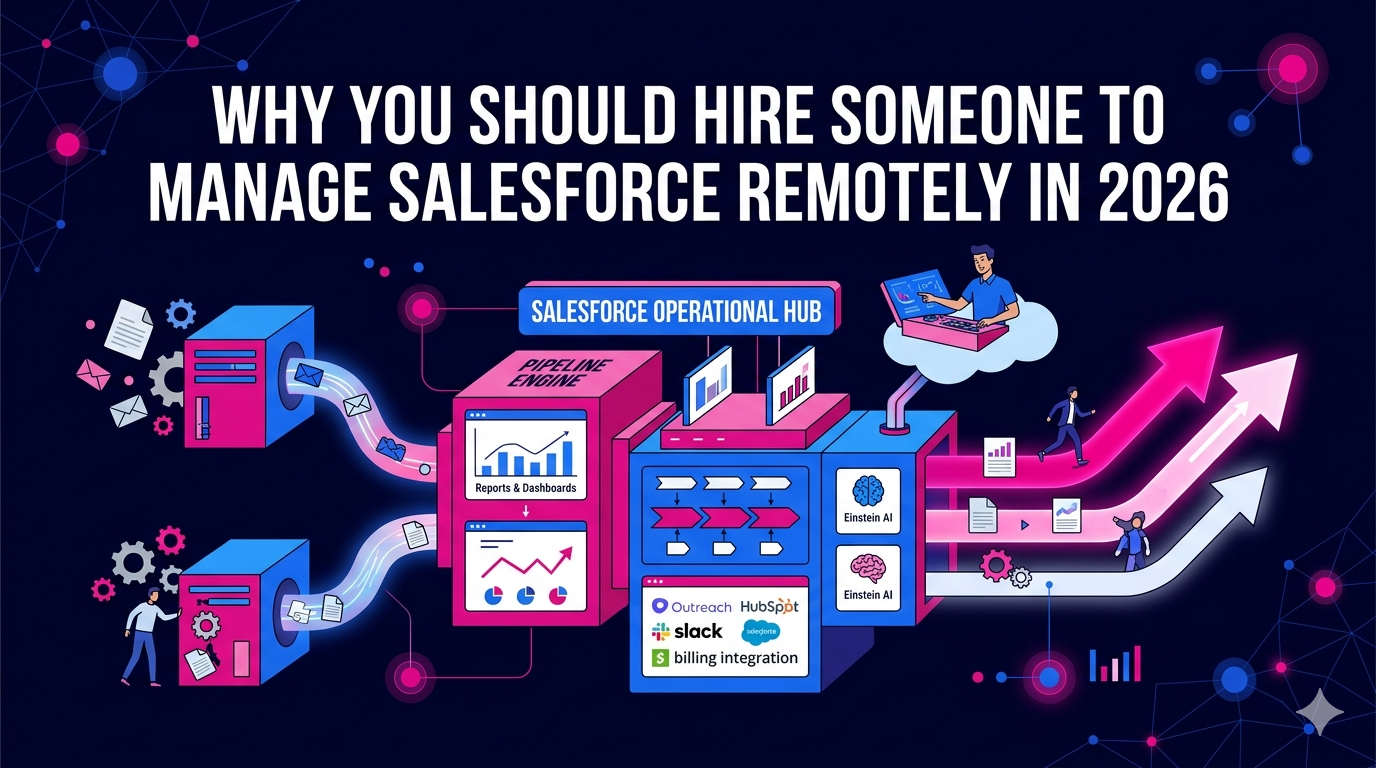
- Integrating Salesforce with tools like Outreach, HubSpot, Gong, Slack, and billing platforms
- Troubleshooting broken automations, sync errors, and data conflicts
- Documenting all processes so the team follows consistent CRM hygiene standards
When you hire someone to manage Salesforce remotely with this scope of responsibility, you are not just outsourcing a task. You are adding a strategic operations layer to your revenue team.
Why Salesforce Needs a Dedicated Remote Manager in 2026
Salesforce has continued expanding its platform aggressively through 2025 and into 2026. The Einstein AI suite now touches nearly every core module, new Data Cloud features are changing how companies unify customer data, and Agentforce integrations are shifting how sales teams interact with their CRM entirely. Managing a modern Salesforce org is a skilled, ongoing job, not a weekend project.
Warning Signs Your Salesforce Instance Is Unmanaged
- Sales reps log activity inconsistently or avoid the CRM altogether
- Opportunity stages do not reflect reality and forecasts are unreliable
- Duplicate leads and contacts inflate your database and skew reporting
- Automations trigger at the wrong time or not at all
- Leadership cannot get accurate pipeline reports without manual spreadsheet work
- New hires take weeks to get set up properly in the system
Each of these issues has a measurable cost. Lost deals, wasted marketing spend, and frustrated reps are direct consequences of an unmanaged Salesforce org. Hiring someone to manage Salesforce remotely addresses all of these problems without the overhead of a full-time office hire.
The Financial Case for Hiring a Remote Salesforce Administrator
In-House vs. Remote: A 2026 Cost Comparison
A mid-level Salesforce Administrator in a US metro in 2026 commands between $80,000 and $110,000 per year in base salary alone. Add benefits, payroll taxes, office space, and equipment, and the true annual cost often exceeds $130,000. A remote Salesforce admin with equivalent skills and certifications typically costs between $3,000 and $6,500 per month depending on scope and experience level. For many growing businesses, that difference funds an entire additional sales hire.
ROI Beyond Salary Savings
The return on investment from clean Salesforce data and reliable automation goes beyond headcount savings. Research published in Salesforce’s own State of Sales report for 2026 shows that high-performing sales teams are significantly more likely to use their CRM consistently and trust its data. A dedicated remote manager makes that consistency possible by enforcing data standards, fixing issues proactively, and keeping leadership dashboards accurate enough to drive real decisions.
How to Find the Right Person to Manage Salesforce Remotely
Hiring the right remote Salesforce manager requires more than posting a job ad. The Salesforce ecosystem has dozens of specializations, and you want someone whose background matches your specific setup and goals.
Credentials to Look For
- Salesforce Certified Administrator (core requirement)
- Salesforce Advanced Administrator (for complex orgs)
- Salesforce Platform App Builder (if custom development is needed)
- Sales Cloud Consultant or Service Cloud Consultant certifications depending on your use case
- Trailhead Ranger status as a sign of continuous learning
Interview Questions That Reveal Real Experience
- Walk me through how you would audit a Salesforce org you are inheriting for the first time.
- Describe an automation you built that directly improved a sales team’s workflow.
- How do you handle duplicate records at scale without manual cleanup?
- What is your process for documenting changes in a Salesforce org?
- How have you handled a situation where a Salesforce update broke an existing workflow?
Strong candidates will answer these with specific examples and measurable outcomes, not generalities. If someone cannot describe a concrete project with clear results, keep looking.
Working with a specialized remote staffing platform removes much of this risk because candidates are pre-vetted against exactly these criteria. Browse pre-vetted remote operations and CRM specialists at The Remote Reps to find qualified professionals ready to manage your Salesforce org from day one.
How to Onboard a Remote Salesforce Manager Successfully
Even the most experienced remote Salesforce admin needs a structured onboarding period to learn your business logic and existing configuration. Rushing this phase is the number one reason remote CRM hires underperform.
Week 1: Discovery and Access
- Provide read-only Salesforce access initially and expand permissions progressively
- Share your org documentation if it exists, or ask them to create an audit document
- Introduce them to sales leadership and any reps who are power users
- Align on communication cadence: daily async updates and a weekly sync call work well for most teams
Weeks 2 to 4: Audit and Quick Wins
- Complete a full org health assessment covering data quality, active automations, and user adoption rates
- Prioritize and fix the top five issues causing the most friction for the sales team
- Build or repair the core reporting dashboard leadership relies on most
Month 2 and Beyond: Optimization
- Implement or refine lead routing and assignment rules
- Build automation sequences that reduce manual data entry for reps
- Set up proactive data quality monitoring using scheduled reports or third-party tools
- Begin planning any larger integration or customization projects in the roadmap
Managing a Remote Salesforce Admin: Best Practices
Once hired, the quality of your working relationship determines the quality of your Salesforce org. These practices ensure your remote manager stays aligned, motivated, and effective.
Communication and Accountability
- Use a shared project management tool like Asana, Linear, or Notion to track all Salesforce requests and projects
- Require a weekly written status update covering completed tasks, in-progress items, and blockers
- Conduct a monthly strategic review to align CRM priorities with overall business goals
- Encourage the remote admin to flag issues proactively rather than waiting to be asked
According to Salesforce’s official Trailhead career guidance for remote Salesforce administrators, the most effective admins are those who act as strategic partners to the business rather than reactive ticket-closers. Hiring someone who embodies that mindset is the difference between a maintained org and a genuinely high-performing one.
Conclusion: The Time to Hire a Remote Salesforce Manager Is Now
Salesforce is your revenue backbone. Every deal, every customer relationship, and every forecast lives inside it. Leaving that backbone unmanaged is a risk no growth-focused business should accept in 2026.
When you hire someone to manage Salesforce remotely, you get certified expertise, ongoing optimization, and measurable improvements in data quality and sales team efficiency at a fraction of the cost of a local hire. The global talent pool for skilled remote Salesforce administrators has never been deeper, and the tools for managing remote professionals have never been better.
Do not let another quarter pass with a Salesforce org that is slowing your team down. Connect with The Remote Reps today and hire a remote Salesforce management expert who can start making an impact this week.
Frequently Asked Questions
How much does it cost to hire someone to manage Salesforce remotely?
The cost to hire someone to manage Salesforce remotely in 2026 typically ranges from $3,000 to $6,500 per month for a full-time remote administrator, depending on their certifications, experience level, and the complexity of your Salesforce org. Part-time arrangements for smaller orgs can cost as little as $1,200 to $2,000 per month. This is substantially less than hiring an in-house Salesforce admin when total employment costs are factored in.
What certifications should someone have to manage Salesforce remotely?
At a minimum, someone you hire to manage Salesforce remotely should hold the Salesforce Certified Administrator credential. For more complex orgs, look for Advanced Administrator or Platform App Builder certifications. If your company uses Sales Cloud heavily, a Sales Cloud Consultant certification is a strong bonus. All certifications should be current, as Salesforce requires credential holders to complete release-based maintenance exams each year.
Is it safe to let a remote person manage Salesforce with admin access?
Yes, with proper security controls in place. Salesforce’s permission system allows you to grant granular access that limits what a remote administrator can view or modify. Use separate system administrator profiles for your remote hire, enable login IP restrictions, require two-factor authentication, and review setup audit trail logs regularly. These practices protect your data while giving the remote admin the access needed to do their job effectively.
How long does it take to see results after I hire someone to manage Salesforce remotely?
Most businesses see meaningful improvements within the first two to four weeks after they hire someone to manage Salesforce remotely. Quick wins like deduplication, fixing broken automations, and improving dashboard accuracy are typically achievable in the first month. Larger projects such as building advanced lead routing, implementing territory management, or completing a major integration may take two to three months to execute fully.
Can a remote Salesforce manager also support my sales team directly?
Yes. Many professionals who manage Salesforce remotely also provide user training, build sales enablement tools inside the CRM, and act as the primary point of contact when reps have questions about how to use the platform. The best remote Salesforce managers develop a deep understanding of your sales process and configure the CRM to make reps’ daily work faster and simpler, which directly improves adoption and data quality.
What tools does a remote Salesforce manager need to work effectively?
Beyond Salesforce access itself, someone you hire to manage Salesforce remotely typically needs access to your team’s communication platform such as Slack or Microsoft Teams, a project management tool for tracking CRM requests, and any third-party tools integrated with your Salesforce org. Video conferencing access for weekly syncs and a shared documentation tool like Confluence or Notion round out the standard toolkit for effective remote Salesforce management.