
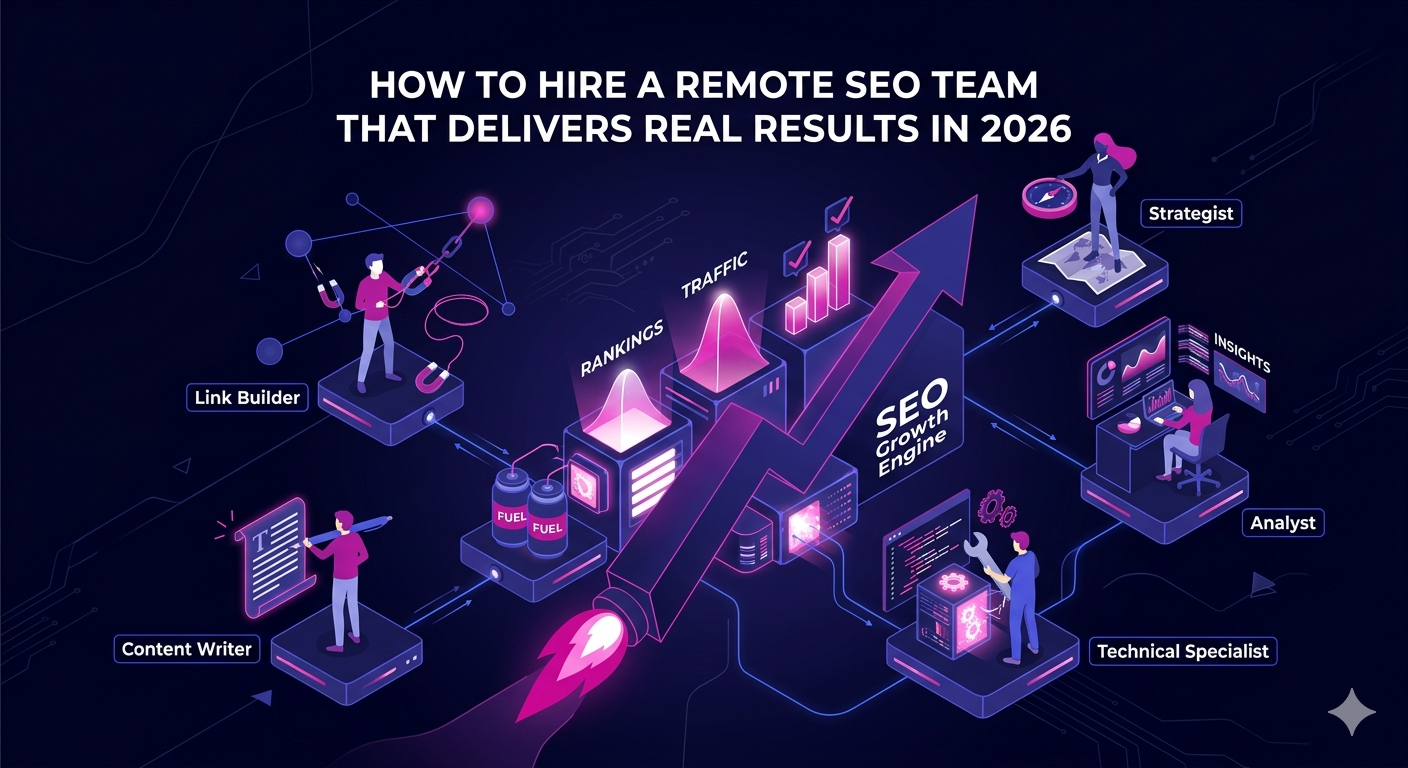
Organic search is still one of the highest-ROI marketing channels available, but executing a serious SEO strategy requires more than a single generalist. If your business is ready to treat SEO as a growth engine rather than a side project, you need to understand how to hire a remote SEO team built with the right roles, the right skills, and the right structure. In 2026, building that team remotely is not just viable. It is the smartest and most cost-effective approach available.
This guide walks you through every step: the roles you need, what to look for in each hire, how to structure remote collaboration, and how to avoid the mistakes that cause most SEO teams to underperform.
Why Build a Remote SEO Team Instead of Hiring an Agency
SEO agencies serve a broad client base, which means your campaigns often compete for attention with dozens of other accounts. A dedicated remote SEO team works exclusively for your brand. They build deep institutional knowledge about your industry, your audience, your competitors, and your existing content. That accumulated context compounds over time in ways a rotating agency account team simply cannot replicate.
Remote hiring also gives you access to a global talent pool. The best technical SEO specialists, content strategists, and link builders are not necessarily located near your office. By hiring remotely, you can recruit based on skill and track record rather than geography, and you typically save 30 to 50 percent compared to equivalent local salaries or agency retainers.
The Core Roles in a Remote SEO Team
Before you post a single job listing, you need a clear picture of what a high-functioning remote SEO team actually looks like. The roles you hire for depend on your business stage, content volume, and competitive landscape, but most growing businesses need the following:
SEO Strategist or Manager
This is the architect of your entire search strategy. An SEO strategist owns keyword research, topic cluster planning, competitor gap analysis, and the overall content and link building roadmap. If you are hiring a small team, this person often serves as the team lead and coordinates the work of every other specialist. Look for someone with at least three years of experience managing SEO campaigns end to end, with verifiable ranking results to show for it.
SEO Content Writer
High-quality, search-optimized content is the fuel that powers organic rankings. Your remote SEO content writer needs to understand keyword intent, on-page optimization, and how to structure long-form content that satisfies both Google and human readers. This is not a role for generalist writers. Look for candidates with a portfolio that includes currently ranking articles and a clear understanding of how content fits into a broader SEO strategy.
Technical SEO Specialist
Technical SEO covers everything that affects how search engines crawl, index, and render your site. Site speed, Core Web Vitals, structured data, crawl budget, canonical tags, and log file analysis all fall under this role. A strong technical SEO specialist can identify and fix the infrastructure issues that prevent even excellent content from ranking. For most mid-sized businesses, this can be a part-time or fractional hire rather than full-time.
Link Building Specialist
Backlinks remain one of the top ranking signals in 2026. Your link building specialist handles outreach, relationship management with publishers, digital PR campaigns, and guest post acquisition. This role requires a combination of research skills, persuasive writing ability, and persistence. Look for candidates who can show real placements on high-domain-authority sites rather than just promised outreach volumes.
SEO Analyst or Reporting Specialist
Data without interpretation is useless. An SEO analyst monitors your keyword rankings, organic traffic trends, conversion rates, and technical health metrics. They translate raw data from tools like Google Search Console, Ahrefs, and Google Analytics into clear, actionable reports that guide the entire team’s priorities. For smaller teams, this function is often handled by the strategist, but growing businesses benefit from a dedicated analyst.
Step-by-Step: How to Hire a Remote SEO Team
Now that you know the roles, here is a practical hiring process that works for remote teams specifically.
Step 1: Define Your SEO Goals and Budget
Before you hire anyone, be specific about what you need. Are you building a content-heavy blog to capture informational traffic? Recovering from a Google penalty? Competing for high-intent commercial keywords in a crowded niche? Your goals determine which roles to prioritize and in what order. Your budget determines whether you hire full-time, part-time, or fractional specialists for each function.
Step 2: Write Role-Specific Job Briefs
Generic job descriptions attract generic candidates. For each role, write a brief that specifies the niche you operate in, the tools your team uses, the expected deliverables, and the KPIs the hire will be measured against. Include a short skills test or portfolio requirement in the application process to filter out candidates who cannot demonstrate practical ability.
Step 3: Source from the Right Platforms
General freelance marketplaces are unpredictable for specialized SEO roles. You need platforms or agencies that focus on vetted remote digital marketing professionals. This saves weeks of screening time and significantly reduces the risk of a bad hire. A specialist hiring platform will pre-screen candidates for relevant experience, tool proficiency, and communication skills before they ever reach your inbox.
Step 4: Evaluate With a Paid Skills Test
For any SEO hire, a short paid test project is one of the most reliable evaluation methods available. For a content writer, assign a real brief and assess keyword usage, structure, and readability. For a technical specialist, give them a sample site audit scenario. For a link builder, ask them to outline a prospecting and outreach strategy for a specific target domain. How a candidate approaches a real task tells you far more than a resume.
Step 5: Build the Infrastructure Before Day One
Remote SEO teams depend on shared tools and clear processes. Before your first hire starts, set up access to your CMS, Google Search Console, Google Analytics, and your primary SEO tools. Create a shared project management workspace in Asana or Notion with documented workflows, style guides, and reporting templates. A new hire who walks into a well-organized system produces results faster and needs less handholding.
To explore experienced, vetted professionals across every SEO function, browse the remote SEO team specialists available at The Remote Reps and find the right candidates to build or scale your team quickly.
How to Manage a Remote SEO Team Effectively
Hiring the right people is only half the challenge. Managing them well across time zones and without in-person oversight requires deliberate structure.
- Hold a weekly team sync to review progress, align on priorities, and unblock issues early
- Use async video updates via tools like Loom for status reports that do not require everyone to be online simultaneously
- Set monthly OKRs (objectives and key results) tied to measurable SEO outcomes, not just activity metrics
- Review a shared ranking and traffic dashboard weekly so every team member can see the impact of their work
- Create a culture of documentation so that knowledge stays in shared systems rather than in individual email inboxes
According to Moz’s guide to building an effective remote SEO team structure, teams that align clearly on goals and maintain consistent communication cycles consistently outperform those that operate in silos, regardless of individual talent levels.
Common Mistakes When Building a Remote SEO Team
Understanding how to hire a remote SEO team also means knowing what to avoid. These are the mistakes that most businesses make:
- Hiring a single generalist and expecting them to cover all SEO functions at a high level
- Skipping the skills assessment and relying on a resume or interview alone
- Failing to define KPIs before hiring, leaving both sides unclear on what success looks like
- Not investing in shared tools and documented processes, creating chaos as the team grows
- Prioritizing low cost over demonstrated track record, which almost always costs more in the long run
FAQ: How to Hire a Remote SEO Team
How many people do I need when I first hire a remote SEO team?
When you are figuring out how to hire a remote SEO team for the first time, start lean. A strategist who can also handle some content, paired with a part-time technical specialist and a link builder, gives you the core capability to execute a full-funnel SEO strategy. Add dedicated content writers and an analyst as your content volume and budget grow. Most businesses can launch effectively with two to three specialists before scaling to a full team.
How long does it take to see results after hiring a remote SEO team?
SEO is not an overnight channel. After you hire a remote SEO team, expect the first three months to focus heavily on audits, strategy development, and foundational fixes. Meaningful ranking improvements typically begin showing up between months three and six, with compounding traffic growth visible at the six to twelve month mark. Teams that publish high-quality content consistently and build authoritative links will see results at the faster end of that range.
What tools does a remote SEO team need to work effectively?
A functional remote SEO team needs access to keyword and backlink research tools such as Ahrefs or SEMrush, Google Search Console and Google Analytics for performance data, a content management system for publishing, a project management platform like Asana or Notion, and a communication tool like Slack for async collaboration. Depending on the team’s specializations, you may also invest in outreach tools like BuzzStream or technical audit platforms like Screaming Frog.
Should I hire a remote SEO team or outsource to an agency?
When you hire a remote SEO team, you get dedicated professionals who focus exclusively on your brand, build deep institutional knowledge, and are accountable directly to you. Agencies split attention across many clients and often rotate staff, which slows down progress and erodes context. For businesses with consistent SEO needs and a medium to long-term growth horizon, a dedicated remote team consistently delivers better outcomes than an agency relationship at a comparable or lower cost.
How do I evaluate the quality of a remote SEO team candidate?
Start with portfolio work and ask for examples of content or campaigns that are currently performing on Google. Follow up with a paid skills test relevant to the specific role. Assess communication quality during the hiring process itself, since remote work depends entirely on clear, responsive communication. Check references where possible and look for candidates who can explain their methodology clearly, not just show results, so you understand how they think and work.
What should I budget to hire a remote SEO team in 2026?
Monthly budgets vary based on team size and role seniority. A lean remote SEO team with a part-time strategist, one content writer, and a part-time technical specialist might cost between $4,000 and $8,000 per month. A full-time, multi-role team covering strategy, content, technical SEO, link building, and analytics can range from $12,000 to $25,000 monthly. These figures are typically 30 to 50 percent lower than equivalent agency retainers for similar scope and quality.
Build Your Remote SEO Team the Right Way
Knowing how to hire a remote SEO team is the first step toward turning organic search into a predictable, scalable growth channel. The businesses that dominate search results in 2026 are not outspending their competitors on ads. They are out-executing them with focused, well-structured teams that produce better content, earn stronger links, and optimize more intelligently.
You do not have to figure out every hire on your own. The Remote Reps connects you with vetted remote SEO professionals across every specialization, so you can build the right team faster and with far less risk than going it alone.