
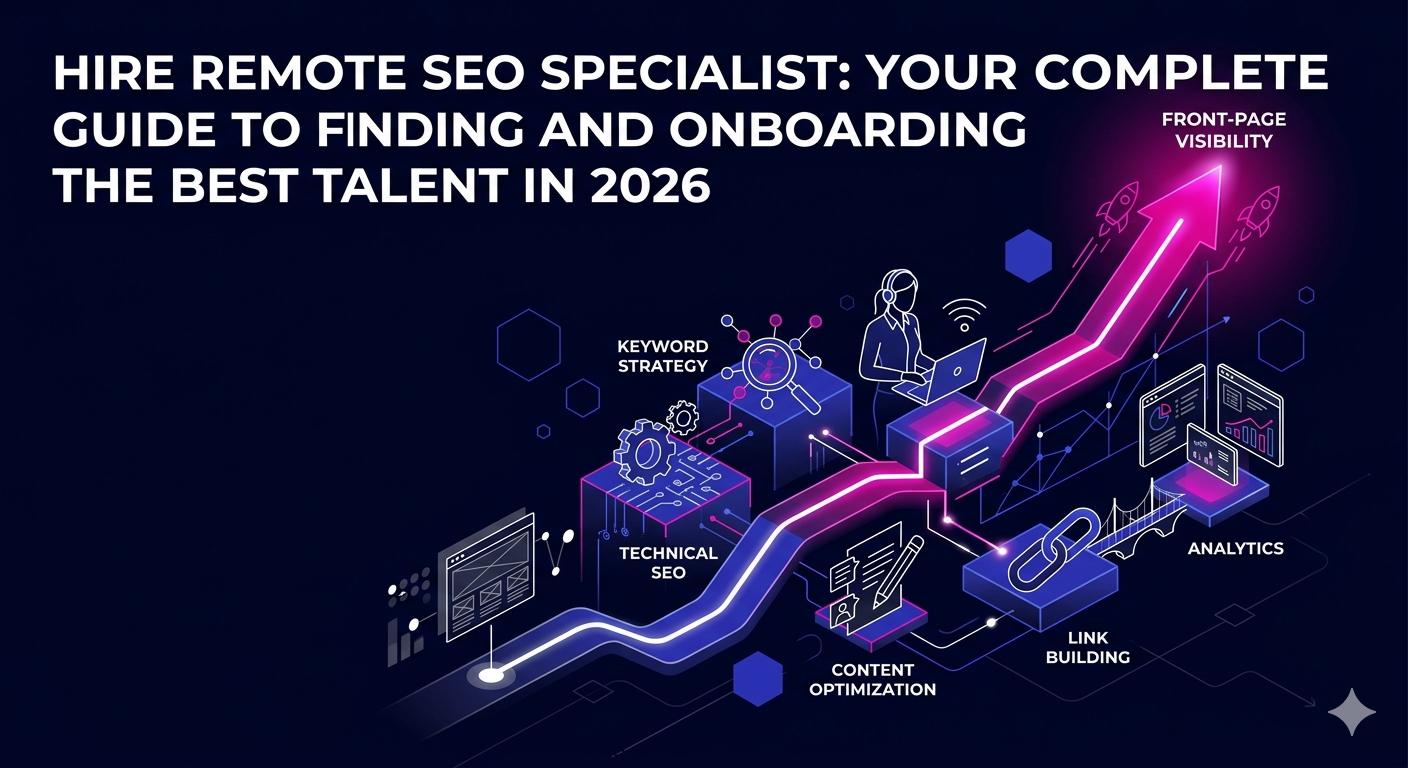
The decision to hire a remote SEO specialist can be the turning point that moves your website from page three obscurity to consistent front-page visibility. In 2026, organic search remains one of the highest-ROI marketing channels available, but capturing that value requires dedicated, skilled execution that most in-house generalists simply cannot provide. Whether you are a founder trying to reduce customer acquisition costs or a marketing director looking to scale organic traffic without expanding headcount, this guide gives you everything you need to find, evaluate, and onboard the right remote SEO specialist for your business.
Why Businesses Are Choosing to Hire a Remote SEO Specialist in 2026
The case for hiring remote SEO talent has never been more compelling. Search engine algorithms have grown more sophisticated every year, and what passed for good SEO five years ago now actively hurts rankings. You need someone who is fully current, deeply specialized, and committed to your organic growth as a primary focus, not a side responsibility.
The Cost Advantage Is Significant
A full-time in-house SEO specialist in a major market costs between $75,000 and $110,000 annually in salary alone. When you add benefits, employer taxes, software licenses for keyword research and technical audit tools, and the physical office costs, that figure climbs considerably higher. Hiring a remote SEO specialist through a dedicated staffing platform typically costs 35 to 55 percent less for equivalent or superior expertise, because you are accessing a global talent pool rather than a single geographic market.
SEO Requires Full Attention, Not a Fraction of Someone’s Day
One of the most common and expensive mistakes businesses make is assigning SEO responsibilities to a content writer, a marketing coordinator, or a web developer who already has a full workload. SEO is a distinct discipline that spans technical auditing, keyword strategy, content optimization, link acquisition, and performance analysis. When you hire a remote SEO specialist whose entire professional focus is organic search, the depth of execution improves dramatically.
Remote SEO Specialists Tend to Deliver Faster Results
Experienced remote SEO professionals are accustomed to working independently, documenting their processes clearly, and delivering measurable outputs on defined timelines. They do not need the weeks of orientation that a new in-house hire typically requires. Many can complete an initial technical audit and priority action list within the first week of engagement.
What Skills Should You Look for When You Hire a Remote SEO Specialist?
Not all SEO practitioners are equally capable. The field has fragmented into several sub-disciplines, and the best remote SEO specialists tend to have genuine depth in at least two or three of them alongside solid working knowledge of the rest.
Technical SEO Proficiency
Technical SEO forms the foundation of everything else. A strong candidate should be comfortable identifying and resolving issues related to crawlability, indexation, site speed, Core Web Vitals, structured data markup, canonical tags, and mobile usability. Ask candidates to walk you through a technical audit they have completed and what specific changes they made based on their findings.
Keyword Research and Search Intent Analysis
Effective keyword research in 2026 goes far beyond identifying high-volume terms. It requires understanding the intent behind search queries, mapping keywords to specific stages of the buyer journey, and identifying content gaps your competitors have overlooked. Look for candidates who can explain how they prioritize keywords and how their research translates into a content strategy with measurable traffic and conversion goals.
On-Page and Content Optimization
Strong remote SEO specialists understand how to optimize existing content for target queries without sacrificing readability or conversion performance. This includes heading structure, internal linking architecture, meta tag optimization, image optimization, and entity-based content strategies that align with how modern search engines process relevance signals.
Link Building and Digital PR
Backlink acquisition remains a critical ranking factor. Ask candidates about specific link building methodologies they use, including outreach, digital PR, content-led link earning, and competitor backlink analysis. Be cautious of any candidate who is vague about their link building approach or who relies heavily on tactics that Google has explicitly penalized.
Analytics and Reporting
An SEO specialist who cannot translate their work into clear business impact is a liability rather than an asset. Look for proficiency in Google Search Console, Google Analytics 4, and third-party tools such as Ahrefs, Semrush, or Screaming Frog. More importantly, ask how they present data to stakeholders who are not technical, since the ability to communicate value is just as important as the ability to create it.
Where to Find Top Remote SEO Specialist Candidates
Your sourcing channel has a major impact on the quality of candidates you encounter. Generic job boards generate high application volume but low average quality for specialized technical roles like SEO. Here are the channels that consistently produce the best results.
Specialized Remote Staffing Platforms
Platforms that focus exclusively on remote marketing and technical talent do the hard screening work before you ever speak to a candidate. They verify technical skills, assess communication ability, check references, and filter for remote-readiness. This dramatically reduces the time you spend evaluating unqualified applicants and increases the likelihood that your first or second interview results in a hire.
If you want to hire a remote SEO specialist with a proven track record in organic search growth, working with a dedicated remote talent platform gives you access to pre-vetted professionals who are ready to deliver results from the start.
SEO Community Networks
Active SEO practitioners tend to participate in specific online communities. Places like LinkedIn groups focused on organic search, Twitter or X SEO discussions, and forums such as Traffic Think Tank often surface strong candidates who are not actively job hunting but are open to the right opportunity. Posting a well-written job description in these spaces attracts practitioners who are genuinely engaged in the field.
Referrals From Your Existing Marketing Network
If you work with other marketing professionals, ask who they would recommend for SEO work. Referrals from trusted contacts consistently outperform cold sourcing because the recommender has firsthand knowledge of the candidate’s work quality and professional reliability.
How to Evaluate Remote SEO Specialist Candidates Effectively
A structured evaluation process protects you from candidates who are skilled at interviewing but weak at executing. Use this framework to separate genuine experts from those who can only talk the talk.
Request a Portfolio of Organic Growth Results
Ask for specific examples of websites where the candidate drove measurable organic traffic or ranking improvements. Strong candidates can show you before-and-after screenshots from Google Search Console or Analytics, explain the strategy they used, and describe the obstacles they encountered along the way. Vague answers about broad strategy improvements without supporting data are a red flag.
Conduct a Paid Trial Task
Offer a compensated short-term project before making a full hiring commitment. A focused task such as a technical SEO audit of your website, a keyword gap analysis comparing you to three competitors, or an on-page optimization plan for five target pages will reveal far more about a candidate’s capabilities than any interview question. Good candidates welcome this opportunity because it lets them demonstrate their value concretely.
Test Communication and Documentation Quality
Remote SEO work requires clear written communication. Pay attention to how candidates communicate during the hiring process itself. Are their emails clear and well-organized? Do they ask smart clarifying questions? Can they explain technical concepts in plain language? These habits predict how well they will communicate with your team once hired.
Setting Your Remote SEO Specialist Up for Success After You Hire
The quality of your onboarding determines how quickly your remote SEO specialist can make an impact. Cutting corners on this step is one of the most common reasons outsourced SEO programs fail in their first three months.
Provide Full Access to All Relevant Tools and Data
Grant access to Google Search Console, Google Analytics 4, your CMS, your ad accounts, and any existing SEO tools on day one. An SEO specialist who cannot see your current data cannot audit your current situation or build a credible strategy. Delayed access is the single biggest source of wasted time in the early weeks of any SEO engagement.
Share Your Business Goals and Competitive Landscape
Give your remote SEO specialist a thorough briefing on your target audience, your most valuable products or services, your current marketing priorities, and your main competitors. The more business context they have, the better their keyword strategy will align with your actual revenue goals rather than just traffic volume metrics.
Agree on KPIs and Reporting Cadence Upfront
Define success before work begins. Common KPIs for remote SEO specialists include organic sessions growth, keyword ranking improvements, click-through rate on target pages, backlinks acquired per month, and organic-sourced leads or conversions. Agree on a monthly reporting format and a regular check-in schedule so performance stays visible and accountable.
According to Google’s official guidance for businesses evaluating remote SEO specialists and consultants, the strongest practitioners focus on creating value for users rather than trying to game algorithms, and that orientation toward genuine quality is what produces durable, compounding organic growth over time.
Conclusion: Make 2026 the Year Your Organic Traffic Finally Scales
If your business has been relying on paid advertising to drive traffic while your competitors build compounding organic authority, 2026 is the year to change that. When you hire a remote SEO specialist with the right skills, the right track record, and a clear mandate aligned to your business goals, the investment pays for itself many times over in reduced acquisition costs and sustainable search visibility.
Start by defining the scope of work you need, then use a rigorous evaluation process to find a candidate who can prove their impact with data rather than promises. Explore the full roster of pre-vetted remote SEO specialists available through TheRemoteReps and connect with a proven organic growth expert today.
Frequently Asked Questions About Hiring a Remote SEO Specialist
How much does it cost to hire a remote SEO specialist in 2026?
The cost to hire a remote SEO specialist varies by experience level and engagement model. Junior remote SEO specialists typically charge $1,500 to $3,000 per month on a part-time basis. Mid-level specialists working full-time range from $3,500 to $6,000 per month. Senior remote SEO specialists with strong track records command $6,500 to $10,000 or more per month. These rates represent significant savings compared to equivalent in-house salaries when you factor in full employment costs.
What is the difference between hiring a remote SEO specialist and using an SEO agency?
When you hire a remote SEO specialist directly, you get a dedicated individual focused entirely on your website. SEO agencies spread their team’s attention across many clients simultaneously, which often leads to slower execution and less institutional knowledge about your specific business. A dedicated remote SEO specialist builds deep familiarity with your site, your audience, and your competitive landscape over time, which compounds into better strategic decisions.
How long does it take to see results after you hire a remote SEO specialist?
Realistic SEO timelines depend on your site’s current authority, your competitive landscape, and the scope of changes being made. Most businesses begin to see measurable improvements in rankings and organic traffic within three to six months of consistent SEO work. Technical fixes and on-page improvements often produce faster results, while link building and content programs typically take six to twelve months to show their full impact.
What tools should a remote SEO specialist use?
A competent remote SEO specialist should be proficient with Google Search Console and Google Analytics 4 as baseline platforms. They should also have working knowledge of at least one major third-party SEO suite such as Ahrefs, Semrush, or Moz for keyword research and competitor analysis, a technical crawler such as Screaming Frog or Sitebulb, and a rank tracking tool. Familiarity with your specific CMS, whether that is WordPress, Shopify, or another platform, is also important for efficient implementation.
How do I manage a remote SEO specialist effectively once hired?
Managing a remote SEO specialist effectively comes down to clarity and consistency. Set clear monthly goals tied to business outcomes, provide access to all necessary tools and data from day one, agree on a reporting format that shows progress against your KPIs, and schedule regular check-ins to review results and adjust priorities. Avoid micromanaging tactical decisions while maintaining strong oversight of strategic direction and measurable outcomes. A good remote SEO specialist will welcome structured accountability because it gives them a clear framework to demonstrate their value.