
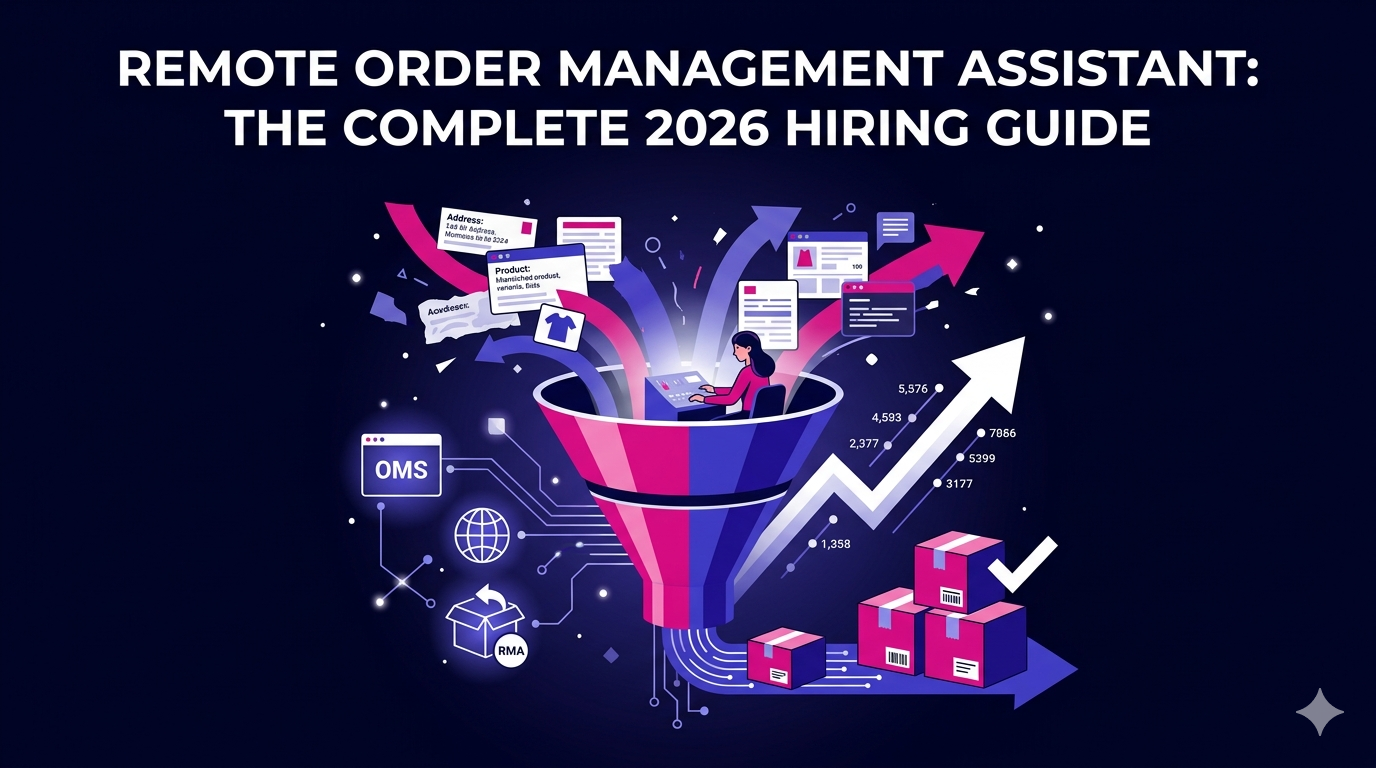
Order processing sounds simple until it is not. A missed shipment, a wrong address, a supplier delay, or an unresolved return can quickly spiral into negative reviews and lost revenue. For growing ecommerce brands and product businesses, the operational complexity of managing orders at scale becomes one of the biggest obstacles to sustainable growth. That is why hiring a remote order management assistant has become one of the most impactful operational decisions a business owner can make in 2026.
This guide walks you through exactly what a remote order management assistant does, the skills you should look for, how to structure the hiring process, and what to expect in terms of cost and results.
What Is a Remote Order Management Assistant?
A remote order management assistant is a trained operations professional who handles the end-to-end process of fulfilling and tracking customer orders from a remote location. They serve as the link between your customers, your warehouse or fulfillment partner, and your internal team, ensuring every order moves through the pipeline accurately and on time.
Unlike a general virtual assistant, an order management specialist understands fulfillment workflows, logistics platforms, inventory systems, and the operational nuances of ecommerce, wholesale, and B2B order processing.
Core Responsibilities of a Remote Order Management Assistant
The specific tasks handled by a remote order management assistant depend on your business model, but the following represent the most common areas of responsibility.
Order Processing and Fulfillment Coordination
- Reviewing and confirming incoming orders across all sales channels
- Submitting orders to fulfillment centers, 3PLs, or dropship suppliers
- Ensuring correct product variants, quantities, and shipping addresses before dispatch
- Managing order splits and backorder notifications
Shipping and Tracking Management
- Generating shipping labels and coordinating with carriers such as UPS, FedEx, and USPS
- Tracking shipments and proactively flagging delays to customers
- Resolving lost or damaged package claims with shipping providers
- Updating tracking information in your order management system (OMS) or ecommerce platform
Returns, Refunds, and Exchanges
- Processing return requests and generating return merchandise authorizations (RMAs)
- Coordinating with warehouses on returned inventory inspection and restocking
- Issuing refunds or store credits in accordance with your policy
- Documenting return reasons to identify product or packaging issues
Inventory and Supplier Communication
- Monitoring stock levels and flagging low inventory to the purchasing team
- Communicating with suppliers about purchase order status and lead times
- Reconciling received inventory against purchase orders
- Updating product availability across sales channels in real time
Reporting and Process Documentation
- Generating daily or weekly order fulfillment reports
- Tracking order accuracy rates, fulfillment speed, and return rates
- Documenting SOPs for recurring order workflows
- Identifying bottlenecks and recommending process improvements
To find pre-vetted professionals ready to step into this role, browse the remote order management assistant and virtual assistant services at The Remote Reps, where candidates are matched to your specific operational needs.
Why Businesses Are Hiring Remote Order Management Assistants in 2026
The shift toward remote operations talent has accelerated across industries. For product-based businesses, the case for a remote order management assistant is especially strong.
Operational Complexity Is Growing
Selling across multiple channels including Shopify, Amazon, Walmart Marketplace, and wholesale portals creates a significant coordination burden. Each channel has its own order format, fulfillment requirement, and shipping deadline. A dedicated remote order management assistant brings structure to that complexity so nothing falls through the cracks.
Errors Are Expensive
Shipping the wrong item, sending an order to the wrong address, or failing to process a refund on time generates chargebacks, negative reviews, and customer churn. These errors are disproportionately common when order management is handled by people who are also juggling other responsibilities. A specialist who owns this function exclusively makes far fewer mistakes.
Cost Efficiency at Scale
Hiring a full-time in-house operations coordinator in the United States costs significantly more than engaging a remote order management assistant through a specialized staffing platform. Remote talent, particularly from regions like Latin America, Eastern Europe, or Southeast Asia, delivers strong operational expertise at rates that make sense for businesses at every stage of growth.
Time Zone Coverage for Global Operations
If your business ships internationally or operates across multiple time zones, a remote order management assistant working in a different region can provide coverage during hours when your core team is offline. This is particularly valuable for resolving time-sensitive shipping issues or supplier communications that cannot wait until morning.
Key Skills to Look for in a Remote Order Management Assistant
Not every administrative professional is prepared to manage the operational demands of an ecommerce or product business. Prioritize these skills when evaluating candidates.
Platform and Systems Proficiency
- Experience with order management systems such as ShipBob, ShipStation, or Linnworks
- Familiarity with ecommerce platforms including Shopify, WooCommerce, or BigCommerce
- Comfort with marketplace seller portals such as Amazon Seller Central or Walmart Seller Center
- Ability to work with spreadsheets and basic reporting tools for inventory tracking
Attention to Detail and Process Discipline
Order management is a precision function. Candidates must demonstrate a track record of accuracy, the ability to follow documented SOPs without deviation, and the initiative to flag issues before they escalate rather than after.
Communication and Problem-Solving
A remote order management assistant regularly interacts with customers, suppliers, and logistics partners. Clear, professional written communication is essential. So is the ability to resolve unexpected issues, such as a carrier delay or a supplier stockout, calmly and efficiently without always escalating to a manager.
How to Structure the Hiring Process
A clear hiring process reduces time to placement and dramatically improves the quality of your hire.
Step 1: Document Your Current Order Workflow
Before you hire, map out every step in your current order management process from the moment an order is placed to the moment it is delivered and confirmed. This becomes your onboarding foundation and makes it easy for a new hire to understand exactly what is expected of them.
Step 2: Define the Scope of the Role
Decide whether you need a generalist who handles all order-related tasks or a specialist focused on a specific function such as returns management or supplier coordination. Clarity on scope helps you write a more targeted job description and attract the right candidates.
Step 3: Assign a Practical Test Task
Give shortlisted candidates a realistic scenario relevant to your business. For example, ask them to process a mock order through your OMS, identify an error in a sample shipment log, or write an SOP for a common fulfillment task. Their output reveals real competence faster than any interview question.
Step 4: Onboard with SOPs and Oversight
The first 30 to 60 days are critical. Provide documented SOPs for every task, schedule brief daily check-ins during the first two weeks, and review their work closely before granting independent ownership of any function. Structured onboarding produces better long-term performance and lower error rates.
What Does It Cost to Hire a Remote Order Management Assistant?
Rates in 2026 vary based on experience, specialization, and location:
- Entry-level (basic order processing and data entry): $6 to $12 per hour
- Mid-level (multi-channel OMS experience, returns management): $12 to $22 per hour
- Senior level (full operational ownership, reporting, supplier management): $22 to $40 per hour
For most growing product businesses, a mid-level remote order management assistant on a part-time or full-time basis delivers the highest return on investment relative to the cost of order errors and founder time spent on operations.
Research published by ShipBob’s order management resource hub for ecommerce operations teams highlights that businesses with dedicated order management processes see measurably lower error rates, faster fulfillment times, and higher customer satisfaction scores compared to those managing orders as a secondary function.
FAQ: Remote Order Management Assistant
What is the difference between a remote order management assistant and a general virtual assistant?
A remote order management assistant specializes in the operational workflows of order processing, fulfillment, returns, and inventory coordination. A general virtual assistant handles a broader range of administrative tasks without the same depth of expertise in logistics systems and ecommerce operations. If your business depends on accurate, timely order fulfillment, a specialist is the stronger choice.
What tools should a remote order management assistant know how to use?
A qualified remote order management assistant should be proficient in at least one order management system such as ShipStation, ShipBob, or Linnworks. They should also be comfortable using ecommerce platforms like Shopify or WooCommerce, marketplace portals like Amazon Seller Central, and basic spreadsheet tools for inventory and reporting. Familiarity with customer communication platforms like Gorgias or Zendesk is an added advantage.
Can a remote order management assistant handle multiple sales channels at once?
Yes. An experienced remote order management assistant is specifically trained to manage orders across multiple channels simultaneously. This includes direct-to-consumer storefronts, marketplace listings, and wholesale or B2B portals. The key is ensuring they have access to a centralized OMS that consolidates orders from all channels into one workflow, reducing the risk of errors from switching between disconnected systems.
How do I ensure accuracy when a remote order management assistant processes orders?
Accuracy starts with clear SOPs and a structured onboarding process. Define every step of your fulfillment workflow in writing, set up order review checkpoints before dispatch, and establish a daily error log that the remote order management assistant fills out. Regular audits of processed orders during the first 60 days, combined with real-time access to your OMS, give you the visibility needed to catch and correct issues early.
Is a remote order management assistant suitable for small businesses with low order volumes?
Absolutely. Even small businesses benefit significantly from having a dedicated remote order management assistant, particularly when order volume is expected to grow. Starting with a part-time arrangement, even 10 to 15 hours per week, allows you to build scalable processes, reduce the risk of errors during growth phases, and free up founder time for higher-value activities like product development and marketing.
How quickly can a remote order management assistant become fully independent?
With proper SOPs and structured onboarding, most experienced remote order management assistants can handle routine tasks independently within two to three weeks. More complex functions like supplier communication, multi-channel reconciliation, or return exception handling typically take four to six weeks before full independence. Setting clear checkpoints and reviewing performance metrics weekly accelerates this timeline significantly.
Ready to Bring Order to Your Operations?
If your order management process is slowing you down, costing you customers, or taking up hours of your week that should be spent growing your business, the solution is clear. A skilled remote order management assistant brings structure, accuracy, and consistent execution to one of your most critical operational functions.
Do not let fulfillment chaos hold your business back. Connect with a vetted remote order management assistant at The Remote Reps and build the operational foundation your business needs to scale in 2026.